Corning's 44% Fiber Surge Shows How AI Is Reshaping Global Optics Demand

Corning's USD 2.38 Billion Optical Quarter, Jenoptik's 53% Order Jump and SEMI's USD 165.9 Billion Chip-Tool Forecast Show AI Demand Reaching Passive Optics
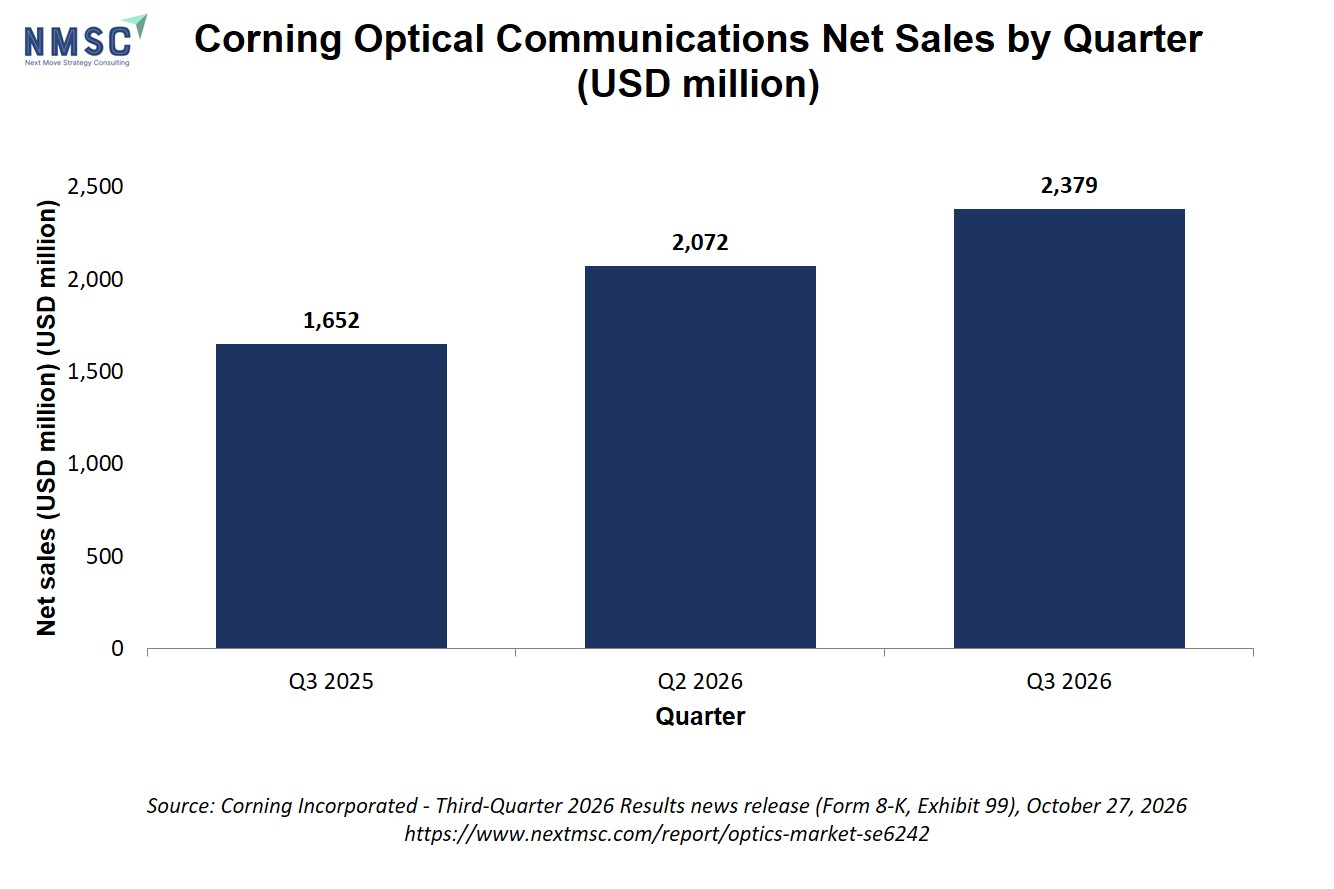
On October 27, 2026, Corning Incorporated reported that third-quarter Optical Communications net sales rose 44% year over year to USD 2.38 billion, with Enterprise Networks sales up 84% and Gen AI product sales growing more than 100%, according to the company's Third-Quarter 2026 results news release filed with the U.S. Securities and Exchange Commission. Corning also said it secured four long-term, multibillion-dollar customer agreements during the quarter, including with Verizon and AT&T. The segment, which supplies optical fiber, cable and connectivity hardware, generated USD 2,379 million of the company's USD 4,855 million in GAAP net sales, nearly half of the total, and it shows that AI data center construction is now setting the pace for passive optical demand.
According to Next Move Strategy Consulting's Global Optics Market report, the global optics market was valued at USD 72.56 billion in 2026 and is projected to reach USD 128.66 billion by 2035, growing at a CAGR of 6.57% from 2026 to 2035. NextMSC primary research and analysis identifies AI data center fiber buildout, semiconductor lithography and inspection demand, and vision care and infrared sensing adoption as the main demand drivers, with Asia-Pacific the leading region. The October 27 results from Corning, and the equipment and order signals gathered below, show those drivers converting into contracted revenue.
For More Information: Download FREE Sample on Global Optics Market Report
The Financial Logic: AI Fiber Is Setting the Pace for Optical Revenue
Corning's segment disclosure shows how unevenly the benefit is spreading. Optical Communications grew 44%, against 37% for Solar, 4% for Automotive and 1% for Life Sciences and Emerging Growth Businesses, while Glass Innovations declined 3% in a quarter in which Corning said television, notebook and smartphone markets were affected by memory pricing. Chief Executive Officer Wendell P. Weeks tied the optical gain to faster adoption of newer products, and Chief Financial Officer Ed Schlesinger said long-term customer agreements share the cost and risk of capacity expansions. Capital expenditures reached USD 545 million in the quarter against USD 334 million a year earlier, and management guided fourth-quarter core sales to a range of USD 5.2 billion to USD 5.3 billion.
Corning Net Sales by Segment, Third Quarter 2026 versus Third Quarter 2025
|
Segment |
Q3 2026 (USD million) |
Q3 2025 (USD million) |
Year-over-year change |
|
Optical Communications |
2,379 |
1,652 |
+44% |
|
Glass Innovations |
1,506 |
1,560 |
(3%) |
|
Automotive |
470 |
454 |
+4% |
|
Solar |
436 |
319 |
+37% |
|
Life Sciences and Emerging Growth Businesses |
290 |
287 |
+1% |
Life Sciences and Emerging Growth Businesses 290 287 +1%
“double our Gen AI sales year over year in the quarter”
- Wendell P. Weeks, Chairman, Chief Executive Officer and President, Corning Incorporated, Corning Third-Quarter 2026 Results news release, October 27, 2026.
Key Industry Developments: Orders, Capacity and Revenue Mix
Jenoptik AG reported on August 12, 2026 that first-half order intake rose 53.0% to EUR 723.4 million, led by an 85.3% increase at its Semiconductor & Advanced Manufacturing unit on demand from both lithography and inspection customers. The group's book-to-bill ratio reached 1.44 and its order backlog rose to EUR 824.8 million from EUR 590.8 million at the end of 2025. Chief Technology Officer and Chief Operating Officer Ralf Kuschnereit cautioned in the same release that part of the momentum came from major orders and may not continue in the second half. On October 21, 2026, Jenoptik Aktiengesellschaft disclosed that nine-month order intake reached EUR 1.1 billion against EUR 777.3 million a year earlier, and raised its full-year EBITDA margin expectation to about 22% from 20% to 21%.
Jenoptik Order Intake, First Half 2026 versus First Half 2025
|
Reporting unit |
H1 2026 (EUR million) |
H1 2025 (EUR million) |
Change |
|
Jenoptik Group |
723.4 |
472.7 |
+53.0% |
|
Semiconductor & Advanced Manufacturing |
350.3 |
189.0 |
+85.3% |
|
Biophotonics |
163.9 |
113.1 |
+44.9% |
On July 24, 2026, ZEISS Semiconductor Manufacturing Technology said its Oberkochen site expansion adds about 25,000 square meters of production and production-related space, with the new office building occupied in July 2026, roughly four years after the May 2022 groundbreaking. The unit is also building a multifunctional factory in Wetzlar and opened a ZEISS Innovation Center in Korea in July 2026. ZEISS framed the investment as a response to AI-driven demand for more powerful chips, which ties lithography optics capacity directly to the wafer-fab spending cycle.
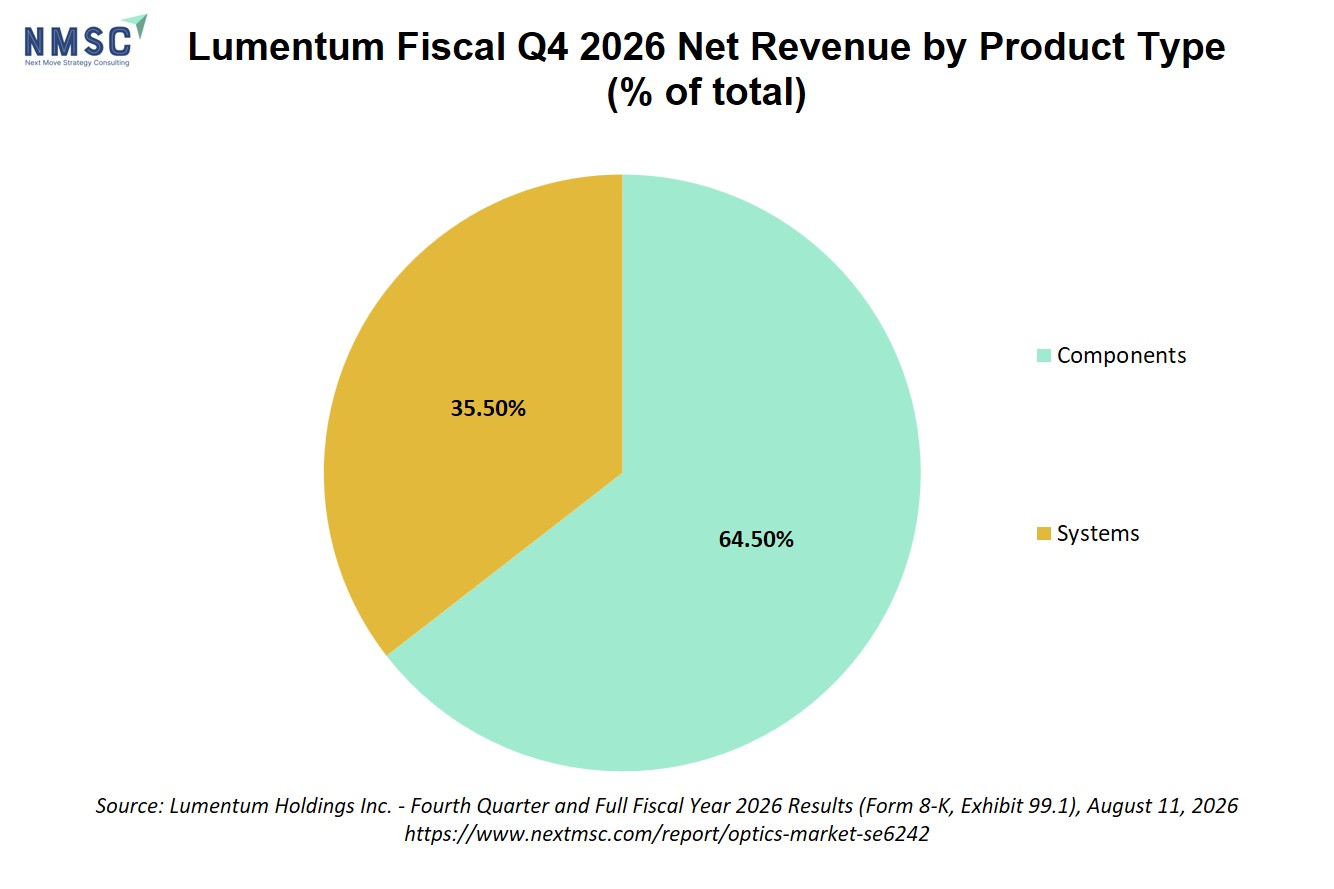
Lumentum Holdings Inc. reported on August 11, 2026 that fiscal fourth-quarter net revenue reached USD 1.01 billion, up 109.3% year over year, and that fiscal 2026 net revenue reached USD 3.01 billion, up 83.2%. Components contributed USD 649.4 million and Systems USD 356.9 million of the fourth-quarter total. President and Chief Executive Officer Michael Hurlston said AI compute workloads are pushing data center architects toward optical links as a primary means of connectivity, and the company guided first-quarter fiscal 2027 revenue to USD 1.225 billion to USD 1.275 billion. Lumentum's lasers and modules sit outside the passive scope of NextMSC's definition, yet NextMSC primary research and analysis treats passive optical content as scaling with active transceiver volume, which makes Lumentum's order book a read-across for fiber, connector and lens-array demand.
Semiconductor Capital Spending: The Lithography and Inspection Link
SEMI said on July 14, 2026 that global sales of semiconductor manufacturing equipment by original equipment manufacturers are forecast to reach a record USD 165.9 billion in 2026, up 23.2%, and USD 229.5 billion in 2028. Wafer fab equipment, which includes wafer processing, mask and reticle, and fab facilities equipment, is forecast to rise 23.1% to USD 143.9 billion after reaching USD 116.9 billion in 2025, with SEMI linking the upward revision to high-bandwidth-memory DRAM and leading-edge logic investment. Test equipment is forecast to grow 31.0% to USD 15.3 billion and assembly and packaging equipment 9.6% to USD 6.7 billion.
“AI is accelerating demand for more powerful and efficient chips”
- Ajit Manocha, President and Chief Executive Officer, SEMI, SEMI Mid-Year Total Semiconductor Equipment Forecast - OEM Perspective press release, July 14, 2026.
SEMI Mid-Year Forecast: 2026 Semiconductor Equipment Sales (Forecast Data)
|
Equipment segment |
2026 forecast (USD billion) |
Growth versus 2025 |
|
Total semiconductor equipment (OEM sales) |
165.9 |
+23.2% |
|
Wafer fab equipment |
143.9 |
+23.1% |
|
Test equipment |
15.3 |
+31.0% |
|
Assembly and packaging equipment |
6.7 |
+9.6% |
Restraint: Germanium Supply Keeps Infrared Optics Exposed
The U.S. Geological Survey's Mineral Commodity Summaries 2026, published in February 2026, reports that U.S. net import reliance for germanium stayed above 50% in each year from 2021 to 2025 and that there was no domestic primary refinery production. It reports that U.S. germanium metal imports fell 67% in 2025 to 7,000 kilograms, attributing the drop to China's December 2024 ban on germanium exports to the United States, and puts the 2025 average European price for germanium metal at USD 4,100 per kilogram against USD 1,991 in 2024. The survey also identifies chalcogenide glass as a substitute for germanium metal in infrared applications.
Germanium Annual Average Prices, 2021 to 2025 (USD per kilogram)
|
Year |
Germanium metal |
Germanium dioxide |
|
2021 |
1,187 |
770 |
|
2022 |
1,294 |
828 |
|
2023 |
1,392 |
883 |
|
2024 |
1,991 |
1,281 |
|
2025 (USGS preliminary figure) |
4,100 |
2,500 |
Tribune India reported on November 9, 2025, citing Xinhua, that China's Ministry of Commerce suspended its U.S.-specific prohibition on exports of gallium, germanium, antimony and superhard materials from that date until November 27, 2026. As of publication on November 3, 2026, 24 days remain before the suspension lapses. For infrared optics buyers, the practical consequence is a fixed decision date: thermal-imaging lens makers must either lock in germanium supply before late November or accelerate qualification of chalcogenide and other substitutes, both of which add cost and lead time to the passive optics base.
Segment Dynamics: Fiber and Infrared Outgrow Core Elements
NextMSC primary research and analysis values Optical Elements at USD 38.22 billion in 2025, about 58% of total revenue, rising to USD 69.48 billion by 2035 at a 5.83% CAGR, slower than the market as a whole. Passive Fiber Optics is the fastest-growing offering at an 8.44% CAGR from 2026 to 2035, expanding from USD 15.82 billion in 2025 to USD 37.31 billion by 2035, while Optical Assemblies grow at 6.11% as original equipment manufacturers in medical devices, machine vision and laser processing outsource alignment, bonding and testing to specialists.
By spectral type, Visible is the largest segment, expanding from USD 34.27 billion in 2025 to USD 57.90 billion by 2035, while Short Wave Infrared grows fastest at 9.82%. In materials, Glass holds the largest share, expanding from USD 23.72 billion in 2025 to USD 39.88 billion by 2035, while Chalcogenide Materials grows fastest at 9.26%, consistent with the substitution pressure created by germanium supply controls. By end-use industry, Data Centers is the fastest-growing at a 10.72% CAGR, and Semiconductor is the largest, rising from USD 9.23 billion in 2025 to USD 19.94 billion by 2035. NextMSC primary research and analysis notes that each lithography and inspection tool contains large numbers of precision mirrors, lenses and gratings, which links that semiconductor figure to the SEMI equipment forecast above.
Regional Outlook: Asia-Pacific Leads, Middle East & Africa Grows Fastest
Asia-Pacific accounted for USD 25.70 billion in 2025, about 39% of global revenue, and NextMSC primary research and analysis projects USD 54.68 billion by 2035 at a 7.50% CAGR, anchored by established lens, optical fiber and semiconductor manufacturing bases. North America reached USD 18.12 billion in 2025 and is projected to grow at 5.53% to USD 32.17 billion by 2035, while Europe reached USD 15.82 billion and is projected to grow at 5.80% to USD 28.69 billion. Middle East & Africa is the fastest-growing region at 7.68%, expanding from USD 3.29 billion in 2025 to USD 7.20 billion by 2035 on Gulf data center, defense and telecom investment. At country level, the U.S. led with USD 14.50 billion in 2025, while India is projected to grow from USD 1.41 billion at an 11.43% CAGR.
NMSC Strategic Perspective: Qualified Subsystems Replace Catalog Parts
NextMSC primary research and analysis identifies a structural transition from discrete optical components toward integrated fiber and assembly formats. AI data centers, lithography equipment and defense sensors are moving to pre-tested subsystems rather than individual elements, which is why Passive Fiber Optics at 8.44% and Optical Assemblies at 6.11% are growing alongside the market's 6.57% CAGR while Optical Elements, at 5.83%, trails it. Corning's 84% Enterprise Networks growth and its multibillion-dollar supply agreements are early evidence of that shift from the supplier side.
The gap between company growth and market growth matters when reading the headline numbers. Corning's Optical Communications segment grew 44% and Lumentum's fiscal 2026 revenue grew 83.2%, yet NextMSC primary research and analysis projects 6.57% for the whole market. The difference reflects scope and base: the NextMSC definition covers passive elements, passive fiber and assemblies, excludes active devices such as lasers, detectors and transceivers, and includes mature segments such as ophthalmic and visible-spectrum optics that grow more slowly. Company-level growth in fiber therefore does not extrapolate to the full passive optics base.
Three conditions bound the outlook. Jenoptik's management has warned that its first-half order pace may not repeat, SEMI's figures are forecasts rather than shipments, and the germanium suspension lapses on November 27, 2026 while U.S. net import reliance stays above 50%. NextMSC primary research and analysis therefore recommends that suppliers prioritize multicore and high-density fiber, chalcogenide and silicon infrared optics, and tested assemblies, secure material supply, and sign long-term customer agreements that share capacity risk, as Corning described. For investors, NextMSC primary research and analysis identifies an absolute opportunity of about USD 56.10 billion between 2026 and 2035, concentrated in fiber, data center and short wave infrared exposure.
Competitive Landscape
Next Move Strategy Consulting's primary research and analysis describes the global optics market as moderately fragmented, with a handful of global groups leading in lenses, glass, fiber and lithography optics, alongside numerous specialists serving catalog and custom demand. The report profiles 20 companies, including EssilorLuxottica SA, Corning Incorporated, Carl Zeiss AG, Coherent Corp., HOYA Corporation, Hamamatsu Photonics K.K., MKS Instruments, Inc., Nikon Corporation, Canon Inc. and SCHOTT AG.
Recent developments highlight capacity expansion and long-term supply agreements in response to growing optical connectivity demand. On May 6, 2026, Corning and NVIDIA announced a multiyear partnership to expand Corning's U.S. optical connectivity manufacturing capacity tenfold and its U.S. fiber production capacity by more than 50%. On June 8, 2026, Amazon announced a multiyear, multibillion-dollar agreement with Corning to supply optical fiber, cable and connectivity solutions for its U.S. data center infrastructure.
Corning subsequently announced a multibillion-dollar supply agreement with Verizon on September 8, 2026, followed by a multiyear agreement with AT&T on September 29, 2026. These agreements reinforce the importance of fiber infrastructure for broadband expansion and AI-related data transmission. Beyond Corning, Jenoptik is expanding optics capacity at its Jena site, ZEISS Semiconductor Manufacturing Technology is adding production and related space at Oberkochen and developing a multifunctional factory in Wetzlar, and Lumentum has guided to higher revenue amid continued demand for optical connectivity driven by AI infrastructure.
Bottom Line
The growth signal in optics this autumn is concentrated in AI connectivity and semiconductor tooling. Corning's Optical Communications sales rose 44% to USD 2.38 billion in the third quarter, Jenoptik's nine-month order intake reached EUR 1.1 billion, SEMI forecasts USD 165.9 billion of chip equipment sales in 2026, and ZEISS Semiconductor Manufacturing Technology is adding about 25,000 square meters of production space. NextMSC primary research and analysis values the global optics market at USD 72.56 billion in 2026 and projects USD 128.66 billion by 2035 at a 6.57% CAGR, with Passive Fiber Optics at 8.44% and Data Centers at 10.72% leading by segment. Two constraints temper the outlook: Jenoptik cautioned that first-half order momentum may not repeat, and China's suspension of its U.S.-specific germanium export prohibition runs only through November 27, 2026, while U.S. net import reliance for germanium stays above 50%. Suppliers with secured materials, qualified assemblies and long-term customer agreements are best placed to convert this demand into durable revenue.
About Next Move Strategy Consulting
Next Move Strategy Consulting is a premier market research and management consulting firm that has been committed to provide strategically analysed well documented latest research reports to its clients. The research industry is flooded with many firms to choose from, what makes NMSC different from the rest is its top-quality research and the obsession of turning data into knowledge by dissecting every bit of it and providing fact-based research recommendation that is supported by information collected from over 500 million websites, paid databases, industry journals and one on one consultations with industry experts across a diverse range of industry sectors. The high-quality customized research reports with actionable insights and excellent end-to-end customer service help our clients to take critical business decisions that enables them to move beyond time and have competitive edge in the industry.
We have been servicing over 1000 customers globally that includes 90% of the Fortune 500 companies over a decade. Our analysts are constantly tracking various high growth markets and identifying hidden opportunities in each sector or the industry. We provide one of the industry’s best quality syndicate as well as custom research reports across 10 different industry verticals. We are committed to deliver high quality research solutions in accordance to your business needs. Our industry standard delivery solutions that ranges from the pre consultation to after-sales services, provide an excellent client experience and ensure right strategic decision making for businesses.
For more information, please contact:
Next Move Strategy Consulting
5th Floor 867 Boylston St, STE 500,
Boston, MA 02116, U.S.
E-Mail: [email protected]
Direct: +1-217-650-7991
Website: www.nextmsc.com
About the Author
 Sanyukta Deb
— Sanyukta Deb is Digital Marketing Team Lead at Next Move Strategy Consulting, where she has led content strategy and technical SEO for the firm's B2B market research publications for over 2 years. Her editorial process translates NextMSC's primary and secondary research — spanning technology, industrial, and consumer sectors — into commercial narratives, backed by search-intent, keyword, and competitive analysis. She brings 5 years of overall experience in digital marketing and content strategy.
About the Reviewer
 Debashree Dey
— Debashree Dey is Assistant Manager at Next Move Strategy Consulting, where she supports cross-vertical market content and communications across diverse industries for 6 years. Her professional background includes senior content writing, communications, and published manuscript authorship, with experience developing audience-focused business narratives and maintaining clear, consistent messaging. Her role supports research-led content development and editorial quality across NextMSC publications.











Add Comment