Data Lakes Market Grows with AWS Redshift RG Launch
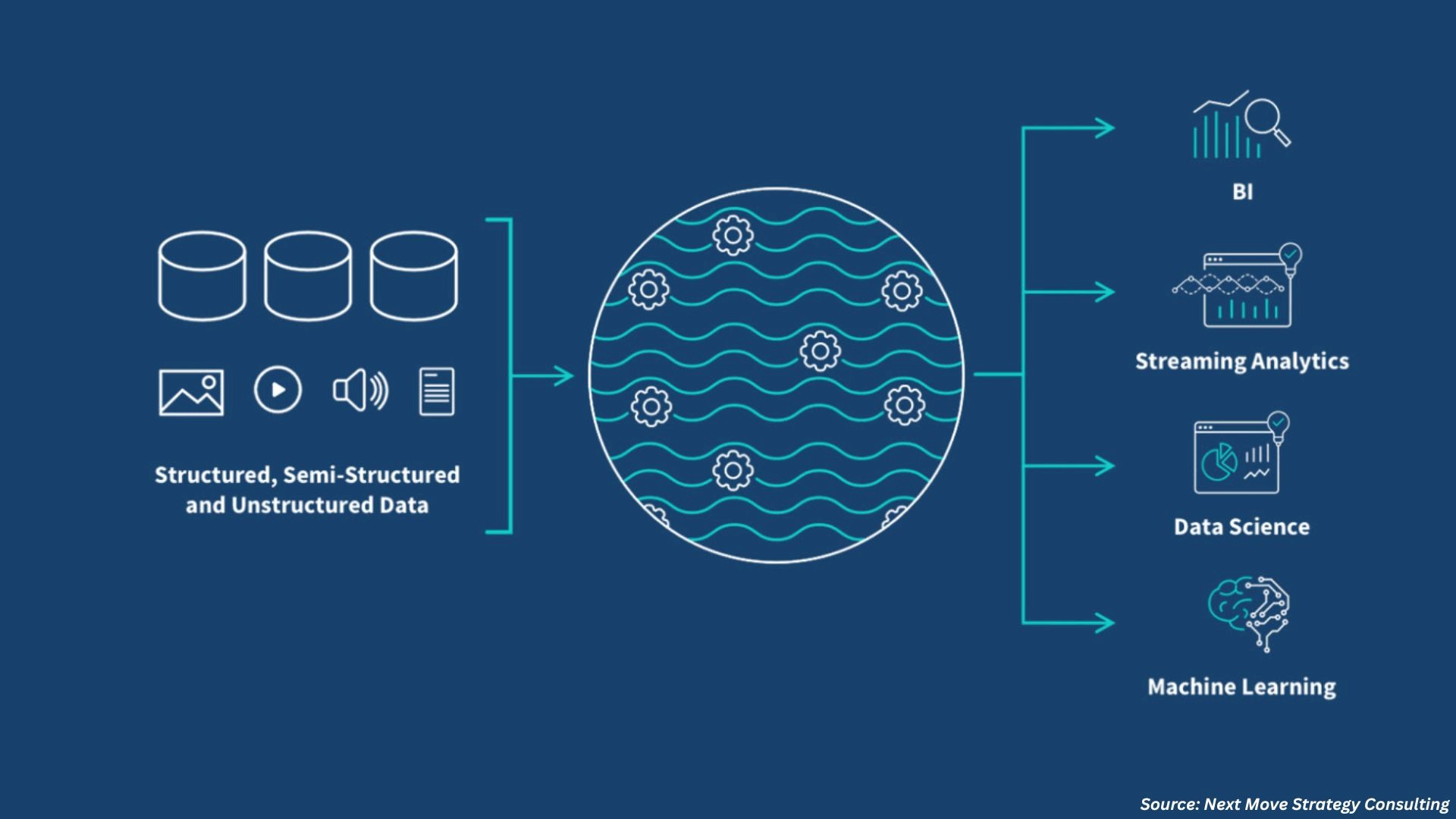
Data Lakes Market Size to Hit USD 38.9 Billion by 2030 as AWS Redshift RG Launch and AI Imaging Platforms Accelerate Enterprise Adoption
The global Data Lakes Market is witnessing accelerated enterprise investment after Amazon Web Services launched its new AWS Graviton-powered Redshift RG infrastructure with an integrated data lake query engine, while Flywheel announced integration with AWS HealthImaging to build advanced medical imaging data lakes for AI-driven clinical workflows. The twin developments are reshaping enterprise analytics architectures as organizations seek lower-cost, AI-ready data environments capable of handling petabyte-scale workloads.
According to the latest analysis from Next Move Strategy Consulting (NMSC), the Data Lakes Market is projected to reach USD 38.9 billion by 2030, driven by surging enterprise AI deployments, rising cloud-native analytics migration, and the growing need for unified storage frameworks across structured and unstructured datasets.
AWS confirmed on May 12, 2026, that its new Amazon Redshift RG instances deliver up to 2.4x faster performance for Apache Iceberg workloads and 30% lower price per vCPU compared with earlier RA3 infrastructure. The launch also removes Amazon Redshift Spectrum scanning charges by integrating the data lake query engine directly into cluster infrastructure.
Simultaneously, Flywheel’s integration with AWS HealthImaging is enabling healthcare organizations to build “golden imaging data lakes” optimized for clinical diagnostics and AI model training, underscoring how industry-specific data lake deployments are expanding beyond traditional enterprise analytics.
Sikha Haritwal, Senior Research Analyst at Next Move Strategy Consulting, notes that “the market is entering a transition phase where data lakes are no longer considered passive storage repositories but operational AI infrastructure. Organizations are prioritizing integrated lakehouse environments that reduce latency, eliminate redundant query costs, and support autonomous AI systems.”
According to the latest NMSC proprietary dataset, enterprise adoption of hybrid lakehouse environments increased sharply during the past two quarters as generative AI workloads intensified pressure on conventional data warehouse systems.
AWS Redshift RG Launch Signals Structural Shift in Enterprise Analytics
Amazon Web Services introduced Redshift RG instances as part of a broader effort to modernize analytics infrastructure for AI-driven enterprise environments. The platform combines warehouse and data lake processing into a unified architecture, allowing enterprises to query Amazon S3-based data lakes and warehouse datasets through a single engine.
The announcement is significant because traditional enterprise analytics environments often relied on separate infrastructure for data lakes and warehouse analytics, increasing operational complexity and compute costs.

AWS stated that the integrated architecture is designed to support AI agents and autonomous analytics systems that generate query volumes substantially higher than conventional human-operated business intelligence workloads.
NMSC researchers identified a substantial increase in enterprise migration activity toward integrated lakehouse architectures following the AWS announcement, particularly among financial services, healthcare analytics, and manufacturing organizations.
Key AWS Redshift RG Performance Metrics
|
Feature |
Previous RA3 Infrastructure |
New RG Infrastructure |
|
Query Speed Improvement |
Baseline |
Up to 2.4x Faster |
|
Cost Efficiency |
Standard Pricing |
30% Lower Price per vCPU |
|
Apache Iceberg Performance |
Standard |
Up to 2.4x Faster |
|
Apache Parquet Performance |
Standard |
Up to 1.5x Faster |
|
Spectrum Scanning Fees |
Applicable |
Eliminated |
Healthcare Imaging Data Lakes Emerge as High-Growth Vertical
Flywheel strengthened momentum in sector-specific data lake deployment after integrating with AWS HealthImaging to create centralized imaging repositories optimized for AI and clinical analysis.
The move reflects growing healthcare demand for scalable imaging data infrastructure capable of supporting AI diagnostics, radiology automation, and precision medicine applications. Medical imaging workloads require specialized architectures capable of managing extremely large file volumes while maintaining regulatory compliance and low-latency retrieval.
According to NMSC analysis, healthcare has emerged as one of the fastest-growing verticals for enterprise data lake deployments during the last 12 months due to rapid adoption of AI-assisted diagnostics and digital imaging transformation initiatives.
AI Agents Are Reshaping Data Lake Economics
Industry analysts indicate that the rise of autonomous AI systems is fundamentally changing enterprise data architecture economics. AI agents continuously query datasets at far higher frequency than traditional dashboards or BI systems, creating substantial compute and storage optimization pressure.
AWS specifically referenced agentic AI workloads as a central reason for redesigning Redshift architecture.

NMSC researchers observed growing enterprise preference for integrated lakehouse models capable of reducing duplicate data movement, minimizing query overhead, and improving AI training throughput.
Community discussions among enterprise cloud engineers also reveal increasing migration activity from legacy on-premise warehouses toward Redshift-based lakehouse ecosystems, especially for ETL modernization and real-time analytics pipelines.
Competitive Landscape Intensifies
Major technology vendors are accelerating investment in AI-ready analytics ecosystems as demand for scalable lakehouse infrastructure expands.
Key Players Operating in the Data Lakes Ecosystem
|
Company |
Strategic Focus |
|
Amazon Web Services |
Unified lakehouse infrastructure |
|
Microsoft |
Fabric analytics ecosystem |
|
Google Cloud |
AI-native analytics platforms |
|
Snowflake |
Cloud-native data collaboration |
|
Databricks |
Lakehouse architecture leadership |
|
Oracle |
Enterprise database modernization |
|
IBM |
Hybrid cloud analytics |
|
Cloudera |
Hybrid data lake management |

What CEOs and Investors Should Do Next
-
Prioritize migration toward unified lakehouse environments capable of supporting generative AI workloads.
-
Reassess analytics cost structures as integrated query engines eliminate separate scanning fees.
-
Increase investment in industry-specific data lake architectures, particularly healthcare and financial analytics.
-
Expand partnerships with cloud providers offering AI-native infrastructure optimization.
-
Evaluate Apache Iceberg and open table formats to improve interoperability and long-term scalability.
The latest market momentum suggests the global data lakes industry is entering a new infrastructure cycle driven not only by cloud migration, but by enterprise AI deployment requirements that demand scalable, low-latency, and cost-efficient analytics ecosystems.
About Next Move Strategy Consulting:
Next Move Strategy Consulting is a premier market research and management consulting firm that has been committed to provide strategically analysed well documented latest research reports to its clients. The research industry is flooded with many firms to choose from, what makes NMSC different from the rest is its top-quality research and the obsession of turning data into knowledge by dissecting every bit of it and providing fact-based research recommendation that is supported by information collected from over 500 million websites, paid databases, industry journals and one on one consultations with industry experts across a diverse range of industry sectors. The high-quality customized research reports with actionable insights and excellent end-to-end customer service help our clients to take critical business decisions that enables them to move beyond time and have competitive edge in the industry.
We have been servicing over 1000 customers globally that includes 90% of the Fortune 500 companies over a decade. Our analysts are constantly tracking various high growth markets and identifying hidden opportunities in each sector or the industry. We provide one of the industry’s best quality syndicate as well as custom research reports across 10 different industry verticals. We are committed to deliver high quality research solutions in accordance to your business needs. Our industry standard delivery solutions that ranges from the pre consultation to after-sales services, provide an excellent client experience and ensure right strategic decision making for businesses.
For more information, please contact:
Next Move Strategy Consulting
5th Floor 867
Boylston St, STE 500,
Boston, MA 02116, U.S.
E-Mail: [email protected]
Direct: +1-217-650-7991
Website: www.nextmsc.com
About the Author
 Sanyukta Deb
— Sanyukta Deb is Digital Marketing Team Lead at Next Move Strategy Consulting, where she has led content strategy and technical SEO for the firm's B2B market research publications for over 2 years. Her editorial process translates NextMSC's primary and secondary research — spanning technology, industrial, and consumer sectors — into commercial narratives, backed by search-intent, keyword, and competitive analysis. She brings 5 years of overall experience in digital marketing and content strategy.
Sanyukta Deb
— Sanyukta Deb is Digital Marketing Team Lead at Next Move Strategy Consulting, where she has led content strategy and technical SEO for the firm's B2B market research publications for over 2 years. Her editorial process translates NextMSC's primary and secondary research — spanning technology, industrial, and consumer sectors — into commercial narratives, backed by search-intent, keyword, and competitive analysis. She brings 5 years of overall experience in digital marketing and content strategy.
About the Reviewer
 Debashree Dey
— Debashree Dey is Assistant Manager at Next Move Strategy Consulting, where she supports cross-vertical market content and communications across diverse industries for 6 years. Her professional background includes senior content writing, communications, and published manuscript authorship, with experience developing audience-focused business narratives and maintaining clear, consistent messaging. Her role supports research-led content development and editorial quality across NextMSC publications.
Debashree Dey
— Debashree Dey is Assistant Manager at Next Move Strategy Consulting, where she supports cross-vertical market content and communications across diverse industries for 6 years. Her professional background includes senior content writing, communications, and published manuscript authorship, with experience developing audience-focused business narratives and maintaining clear, consistent messaging. Her role supports research-led content development and editorial quality across NextMSC publications.

















Add Comment