Space Launch Services Market: SDA Eyes Two More New Launches
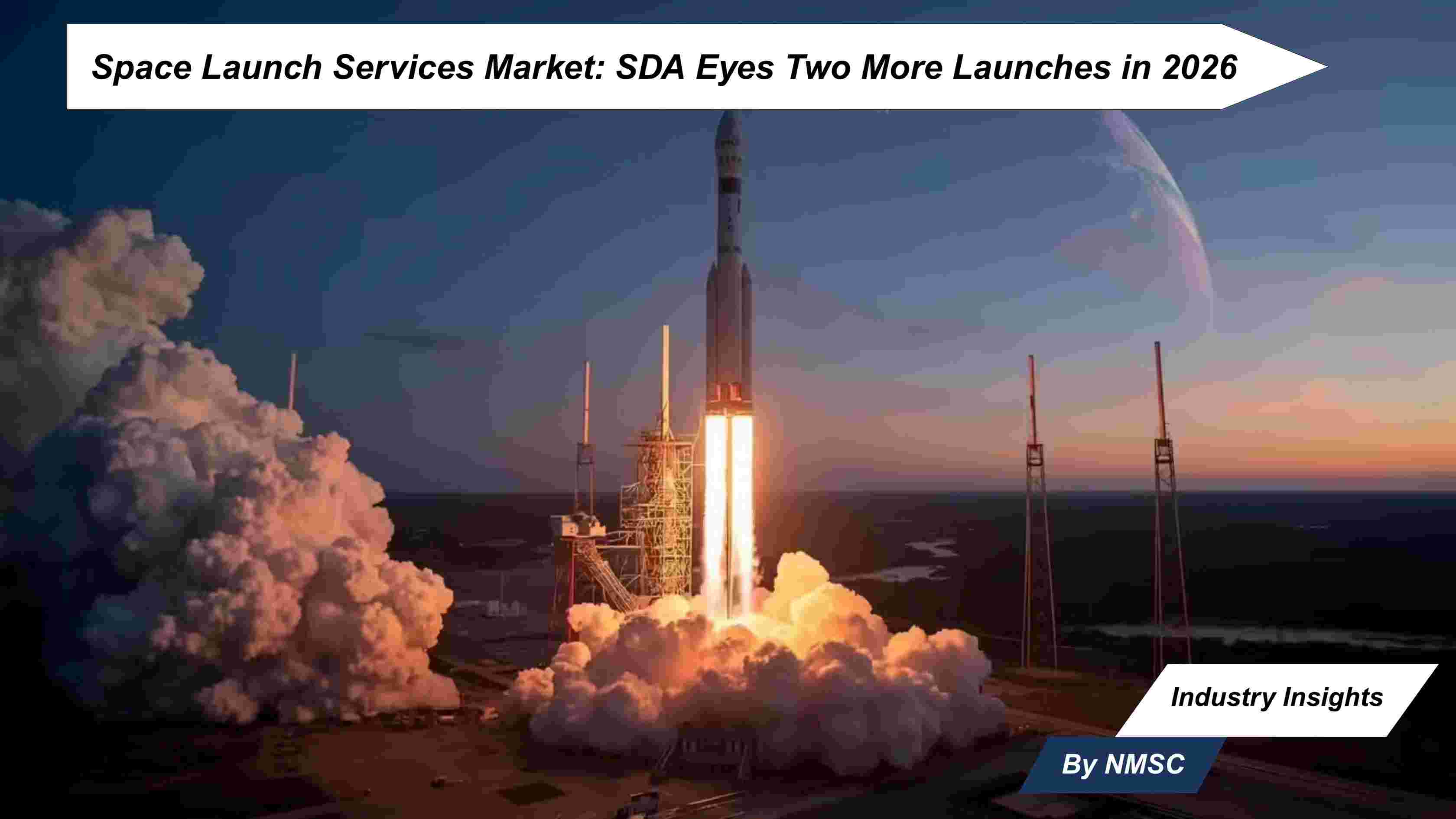
U.S. Space Development Agency Targets Two More Satellite Launches Before Year-End
WASHINGTON, United States September 21, 2026, the U.S. Space Development Agency (SDA) has announced plans to execute two additional satellite launches before the close of 2026, with a broader objective of completing its Tranche 1 constellation campaign by spring 2027 a development that underscores sustained government demand within the space launch services market, which is projected to reach USD 40.12 billion by 2030, growing at a CAGR of 13.6%. SDA Director Gurpartap "GP" Sandhoo made the announcement during the Air and Space Forces Association's annual Air, Space and Cyber Conference, outlining the agency's near-term launch cadence and long-range constellation objectives.
The SDA currently has six launches remaining in its Tranche 1 campaign, which encompasses both transport and tracking satellite planes. Sandhoo indicated that the agency's next launch is expected within approximately three weeks, which would bring the total to four operational transport satellite planes in orbit. The remaining two transport planes and four tracking planes represent the agency's primary focus over the next six to eight months.
The agency has fielded 63 of its 154 planned satellites to date, following a months-long operational pause caused by software and hardware issues affecting Tranche 1 satellites built by York Space Systems and Lockheed Martin. Sandhoo noted that satellite checkout times have improved significantly between successive launches, with the second York plane completing checkout two to three times faster than the first a sign of operational maturation within the program. Supply chain constraints, however, continue to present challenges.
In parallel, Congress is advancing legislation that could dissolve the SDA as an independent organization as part of broader Space Force acquisition reform efforts. Sandhoo expressed measured concern, noting that the agency's special hiring authorities and original classification authorities are critical to its operational effectiveness. He indicated that if those authorities are preserved, the reorganization would amount to "just a name change," though he acknowledged that losing them would create navigational challenges for the agency.
Key Highlights:
-
Launch Cadence: SDA is targeting two additional launches before December 31, 2026, with the next mission expected within approximately three weeks of the September 21 announcement.
-
Constellation Progress: The agency has deployed 63 of 154 planned satellites; six Tranche 1 launches remain, covering two transport planes and four tracking planes, with full Tranche 1 completion targeted for spring 2027.
-
Operational Improvement: Satellite checkout times between successive York Space Systems launches improved by a factor of two to three, reflecting accelerating operational efficiency within the SDA's launch program.
-
Institutional Uncertainty: Congressional proposals to absorb the SDA into the Space Force's broader acquisition structure introduce organizational risk, with the agency's unique hiring and classification authorities at the center of the debate.
Analyst Insight:
According to analysts at Next Move Strategy Consulting, the SDA's accelerated launch schedule reflects a structural shift in government procurement toward proliferated low Earth orbit (LEO) satellite architectures, which require frequent, reliable, and cost-effective launch services at a scale that was not previously demanded by traditional government space programs. NMSC analysts note that as military and government end-users increasingly drive launch volume particularly through multi-satellite constellation deployments commercial launch service providers stand to benefit from a sustained pipeline of government contracts, reinforcing the market's projected trajectory toward USD 40.12 billion by 2030.
Industry Outlook:
The SDA's push to complete Tranche 1 and transition into Tranche 2 operations signals a maturing phase of the U.S. government's proliferated warfighter space architecture, with direct implications for the commercial launch services ecosystem. As the agency scales its constellation, demand for dedicated and rideshare launch capacity particularly for small and medium satellites in LEO is expected to intensify, creating competitive opportunities for established and emerging launch providers alike.
The potential reorganization of the SDA within the Space Force's acquisition framework introduces a degree of institutional uncertainty, but analysts broadly expect the underlying launch demand to remain intact regardless of the agency's administrative structure. For the broader space launch services industry, the continued expansion of government-backed satellite constellations represents one of the most durable demand drivers in the near-to-medium term.
Source: Federal News Network
For More Information: Download FREE Sample on Space Launch Services Market Report
Prepared By: Sanyukta Deb
About the Author
 Sanyukta Deb
— Sanyukta Deb is Digital Marketing Team Lead at Next Move Strategy Consulting, where she has led content strategy and technical SEO for the firm's B2B market research publications for over 2 years. Her editorial process translates NextMSC's primary and secondary research — spanning technology, industrial, and consumer sectors — into commercial narratives, backed by search-intent, keyword, and competitive analysis. She brings 5 years of overall experience in digital marketing and content strategy.
Sanyukta Deb
— Sanyukta Deb is Digital Marketing Team Lead at Next Move Strategy Consulting, where she has led content strategy and technical SEO for the firm's B2B market research publications for over 2 years. Her editorial process translates NextMSC's primary and secondary research — spanning technology, industrial, and consumer sectors — into commercial narratives, backed by search-intent, keyword, and competitive analysis. She brings 5 years of overall experience in digital marketing and content strategy.
About the Reviewer
 Debashree Dey
— Debashree Dey is Assistant Manager at Next Move Strategy Consulting, where she supports cross-vertical market content and communications across diverse industries for 6 years. Her professional background includes senior content writing, communications, and published manuscript authorship, with experience developing audience-focused business narratives and maintaining clear, consistent messaging. Her role supports research-led content development and editorial quality across NextMSC publications.
Debashree Dey
— Debashree Dey is Assistant Manager at Next Move Strategy Consulting, where she supports cross-vertical market content and communications across diverse industries for 6 years. Her professional background includes senior content writing, communications, and published manuscript authorship, with experience developing audience-focused business narratives and maintaining clear, consistent messaging. Her role supports research-led content development and editorial quality across NextMSC publications.


















Add Comment