Digital Agriculture Market: Policy Shifts Drive Growth
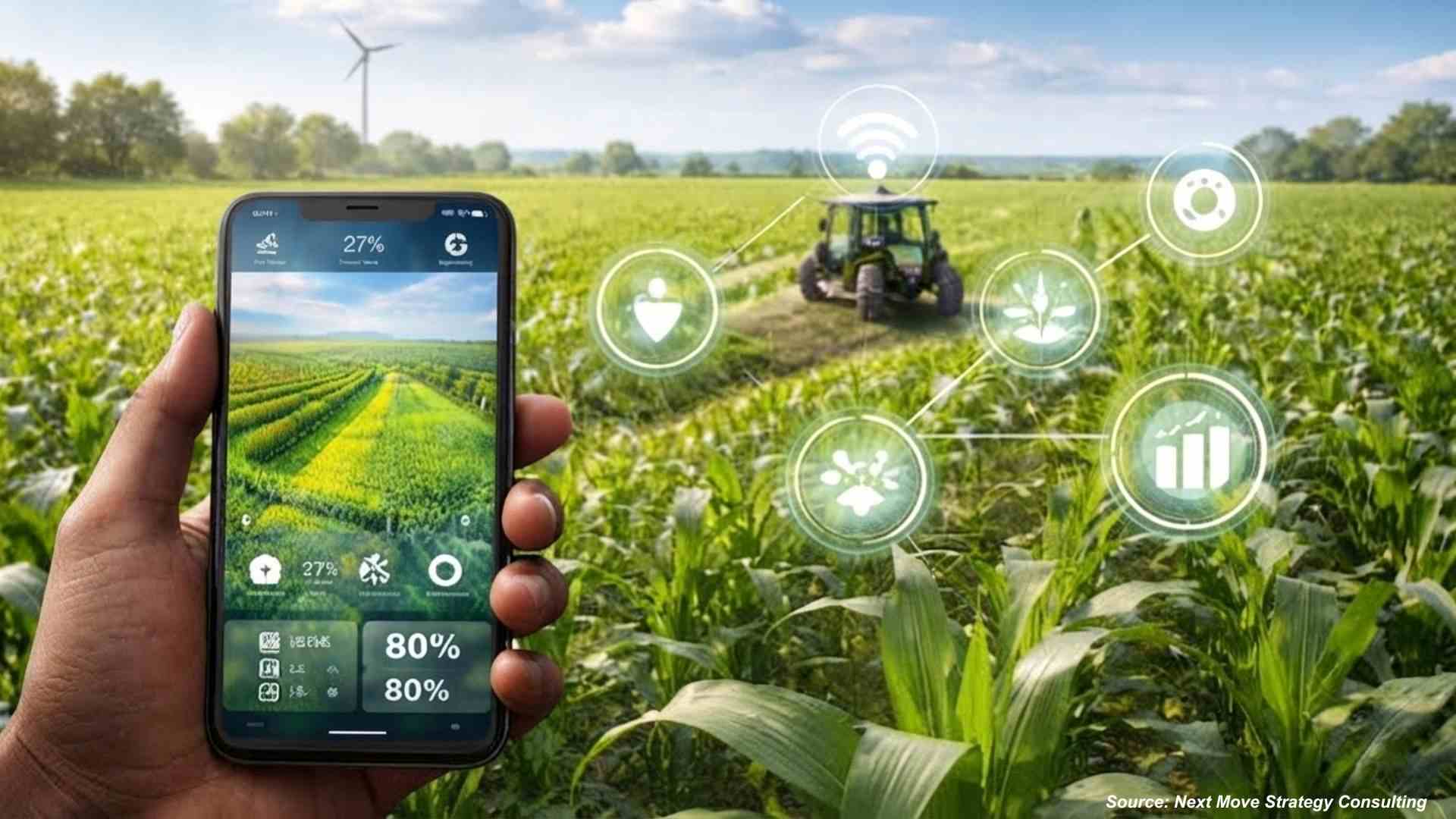
U.S. Executive Order on Precision Farming Accelerates Global Digital Agriculture Transformation as Market Eyes USD 58.64 Billion by 2030
On June 25, 2026, President Donald J. Trump signed Executive Order 14414, "Advancing Regenerative Agriculture and Strengthening American Farm Resilience," formally establishing the promotion of precision agriculture technologies as an explicit policy priority of the United States federal government. The order directs federal agencies to significantly increase investment in regenerative and precision agriculture practices, reduce regulatory barriers to farm modernization, and strengthen public-private partnerships across the agricultural technology ecosystem. Critically, the Department of Health and Human Services, the U.S. Department of Agriculture, and the Environmental Protection Agency have collectively committed over USD 1 billion toward accelerating farm modernization and long-term food supply security under the broader Make America Healthy Again agenda.
The executive action arrives at a pivotal inflection point for global agricultural technology. Compounding its significance, the 2026 Farm Bill advancing through the U.S. Congress includes a provision that would reimburse farmers up to 90 percent of the cost of adopting AI and precision agriculture technologies through the Environmental Quality Incentives Program (EQIP), a measure that analysts and industry observers regard as one of the most consequential federal incentives for agricultural digitization in recent legislative history. Together, these policy developments are reshaping the investment calculus for agri-technology companies, equipment manufacturers, and institutional investors operating across the global Digital Agriculture Market.
For More Information: Download FREE Sample on Digital Agriculture Market Report
Market Scale and Growth Trajectory
According to analysis by Next Move Strategy Consulting, the global digital agriculture market was valued at USD 28.56 billion in 2024 and is projected to reach USD 32.20 billion in 2025, advancing to USD 58.64 billion by 2030 at a compound annual growth rate of 12.74 percent over the 2025–2030 forecast period. The market's expansion is underpinned by the accelerating integration of Internet of Things (IoT) sensor networks, artificial intelligence, machine learning, remote sensing, and autonomous equipment across farm operations globally.
The policy environment reinforcing this trajectory extends well beyond U.S. borders. On June 29, 2026, the OECD and FAO jointly released the OECD-FAO Agricultural Outlook 2026-2035, which projects global agricultural production to expand by 13 percent over the next decade, driven primarily by productivity improvements and intensification, with growth concentrated in Asia, sub-Saharan Africa, and Latin America. The Outlook further projects that productivity gains will raise global gross agricultural income per worker by 9 percent by 2035, though it cautions that inherent market variability leaves a one-in-four probability that income could fall below current levels by the end of the projection period — a risk profile that underscores the urgency of technology-driven productivity enhancement.
Precision Agriculture Adoption: A Widening Divide
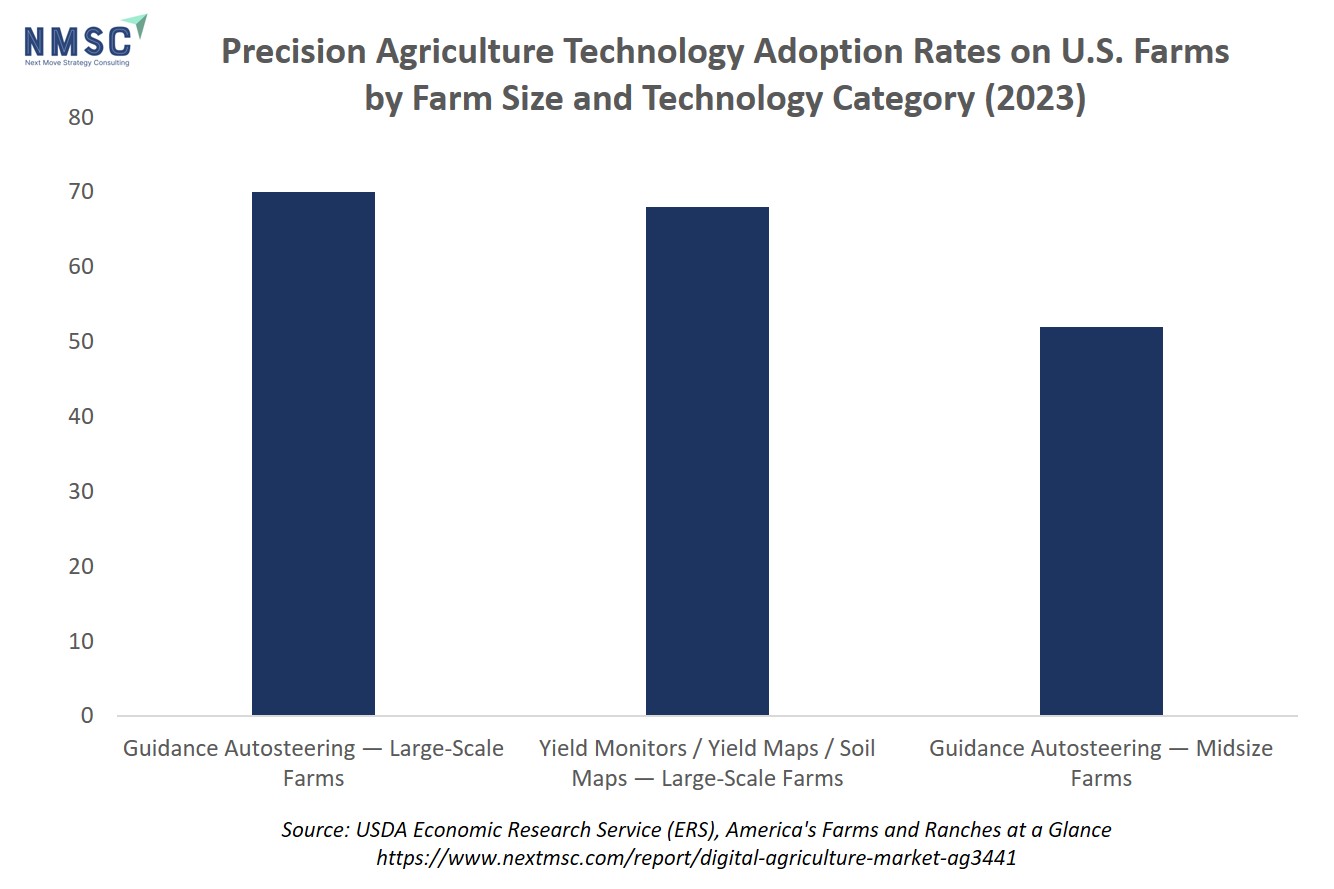
Despite the favorable policy environment, adoption of precision agriculture technologies remains highly stratified by farm scale. Data published by the USDA Economic Research Service in December 2024 reveal that guidance autosteering systems — among the most widely deployed precision technologies — were used by 70 percent of large-scale crop-producing farms and 52 percent of midsize farms in 2023, compared with adoption rates in the single digits for the same technologies in the early 2000s. Yield monitors, yield maps, and soil maps were deployed on 68 percent of large-scale crop-producing farms. Small family farms — particularly those with gross cash farm income below USD 150,000 — recorded the lowest adoption rates across all technology categories, reflecting the persistent cost and connectivity barriers that continue to constrain inclusive market growth.
The U.S. Government Accountability Office has separately confirmed that only 27 percent of U.S. farms or ranches used precision agriculture practices to manage crops or livestock as of 2023, underscoring the substantial headroom for market penetration that remains even in the world's most technologically advanced agricultural economy.
Global Agricultural Production: The Productivity Imperative
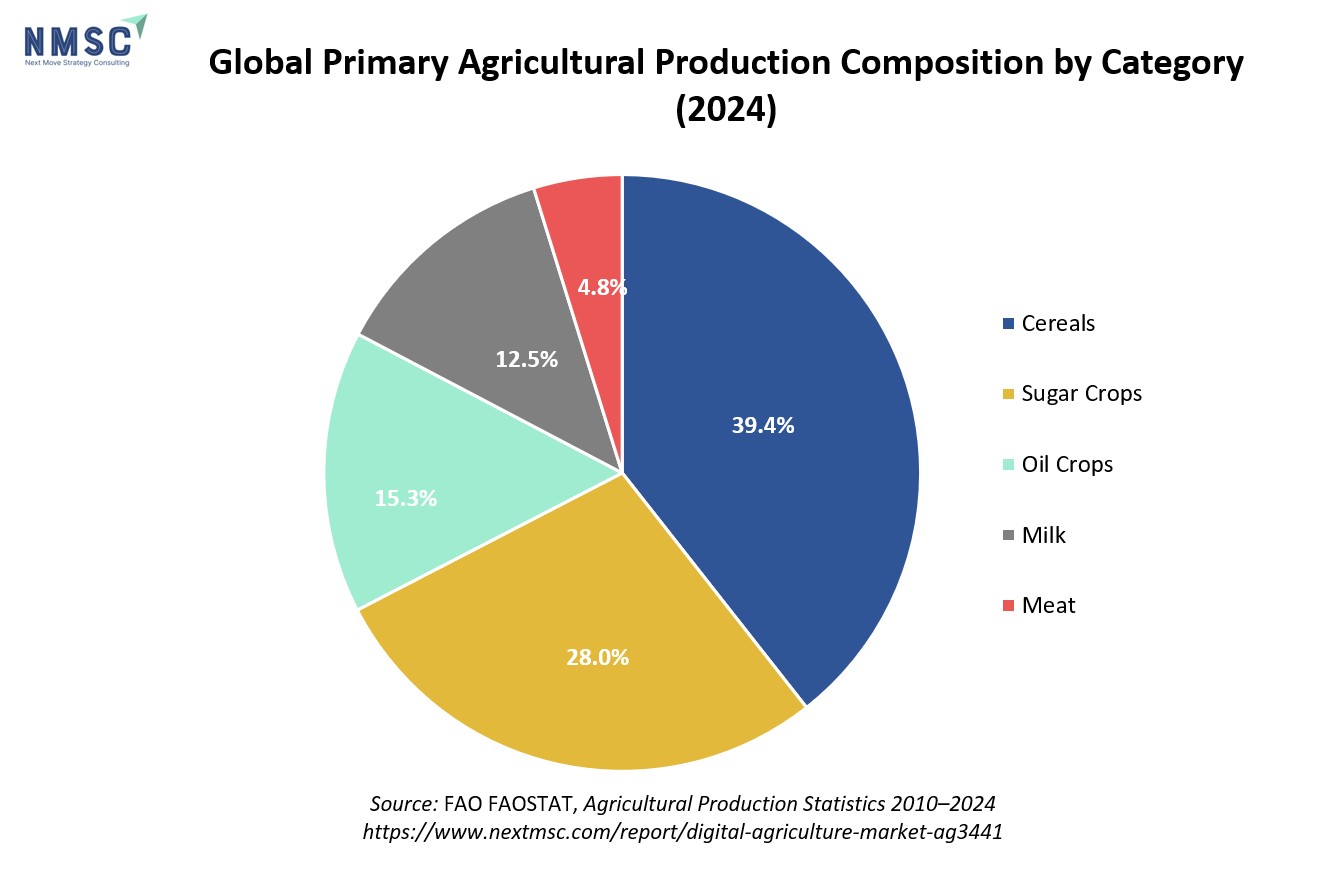
The scale of the challenge — and the opportunity — confronting digital agriculture is best understood in the context of global food production dynamics. According to FAOSTAT data released by the Food and Agriculture Organization of the United Nations in December 2025, the global harvested area of primary crops reached 1.5 billion hectares in 2024, an increase of 197 million hectares from 2010. Global cereal production rose 27 percent between 2010 and 2024 to reach 3.1 billion tonnes, driven primarily by yield improvements — precisely the category of gain that precision agriculture technologies are engineered to accelerate. Oil crop production expanded by 50 percent over the same period to 1.2 billion tonnes, while sugar crop output increased 17 percent to 2.2 billion tonnes.
OECD-FAO Agricultural Labor Productivity by Income Group — Estimates and Projections
|
Income Group |
Representative Regions |
Avg. Productivity (2023–2025 Est.) |
Projected Productivity (2035) |
Projected Change |
|
High-Income Countries |
North America, Western Europe, Oceania |
USD 21,100 |
USD 22,155 |
+5.0% |
|
Low-Income Countries |
Sub-Saharan Africa, South Asia |
USD 930 |
USD 1,100 |
+18.3% |
|
Global Average (All Income Groups) |
Global |
USD 3,800 |
USD 4,142 (est.) |
+9.0% |
Technology Enablers and Market Segmentation
The NMSC analysis identifies IoT and sensor networks, remote sensing and aerial imagery, artificial intelligence and machine learning, edge computing, robotics and automation, blockchain-based traceability, and satellite connectivity as the primary technology enablers driving market expansion. On the component side, the market is structured across hardware — encompassing automation and control systems, sensing and monitoring devices, imaging and positioning systems, robotics, and irrigation hardware — software and platforms, and services including advisory, implementation, managed operations, and financing.
The application landscape spans crop monitoring and scouting, soil health and nutrient management, irrigation and water management, pest and disease management, precision input application, yield monitoring and forecasting, post-harvest handling and cold chain management, traceability and compliance, and farm finance and insurance. This breadth of application reflects the comprehensive digitization underway across the agricultural value chain, from field-level sensing to supply chain transparency.
Regional Dynamics: North America, Europe, Asia-Pacific, and Emerging Markets
North America retains its position as the most technologically advanced digital agriculture region, supported by large-scale industrial farming operations, high infrastructure readiness, and proximity to major agricultural equipment OEMs and agri-tech startup ecosystems. In May 2025, Deere & Company strengthened its market position by acquiring a leading drone imaging firm, integrating high-resolution aerial scouting and advanced analytics into its Operations Center platform for more precise crop monitoring and input management.
Europe's digital agriculture expansion is underpinned by the European Green Deal, Common Agricultural Policy subsidies, and national funding schemes across more than half of EU member states, which collectively drive precision farming adoption. High uptake of IoT devices and collaborative data-sharing platforms, alongside robust research networks, continue to accelerate innovation and sustainability across European farms.
Asia-Pacific is experiencing accelerated uptake of advanced drone platforms and digital farm management tools tailored to local agricultural operations. The region's growth is driven by the urgent need to boost food output for large rural populations and by strong government initiatives promoting rural digitization. DJI Agriculture's April 2024 global launch of its Agras T50 and T25 drones — with payload capacities up to 50 kilograms — alongside an upgraded SmartFarm application, exemplifies the scale of innovation targeting this market.
Emerging markets in Latin America, the Middle East, and Africa are rapidly adopting digital solutions supported by public-private partnerships and development finance. The Food and Agriculture Organization's Digital Villages Initiative (FDiVi), launched in April 2024, is equipping approximately 150 farmer groups in Malawi, Rwanda, and Zimbabwe with mobile advisory platforms, AI-enabled chatbots, and tablets, demonstrating the expanding reach of digital agriculture into previously underserved agricultural communities.
FAO Global Crop Production Statistics — 2010 vs. 2024
|
Commodity Category |
2024 Production |
Change vs. 2010 |
Primary Growth Driver |
|
Cereals |
3,100 Mt (3.1 Gt) |
+27% |
Yield improvements |
|
Oil Crops |
1,200 Mt (1.2 Gt) |
+50% |
Area expansion (oil palm, soya beans) |
|
Sugar Crops |
2,200 Mt (2.2 Gt) |
+17% |
Area and yield gains |
|
Meat (Total) |
374 Mt |
+7 Mt vs. 2023 |
Chicken, pig, and cattle production |
|
Milk (Total) |
985 Mt |
N/A (2024 data) |
Cattle milk (81% of total) |
|
Global Harvested Area |
1.5 billion hectares |
+197 million ha vs. 2010 |
Oil crops; roots and tubers |
Key Corporate Developments and Strategic Positioning
The competitive landscape of the digital agriculture market is undergoing rapid consolidation and capability expansion. In September 2025, Deere & Company expanded its autonomous farming technology portfolio by launching next-generation AI-enabled autonomous tractors, precision spraying equipment, and connected farm management capabilities integrated into the John Deere Operations Center platform, with a focus on real-time field analytics, automated route optimization, machine learning-based crop monitoring, and variable rate application technologies.
In August 2025, PTx Trimble accelerated the expansion of its precision agriculture dealership and technology ecosystem across North America and Europe, enhancing its connected farming portfolio with advanced GNSS guidance systems, cloud-based analytics tools, autonomous steering technologies, and precision input management solutions. CNH Industrial, in July 2025, introduced upgraded AI-powered precision spraying technologies and autonomous field operation systems across its Case IH and New Holland equipment portfolio, while simultaneously strengthening digital connectivity through advanced telematics, remote diagnostics, and satellite-enabled connectivity solutions.
DJI Agriculture, in June 2025, launched a new generation of agricultural drones equipped with enhanced payload capacity, AI-powered crop analytics, multispectral imaging, and precision spraying technologies. The Climate Corporation, in May 2025, enhanced its climate-smart agriculture platform with AI-based agronomic advisory tools, predictive yield forecasting technologies, and advanced weather intelligence systems, enabling data-driven farm planning and improved risk management capabilities.
Structural Drivers and Restraints
The NMSC analysis identifies three primary structural growth drivers: the increasing use of IoT for real-time farm monitoring, government-led digital initiatives, and government grant programs accelerating technology adoption. The U.S. Department of Agriculture's Conservation Innovation Grants and SBIR/STTR initiatives, which earmarked USD 1.5 billion in April 2024 to help farmers integrate conservation and climate-smart tools ranging from IoT sensors to precision application equipment, represent a concrete illustration of this public investment dynamic.
Counterbalancing these drivers are three principal restraints: limited rural connectivity, high upfront technology costs, and digital literacy gaps. In many agricultural regions globally, unreliable internet infrastructure and inconsistent electricity supply hinder the consistent deployment of IoT sensors and cloud-based platforms. Steep capital requirements for AI-powered advisory tools and advanced sensor systems place them beyond the financial reach of smallholder and low-income farm operations. The OECD-FAO Outlook's finding that agricultural workers in low-income regions earn approximately USD 930 per year — projected to rise only modestly to USD 1,100 by 2035 — contextualizes the depth of the affordability challenge confronting inclusive digital agriculture adoption.
The emergence of data-efficient mobile applications and open-source digital platforms represents the most scalable near-term opportunity to bridge this divide. IBM's My FarmWell application in the MENA region, which uses minimal data to deliver sustainable farming insights to water-stressed communities, exemplifies the commercial and developmental potential of lightweight, interoperable digital tools designed for resource-constrained environments.
Regulatory and Policy Landscape
The regulatory environment for digital agriculture is evolving rapidly across all major markets. In the United States, Executive Order 14414 establishes a formal federal mandate to promote precision agriculture technologies, reduce regulatory friction, and expand public-private partnerships — a policy posture that is expected to accelerate private sector investment and technology deployment timelines. The 2026 Farm Bill's proposed 90 percent cost-share reimbursement for precision agriculture adoption through EQIP represents a structural demand stimulus that could materially accelerate technology uptake among mid-scale and smaller farm operations.
In Europe, the Green Deal and Common Agricultural Policy subsidy frameworks continue to incentivize precision farming adoption, while Asia-Pacific governments are embedding digital public infrastructure into national agricultural strategies. The FAO's FDiVi initiative reflects a multilateral commitment to extending digital agriculture's reach into sub-Saharan Africa and other low-income agricultural economies, supported by development finance and public-private collaboration.
Bottom Line
The global digital agriculture market stands at a structural inflection point, propelled by converging forces of policy mandate, technological maturation, and escalating food security imperatives. The signing of U.S. Executive Order 14414 in June 2026, combined with the 2026 Farm Bill's proposed 90 percent cost-share provisions for precision agriculture adoption, represents the most significant federal policy commitment to agricultural digitization in recent history — a development with direct implications for market demand, investment flows, and competitive positioning across the global agri-technology value chain.
With the market projected to expand from USD 32.20 billion in 2025 to USD 58.64 billion by 2030 at a CAGR of 12.74 percent, the investment opportunity is substantial. However, the persistent adoption gap between large-scale commercial operations and smallholder farms — underscored by USDA data showing only 27 percent of U.S. farms using precision agriculture practices — signals that inclusive market penetration remains a critical challenge and a significant growth frontier. The OECD-FAO Outlook's projection of a 13 percent increase in global agricultural production over the next decade, driven primarily by productivity gains, reinforces the strategic imperative for digital agriculture solutions that can deliver measurable yield and efficiency improvements at scale. Investors, technology developers, and policymakers who position early in this convergence of policy support, technological capability, and global food security demand are best placed to capture the market's long-term value creation potential.
About Next Move Strategy Consulting
Next Move Strategy Consulting is a premier market research and management consulting firm that has been committed to provide strategically analysed well documented latest research reports to its clients. The research industry is flooded with many firms to choose from, what makes NMSC different from the rest is its top-quality research and the obsession of turning data into knowledge by dissecting every bit of it and providing fact-based research recommendation that is supported by information collected from over 500 million websites, paid databases, industry journals and one on one consultations with industry experts across a diverse range of industry sectors. The high-quality customized research reports with actionable insights and excellent end-to-end customer service help our clients to take critical business decisions that enables them to move beyond time and have competitive edge in the industry.
We have been servicing over 1000 customers globally that includes 90% of the Fortune 500 companies over a decade. Our analysts are constantly tracking various high growth markets and identifying hidden opportunities in each sector or the industry. We provide one of the industry's best quality syndicate as well as custom research reports across 10 different industry verticals. We are committed to deliver high quality research solutions in accordance to your business needs. Our industry standard delivery solutions that ranges from the pre consultation to after-sales services, provide an excellent client experience and ensure right strategic decision making for businesses.
For more information, please contact:
Next Move Strategy Consulting
5th Floor 867
Boylston St, STE 500,
Boston, MA 02116, U.S.
E-Mail: [email protected]
Direct: +1-217-650-7991
Website: www.nextmsc.com
About the Author
 Sanyukta Deb
— Sanyukta Deb is Digital Marketing Team Lead at Next Move Strategy Consulting, where she has led content strategy and technical SEO for the firm's B2B market research publications for over 2 years. Her editorial process translates NextMSC's primary and secondary research — spanning technology, industrial, and consumer sectors — into commercial narratives, backed by search-intent, keyword, and competitive analysis. She brings 5 years of overall experience in digital marketing and content strategy.
Sanyukta Deb
— Sanyukta Deb is Digital Marketing Team Lead at Next Move Strategy Consulting, where she has led content strategy and technical SEO for the firm's B2B market research publications for over 2 years. Her editorial process translates NextMSC's primary and secondary research — spanning technology, industrial, and consumer sectors — into commercial narratives, backed by search-intent, keyword, and competitive analysis. She brings 5 years of overall experience in digital marketing and content strategy.
About the Reviewer
 Debashree Dey
— Debashree Dey is Assistant Manager at Next Move Strategy Consulting, where she supports cross-vertical market content and communications across diverse industries for 6 years. Her professional background includes senior content writing, communications, and published manuscript authorship, with experience developing audience-focused business narratives and maintaining clear, consistent messaging. Her role supports research-led content development and editorial quality across NextMSC publications.
Debashree Dey
— Debashree Dey is Assistant Manager at Next Move Strategy Consulting, where she supports cross-vertical market content and communications across diverse industries for 6 years. Her professional background includes senior content writing, communications, and published manuscript authorship, with experience developing audience-focused business narratives and maintaining clear, consistent messaging. Her role supports research-led content development and editorial quality across NextMSC publications.
















Add Comment