EU NGT Regulation Reshapes Agricultural Biotech Landscape

European Parliament's Landmark Approval of New Genomic Techniques Regulation Signals a Structural Shift in Global Agricultural Biotechnology Policy, Accelerating Innovation Pathways and Market Expansion
On June 17, 2026, the European Parliament voted to give final approval to the regulation on plants obtained through new genomic techniques (NGTs), concluding a multi-year EU legislative process that is set to fundamentally alter the regulatory architecture governing crop innovation across the bloc and beyond. The EU Council had formally adopted the new rules on April 21, 2026, following years of scientific review and stakeholder consultation. The regulation now proceeds to signature and publication in the Official Journal, followed by a mandatory two-year implementation period during which the European Commission will develop the necessary secondary legislation and implementing acts.
The new framework establishes two distinct regulatory pathways based on a plant's genetic equivalence to conventionally bred varieties. Category 1 plants — deemed equivalent to conventionally bred varieties — will follow a simplified regulatory pathway, while Category 2 plants remain subject to the existing genetically modified organism (GMO) framework. According to the USDA Foreign Agricultural Service, the regulation is expected to provide greater regulatory predictability, foster innovation, and open new market opportunities for NGT-derived crop varieties, bringing the EU in line with regulatory approaches already adopted in other major agricultural markets including the United States, Canada, Argentina, and Brazil.
A coalition of 30 agri-food organizations, including CropLife Europe, formally welcomed the adoption of the EU NGT Regulation, describing the new framework as "a balanced and science-based approach that enables innovation in plant breeding while ensuring safety."
For More Information: Download FREE Sample on Agricultural Biotechnology Market Report
A Pivotal Regulatory Inflection Point for the Global Market
The EU's regulatory pivot arrives at a critical juncture for the global Agricultural Biotechnology Market, which has been experiencing sustained expansion driven by mounting food security imperatives, climate-adaptive crop development, and the accelerating commercialization of precision breeding technologies including CRISPR-Cas9 genome editing. The EU's decision to align its regulatory framework with science-based genomic techniques standards already in place across major agricultural economies is expected to unlock significant commercial opportunities for biotech seed developers, agri-input corporations, and research institutions operating within the European market.
According to Next Move Strategy Consulting's analysis of the agricultural biotechnology market, the sector is positioned for sustained long-term growth, underpinned by rising global food demand, climate change adaptation imperatives, and the accelerating commercialization of precision breeding technologies. The NMSC report identifies key growth drivers including increasing adoption of biotech seeds in emerging markets, expanding regulatory acceptance of gene-edited crops, and growing investment in biological crop protection solutions across both developed and developing economies.
Record Global GM Crop Adoption Underscores Structural Demand
The regulatory momentum in Europe coincides with record-breaking global adoption of genetically modified (GM) crops. According to data published in the Journal of Integrative Agriculture (2026), the global GM crop cultivation area reached 209.8 million hectares in 2024, representing a 1.7% year-on-year increase. In 2025, the global area under GM crops expanded further to 216.0 million hectares — a new record — reflecting a 2.5% increase over the prior year, according to the GM Agbioinvestor Global GM Crop Area Review published in May 2026.
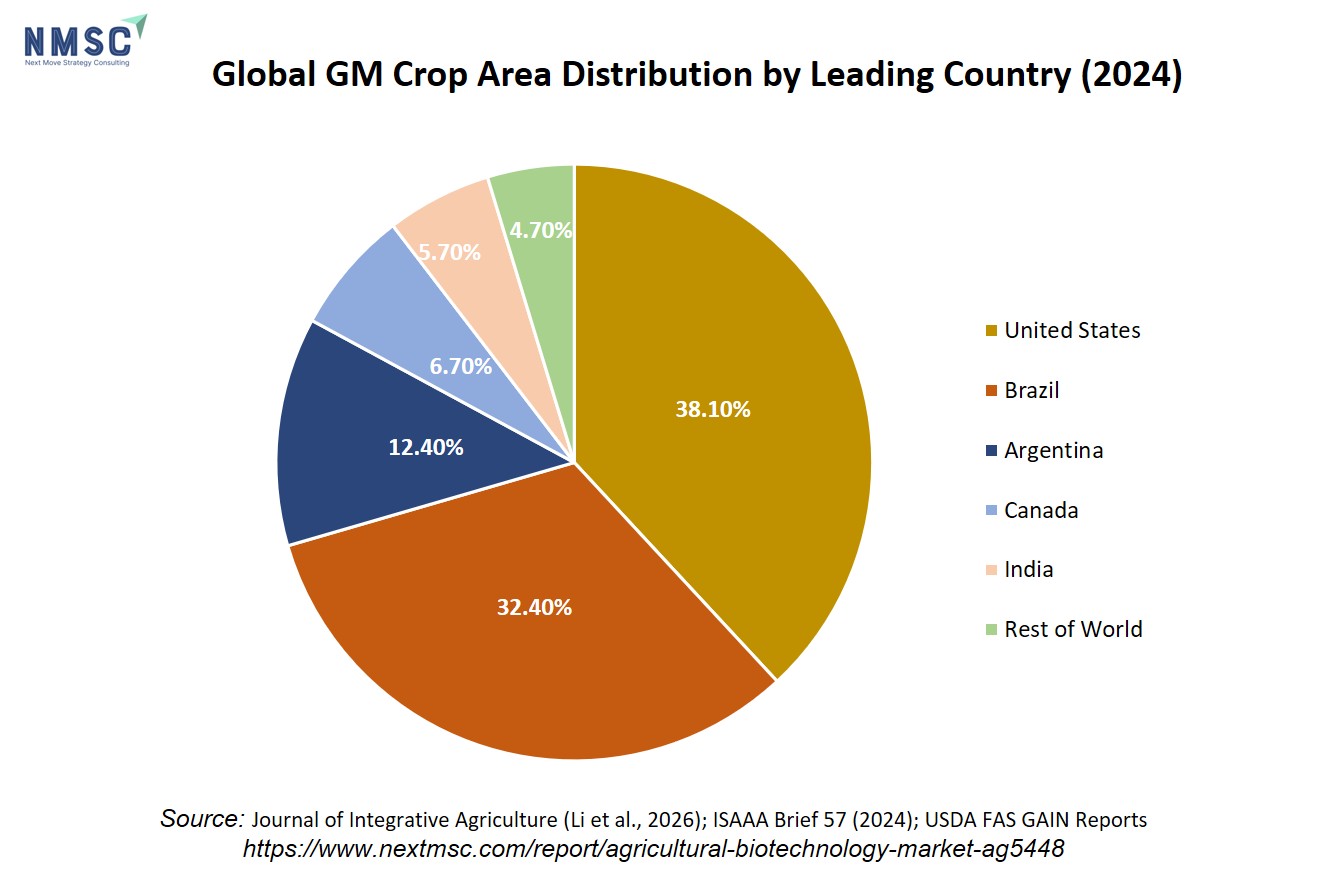
The International Service for the Acquisition of Agri-biotech Applications (ISAAA) reported that in 2024, agricultural biotechnology continued to expand globally, with over 20 biotech/GM crops cultivated across 31 countries. The United States led global biotech crop plantings with 79.9 million hectares, followed by Brazil, Argentina, India, and Canada — five nations collectively accounting for 90.6% of the global GM crop cultivation area. From 1996 to 2024, 73 countries have adopted biotech crops, demonstrating 29 years of safe use and widespread integration into mainstream agricultural production systems.
U.S. GE Crop Adoption: A Benchmark for Global Commercialization
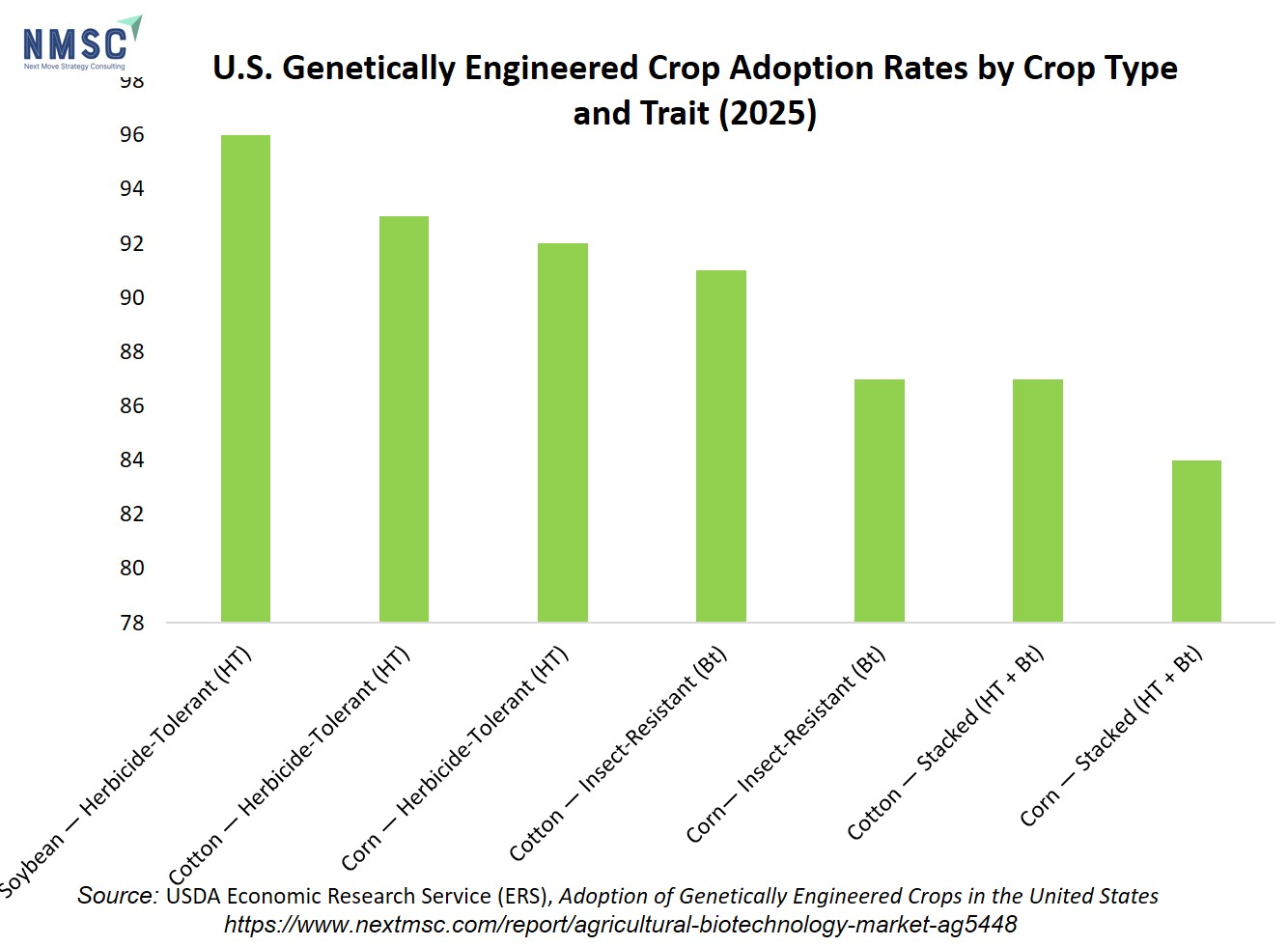
The United States remains the definitive benchmark for genetically engineered (GE) crop commercialization. According to the USDA Economic Research Service (ERS), GE seeds were commercially introduced for major field crops in 1996, with adoption rates increasing rapidly in the years that followed. Currently, more than 90% of U.S. corn, upland cotton, and soybeans are produced using GE varieties.
Soybean herbicide-tolerant (HT) acreage reached its highest-ever adoption rate of 96% in 2024 and maintained that level in 2025. HT cotton adoption stood at 93% of upland cotton acres, while HT corn reached approximately 92% of domestic acreage. Insect-resistant Bt corn acreage grew to 87% in 2025, while Bt cotton reached 91% of U.S. cotton acres. Stacked varieties — combining both HT and Bt traits — accounted for 87% of cotton acres and 84% of corn acres in 2025.
Regional Dynamics: Asia Emerges as a Biotech Powerhouse
North America continues to dominate global biotech crop production, but Asia's trajectory is increasingly significant. The ISAAA reported that Asia has officially become a powerhouse, accounting for nearly 10% of global biotech crop plantings in 2024, with 20.81 million hectares under cultivation.
Vietnam's issuance of Decree 43/2026/ND-CP on January 26, 2026, which significantly amended the country's regulatory framework for agricultural biotechnology, further signals Asia's growing institutional commitment to biotech crop adoption. According to the USDA FAS GAIN Report (April 2026), the decree streamlines crop approval processes and modernizes the country's biosafety regulatory architecture, facilitating faster commercialization of genetically engineered crop varieties.
Latin America, led by Brazil and Argentina, continues to represent the second-largest regional concentration of GM crop cultivation globally. Brazil's agrifoodtech funding grew 32% in Q1 2025, raising $249 million across 49 deals — a signal of robust investor confidence in agricultural biotechnology across the region. In 2024, agricultural biotechnology was identified as the best-funded upstream category in global agrifoodtech, attracting $1.9 billion in investment.
CRISPR and Next-Generation Precision Breeding: The Technology Frontier
Beyond conventional GM crop adoption, next-generation precision breeding technologies are reshaping the competitive landscape of agricultural biotechnology. CRISPR-Cas9 genome editing has emerged as a transformative tool for crop improvement, enabling precise DNA modifications without the introduction of foreign genetic material. A 2026 study published in ScienceDirect confirmed that CRISPR/Cas9 technology has transformed modern agriculture by introducing accurate and targeted genetic modifications, with applications spanning drought tolerance, disease resistance, yield enhancement, and nutritional improvement.
A 2026 study published in PubMed further noted that CRISPR-based genome editing has revolutionized crop improvement, offering unprecedented precision in trait development across a broad range of commercially significant crop species. The 8th CRISPR AgBio Congress, convened in 2026, brought together leading AgBiotech innovators, seed companies, growers, and consumer food brands to advance the commercialization of gene-edited agricultural products — reflecting the sector's accelerating transition from laboratory research to field-scale deployment.
The convergence of CRISPR technology with artificial intelligence-driven crop design and digital agriculture platforms is expected to materially compress development timelines for next-generation biotech crop varieties, creating new competitive dynamics across the global seed and agri-input industry.
Competitive Landscape and Investment Flows
The agricultural biotechnology sector is characterized by a concentrated competitive landscape dominated by multinational agri-input corporations alongside a growing cohort of specialized biotech innovators. Key industry participants include Bayer AG (Crop Science Division), Corteva Agriscience, Syngenta Group, BASF SE, and Pioneer Hi-Bred International, among others. These companies have been actively investing in CRISPR-based breeding platforms, biological crop protection solutions, and digital agriculture integration to strengthen their competitive positioning in an increasingly innovation-driven market environment.
According to OECD data, global R&D expenditure may have reached USD 3.8 trillion in 2024, with OECD countries accounting for the majority of that investment. Business R&D expenditure rose by an estimated 6% in 2025, double the 3% recorded in 2024, with growth increasingly driven by AI and advanced technology applications — a trend with direct implications for agricultural biotechnology's precision breeding and genomics segments.
Regulatory Landscape: A Global Convergence in Motion
The EU NGT Regulation represents the most consequential regulatory development in global agricultural biotechnology in over two decades. Its passage signals a broader global convergence toward science-based, proportionate regulatory frameworks for genomic techniques — a trend that is expected to reduce market fragmentation, lower compliance costs for multinational biotech developers, and accelerate the commercialization of precision-bred crop varieties across multiple jurisdictions simultaneously.
The USDA's Spring 2025 Unified Agenda of Regulatory and Deregulatory Actions listed anticipated regulatory updates from APHIS related to agricultural biotechnology, reflecting the U.S. administration's continued focus on modernizing its own regulatory framework to sustain American leadership in the sector. Vietnam's Decree 43/2026/ND-CP and the EU NGT Regulation collectively illustrate a global regulatory momentum that is progressively expanding the commercial addressable market for agricultural biotechnology products.
The GMO Directive reform currently under discussion in the EU, which aims to align seed approval rules with the new NGT Regulation, is expected to further streamline the pathway from regulatory approval to commercial seed market entry for NGT-derived varieties.
Bottom Line
The European Parliament's landmark approval of the New Genomic Techniques Regulation on June 17, 2026, represents the most consequential regulatory development in global agricultural biotechnology in over two decades. By establishing a science-based, two-tier regulatory framework that distinguishes between conventionally equivalent and GMO-classified plants, the EU has effectively removed a longstanding structural barrier to biotech crop innovation in one of the world's most significant agricultural markets. This regulatory shift, combined with record global GM crop adoption — 209.8 million hectares in 2024 and 216.0 million hectares in 2025 — and accelerating CRISPR-based breeding commercialization, positions the agricultural biotechnology sector for a sustained expansion cycle. Investors and industry participants should monitor the EU's two-year implementation period closely, as the development of secondary legislation will determine the practical commercial pathways for NGT-derived crop varieties. Emerging market regulatory modernization, exemplified by Vietnam's Decree 43/2026/ND-CP, further broadens the global addressable market. Strategic opportunities are concentrated in precision breeding technology platforms, biotech seed development, and biological crop protection — segments expected to attract disproportionate capital allocation in the near to medium term.
About Next Move Strategy Consulting
Next Move Strategy Consulting is a premier market research and management consulting firm that has been committed to provide strategically analysed well documented latest research reports to its clients. The research industry is flooded with many firms to choose from, what makes NMSC different from the rest is its top-quality research and the obsession of turning data into knowledge by dissecting every bit of it and providing fact-based research recommendation that is supported by information collected from over 500 million websites, paid databases, industry journals and one on one consultations with industry experts across a diverse range of industry sectors. The high-quality customized research reports with actionable insights and excellent end-to-end customer service help our clients to take critical business decisions that enables them to move beyond time and have competitive edge in the industry.
We have been servicing over 1000 customers globally that includes 90% of the Fortune 500 companies over a decade. Our analysts are constantly tracking various high growth markets and identifying hidden opportunities in each sector or the industry. We provide one of the industry's best quality syndicate as well as custom research reports across 10 different industry verticals. We are committed to deliver high quality research solutions in accordance to your business needs. Our industry standard delivery solutions that ranges from the pre consultation to after-sales services, provide an excellent client experience and ensure right strategic decision making for businesses.
For more information, please contact:
Next Move Strategy Consulting
5th Floor 867
Boylston St, STE 500,
Boston, MA 02116, U.S.
E-Mail: [email protected]
Direct: +1-217-650-7991
Website: www.nextmsc.com
About the Author
 Sanyukta Deb
— Sanyukta Deb is Digital Marketing Team Lead at Next Move Strategy Consulting, where she has led content strategy and technical SEO for the firm's B2B market research publications for over 2 years. Her editorial process translates NextMSC's primary and secondary research — spanning technology, industrial, and consumer sectors — into commercial narratives, backed by search-intent, keyword, and competitive analysis. She brings 5 years of overall experience in digital marketing and content strategy.
Sanyukta Deb
— Sanyukta Deb is Digital Marketing Team Lead at Next Move Strategy Consulting, where she has led content strategy and technical SEO for the firm's B2B market research publications for over 2 years. Her editorial process translates NextMSC's primary and secondary research — spanning technology, industrial, and consumer sectors — into commercial narratives, backed by search-intent, keyword, and competitive analysis. She brings 5 years of overall experience in digital marketing and content strategy.
About the Reviewer
 Debashree Dey
— Debashree Dey is Assistant Manager at Next Move Strategy Consulting, where she supports cross-vertical market content and communications across diverse industries for 6 years. Her professional background includes senior content writing, communications, and published manuscript authorship, with experience developing audience-focused business narratives and maintaining clear, consistent messaging. Her role supports research-led content development and editorial quality across NextMSC publications.
Debashree Dey
— Debashree Dey is Assistant Manager at Next Move Strategy Consulting, where she supports cross-vertical market content and communications across diverse industries for 6 years. Her professional background includes senior content writing, communications, and published manuscript authorship, with experience developing audience-focused business narratives and maintaining clear, consistent messaging. Her role supports research-led content development and editorial quality across NextMSC publications.

















Add Comment