Electreon’s InductEV Deal Reshapes the Wireless Power Transmission Market
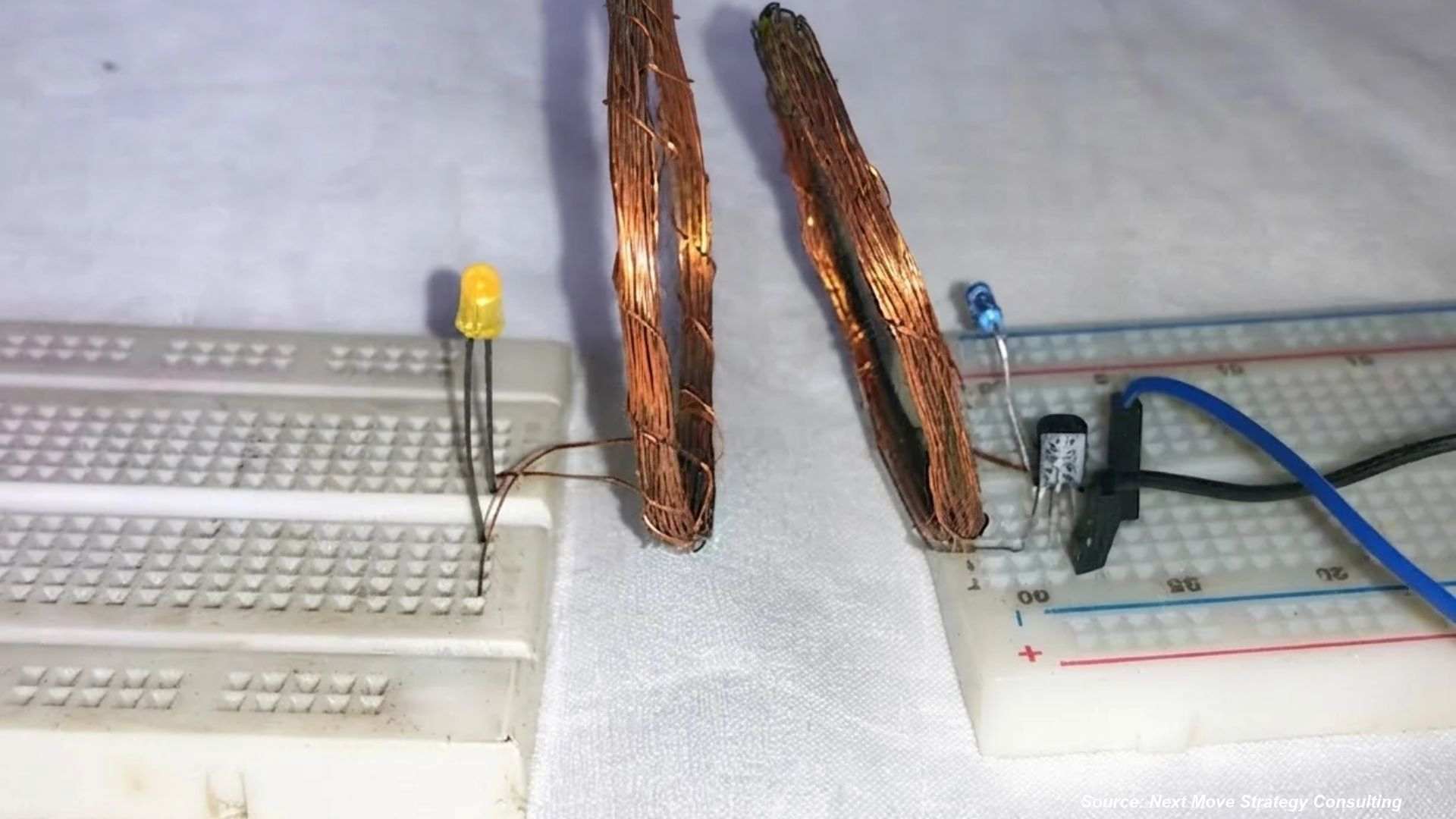
Electreon's Acquisition of InductEV Creates the World's First Full-Spectrum Wireless EV Charging Platform, Accelerating the Market's Transition from Consumer Convenience to Critical Infrastructure
On March 10, 2026, Electreon Wireless Ltd. completed its acquisition of InductEV, combining Electreon's dynamic and semi-dynamic in-road wireless charging technology — deployed across electrified road segments in Europe and the United States — with InductEV's high-power stationary wireless charging systems engineered for transit and heavy-duty Class 8 freight applications. The combined entity now fields the industry's only commercially deployed wireless EV charging portfolio spanning passenger vehicles, last-mile delivery vans, public transit buses, and long-haul trucking, eliminating the product gap that had previously forced fleet operators to source dynamic and stationary wireless charging from separate vendors.
This consolidation event is not an isolated corporate transaction. It is a structural signal that the wireless power transmission market is entering a phase of commercial maturation in which scale, portfolio breadth, and multi-vehicle-class coverage are becoming the decisive competitive variables — displacing the single-technology, single-application positioning that characterised the market's earlier development stage.
According to Next Move Strategy Consulting's Wireless Power Transmission Market report, the global wireless power transmission market was valued at USD 19.75 billion in 2025 and is estimated at USD 25.99 billion in 2026, projected to reach USD 147.88 billion by 2035, growing at a CAGR of 21.31% from 2026 to 2035. NMSC's proprietary research and analysis identifies rising electric vehicle adoption and charging infrastructure investment, accelerating consumer device standardisation around Qi2, and expanding industrial automation and robotics fleet deployment as the three principal demand vectors sustaining this growth trajectory across the forecast period.
For More Information: Download FREE Sample on Wireless Power Transmission Market Report
IEA: Global EV Sales Exceeded 20 Million in 2025, Creating an Unprecedented Addressable Market for Wireless Charging Infrastructure
The single most consequential external demand driver for the wireless power transmission market's EV charging segment is the accelerating pace of global electric vehicle adoption, which the International Energy Agency has now quantified with precision in its Global EV Outlook 2026.
According to the IEA's Global EV Outlook 2026, electric car sales grew by 20% globally to exceed 20 million units in 2025, meaning one-quarter of all new cars sold worldwide were electric. Europe recorded the strongest growth among major markets, with electric car sales rising by more than 30% to reach 28% of total sales, driven by the increased stringency of the European Union's CO₂ standards for passenger vehicles. China's electric vehicles accounted for nearly 55% of all car sales in 2025, while Southeast Asia saw annual EV sales more than double to reach a sales share of nearly 20%. Global electric car sales are expected to grow to 23 million units in 2026, representing 28% of total car sales worldwide.
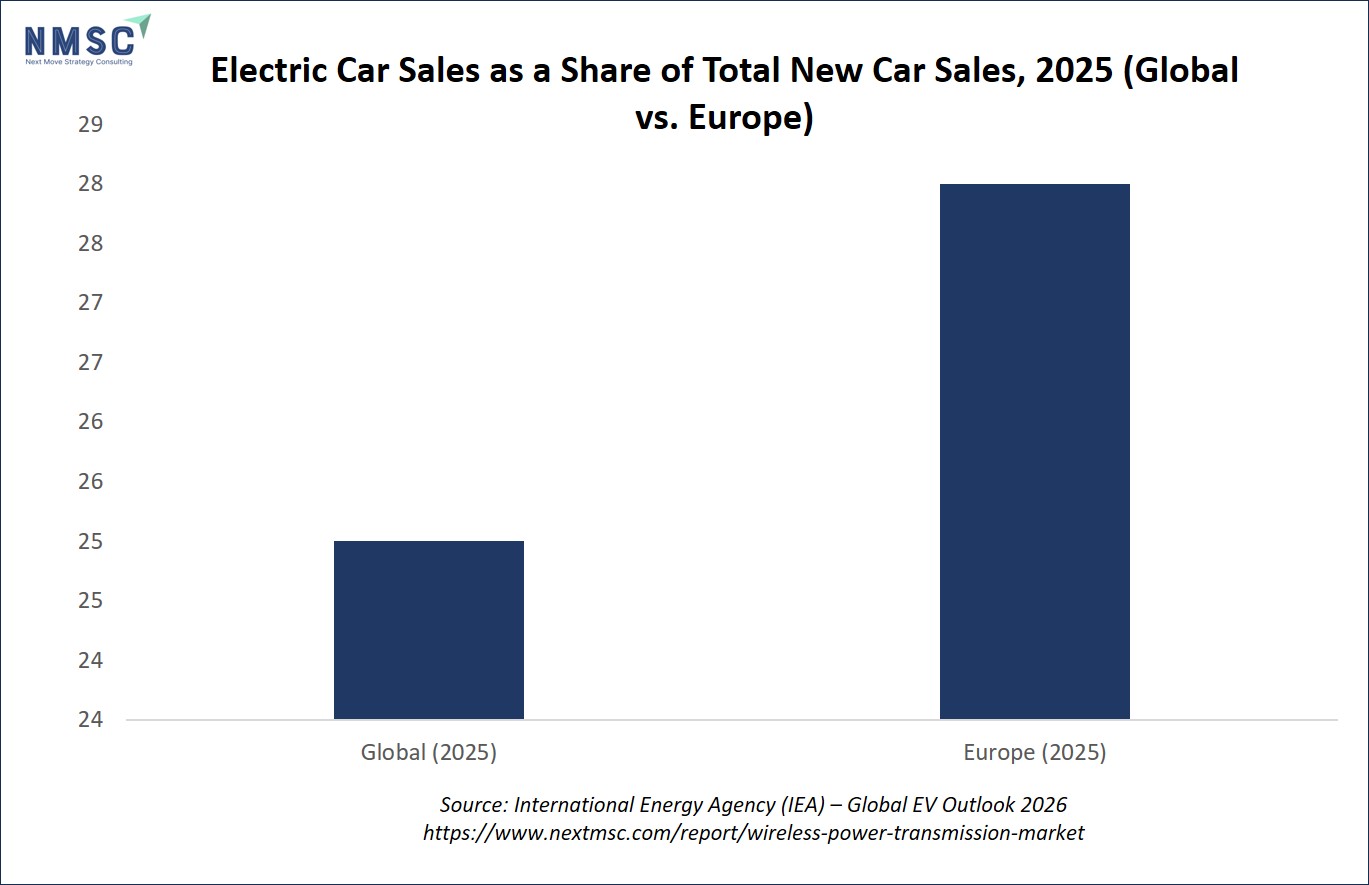
This volume of EV deployment creates a proportionally large and structurally durable addressable market for wireless EV charging systems. Unlike plug-in charging infrastructure, which requires driver engagement at each charging event, wireless charging pads embedded in parking bays, transit stops, and freight depots generate recurring energy transfer revenue without user interaction — a commercial model that becomes more attractive as fleet operators scale from dozens to hundreds of vehicles. NMSC's proprietary research and analysis identifies Electric Vehicle Charging Systems as the fastest-growing product type within the wireless power transmission market, expanding at a 26.57% CAGR from 2026 to 2035, from USD 1.10 billion in 2025 to USD 12.82 billion by 2035.
Qi2 25W: The Wireless Power Consortium's July 2025 Standard Launch Compresses Consumer Charging Fragmentation and Expands the Addressable Device Base
While the EV segment commands the highest growth rate, the consumer charging segment remains the market's largest revenue contributor — and its trajectory was materially altered by a standards event that occurred on July 23, 2025.
On that date, the Wireless Power Consortium (WPC) formally launched Qi v2.2.1, branded as Qi2 25W, delivering nearly 70% more charging power than the original Qi2 standard introduced in November 2023. Fourteen devices — both receivers and transmitters — completed Qi2 25W certification testing in a limited launch, with full-scale certification immediately opened to several hundred devices in the queue. Critically, the Qi2 25W launch marked the first time that major Android smartphone manufacturers joined the Qi2 magnetic alignment ecosystem alongside Apple iPhone, eliminating the cross-platform fragmentation that had previously constrained wireless charging accessory market growth.
"The momentum building behind the next stage in the evolution of the Qi standard is incredible," said Fady Mishriki, Chair of the WPC's Board of Directors, in the WPC's July 23, 2025 press release. "Consumers will be delighted when they experience Qi2 25W as it delivers nearly 70% more power than the original Qi2. The number of devices in the Qi2 25W certification queue for launch is unprecedented, as is the quality and breadth of our members' product designs."
"Qi2 25W's remarkably fast and efficient wireless charging will encourage increased penetration of wireless charging usage and accelerate the adoption of the new standard," added Paul Struhsaker, Executive Director of the WPC, in the same release.
The commercial impact of the Qi2 25W launch was immediately visible at CES 2026. On January 4, 2026, Belkin International, Inc. unveiled a new charging portfolio at CES 2026 that included Qi2 25W wireless chargers — among them the UltraCharge Pro 2-in-1 Convertible Charger and the UltraCharge Modular Charging Dock — alongside high-capacity power banks and a Nintendo Switch 2 charging case, demonstrating the breadth of device categories that the Qi2 25W standard is now enabling beyond smartphones.
NMSC's proprietary research and analysis identifies Consumer Charging Systems as the dominant product segment, valued at USD 8.42 billion in 2025 and projected to reach USD 50.39 billion by 2035 at an 18.60% CAGR — a trajectory that the Qi2 25W standard's cross-platform unification is expected to sustain by compressing the adoption timeline among device manufacturers previously reliant on proprietary charging protocols.
Powercast at CES 2026: Wireless Power Repositioned as Infrastructure, Not Accessory
The most strategically significant framing shift at CES 2026 came not from a consumer electronics brand but from Powercast Corporation, which used its January 6–9, 2026 exhibition at the Venetian Expo to formally reposition wireless power as foundational infrastructure for smart homes, AI-driven monitoring systems, automation, robotics, data centres, and industrial environments — rather than a convenience feature for smartphone charging.
Powercast demonstrated three distinct wireless power platforms at CES 2026: long-range radio frequency (RF) power delivering over-the-air energy up to 200 feet for battery-free IoT sensors; magnetic resonance technology — developed in partnership with Etherdyne Technologies — creating embedded wireless power zones within desks, walls, and work surfaces capable of delivering up to 100 watts total to multiple simultaneous devices; and SmartInductive™ high-power inductive charging, developed in partnership with Powermat, delivering up to 1,000 watts in dock-based applications for drones, robots, mobility platforms, medical devices, and industrial tools. A new 50-watt receiver capable of wirelessly powering a laptop in a desktop environment was debuted for the first time at CES 2026.
"Wireless power is not what's next — it's NOW. And it is quickly becoming foundational infrastructure for smart home, AI, automation, and other industries," said Charles Goetz, CEO of Powercast Corporation, in the company's CES 2026 announcement published December 31, 2025. "We're building a world where wireless power works like Wi-Fi — invisible, ubiquitous, and always available."
Powercast's CES 2026 positioning is directly relevant to the wireless power transmission market's fastest-growing technology segment. NMSC's proprietary research and analysis identifies Laser Power Transfer as the fastest-growing technology at a 31.81% CAGR from 2026 to 2035, expanding from USD 0.70 billion in 2025 to USD 12.68 billion by 2035, as long-range, line-of-sight charging gains commercial traction for IoT sensors and aerospace applications. RF Power Transfer — the technology Powercast demonstrated at CES 2026 — is projected to grow at a 23.66% CAGR, from USD 1.71 billion in 2025 to USD 15.56 billion by 2035.
WiTricity AI Tech Expands Wireless EV Charging Accessibility with MR/1™ 600W System
On February 12, 2026, WiTricity AI Tech, LLC announced the launch of the MR/1™ 600-watt Wireless Charging System for golf carts and light electric vehicles — priced at USD 1,625, representing a 50% reduction from the cost of the company's flagship 900W system. The MR/1 600W maintains the same autonomous, contact-free charging mechanism as the higher-power system — vehicles park over the charging pad and energy transfer begins automatically without user interaction — while targeting cost-sensitive fleet operators and smaller installations that the 900W commercial system had previously priced out.
"The MR/1 600W gives customers a clear choice," said Joe Benz, CEO of WiTricity AI Tech, LLC, in the company's February 12, 2026 announcement. "For high-duty commercial fleets, the 900-watt system remains the fastest option. For courses and communities that want the benefits of wireless charging at a lower entry cost, the 600-watt system delivers an excellent balance of performance, simplicity, and value."
The price reduction strategy employed by WiTricity AI Tech is a textbook market-expansion move: by halving the entry cost of wireless EV charging hardware, the company is deliberately targeting the price-sensitive segment of the fleet operator market that had previously defaulted to conventional plug-in charging. This approach directly addresses the high initial infrastructure and coil installation costs that NMSC's proprietary research and analysis identifies as the primary restraint on wireless power transmission market expansion, estimated to exert a -1.8% impact on CAGR across the forecast period.
Regional Dynamics: Asia-Pacific Commands 66% Market Share While India Emerges as the Fastest-Growing Country
Asia-Pacific's dominance of the wireless power transmission market is structural rather than cyclical, rooted in the region's position as the world's largest consumer electronics manufacturing base and the epicentre of global EV production scale-up. According to NMSC's proprietary research and analysis, Asia-Pacific held approximately 66% of global market revenue — USD 13.06 billion — in 2025 and is projected to reach USD 104.02 billion by 2035, registering the fastest regional CAGR of 22.06%. China alone accounted for approximately USD 5.10 billion in 2025, with its market forecast to reach USD 42.30 billion by 2035 at a 23.6% CAGR, underpinned by the country's position as the world's largest EV manufacturing hub — accounting for nearly 75% of electric cars produced globally in 2025, per the IEA's Global EV Outlook 2026.
India is identified by NMSC's proprietary research and analysis as the fastest-growing country within the wireless power transmission market, projected to expand at a 28.9% CAGR from 2026 to 2035 — from approximately USD 2.15 billion in 2025 to USD 21.40 billion by 2035 — driven by the country's large and rapidly growing smartphone user base and expanding electric vehicle adoption incentives. The IEA's Global EV Outlook 2026 further notes that electric two- and three-wheeler sales in India grew more than 30% in the first quarter of 2026, creating derivative demand for wireless charging infrastructure in the two-wheeler segment that is not yet fully captured in conventional EV charging market analyses.
North America, valued at USD 1.74 billion in 2025 and projected to reach USD 13.12 billion by 2035 at a 21.38% CAGR, benefits from sustained EV charging infrastructure investment and high consumer device penetration. Europe, at USD 2.75 billion in 2025 and projected to reach USD 14.58 billion by 2035 at a 17.13% CAGR, is shaped by dynamic EV charging corridor pilots — exemplified by Electreon's pre-acquisition road deployments across multiple European countries — and industrial automation adoption across member states.
Industrial Robotics: The Underpenetrated Demand Multiplier
Beyond EV charging and consumer electronics, the industrial charging segment represents a structurally underpenetrated demand opportunity that NMSC's proprietary research and analysis projects will grow from USD 2.66 billion in 2025 to USD 23.09 billion by 2035 at a 23.10% CAGR — the third-fastest growth rate among all product type segments.
The mechanism is specific: automated guided vehicles (AGVs) and autonomous mobile robots (AMRs) deployed in warehouse and manufacturing environments require continuous, uninterrupted power delivery to sustain throughput targets. Manual battery swaps introduce downtime that directly reduces facility productivity; conventional plug-in charging requires vehicles to navigate to fixed charging stations, removing them from active duty. Wireless inductive charging pads embedded in floor surfaces at workstations, conveyor intersections, and staging areas allow AGVs and AMRs to receive opportunistic top-up charges during natural operational pauses — a charging architecture that Wiferion GmbH has commercialised for industrial mobile robotics fleets across manufacturing and logistics facilities.
The Above 5 kW power range segment — which encompasses the high-power inductive systems required for industrial robotics and heavy-duty EV charging — is identified by NMSC's proprietary research and analysis as the fastest-growing power range, expanding at a 26.03% CAGR from 2026 to 2035, from USD 2.34 billion in 2025 to USD 25.92 billion by 2035.
NMSC Strategic Perspective: Three Structural Shifts That Will Define the Market Through 2035
From NMSC's analytical standpoint, the confluence of events in the first half of 2026 — Electreon's acquisition of InductEV, the Qi2 25W standard's commercial rollout, Powercast's infrastructure-grade positioning at CES 2026, and WiTricity AI Tech's price-reduction strategy — collectively signal three structural shifts that will define the wireless power transmission market's commercial architecture through the 2035 forecast horizon.
First: The EV charging segment is transitioning from pilot to procurement. Electreon's acquisition of InductEV is not a research-stage investment — it is a consolidation of two commercially deployed technology platforms into a single entity capable of serving the full spectrum of fleet operator requirements. This transition from pilot deployment to active procurement is the event that unlocks the EV Charging Systems segment's 26.57% CAGR, because fleet operators can now source a complete wireless charging solution from a single vendor with a proven installation track record across multiple vehicle classes and geographies.
Second: Consumer charging standardisation is compressing the adoption timeline for the entire market. The Qi2 25W standard's cross-platform unification — bringing Android manufacturers into the Qi2 magnetic alignment ecosystem for the first time — eliminates the proprietary fragmentation that had previously forced consumers to choose between charging ecosystems. When consumers no longer face a compatibility penalty for switching devices, wireless charging pad penetration in residential and commercial settings accelerates, expanding the installed base that generates recurring accessory revenue for the entire consumer charging supply chain.
Third: The IoT and industrial segments are approaching the inflection point where wireless power becomes the default specification, not the premium option. Powercast's CES 2026 demonstration of battery-free sensors powered over 200 feet by RF energy, and WiTricity AI Tech's 50% price reduction on its wireless EV charging hardware, both reflect the same underlying dynamic: the cost of wireless power delivery is declining faster than the cost of the cable and battery infrastructure it replaces. When the total cost of ownership of wireless power falls below that of wired alternatives — a threshold that NMSC's proprietary research and analysis indicates is approaching in the industrial robotics and IoT sensor segments — adoption transitions from discretionary to mandatory in new facility specifications.
NMSC's proprietary research and analysis projects that the wireless power transmission market will create an absolute dollar opportunity of USD 121.89 billion between 2026 and 2035, with the largest concentrations of value in Asia-Pacific consumer electronics manufacturing, North American and European EV charging infrastructure, and global industrial automation charging systems. Companies that achieve certification breadth across Qi2, AirFuel, and SAE J2954 standards — enabling them to serve consumer, automotive, and industrial customers from a single technology platform — are best positioned to capture disproportionate share of this opportunity as competitive intensity increases through 2035.
Key Competitive Developments
The wireless power transmission competitive landscape is characterised by a bifurcated structure: vertically integrated consumer electronics manufacturers embedding proprietary charging accessories, and specialty technology licensors supplying charging modules to automakers and industrial equipment makers. Recent developments across both archetypes reflect the market's accelerating commercial maturation.
Electreon Wireless Ltd. completed its acquisition of InductEV on March 10, 2026, creating the industry's first full-spectrum wireless EV charging platform covering dynamic in-road charging, semi-dynamic charging at transit stops, and high-power stationary charging for transit and Class 8 freight vehicles.
Belkin International, Inc. unveiled its Qi2 25W charging portfolio at CES 2026 on January 4, 2026, including the UltraCharge Pro 2-in-1 Convertible Charger and UltraCharge Modular Charging Dock — products that simultaneously charge smartphones, earbuds, and smartwatches at Qi2 25W speeds, demonstrating the multi-device charging architecture that the Qi2 standard enables.
WiTricity AI Tech, LLC launched the MR/1™ 600W Wireless Charging System on February 12, 2026, at USD 1,625 — 50% below the cost of its 900W flagship — expanding the addressable market for autonomous wireless EV charging to cost-sensitive fleet operators and smaller installations.
Powercast Corporation demonstrated its full wireless power portfolio at CES 2026 (January 6–9, 2026), including a new 50W magnetic resonance receiver capable of wirelessly powering a laptop, and SmartInductive™ technology delivering up to 1,000 watts for industrial robotics and drone applications — the highest power output demonstrated by any RF/resonance wireless power vendor at the event. Powercast has deployed over 30 million wireless power-enabled products worldwide and holds over 300 wireless power patents.
Bottom Line
The global wireless power transmission market is undergoing a structural transition from a consumer convenience technology to a multi-sector critical infrastructure category, driven by three independently powerful and mutually reinforcing forces. Electreon's March 2026 acquisition of InductEV — creating the world's first full-spectrum wireless EV charging platform spanning passenger vehicles, transit buses, and Class 8 freight trucks — signals that the EV charging segment has crossed from pilot deployment into active fleet procurement, directly unlocking the segment's 26.57% CAGR. The Wireless Power Consortium's July 2025 launch of Qi2 25W, which brought Android manufacturers into the Qi2 magnetic alignment ecosystem for the first time, eliminates the cross-platform fragmentation that had constrained consumer charging pad penetration, sustaining the Consumer Charging Systems segment's trajectory toward USD 50.39 billion by 2035. Simultaneously, Powercast's CES 2026 demonstration of 200-foot RF wireless power for battery-free IoT sensors and 1,000-watt SmartInductive™ systems for industrial robotics confirms that wireless power delivery costs are declining to the point where the technology is becoming the default specification in new industrial and smart-building installations. According to NMSC's proprietary research and analysis, the global wireless power transmission market is projected to grow from USD 25.99 billion in 2026 to USD 147.88 billion by 2035 at a CAGR of 21.31%, creating an absolute dollar opportunity of USD 121.89 billion over the forecast period, with Asia-Pacific — led by China and India — delivering the fastest regional growth at a 22.06% CAGR.
About Next Move Strategy Consulting
Next Move Strategy Consulting is a premier market research and management consulting firm that has been committed to provide strategically analysed well documented latest research reports to its clients. The research industry is flooded with many firms to choose from, what makes NMSC different from the rest is its top-quality research and the obsession of turning data into knowledge by dissecting every bit of it and providing fact-based research recommendation that is supported by information collected from over 500 million websites, paid databases, industry journals and one on one consultations with industry experts across a diverse range of industry sectors. The high-quality customized research reports with actionable insights and excellent end-to-end customer service help our clients to take critical business decisions that enables them to move beyond time and have competitive edge in the industry.
We have been servicing over 1000 customers globally that includes 90% of the Fortune 500 companies over a decade. Our analysts are constantly tracking various high growth markets and identifying hidden opportunities in each sector or the industry. We provide one of the industry's best quality syndicate as well as custom research reports across 10 different industry verticals. We are committed to deliver high quality research solutions in accordance to your business needs. Our industry standard delivery solutions that ranges from the pre consultation to after-sales services, provide an excellent client experience and ensure right strategic decision making for businesses.
For more information, please contact:
Next Move Strategy Consulting
5th Floor 867 Boylston St, STE 500,
Boston, MA 02116, U.S.
E-Mail: [email protected]
Direct: +1-217-650-7991
Website: www.nextmsc.com
About the Author
 Sanyukta Deb
— Sanyukta Deb is Digital Marketing Team Lead at Next Move Strategy Consulting, where she has led content strategy and technical SEO for the firm's B2B market research publications for over 2 years. Her editorial process translates NextMSC's primary and secondary research — spanning technology, industrial, and consumer sectors — into commercial narratives, backed by search-intent, keyword, and competitive analysis. She brings 5 years of overall experience in digital marketing and content strategy.
Sanyukta Deb
— Sanyukta Deb is Digital Marketing Team Lead at Next Move Strategy Consulting, where she has led content strategy and technical SEO for the firm's B2B market research publications for over 2 years. Her editorial process translates NextMSC's primary and secondary research — spanning technology, industrial, and consumer sectors — into commercial narratives, backed by search-intent, keyword, and competitive analysis. She brings 5 years of overall experience in digital marketing and content strategy.
About the Reviewer
 Debashree Dey
— Debashree Dey is Assistant Manager at Next Move Strategy Consulting, where she supports cross-vertical market content and communications across diverse industries for 6 years. Her professional background includes senior content writing, communications, and published manuscript authorship, with experience developing audience-focused business narratives and maintaining clear, consistent messaging. Her role supports research-led content development and editorial quality across NextMSC publications.
Debashree Dey
— Debashree Dey is Assistant Manager at Next Move Strategy Consulting, where she supports cross-vertical market content and communications across diverse industries for 6 years. Her professional background includes senior content writing, communications, and published manuscript authorship, with experience developing audience-focused business narratives and maintaining clear, consistent messaging. Her role supports research-led content development and editorial quality across NextMSC publications.

















Add Comment