EU AI Act Full Applicability Reshapes Self-Supervised Learning Market

EU AI Act Enforcement and Meta's DINOv3 Milestone Accelerate Strategic Repositioning Across the Global Self-Supervised Learning Industry
The European Union's Artificial Intelligence Act achieved full legal applicability on August 2, 2026 — the most consequential regulatory milestone in the history of AI governance — triggering immediate compliance obligations for developers and deployers of General Purpose AI (GPAI) models, the category that encompasses the majority of self-supervised learning foundation systems. The regulation, which entered into force on August 1, 2024, imposes transparency, technical documentation, and risk-management requirements on GPAI model providers operating within or serving the EU market, directly reshaping the commercial and technical strategies of leading technology firms deploying self-supervised architectures at scale.
The regulatory inflection point arrives as the global Self-Supervised Learning Market undergoes a period of accelerated structural transformation, driven by surging enterprise adoption, record-breaking venture capital inflows into AI infrastructure, and landmark model releases — most notably Meta AI's DINOv3 — that have redefined the performance ceiling of label-free machine learning.
For More Information: Download FREE Sample on Self-Supervised Learning Market Report
Market Overview
According to analysis by Next Move Strategy Consulting (NMSC), the Self-Supervised Learning Market is projected to surge to USD 95.14 billion by 2030, reflecting the technology's expanding role across enterprise AI, healthcare diagnostics, autonomous systems, and natural language processing applications. The market's trajectory is underpinned by a fundamental shift in AI development philosophy: the recognition that manually labeled datasets represent a structural bottleneck to scaling intelligent systems. Self-supervised learning resolves this constraint by enabling models to derive supervisory signals from the inherent structure of unlabeled data — a capability that has proven transformative across computer vision, speech recognition, and multimodal AI.
Regulatory Catalyst: EU AI Act Full Applicability
The August 2, 2026 applicability date of the EU AI Act represents a watershed moment for the self-supervised learning ecosystem. Under the Act's provisions, GPAI models — defined as AI models trained on broad data using self-supervision at scale and capable of serving multiple downstream tasks — are subject to mandatory technical documentation, copyright compliance obligations, and, for models classified as presenting systemic risk, adversarial testing and incident reporting requirements.
Compliance obligations for GPAI model providers had already applied from August 2, 2025 — one year ahead of the Act's full applicability — providing leading technology firms a structured transition period. Industry analysts and legal experts have noted that the EU AI Act's GPAI provisions are likely to accelerate consolidation among self-supervised learning model providers, as compliance infrastructure requirements favor well-capitalized incumbents over early-stage developers. The regulation is also expected to stimulate demand for compliance-oriented AI governance tooling, model documentation platforms, and third-party audit services — creating adjacent market opportunities within the broader SSL ecosystem.
Investment Landscape: Record Capital Flows Into AI Infrastructure
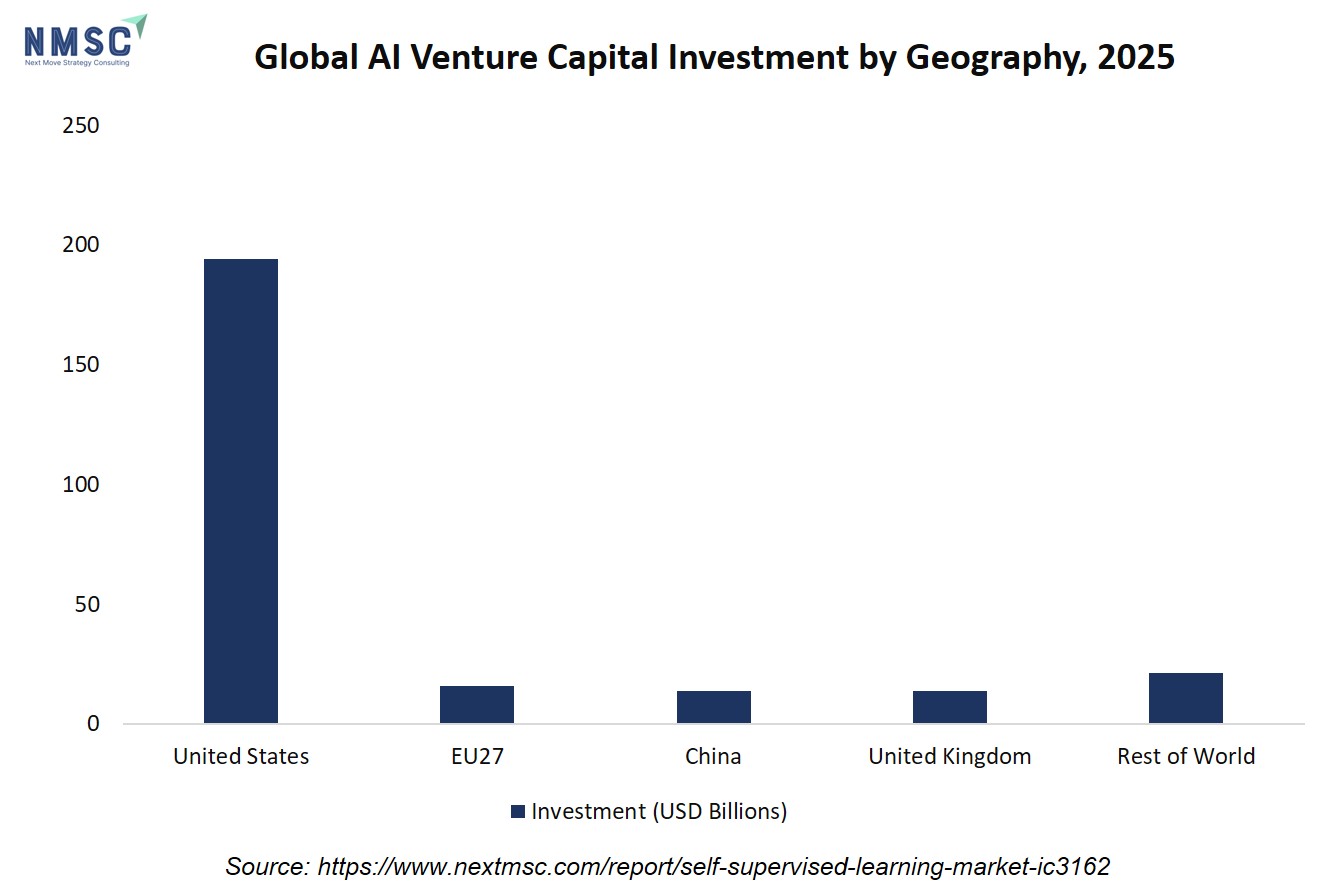
The investment environment underpinning the self-supervised learning market has reached unprecedented scale. According to the OECD's February 2026 policy brief on venture capital investments in artificial intelligence, global AI VC investment totaled USD 258.7 billion in 2025, representing 61% of all venture capital deployed globally — double its 2022 share of 30%.
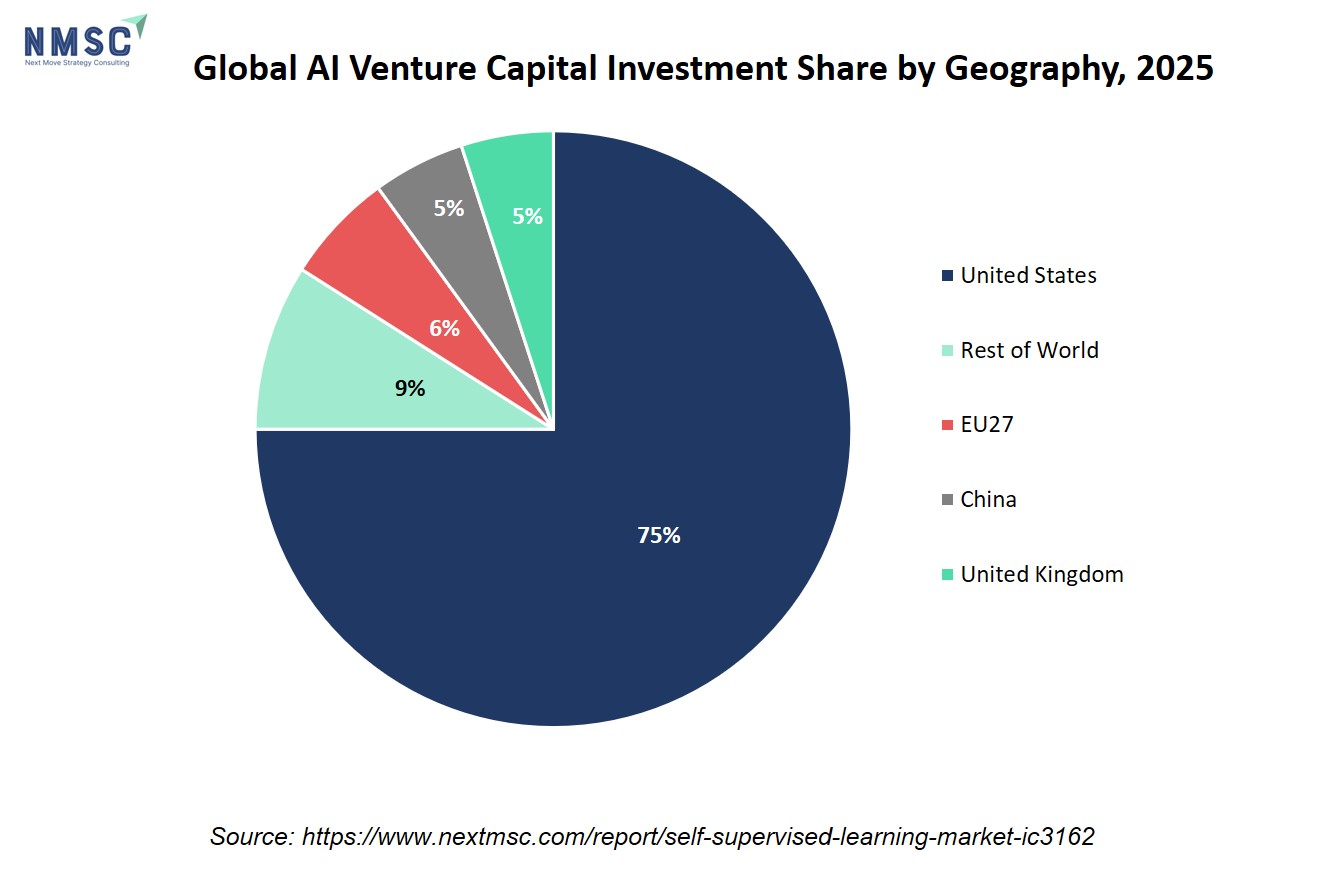
The United States attracted approximately 75% of global AI VC deal value, equivalent to USD 194 billion, followed by the EU27 at 6% (USD 15.8 billion), China at 5% (USD 13.9 billion), and the United Kingdom at 5% (USD 13.8 billion).
The Stanford HAI 2026 AI Index Report further contextualizes the scale of U.S. dominance: U.S. private AI investment reached USD 285.9 billion in 2025, more than 23 times the USD 12.4 billion invested in China. This concentration of capital in the United States has significant implications for the self-supervised learning market, as the majority of foundational SSL research and commercial deployment originates from U.S.-headquartered technology firms.
A notable structural shift identified by the OECD is the surge in AI VC investment directed toward IT infrastructure and hosting — the category that encompasses both compute infrastructure providers and foundation model developers. This sector attracted USD 109.3 billion in 2025, representing over 42% of all AI VC investment and nearly as much as all other industries combined. The trend reflects the capital-intensive nature of training large-scale self-supervised models, which require substantial compute resources and data infrastructure.
Technological Developments: Meta's DINOv3 and the Scaling Frontier
Among the most significant recent technological developments in the self-supervised learning domain is Meta AI's release of DINOv3, a state-of-the-art computer vision model trained exclusively through self-supervised learning on approximately 1.7 billion unlabeled images. DINOv3 builds upon the scaling progress of its predecessor DINOv2, achieving what Meta AI describes as absolute state-of-the-art performance across a range of computer vision benchmarks — including image classification, depth estimation, and semantic segmentation — without reliance on any manually labeled training data.
The DINOv3 release is emblematic of a broader industry trend: the progressive displacement of supervised learning paradigms by self-supervised approaches in high-stakes computer vision applications. By demonstrating that models trained entirely on unlabeled data can outperform supervised counterparts on standard benchmarks, Meta AI has reinforced the commercial and scientific case for continued investment in SSL infrastructure.
The development also carries direct implications for the EU AI Act compliance landscape. DINOv3, trained at scale on web-sourced imagery, exemplifies the class of GPAI models subject to the Act's copyright compliance and transparency documentation requirements — a regulatory reality that Meta and other leading SSL developers must now navigate as the Act achieves full applicability.
Segmentation Analysis: NLP and Computer Vision Lead Adoption
The self-supervised learning market exhibits distinct segmentation dynamics across technology verticals and end-use industries. Natural language processing (NLP) has historically represented the dominant technology segment, driven by the widespread commercial deployment of transformer-based language models — architectures that are fundamentally dependent on self-supervised pre-training methodologies. The success of large language models across enterprise applications including customer service automation, legal document analysis, and code generation has established NLP as the primary commercial driver of SSL market revenues.
Computer vision represents the fastest-growing technology segment, propelled by advances in masked image modeling and contrastive learning frameworks. Applications spanning autonomous vehicle perception, medical imaging diagnostics, industrial quality inspection, and retail analytics are increasingly adopting SSL-trained vision models as a cost-effective alternative to supervised approaches that require extensive manual annotation.
From an end-use industry perspective, healthcare and life sciences have emerged as a high-priority vertical for SSL adoption, driven by the availability of large volumes of unlabeled medical imaging data and the prohibitive cost of expert annotation. Financial services, retail, and information technology sectors are also registering accelerating adoption rates.
Global Private AI Investment by Country, 2025
|
Country / Region |
Private AI Investment (USD Billions) |
Relative Scale |
|
United States |
285.9 |
Benchmark |
|
EU27 (VC only) |
15.8 |
~5.5% of U.S. |
|
China |
12.4 |
~4.3% of U.S. |
|
United Kingdom |
13.8 |
~4.8% of U.S. |
Notes: EU27 and UK figures represent venture capital investment only, as reported by the OECD using Preqin data. U.S. and China figures represent total private AI investment as reported by Stanford HAI. Figures are not directly comparable across methodologies. Data is nominal and not adjusted for inflation.
Regional Analysis
North America maintains its position as the dominant regional market for self-supervised learning, supported by the concentration of leading technology firms, research institutions, and venture capital infrastructure. The region's advantage is reinforced by the presence of hyperscale cloud providers — including Amazon Web Services, Microsoft Azure, and Google Cloud — whose compute infrastructure underpins the training and deployment of large-scale SSL models.
Europe is experiencing a period of regulatory-driven market restructuring. The EU AI Act's full applicability creates both compliance costs and market opportunities: while GPAI model providers face new documentation and transparency obligations, the regulatory framework is expected to stimulate demand for compliant AI infrastructure, governance tooling, and third-party audit services. European technology firms and research institutions are also increasing investment in open-source SSL frameworks as a strategy for maintaining technological sovereignty.
Asia-Pacific represents the fastest-growing regional market, driven by accelerating AI adoption in China, Japan, South Korea, and India. China's domestic AI ecosystem, while receiving significantly less international VC than the United States, is characterized by substantial state-directed investment in AI research and infrastructure. The OECD notes that China accounted for approximately 5% of global AI VC deal value in 2025, though domestic government and corporate investment channels represent a substantially larger share of total AI capital formation.
Global AI Venture Capital Investment by Industry Sector, 2025
|
Industry Sector |
AI VC Investment (USD Billions) |
Share of Total AI VC (%) |
Key Observation |
|
IT Infrastructure & Hosting |
109.3 |
~42.2% |
Surged; includes model developers and compute providers |
|
Generative AI Firms (subset) |
35.3 |
~13.6% |
Continued strong growth; subset of IT Infrastructure |
|
Healthcare, Drugs & Biotechnology |
20.0 |
~7.7% |
Recovery to pre-pandemic investment levels |
|
All Other Industries Combined |
149.4 |
~57.8% |
Diversified across financial services, retail, mobility, and others |
|
Total Global AI VC |
258.7 |
100% |
Represents 61% of all global VC investment in 2025 |
Notes: Generative AI is a subset of IT Infrastructure & Hosting and is not additive to the sector total. "All Other Industries Combined" is calculated as total AI VC (USD 258.7B) minus IT Infrastructure & Hosting (USD 109.3B). Percentages may not sum to 100% due to rounding and categorical overlap.
Key Market Participants
The self-supervised learning market is characterized by a concentrated competitive landscape at the foundation model layer, with a broader ecosystem of application developers and infrastructure providers. Leading participants include Alphabet (Google DeepMind), Meta AI, Microsoft (in partnership with OpenAI), Amazon Web Services, NVIDIA, IBM, and Hugging Face. These organizations have made foundational contributions to SSL methodology — including BERT, GPT, CLIP, DINO, and SimCLR — and continue to drive the frontier of model capability and efficiency.
The competitive dynamics of the market are increasingly shaped by the compute requirements of large-scale SSL pre-training, which create significant barriers to entry and favor organizations with access to substantial GPU infrastructure. The OECD's finding that mega deals exceeding USD 100 million comprised approximately 73% of total AI VC investment value in 2025 reflects this capital concentration dynamic, with the top five mega deals alone accounting for nearly USD 63 billion in funding.
Bottom Line
The global self-supervised learning market stands at a critical strategic inflection point, shaped by the convergence of three powerful forces: the EU AI Act's full regulatory applicability as of August 2, 2026, record-breaking capital deployment into AI infrastructure, and continued technological advancement exemplified by Meta AI's DINOv3. The market's projected expansion from USD 16.39 billion in 2024 to USD 95.14 billion by 2030 reflects durable structural demand driven by the fundamental limitations of supervised learning at scale. For investors, the OECD's documentation of USD 258.7 billion in global AI VC investment in 2025 — with over 42% directed toward IT infrastructure and hosting — signals sustained institutional confidence in the AI compute and model development ecosystem that underpins SSL. Regulatory compliance obligations under the EU AI Act will create near-term cost pressures for GPAI model providers while simultaneously generating adjacent market opportunities in governance, documentation, and audit services. Strategic risks include compute concentration among a small number of hyperscale providers, geopolitical constraints on semiconductor supply chains, and the potential for regulatory fragmentation across major jurisdictions. Organizations that invest proactively in compliance infrastructure, open-source model development, and domain-specific SSL applications are best positioned to capture durable value in this rapidly evolving market.
About Next Move Strategy Consulting
Next Move Strategy Consulting is a premier market research and management consulting firm that has been committed to provide strategically analysed well documented latest research reports to its clients. The research industry is flooded with many firms to choose from, what makes NMSC different from the rest is its top-quality research and the obsession of turning data into knowledge by dissecting every bit of it and providing fact-based research recommendation that is supported by information collected from over 500 million websites, paid databases, industry journals and one on one consultations with industry experts across a diverse range of industry sectors. The high-quality customized research reports with actionable insights and excellent end-to-end customer service help our clients to take critical business decisions that enables them to move beyond time and have competitive edge in the industry.
We have been servicing over 1000 customers globally that includes 90% of the Fortune 500 companies over a decade. Our analysts are constantly tracking various high growth markets and identifying hidden opportunities in each sector or the industry. We provide one of the industry's best quality syndicate as well as custom research reports across 10 different industry verticals. We are committed to deliver high quality research solutions in accordance to your business needs. Our industry standard delivery solutions that ranges from the pre consultation to after-sales services, provide an excellent client experience and ensure right strategic decision making for businesses.
For more information, please contact:
Next Move Strategy Consulting
5th Floor 867 Boylston St, STE 500,
Boston, MA 02116, U.S.
E-Mail: [email protected]
Direct: +1-217-650-7991
Website: www.nextmsc.com
About the Author
 Sanyukta Deb
— Sanyukta Deb is Digital Marketing Team Lead at Next Move Strategy Consulting, where she has led content strategy and technical SEO for the firm's B2B market research publications for over 2 years. Her editorial process translates NextMSC's primary and secondary research — spanning technology, industrial, and consumer sectors — into commercial narratives, backed by search-intent, keyword, and competitive analysis. She brings 5 years of overall experience in digital marketing and content strategy.
Sanyukta Deb
— Sanyukta Deb is Digital Marketing Team Lead at Next Move Strategy Consulting, where she has led content strategy and technical SEO for the firm's B2B market research publications for over 2 years. Her editorial process translates NextMSC's primary and secondary research — spanning technology, industrial, and consumer sectors — into commercial narratives, backed by search-intent, keyword, and competitive analysis. She brings 5 years of overall experience in digital marketing and content strategy.
About the Reviewer
 Supradip Baul
— Supradip Baul is an accomplished business consultant and strategist with over a decade of rich experience in market intelligence, strategy, technology, and business transformation. His work has included rigorous qualitative and quantitative analysis across multiple industries, helping clients shape investment decisions and long-term roadmaps. Earlier in his career, he was associated with Gartner, where he contributed to industry-leading reports and market share analyses. He has worked with leading global companies and holds an MBA with a dual specialization in Marketing and Finance.
Supradip Baul
— Supradip Baul is an accomplished business consultant and strategist with over a decade of rich experience in market intelligence, strategy, technology, and business transformation. His work has included rigorous qualitative and quantitative analysis across multiple industries, helping clients shape investment decisions and long-term roadmaps. Earlier in his career, he was associated with Gartner, where he contributed to industry-leading reports and market share analyses. He has worked with leading global companies and holds an MBA with a dual specialization in Marketing and Finance.
















Add Comment