EU Battery Localization Rules Reshape Global Housing Market

European Commission's Industrial Accelerator Act Triggers Structural Realignment Across the Global Battery Module Housing Supply Chain
On March 4, 2026, the European Commission formally proposed the Industrial Accelerator Act (IAA), a sweeping legislative instrument that introduces mandatory local content requirements for electric vehicle batteries and structural components sold within the European Union. Under the IAA's framework, final vehicle assembly must occur within the EU, and at least 70% of a vehicle's non-battery components by value must originate from within the bloc. From approximately 2030, the battery requirements will extend to at least five main components, including battery cells, cathode active material, and battery management systems.
The IAA's structural battery localization mandate carries direct and material consequences for the global Battery Module Housing Market. Battery module housings — the structural enclosures that protect, mount, and thermally manage electric vehicle and stationary battery packs — are integral to the battery assembly value chain. As European OEMs and Tier 1 battery system integrators reconfigure their supply chains to comply with IAA local content thresholds, housing manufacturers with established European fabrication capacity stand to capture a disproportionate share of the region's growing procurement pipeline.
For More Information: Download FREE Sample on Battery Module Housing Market Report
The IAA's introduction arrives at a moment of accelerating global EV production. According to the International Energy Agency's Global EV Outlook 2026, nearly 22 million electric cars were produced globally in 2025, representing an increase of more than 25% compared to the previous year. China remained the world's dominant production hub, accounting for approximately 75% of global electric car output, with domestic production of approximately 16 million units in 2025. The European Union recorded a 30% increase in electric car production from 2024, reaching nearly 3.2 million units in 2025.
Battery Demand Surge Anchors Housing Market Expansion
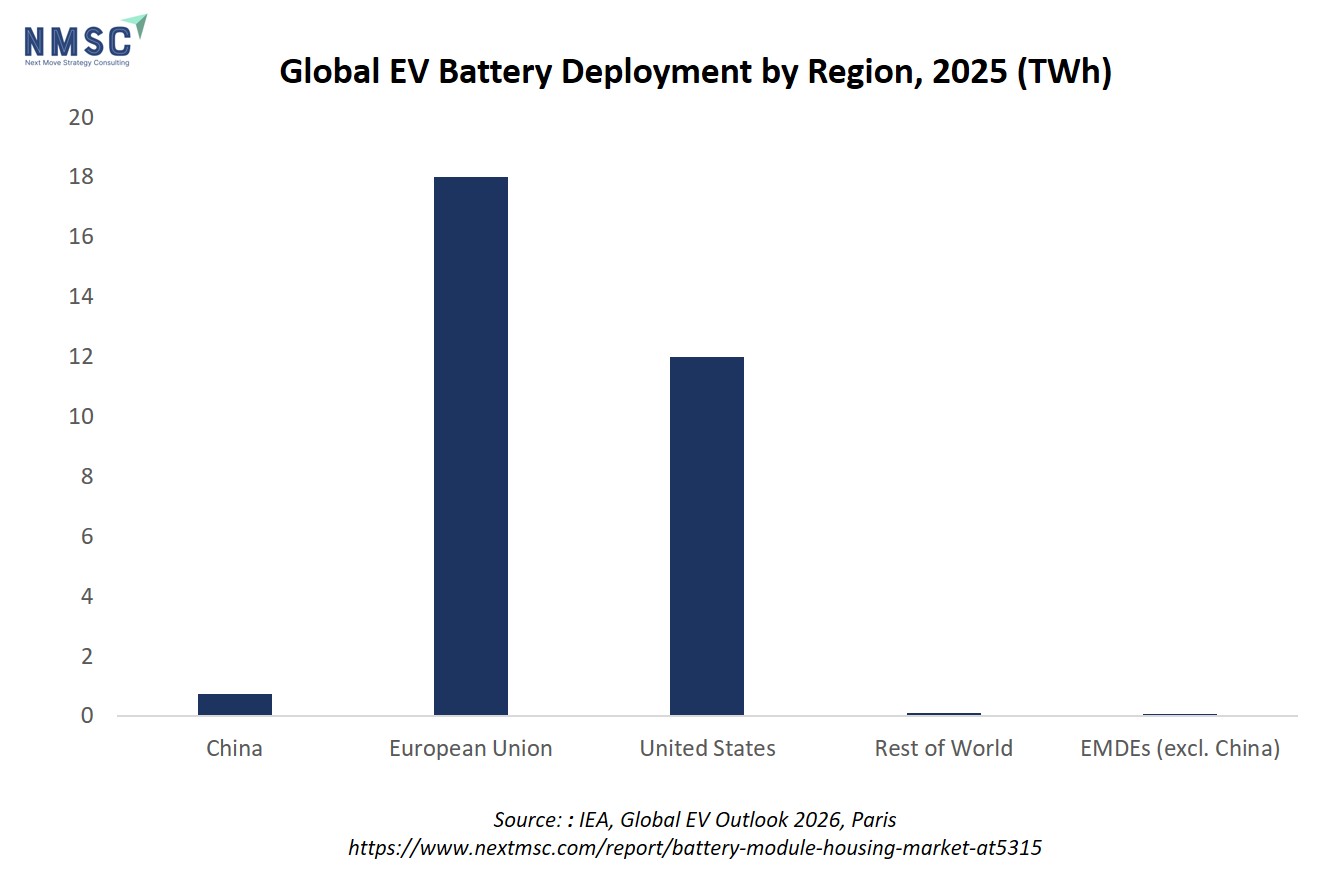
Global EV battery deployment reached 1.2 TWh in 2025, an increase of almost 30% compared to 2024, and more than seven times greater than in 2020. Light-duty vehicles represented more than 85% of 2025 EV battery deployment, while electric trucks — whose battery demand more than doubled — accounted for approximately 8% of global EV battery deployment, up from less than 5% in 2024.
This sustained demand trajectory directly underpins housing market expansion. According to analysis by Next Move Strategy Consulting, the Battery Module Housing Market was valued at USD 5.21 billion in 2025 and is estimated at USD 6.02 billion in 2026, with a forecast to reach USD 22.2 billion by 2035, expanding at a 15.6% CAGR between 2026 and 2035. Asia-Pacific leads with approximately a 47% revenue share, while Passenger Electric Vehicle applications dominate all end-use segments with approximately a 52% share.
The IEA projects that global EV battery deployment will reach approximately 3 TWh by 2030 and approximately 4 TWh by 2035 under its Stated Policies Scenario, representing a more than threefold increase from 2025 levels. This trajectory provides a durable demand foundation for housing manufacturers across all major geographies.
EU Industrial Accelerator Act: Structural Implications for Housing Suppliers
The IAA's local content architecture introduces a tiered compliance timeline that will progressively tighten sourcing requirements for battery components sold in the European market. From approximately mid-2027, EV local content rules take effect, with stricter criteria applying from approximately 2030. The act also proposes enhanced scrutiny of foreign direct investments exceeding EUR 100 million in strategic sectors — including EVs and batteries — from countries holding more than 40% of associated global manufacturing capacity.
For battery module housing manufacturers, the IAA's structural battery localization mandate creates a multi-year procurement pipeline anchored to European assembly operations. Suppliers with established aluminum extrusion, composite molding, and crash-validated structural fabrication capacity within the EU are positioned to benefit from OEM sourcing shifts driven by compliance requirements. The European Commission's countervailing duties on Chinese-made battery electric vehicles, maintained through at least 2029, further reinforce the incentive for European OEMs to deepen domestic supply chain integration.
Europe's battery module housing market was valued at USD 1.25 billion in 2025, according to NMSC analysis, and is projected to reach USD 4.44 billion by 2035 at a 13.33% CAGR, driven by CO2 emission performance standards and the EU Battery Regulation's recyclability and recycled-content mandates. Germany, the region's largest market, was valued at approximately USD 0.40 billion in 2025 and is projected to reach USD 1.42 billion by 2035.
Global Electric Car Production by Major Region, 2025
|
Region |
Electric Car Production (Million Units) |
Share of Global Total (%) |
Year-on-Year Change |
|
China |
~16.0 |
~73% |
+25%+ |
|
European Union |
~3.2 |
~15% |
+30% |
|
North America |
~2.2 |
~10% |
+10% |
|
Other Regions |
~0.6 |
~2% |
Positive |
|
Global Total |
~22.0 |
100% |
+25%+ |
Manufacturing Concentration and Supply Chain Diversification Pressures
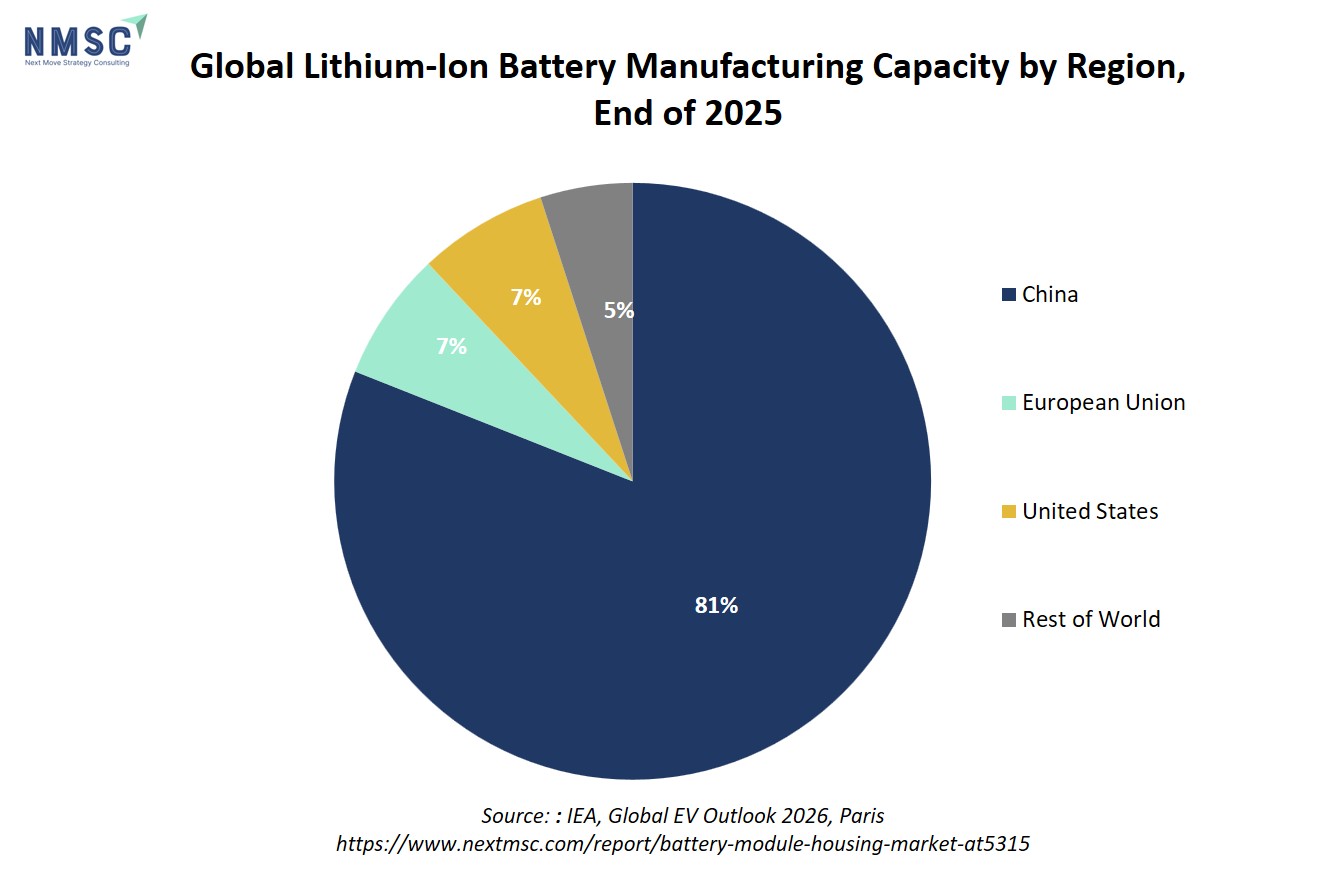
The geographic concentration of battery manufacturing capacity presents both a structural risk and a strategic opportunity for housing suppliers. China accounted for over 80% of global lithium-ion battery manufacturing capacity at end-2025, while the European Union and the United States each accounted for approximately 6–7%. Year-on-year capacity growth was faster in the European Union and the United States — at approximately 50% — than in China, at just over 25%, reflecting accelerating investment in non-Chinese battery manufacturing infrastructure.
This diversification dynamic is reshaping housing supplier qualification criteria. As battery cell manufacturing capacity expands in Europe and North America, OEMs and Tier 1 battery system integrators are increasingly co-developing housing architecture with cell suppliers at the design stage — a shift that favors manufacturers combining materials engineering with crash-safety validation capability over component-only suppliers, according to NMSC analysis.
Average battery prices declined by 8% in 2025, supported by continued improvements in manufacturing efficiency, advances in battery chemistries, and intensifying global market competition. However, regional price disparities have widened: in 2025, battery pack prices in China were 30% lower than in North America and 35% lower than in Europe, compared to respective gaps of 20% and 25% in 2022. This cost differential reinforces the competitive pressure on European and North American housing manufacturers to achieve manufacturing efficiency gains through automation and scale.
Global EV Battery Deployment Outlook, 2020–2035 (TWh)
|
Year |
EV Battery Deployment (TWh) |
Notes |
|
2020 |
~0.17 |
Baseline reference year |
|
2024 |
~0.93 |
Pre-2025 level |
|
2025 |
1.20 |
Actual; +30% year-on-year |
|
2030 (STEPS) |
~3.00 |
IEA Stated Policies Scenario projection |
|
2035 (STEPS) |
~4.00 |
IEA Stated Policies Scenario projection |
|
2035 (NZE) |
~9.00 |
IEA Net Zero Emissions Scenario projection |
Architecture Transition: Cell-to-Chassis and Composite Materials Redefine Supplier Positioning
The structural evolution of battery pack architecture is reshaping the competitive landscape within the housing supply chain. Prismatic cells — the dominant form factor globally, accounting for over 60% of EV and most stationary storage batteries — have enabled cell-to-pack and cell-to-chassis designs that eliminate intermediate battery modules and increase overall energy density. These architectural innovations are particularly significant for housing manufacturers, as cell-to-chassis designs integrate the housing directly into the vehicle's structural floor, compressing the housing's role into a combined structural and thermal-management component.
According to NMSC analysis, Cell-to-Chassis configurations represent the fastest-growing battery configuration segment, expanding at a 21.85% CAGR from 2026 to 2035. Integrated Housing — the product architecture aligned with cell-to-chassis adoption — is the fastest-growing architecture segment at a 19.80% CAGR over the same period. Composite materials, including carbon fiber and glass fiber reinforced plastic, are the fastest-growing material category at an 18.69% CAGR, as automakers pursue weight reduction to extend vehicle range.
In March 2026, Magna International highlighted its OPTiForm battery enclosure — a one-piece deep-drawn design developed to address manufacturing inefficiencies in EV battery enclosures — reflecting the industry's focus on more efficient and cost-effective battery housing production. The solution aims to simplify production, improve sealing, increase available battery space, and reduce weight while enabling scalable manufacturing.
Lithium iron phosphate batteries accounted for over 55% of EV batteries deployed globally in 2025, up from nearly 50% in 2024, with deployment heavily concentrated in China but expanding rapidly in other emerging markets. LFP's near-exclusive reliance on prismatic cells reinforces demand for the tray and box housing formats that dominate current production volumes, while the shift toward higher-energy-density NMC chemistries in premium passenger EV platforms sustains demand for thermally optimized, lightweight composite housing architectures.
Asia-Pacific Dominance and India's Emerging Trajectory
Asia-Pacific's structural advantages — the world's largest electric vehicle manufacturing base, vertically integrated battery cell supply chains, and accelerating cell-to-pack and cell-to-chassis adoption — underpin its position as the dominant and fastest-growing regional market. According to NMSC analysis, Asia-Pacific is projected to register a 17.64% CAGR from 2026 to 2035, reaching USD 12.21 billion by 2035 from USD 2.45 billion in 2025.
China's market, valued at approximately USD 1.42 billion in 2025, is projected to reach USD 7.55 billion by 2035 at an 18.1% CAGR, anchored by the world's largest EV production base and the fastest technology penetration of cell-to-chassis architectures among leading domestic battery and vehicle manufacturers. India represents the fastest-growing country-level market, projected to expand at a 19.2% CAGR from USD 0.23 billion in 2025 to USD 1.34 billion by 2035, driven by rapidly expanding two- and three-wheeler and passenger EV adoption and national electric mobility incentive programs.
Chinese electric car exports doubled in 2025 against the backdrop of an intense domestic EV price war, with more than 2.5 million units exported — representing more than 35% of all Chinese car exports. This export surge, combined with Chinese OEMs establishing overseas manufacturing facilities across Southeast Asia, is extending the geographic reach of Chinese battery and housing supply chains into new markets.
Regulatory Convergence and Safety Standards Elevate Structural Requirements
Beyond the EU Industrial Accelerator Act, the broader regulatory environment is tightening structural and safety requirements for battery enclosures globally. The EU Battery Regulation is encouraging suppliers to prioritize recycled aluminum content and end-of-life recyclability, while UN ECE R100 crash and thermal propagation standards shape housing material selection and structural validation requirements across major automotive markets.
In the United States, China's export controls on key battery components — announced in October 2025 and subsequently paused for one year — underscore the vulnerabilities associated with concentrated supply chains and are accelerating domestic investment in battery manufacturing infrastructure. The committed battery project pipeline in the United States is sufficient to meet projected domestic demand through 2030, though cathode and anode active material supply remains constrained by available manufacturing capacity.
Stationary energy storage is emerging as a structurally distinct demand pool for housing suppliers. Battery stationary storage accounted for one-third of battery deployment in the United States in 2025, with its role growing as deployments expand across power grids and data centers. According to NMSC analysis, Stationary Energy Storage is the fastest-growing vehicle-type application segment at an 18.55% CAGR from 2026 to 2035, creating a distinct demand pool for housing suppliers beyond automotive applications.
Competitive Landscape: Capacity Investment and Technology Differentiation
The Battery Module Housing market features a moderately consolidated competitive landscape, with established automotive materials and structures groups competing alongside specialized composite manufacturers on engineering capability, certification, and regional manufacturing footprint. Key players profiled by NMSC include Magna International Inc., Minth Group Limited, Gestamp Automoción, Constellium SE, Novelis Inc., Nemak, Linamar Corporation, Benteler International AG, ElringKlinger AG, SGL Carbon SE, thyssenkrupp AG, and Norsk Hydro ASA, among others.
Constellium's completed EUR 30 million Singen, Germany finishing-line investment expanded its battery-grade aluminum foil stock supply capacity, while Magna's USD 790 million BlueOval City supplier park commitment illustrates sustained capital inflows supporting battery structures manufacturing capacity. In March 2025, Novelis, Shape Corp., and Metalsa announced a collaboration to develop and test aluminum roll-form-intensive EV battery tray concepts, combining advanced roll forming, next-generation aluminum alloy development, and precision assembly to improve battery enclosure design, quality, weight, and production speed.
Innovation and differentiation strategy increasingly center on structural integration and lightweight material substitution. Suppliers unable to demonstrate crash-validated lightweighting credentials risk exclusion from OEM structural-component shortlists as cell-to-chassis architectures gain share through 2035, according to NMSC analysis.
Bottom Line
The global Battery Module Housing Market is entering a decade of structurally supported, double-digit growth, anchored by accelerating EV production volumes, architectural transitions toward cell-to-chassis integration, and expanding stationary energy storage deployment. The European Commission's Industrial Accelerator Act, proposed in March 2026, represents the most consequential near-term regulatory catalyst, compelling OEMs and Tier 1 battery system integrators to localize battery component sourcing within the EU — creating durable procurement pipelines for housing manufacturers with established European fabrication capacity.
The IEA's confirmation that global EV battery deployment reached 1.2 TWh in 2025 — more than seven times the 2020 level — validates the demand trajectory underpinning NMSC's projected USD 22.2 billion market by 2035. Key investment opportunities are concentrated in composite molding capacity for premium passenger EV platforms, cell-to-chassis co-development partnerships with OEM engineering teams, and standardized frame and box housing formats for utility-scale stationary storage integrators.
Principal risks include aluminum and battery-grade steel price volatility, slowing EV demand growth in select mature markets, and the high capital cost of composite molding tooling. Investors and manufacturers should monitor IAA legislative progress, lithium and cobalt price trajectories, and OEM electrification timeline revisions as primary variables shaping near-term revenue recognition across the housing supply chain.
About Next Move Strategy Consulting
Next Move Strategy Consulting is a premier market research and management consulting firm that has been committed to provide strategically analysed well documented latest research reports to its clients. The research industry is flooded with many firms to choose from, what makes NMSC different from the rest is its top-quality research and the obsession of turning data into knowledge by dissecting every bit of it and providing fact-based research recommendation that is supported by information collected from over 500 million websites, paid databases, industry journals and one on one consultations with industry experts across a diverse range of industry sectors. The high-quality customized research reports with actionable insights and excellent end-to-end customer service help our clients to take critical business decisions that enables them to move beyond time and have competitive edge in the industry.
We have been servicing over 1000 customers globally that includes 90% of the Fortune 500 companies over a decade. Our analysts are constantly tracking various high growth markets and identifying hidden opportunities in each sector or the industry. We provide one of the industry's best quality syndicate as well as custom research reports across 10 different industry verticals. We are committed to deliver high quality research solutions in accordance to your business needs. Our industry standard delivery solutions that ranges from the pre consultation to after-sales services, provide an excellent client experience and ensure right strategic decision making for businesses.
For more information, please contact:
Next Move Strategy Consulting
5th Floor 867
Boylston St, STE 500,
Boston, MA 02116, U.S.
E-Mail: [email protected]
Direct: +1-217-650-7991
Website: www.nextmsc.com
About the Author
 Sanyukta Deb
— Sanyukta Deb is Digital Marketing Team Lead at Next Move Strategy Consulting, where she has led content strategy and technical SEO for the firm's B2B market research publications for over 2 years. Her editorial process translates NextMSC's primary and secondary research — spanning technology, industrial, and consumer sectors — into commercial narratives, backed by search-intent, keyword, and competitive analysis. She brings 5 years of overall experience in digital marketing and content strategy.
Sanyukta Deb
— Sanyukta Deb is Digital Marketing Team Lead at Next Move Strategy Consulting, where she has led content strategy and technical SEO for the firm's B2B market research publications for over 2 years. Her editorial process translates NextMSC's primary and secondary research — spanning technology, industrial, and consumer sectors — into commercial narratives, backed by search-intent, keyword, and competitive analysis. She brings 5 years of overall experience in digital marketing and content strategy.
About the Reviewer
 Debashree Dey
— Debashree Dey is Assistant Manager at Next Move Strategy Consulting, where she supports cross-vertical market content and communications across diverse industries for 6 years. Her professional background includes senior content writing, communications, and published manuscript authorship, with experience developing audience-focused business narratives and maintaining clear, consistent messaging. Her role supports research-led content development and editorial quality across NextMSC publications.
Debashree Dey
— Debashree Dey is Assistant Manager at Next Move Strategy Consulting, where she supports cross-vertical market content and communications across diverse industries for 6 years. Her professional background includes senior content writing, communications, and published manuscript authorship, with experience developing audience-focused business narratives and maintaining clear, consistent messaging. Her role supports research-led content development and editorial quality across NextMSC publications.
















Add Comment