EU Mandate Reshapes Global Rear-View Mirror Market

EU's July 2026 Driver Monitoring Directive Accelerates Smart Mirror Adoption, Reshaping a USD 6.22 Billion Global Industry Amid Record Vehicle Production and Intensifying Safety Regulation
The European Union's General Safety Regulation (GSR), which entered into force on July 7, 2026, has introduced one of the most consequential vehicle safety mandates in recent European regulatory history. Under the directive, Advanced Driver Distraction Warning (ADDW) systems — relying on camera-based monitoring technology — are now compulsory in all newly registered passenger cars and vans sold across EU member states. The regulation, enforced by the European Commission, compels automakers and tier-one suppliers to accelerate the integration of intelligent monitoring systems into vehicle interiors, including the rearview mirror housing — a development that carries direct and measurable implications for the global automotive safety components sector.
The regulatory development carries immediate structural consequences for the global Rear-View Mirror Market, is projected to reach USD 8.39 billion by 2030, expanding at a compound annual growth rate (CAGR) of 5.1%, according to Next Move Strategy Consulting.
For More Information: Download FREE Sample on Rear-View Mirror Market Report
EU GSR Mandate: A Structural Catalyst for Smart Mirror Integration
The EU's ADDW mandate marks a decisive inflection point for automotive safety technology. Effective July 7, 2026, all new passenger vehicles and vans registered in EU member states must be equipped with systems capable of detecting driver distraction and issuing timely corrective warnings. The regulation builds upon the broader GSR framework that has progressively introduced mandatory safety technologies since 2022, and requires camera-based sensing systems to monitor driver attention — a function that leading suppliers are increasingly embedding within the rearview mirror assembly itself.
Magna International, one of the world's largest automotive suppliers, has positioned its driver monitoring system (DMS) technology as a mirror-integrated solution. In a development reported in May 2026, Magna's DMS technology — fully integrated into the vehicle's interior mirror using advanced camera and sensor systems — demonstrated the industry's trajectory toward multifunctional mirror platforms that consolidate safety sensing, driver monitoring, and rear visibility into a single unit.
The EU mandate is expected to generate substantial demand for smart rear-view mirror systems across European OEM supply chains, with ripple effects extending to global platform architectures as automakers standardize safety-compliant mirror modules across their vehicle lineups.
Global Vehicle Production Surge Underpins Market Demand
The structural demand for rear-view mirrors is anchored in the sustained expansion of global vehicle production. According to the International Organization of Motor Vehicle Manufacturers (OICA), global vehicle production rose from 92.7 million units in 2024 to 96.4 million units in 2025, representing a 3.9% year-on-year increase. Global vehicle sales correspondingly climbed from 95.3 million to 99.8 million units — a 4.7% gain — underscoring robust end-market demand that directly translates into rear-view mirror unit volumes.
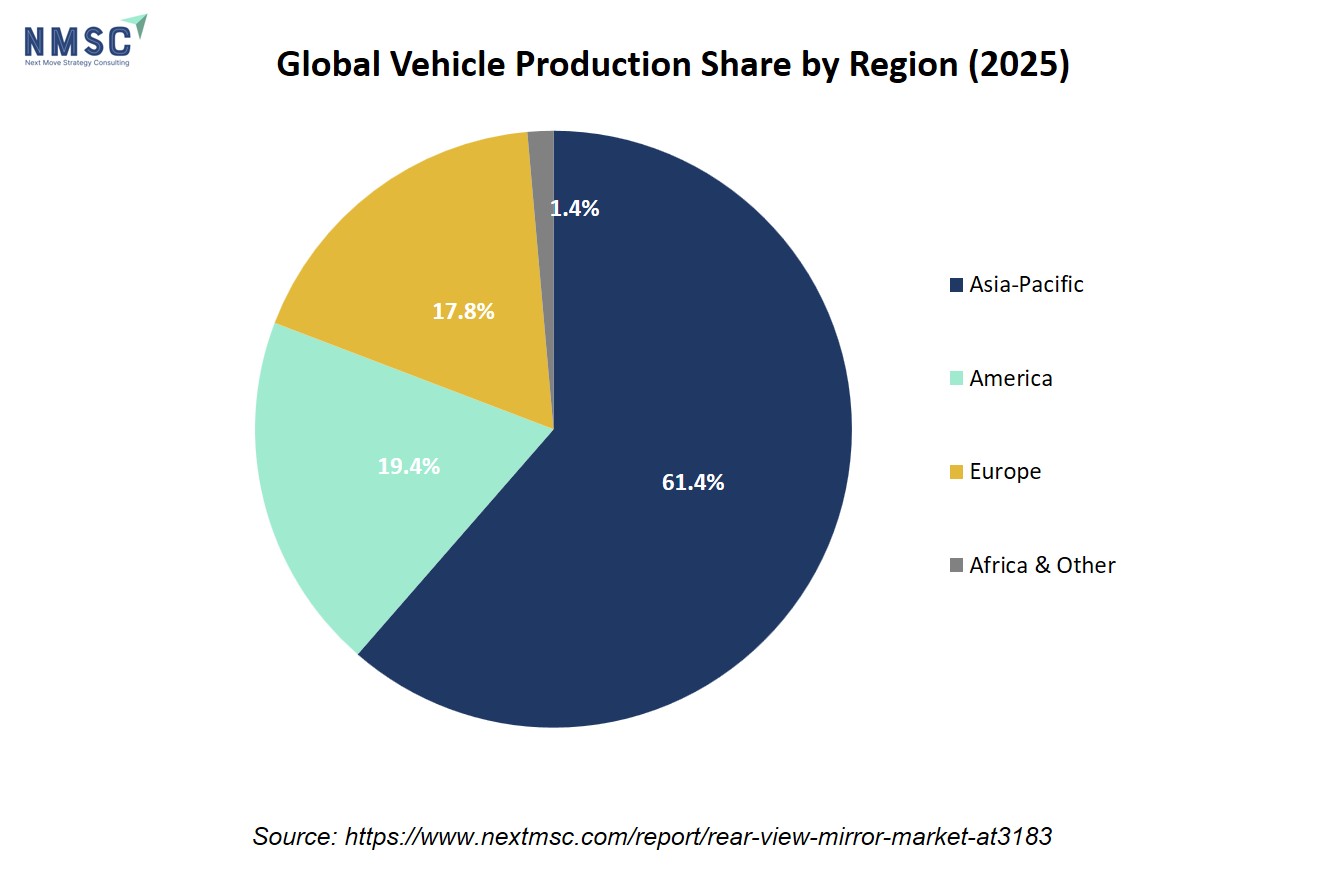
Asia-Pacific emerged as the dominant production hub, with regional output rising 7.6% to approximately 59.2 million vehicles in 2025, accounting for more than 61% of global production. China remained the world's largest automotive manufacturing nation, adding approximately 3.25 million vehicles in a single year to reach 34.53 million units produced in 2025. India recorded production of 6.49 million vehicles, with domestic passenger vehicle sales exceeding 4.6 million units in fiscal year 2025–26 — reinforcing the Asia-Pacific region's position as the primary growth engine for rear-view mirror demand.
Road Safety Imperatives Drive Advanced Mirror Adoption
Beyond regulatory mandates, the global road safety crisis continues to serve as a fundamental demand driver for advanced rear-view mirror technologies. The World Health Organization (WHO) estimates that approximately 1.19 million people lose their lives annually due to road traffic crashes, with millions more sustaining non-fatal injuries — a public health burden that has intensified governmental pressure for enhanced vehicle visibility and driver monitoring systems across all major markets.
In the United States, the National Highway Traffic Safety Administration (NHTSA) has been actively evaluating the regulatory framework governing rear visibility. In May 2025, NHTSA published a Federal Register notice seeking public comment on a revision to its information collection titled "Drivers' Use of Camera-Based Rear Visibility Systems Versus Traditional Mirrors" (OMB Control Number 2127-0756), in support of research informing a potential advance notice of proposed rulemaking (ANPRM) that would permit camera-based systems as an alternative compliance option under Federal Motor Vehicle Safety Standard (FMVSS) No. 111. The ongoing regulatory deliberation signals that the United States may follow the European trajectory in permitting — and potentially mandating — camera-monitor systems as compliant alternatives to conventional mirrors, further expanding the addressable market for smart rear-view mirror technology.
The U.S. Department of Transportation reported 42,514 roadway deaths in 2023, a 10% increase from 2020 levels, intensifying regulatory and consumer pressure for advanced visibility and safety technologies across the North American market.
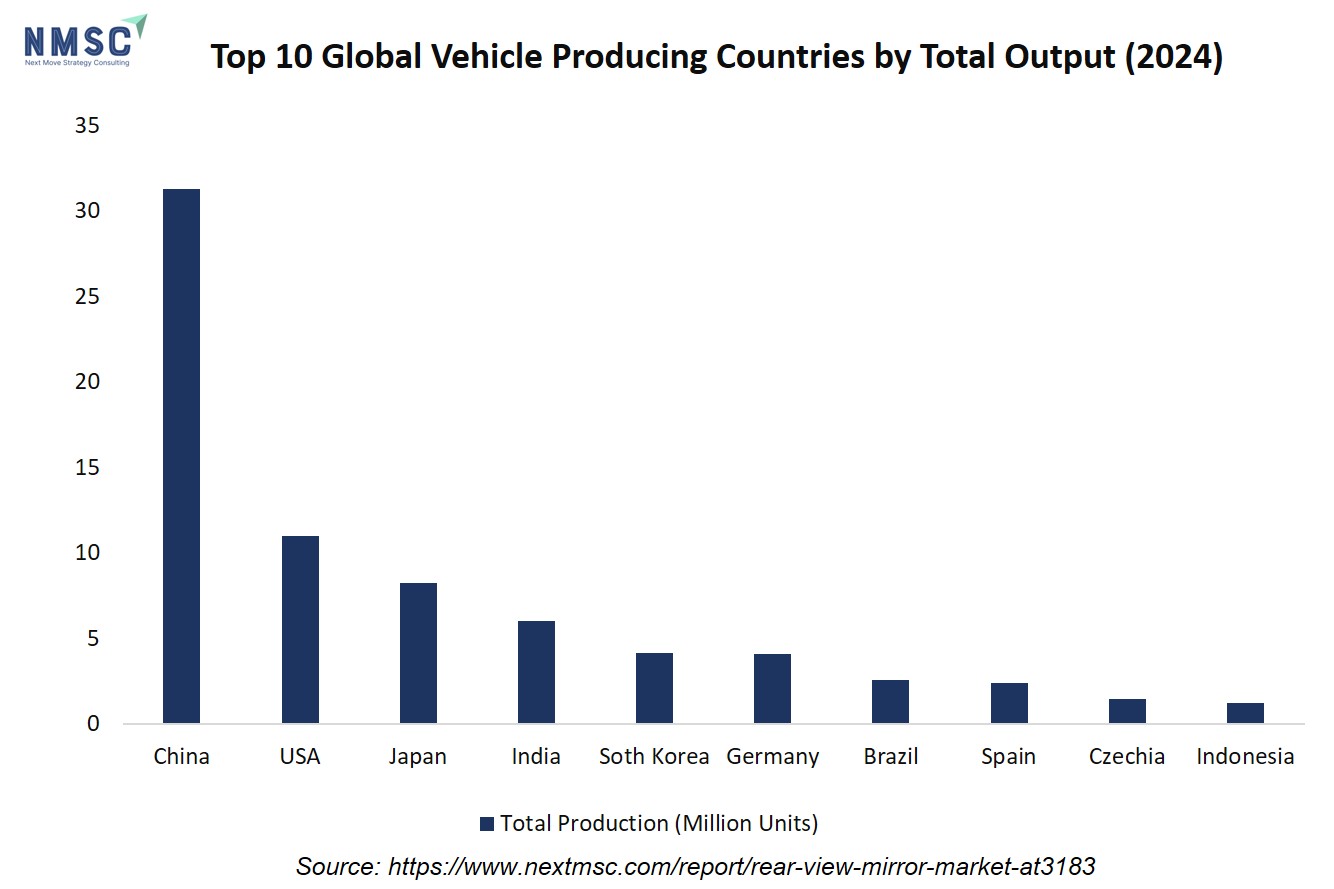
Top 10 Global Vehicle Producing Countries — Total Output (2024)
|
Rank |
Country |
Cars (Units) |
Commercial Vehicles (Units) |
Total Output (Units) |
|
1 |
China |
27,476,886 |
3,804,706 |
31,281,592 |
|
2 |
USA |
1,432,615 |
9,129,573 |
10,562,188 |
|
3 |
Japan |
7,139,188 |
1,095,493 |
8,234,681 |
|
4 |
India |
4,991,413 |
1,023,278 |
6,014,691 |
|
5 |
South Korea |
3,849,326 |
277,926 |
4,127,252 |
|
6 |
Germany |
4,069,222 |
N/A |
4,069,222* |
|
7 |
Brazil |
1,895,020 |
654,575 |
2,549,595 |
|
8 |
Spain |
1,918,244 |
458,260 |
2,376,504 |
|
9 |
Czechia |
1,452,881 |
6,011 |
1,458,892 |
|
10 |
Indonesia |
1,026,976 |
169,688 |
1,196,664 |
Notes: Germany commercial vehicle data not available for 2024 (reported as N/A). Total for Germany reflects passenger cars only.
Technological Transformation: From Conventional Glass to Intelligent Platforms
The rear-view mirror market is undergoing a fundamental technological transition, driven by the convergence of digital imaging, artificial intelligence, and advanced driver assistance systems (ADAS). Conventional glass mirrors — which have served as the industry standard for over a century — are increasingly being supplemented or replaced by smart mirror systems incorporating high-definition cameras, LCD displays, auto-dimming electrochromic glass, blind spot detection sensors, and integrated driver monitoring cameras.
Gentex Corporation, a leading supplier of auto-dimming mirrors, developed an advanced rear-view mirror system in January 2024 designed to improve driver visibility and enhance safety. Tokairika Co., Ltd. entered a partnership with Suzuki in July 2024 to develop a rearview camera system for motorcycles, incorporating wide-angle cameras to provide riders with enhanced situational awareness. Uno Minda launched a new series of four-wheeler rearview mirrors in March 2024 aimed at improving road user safety and driving experience.
The integration of digital rear-view mirror technology — exemplified by Polestar's digital rearview mirror developed in February 2024, which enhances driver visibility during adverse weather conditions — illustrates the industry's commitment to leveraging camera-display systems to overcome the physical limitations of conventional glass mirrors. These innovations represent a broader industry shift toward mirror platforms that deliver real-time video footage, reduce blind spots, and integrate seamlessly with vehicle ADAS architectures.
Global Vehicle Production and Sales by Region (2025)
|
Region |
Production (M Units) |
Sales (M Units) |
Production YoY |
Share of Global Production |
|
Asia-Pacific |
59.2 |
55.02 |
+7.6% |
~61.4% |
|
Americas |
18.74 |
24.86 |
-2.1% |
~19.4% |
|
Europe |
17.2 |
18.63 |
-0.8% |
~17.8% |
|
Africa & Other |
~1.26 |
~1.29 |
+22.0%* |
~1.4% |
|
Global Total |
96.4 |
99.8 |
+3.9% |
100% |
Notes: Africa & Other production figure is estimated as residual from reported regional totals. YoY = Year-on-Year versus 2024. Africa sales growth reflects a small base effect.
Regional Market Dynamics: Asia-Pacific Dominance and North American Growth
Asia-Pacific commands the largest share of the global rear-view mirror market, a position reinforced by the region's overwhelming dominance in vehicle production. China's automotive output reached 34.53 million units in 2025, while India's production of 6.49 million vehicles and record domestic sales underscore the subcontinent's emergence as a high-growth market for automotive components. Government regulations across the region — including India's draft Automotive Industry Standard AIS-002, developed under the Ministry of Road Transport and Highways — mandate the installation of rear-facing mirrors and indirect vision devices, providing a regulatory foundation for sustained market demand.
North America represents the fastest-growing regional segment within the rear-view mirror market. The United States produced 10.56 million vehicles in 2024, with 16.7 million units sold in 2025, maintaining its position as one of the world's largest automotive markets and a critical demand center for rear-view mirror systems. The combination of elevated road fatality rates, active NHTSA regulatory deliberation on camera-monitor systems, and strong consumer demand for advanced safety features positions North America as a high-value growth market for smart mirror technology.
Europe, while facing production headwinds — with output declining 0.8% to 17.2 million vehicles in 2025 — is simultaneously experiencing a regulatory-driven upgrade cycle. The EU GSR's ADDW mandate effective July 7, 2026, is expected to accelerate the replacement of conventional mirrors with smart mirror systems across European vehicle platforms, partially offsetting volume pressures with higher-value content per vehicle.
Competitive Landscape: Strategic Initiatives Among Key Players
The global rear-view mirror market is characterized by a concentrated competitive landscape, with established tier-one suppliers and specialized mirror manufacturers competing on technology differentiation, OEM relationships, and geographic reach. Key players include Motherson Group, Gentex Corporation, Ficosa International S.A., Magna International Inc., Murakami Corporation, FLABEG Holding GmbH, Uno Minda Ltd., Tokairika Co., Ltd., SL Corporation, Burco Inc., Pioneer Corporation, Lumax Genuine Spares Pvt Ltd., Enginetech Systems, Ampas Auto Mirror Corporation, and Modern Auto Products Corporation.
These companies are pursuing product launches, strategic partnerships, and acquisitions to strengthen their market positions. The integration of driver monitoring systems, auto-dimming electrochromic technology, blind spot detection, and camera-monitor capabilities into mirror assemblies represents the primary axis of competitive differentiation, as OEMs seek to consolidate multiple safety functions into a single, cost-effective mirror platform. The EU's July 2026 ADDW mandate is expected to intensify competitive activity among suppliers capable of delivering mirror-integrated DMS solutions at scale, with first-mover advantages accruing to those with validated, regulation-compliant technology platforms.
Market Segmentation and Growth Vectors
The rear-view mirror market is segmented by type — Outside Rear View Mirror (ORVM) and Interior Rear View Mirror — product type (Smart and Conventional), features (Auto-Dimming, Blind Spot Detection, Power Control, Automatic Folding, Heating Function), mounting location (Door and Body), vehicle type (Private and Commercial), and sales channel (OEMs and Aftermarket).
Smart rear-view mirrors represent the highest-growth product segment, driven by OEM adoption of integrated camera-display systems and regulatory mandates for driver monitoring. The OEM sales channel dominates market revenues, reflecting the mirror's status as a standard vehicle component specified at the design stage. The aftermarket segment presents incremental growth opportunities as vehicle owners seek to retrofit advanced mirror capabilities into existing vehicles. The availability of alternative technologies — including 360-degree camera systems — represents a structural competitive challenge, though the mirror's regulatory status as a mandated safety component provides a durable demand floor across all vehicle categories.
Bottom Line
The global rear-view mirror market is entering a period of accelerated structural transformation, driven by the convergence of regulatory mandates, rising vehicle production, and rapid technological advancement. The EU's July 2026 ADDW directive represents a pivotal regulatory catalyst, compelling automakers and suppliers to integrate intelligent camera-based monitoring systems into mirror assemblies across European vehicle platforms — a development with global supply chain implications as OEMs standardize safety-compliant architectures. With global vehicle production reaching 96.4 million units in 2025 and Asia-Pacific consolidating its dominance at over 61% of global output, the volume foundation for rear-view mirror demand remains robust. The market's projected expansion from USD 6.22 billion in 2024 to USD 8.39 billion by 2030 reflects both sustained unit volume growth and a structural shift toward higher-value smart mirror systems. Key risks include competitive pressure from 360-degree camera systems and potential margin compression as technology content increases. For investors and industry participants, the smart mirror segment — particularly mirror-integrated driver monitoring and camera-monitor systems — represents the most compelling growth vector over the forecast horizon, with regulatory tailwinds in both Europe and North America providing durable demand visibility.
About Next Move Strategy Consulting
Next Move Strategy Consulting is a premier market research and management consulting firm that has been committed to provide strategically analysed well documented latest research reports to its clients. The research industry is flooded with many firms to choose from, what makes NMSC different from the rest is its top-quality research and the obsession of turning data into knowledge by dissecting every bit of it and providing fact-based research recommendation that is supported by information collected from over 500 million websites, paid databases, industry journals and one on one consultations with industry experts across a diverse range of industry sectors. The high-quality customized research reports with actionable insights and excellent end-to-end customer service help our clients to take critical business decisions that enables them to move beyond time and have competitive edge in the industry.
We have been servicing over 1000 customers globally that includes 90% of the Fortune 500 companies over a decade. Our analysts are constantly tracking various high growth markets and identifying hidden opportunities in each sector or the industry. We provide one of the industry's best quality syndicate as well as custom research reports across 10 different industry verticals. We are committed to deliver high quality research solutions in accordance to your business needs. Our industry standard delivery solutions that ranges from the pre consultation to after-sales services, provide an excellent client experience and ensure right strategic decision making for businesses.
For more information, please contact:
Next Move Strategy Consulting
5th Floor 867 Boylston St, STE 500,
Boston, MA 02116, U.S.
E-Mail: [email protected]
Direct: +1-217-650-7991
Website: www.nextmsc.com
About the Author
 Sanyukta Deb
— Sanyukta Deb is Digital Marketing Team Lead at Next Move Strategy Consulting, where she has led content strategy and technical SEO for the firm's B2B market research publications for over 2 years. Her editorial process translates NextMSC's primary and secondary research — spanning technology, industrial, and consumer sectors — into commercial narratives, backed by search-intent, keyword, and competitive analysis. She brings 5 years of overall experience in digital marketing and content strategy.
Sanyukta Deb
— Sanyukta Deb is Digital Marketing Team Lead at Next Move Strategy Consulting, where she has led content strategy and technical SEO for the firm's B2B market research publications for over 2 years. Her editorial process translates NextMSC's primary and secondary research — spanning technology, industrial, and consumer sectors — into commercial narratives, backed by search-intent, keyword, and competitive analysis. She brings 5 years of overall experience in digital marketing and content strategy.
About the Reviewer
 Debashree Dey
— Debashree Dey is Assistant Manager at Next Move Strategy Consulting, where she supports cross-vertical market content and communications across diverse industries for 6 years. Her professional background includes senior content writing, communications, and published manuscript authorship, with experience developing audience-focused business narratives and maintaining clear, consistent messaging. Her role supports research-led content development and editorial quality across NextMSC publications.
Debashree Dey
— Debashree Dey is Assistant Manager at Next Move Strategy Consulting, where she supports cross-vertical market content and communications across diverse industries for 6 years. Her professional background includes senior content writing, communications, and published manuscript authorship, with experience developing audience-focused business narratives and maintaining clear, consistent messaging. Her role supports research-led content development and editorial quality across NextMSC publications.

















Add Comment