EU's 71-Point Battery Passport Guidance Starts the Compliance Countdown

European Commission's 71 Data-Point Guidance of 21 August 2026 Turns the 18 February 2027 Battery Passport Deadline Into an Operational Task for EV, E-Mobility and Industrial Battery Suppliers
On 21 August 2026, the European Commission’s Directorate-General for Internal Market, Industry, Entrepreneurship and SMEs published an updated ‘Guidance Document: Digital Batteries Passport – data points by category’, consolidating 71 data points that economic operators must record and, where the law requires it, display. From 18 February 2027, every electric-vehicle battery, every battery for light means of transport such as e-bikes and e-scooters, and every industrial battery with a capacity above 2 kWh that is placed on the EU market or put into service must carry a battery passport. For each of the 71 entries, the document states whether the data point is mandatory, optional, conditional on specific circumstances or not required to be completed or displayed when the obligation begins, and it names the legal source behind each one. The Commission states that the guidance adds no new legal requirements and is not its authoritative interpretation of Regulation (EU) 2023/1542, so the date set by the law is unchanged while the workload behind it is now itemised line by line.
According to Next Move Strategy Consulting’s Battery Digital Passport Market report, the global battery digital passport market was valued at USD 374.75 million in 2025 and is projected to reach USD 3,352.99 million by 2035, growing at a CAGR of 24.5% from 2026 to 2035. NextMSC primary research and analysis rates regulatory documentation mandates and second-life and recycling demand as the two high-impact growth drivers with immediate effect, which is the commercial logic the Commission’s itemised data list now puts into operational form.
For More Information: Download FREE Sample on Battery Digital Passport Market Report
The Compliance Scope: Three Battery Categories, One Deadline
The Brussels Times reported on 21 August 2026 that the guidance is aimed at three groups: economic operators such as manufacturers and importers, conformity assessment bodies and market surveillance authorities. That reading matters commercially. A document written for all three audiences means the same 71 fields will be filled in by producers, checked by assessors and inspected by regulators, so data quality, not only data existence, becomes the compliance test from February 2027.
EU Digital Batteries Passport: Scope From 18 February 2027
|
Battery category |
Passport obligation from 18 February 2027 |
Covered by the 71-data-point guidance |
|
Electric-vehicle batteries |
Required |
Yes |
|
Batteries for light means of transport |
Required |
Yes |
|
Industrial batteries with capacity above 2 kWh |
Required |
Yes |
The Volume Behind the Passport: Record EV Sales Widen the Data Load
The International Energy Agency’s Global EV Outlook 2026 reports that electric car sales topped 20 million worldwide in 2025, an increase of about 20% on 2024 and equal to one in four new cars sold. In its launch statement the agency projected 23 million electric car sales in 2026, close to 30% of all cars sold. China accounted for more than 13 million of the 2025 total, Europe for 4.2 million, the United States for around 1.5 million and the rest of the world for 2 million, up from 1.3 million a year earlier.
Electric Car Sales by Region, 2025
|
Region |
Electric car sales, 2025 |
Share of new car sales |
|
China |
More than 13 million |
Almost 55% |
|
Europe |
4.2 million |
28% |
|
United States |
Around 1.5 million |
Around 10% for the full year |
|
Rest of world |
2 million |
Not stated by the source |
“Electric car sales set new records in close to 100 countries last year.”
- Fatih Birol, Executive Director, International Energy Agency, Engineering News (Creamer Media), 21 May 2026.
The supply-chain consequence is geographic. The IEA states that China accounted for over 80% of global battery cell production in 2025, while Chinese automakers supplied 60% of the electric cars sold. A passport obligation written in Brussels therefore depends on production data generated mostly in East Asian cell plants, which is why NextMSC primary research and analysis treats cross-border data interoperability as the central execution risk in this market rather than a secondary compliance detail.
Inside the EU: Germany and France Anchor the Regulated Demand Base
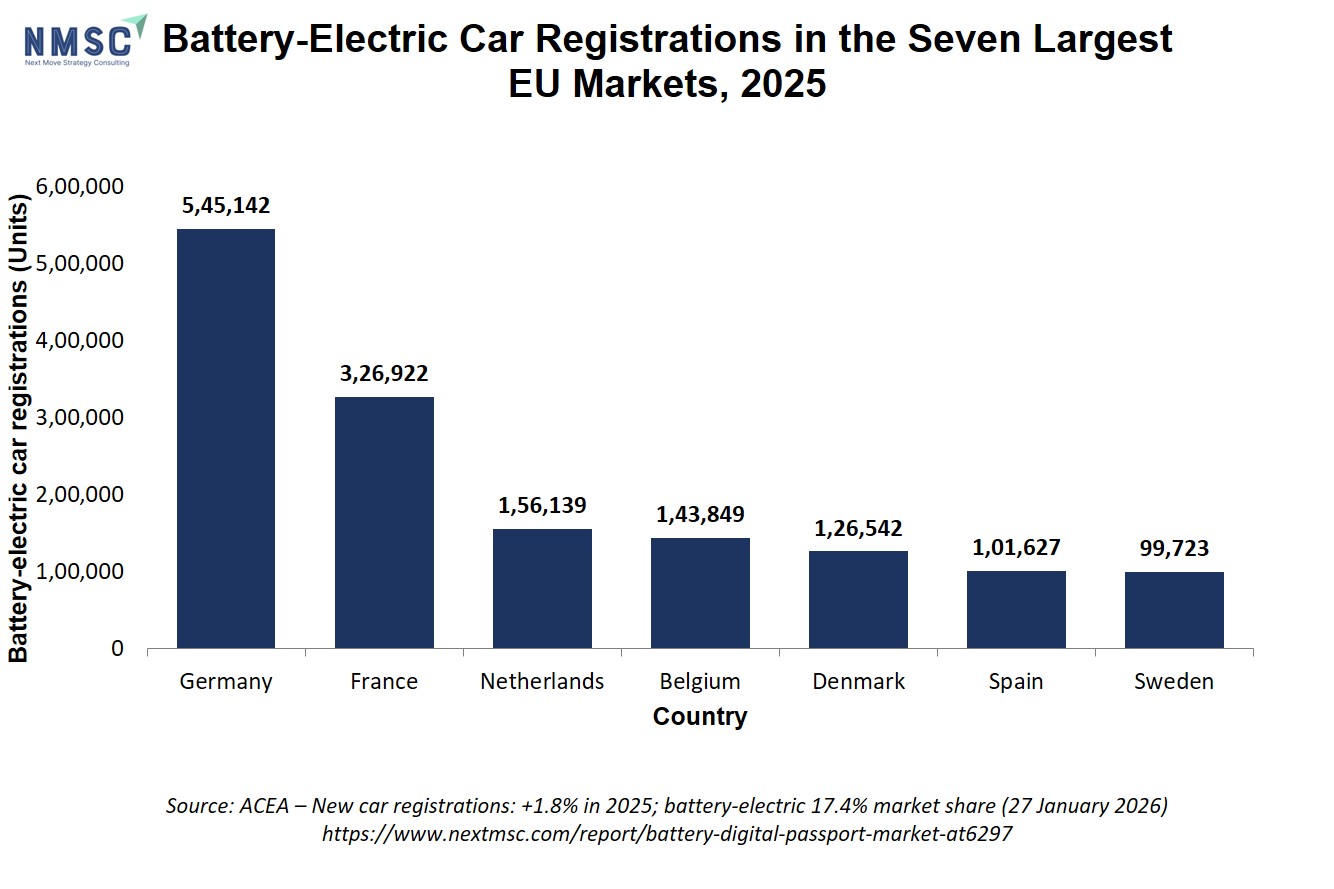
ACEA, the European Automobile Manufacturers’ Association, reported on 27 January 2026 that battery-electric cars reached a 17.4% share of EU new car registrations in 2025, equal to 1,880,370 of the 10,822,831 cars registered, against a 13.6% share in 2024. Germany registered 545,142 battery-electric cars and France 326,922, followed by the Netherlands with 156,139, Belgium with 143,849, Denmark with 126,542, Spain with 101,627 and Sweden with 99,723. ACEA notes that the current-year figures are provisional and may be revised.
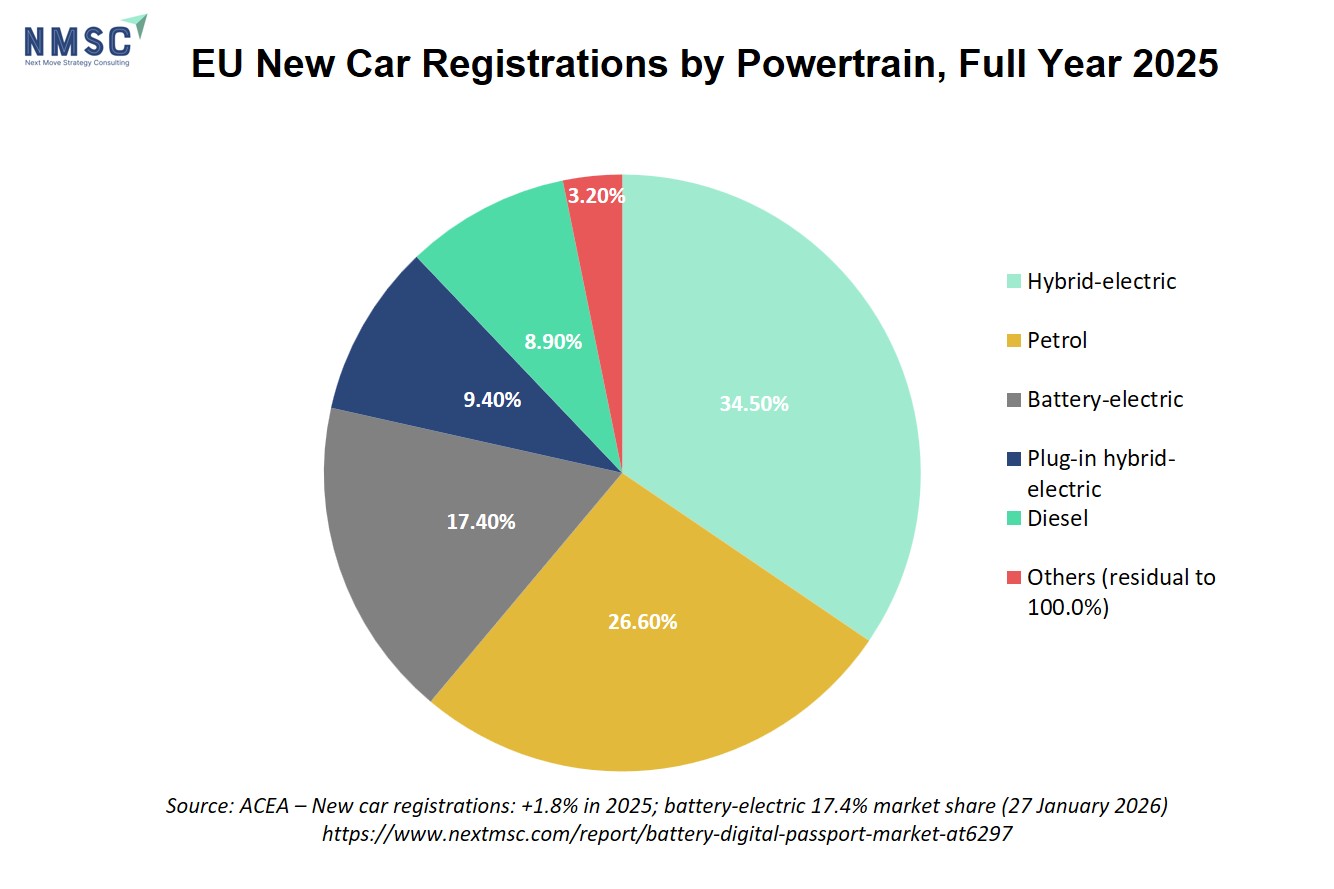
Battery-electric cars still trail hybrid-electric vehicles in the EU mix. ACEA’s full-year 2025 data put hybrid-electric cars at 34.5% of registrations, petrol at 26.6%, battery-electric at 17.4%, plug-in hybrid-electric at 9.4% and diesel at 8.9%. The 2025 mix indicates how large the EV battery base subject to the passport will become as the share of petrol and diesel registrations, which together fell from 45.2% in 2024 to 35.5% in 2025, continues to narrow.
Industry Readiness: Global Battery Alliance Trials Test the Data Chain
The Global Battery Alliance’s 2026 Operational Trials of its Battery Passport show how much coordination the data chain requires. Its July 2026 quarterly edition reports 40 participating organisations in 17 consortia from 10 countries, with the cell manufacturers involved representing around 80% of global EV battery production. The trials produced 37 Battery Benchmark reports and 33 product carbon footprint assessments. The Alliance’s trial page lists AESC, CATL, CALB, FinDreams, Gotion, Hithium, IONCOR, Jinko ESS, Panasonic, REPT BATTERO, Rio Tinto and Sunwoda as lead companies, and cautions that the 2026 trials relied on draft methodologies, so no conclusions should be drawn about any company’s sustainability performance.
Global Battery Alliance 2026 Operational Trials at a Glance
|
Indicator |
2026 Operational Trials |
|
Participating organisations |
40 |
|
Supply-chain consortia |
17 |
|
Countries represented |
10 |
|
Share of global EV battery production held by participating cell manufacturers |
Around 80% |
|
Battery Benchmark reports produced |
37 |
|
Product carbon footprint assessments produced |
33 |
Segment Dynamics: Software Leads Value, Hardware Leads Growth
According to NextMSC primary research and analysis, Software Platforms form the largest product segment, valued at USD 173.72 million in 2025 with a share of about 46%, because the 71 data points have to be collected, validated and exposed through a single record per battery. Edge Modules & Hardware is the fastest-growing product segment at a 33.15% CAGR, reflecting the physical identifier and data-capture layer that has to travel with each battery.
By application, NextMSC’s analysis shows EV Traction Batteries as the largest segment at USD 176.71 million in 2025, rising to USD 996.23 million by 2035, while Consumer Electronics Batteries is the fastest-growing at a 32.29% CAGR. Among end users, Automotive OEMs & Fleets lead at USD 173.96 million in 2025, growing to USD 1,018.68 million by 2035, and Recyclers & Second-Life Operators expand fastest at a 30.77% CAGR. In distribution, Direct Enterprise Sales is the largest channel at USD 172.84 million in 2025, rising to USD 977.38 million by 2035, and Digital Self-Serve Platforms grows fastest at a 32.45% CAGR.
Regional Outlook
NextMSC primary research and analysis places North America as the largest region in 2025 at USD 127.42 million, a share of about 34%, rising to USD 1,005.90 million by 2035 at a CAGR of 22.78% from 2026. Europe, where the binding rule originates, stood at USD 101.18 million in 2025 and is projected to reach USD 804.72 million by 2035 at a 22.88% CAGR.
Asia-Pacific records the highest regional CAGR in NextMSC’s model at 28.14%, taking the region from USD 101.18 million in 2025 to USD 1,173.54 million by 2035, which would make it the largest region by the end of the forecast period. That outcome is consistent with the IEA’s finding that China holds over 80% of cell production. Latin America is projected to grow from USD 26.23 million to USD 201.18 million at a 22.39% CAGR, and the Middle East & Africa from USD 18.74 million to USD 167.65 million at a 24.5% CAGR.
Growth Drivers and Restraints
NextMSC’s published assessment ranks regulatory documentation mandates and second-life and recycling demand as high-impact drivers with immediate effect, and fleet residual value management as a medium-impact driver over the medium term. On the restraint side, data interoperability gaps carry a high impact with immediate effect, identifier durability concerns a medium impact over the medium term, and cybersecurity requirements a low impact over the long term. The Commission’s item-by-item guidance narrows the first restraint, because it tells operators which of the 71 fields they must populate, but it does not by itself make systems from different suppliers exchange data.
NMSC Strategic Perspective: Compliance Is Becoming a Data Infrastructure Market
NextMSC primary research and analysis reads the 21 August 2026 guidance as the point at which the battery passport moves from a policy concept to a procurement line. A listed set of 71 data points with a stated legal basis lets battery makers, importers and fleet owners scope software, identifier hardware and verification work with defined requirements, which shortens the path from budget approval to purchase order. The USD 2,886.43 million absolute opportunity that NextMSC identifies between 2026 and 2035 follows from that conversion of legal text into recurring data-management spend.
NextMSC’s analysis also indicates that value will concentrate in software platforms, where the largest segment already holds about 46% of the 2025 base, while edge hardware grows fastest from a smaller base. Vendors that pair a platform with durable identifiers and an interoperable data exchange are better placed than point-solution providers, because a regulator or assessor reading the passport will test the full record, not a single field. The IEA’s evidence that cell production is concentrated in China, and the Global Battery Alliance’s experience of coordinating 17 consortia across 10 countries, both point to the same priority: the supplier that can ingest verified data from East Asian cell plants and present it in the EU format will hold the strongest position.
For investors, NextMSC’s analysis suggests weighting exposure toward platform and interoperability capability in Europe and Asia-Pacific, where the regulatory trigger and the production base sit, and treating recycler and second-life workflows as the fastest-growing end-user entry point at a 30.77% CAGR. The principal downside is delay in aligning data formats across suppliers, which would postpone revenue recognition even though the legal date holds.
Competitive Landscape
Passport delivery today sits with software specialists and the battery producers that adopt them. In July 2024, KHL Group’s Power Progress reported that Volvo Cars would launch what it described as the first commercially available EV battery passport for the EX90, developed with the UK-based provider Circulor and accessed by scanning a QR code on the driver’s-side door. The Global Battery Alliance’s 2026 trials extend that early deployment to cell manufacturers and raw-material producers, with AESC, CATL, CALB, FinDreams, Gotion, Hithium, Panasonic, REPT BATTERO, Sunwoda and Rio Tinto among the lead companies named on the Alliance’s trial page.
Bottom Line
The European Commission’s 21 August 2026 guidance converted the 18 February 2027 battery passport deadline into a defined list of 71 data points covering electric-vehicle, light-transport and industrial batteries above 2 kWh. The demand base behind that list is large: the IEA recorded more than 20 million electric car sales in 2025, and ACEA recorded 1,880,370 battery-electric registrations in the EU. According to NextMSC primary research and analysis, the global battery digital passport market will expand from USD 374.75 million in 2025 to USD 3,352.99 million by 2035 at a 24.5% CAGR, with Software Platforms the largest product segment and Asia-Pacific the fastest-growing region at 28.14%. Data interoperability across suppliers remains the main restraint, and the Global Battery Alliance trials, which involved 40 organisations in 10 countries, show how much coordination it requires. Vendors that combine a platform, durable identifiers and verified supplier data are best placed to capture the USD 2,886.43 million opportunity through 2035.
About Next Move Strategy Consulting
Next Move Strategy Consulting is a premier market research and management consulting firm that has been committed to provide strategically analysed well documented latest research reports to its clients. The research industry is flooded with many firms to choose from, what makes NMSC different from the rest is its top-quality research and the obsession of turning data into knowledge by dissecting every bit of it and providing fact-based research recommendation that is supported by information collected from over 500 million websites, paid databases, industry journals and one on one consultations with industry experts across a diverse range of industry sectors. The high-quality customized research reports with actionable insights and excellent end-to-end customer service help our clients to take critical business decisions that enables them to move beyond time and have competitive edge in the industry.
We have been servicing over 1000 customers globally that includes 90% of the Fortune 500 companies over a decade. Our analysts are constantly tracking various high growth markets and identifying hidden opportunities in each sector or the industry. We provide one of the industry’s best quality syndicate as well as custom research reports across 10 different industry verticals. We are committed to deliver high quality research solutions in accordance to your business needs. Our industry standard delivery solutions that ranges from the pre consultation to after-sales services, provide an excellent client experience and ensure right strategic decision making for businesses.
For more information, please contact:
Next Move Strategy Consulting
5th Floor 867 Boylston St, STE 500,
Boston, MA 02116, U.S.
E-Mail: [email protected]
Direct: +1-217-650-7991
Website: www.nextmsc.com
About the Author
 Sanyukta Deb
— Sanyukta Deb is Digital Marketing Team Lead at Next Move Strategy Consulting, where she has led content strategy and technical SEO for the firm's B2B market research publications for over 2 years. Her editorial process translates NextMSC's primary and secondary research — spanning technology, industrial, and consumer sectors — into commercial narratives, backed by search-intent, keyword, and competitive analysis. She brings 5 years of overall experience in digital marketing and content strategy.
About the Reviewer
 Debashree Dey
— Debashree Dey is Assistant Manager at Next Move Strategy Consulting, where she supports cross-vertical market content and communications across diverse industries for 6 years. Her professional background includes senior content writing, communications, and published manuscript authorship, with experience developing audience-focused business narratives and maintaining clear, consistent messaging. Her role supports research-led content development and editorial quality across NextMSC publications.













Add Comment