EV Slowdown Drives Strategic Shift in Battery Sector
Industry Insights from Next Move Strategy Consulting
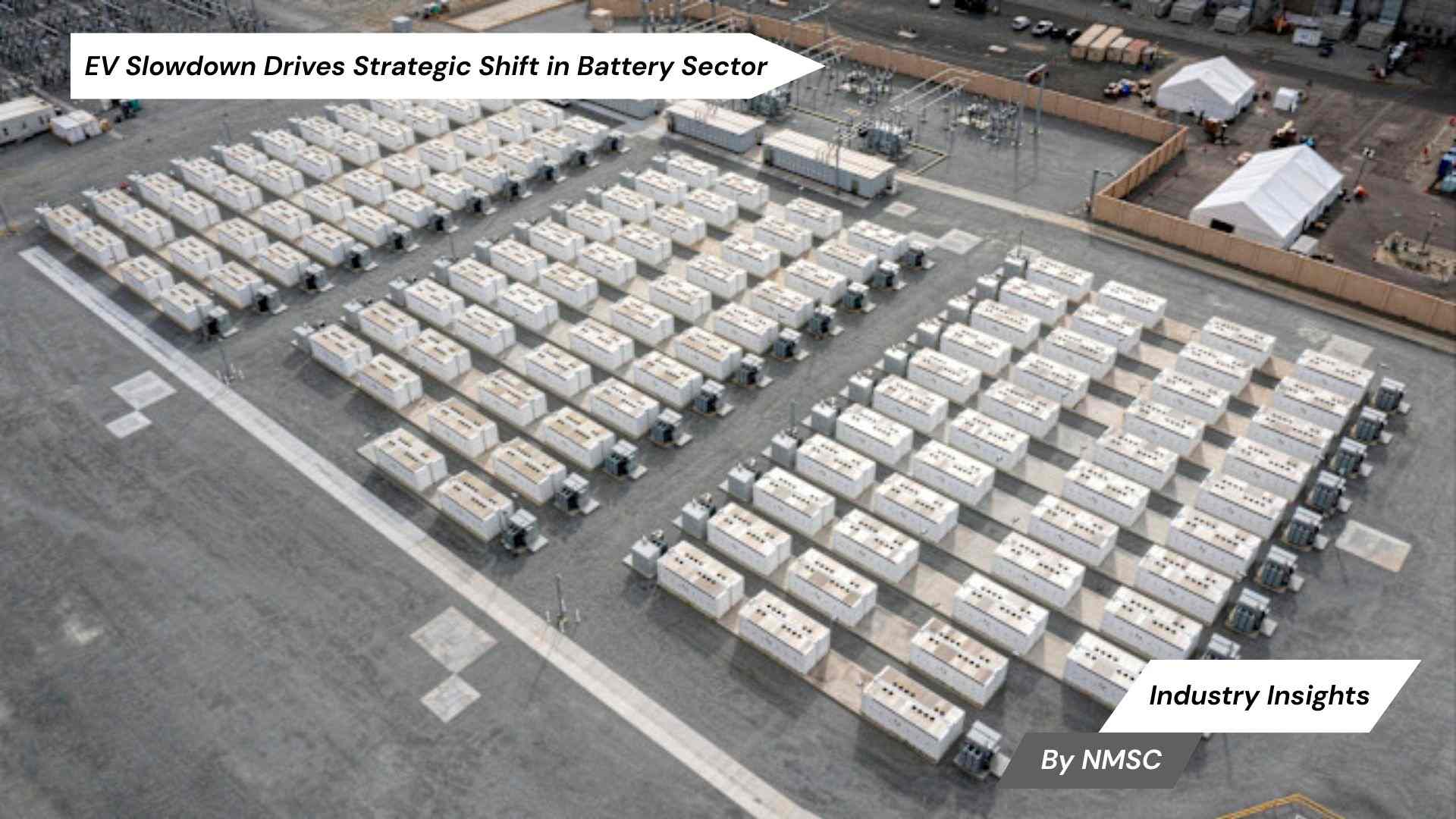
As global electric vehicle (EV) market demand softens more than anticipated, South Korea’s battery materials sector is undertaking a marked strategic shift. Rather than relying predominantly on automotive demand, major suppliers are repositioning themselves toward burgeoning markets such as AI-powered data centers, energy storage systems (ESS), and humanoid robotics.
Responding to an Extended EV Plateau
After several years of robust growth fueled by EV adoption, the pace of new vehicle battery demand is leveling off. In response, materials producers — traditionally aligned with automotive battery supply chains — are revising their business models to diversify beyond EVs.
Growth Engines: AI Data Centers and ESS
The emerging prominence of AI workloads is creating large, stable opportunities within the ESS market. AI data centers require substantial and reliable power storage solutions, often on a contractual basis that offers longer-term demand visibility than the cyclical EV market. This contrast has led some battery materials manufacturers to recalibrate production toward ESS components.
Tesla’s performance, where energy storage revenue outpaced EV profitability in recent periods, underscores this structural opportunity and signals broader industry momentum toward power-infrastructure applications.
Robotics: A Premium Battery Application
Humanoid robotics represents another frontier for high-output battery materials. With design requirements that emphasize compact size and energy density, advanced battery chemistries are becoming essential for next-generation robots. Korean firms with expertise in high-nickel cathode materials and developing solid-state technologies are positioning themselves to capture this premium segment.
Strategic Production Shifts Across the Supply Chain
Across the battery materials landscape, companies are reconfiguring operations and portfolios:
-
Copper Foil Producers: Firms are dividing production capacity between traditional EV battery demand and emerging ESS orders, adapting by geographic region and end use.
-
Cathode Manufacturers: Investments in lithium iron phosphate (LFP) products for ESS and solid-state battery materials for robotics reflect product diversification strategies.
-
Electrolyte and Separator Makers: These suppliers are expanding tailored offerings for both energy storage infrastructure and advanced battery designs.
Together, these moves highlight industry efforts to balance near-term market challenges with long-term opportunities in adjacent sectors.
Next Move Strategy Consulting’s Industry Analysis
The adaptation of battery materials makers signals a broader realignment within the EV supply ecosystem. As EV battery demand growth moderates — evidenced by shifts in global EV battery usage trends — materials suppliers are wisely diversifying into segments with stronger secular growth drivers such as AI infrastructure and robotics. This pivot is expected to mitigate risk and stabilize revenues, while also accelerating innovation in high-performance battery technologies. From a market perspective, companies that successfully transition toward ESS and robotics battery demand could outperform peers tied strictly to automotive cycles.
Source: KM Journal
Prepared By: Next Move Strategy Consulting
About the Author
 Sanyukta Deb
— Sanyukta Deb is Digital Marketing Team Lead at Next Move Strategy Consulting, where she has led content strategy and technical SEO for the firm's B2B market research publications for over 2 years. Her editorial process translates NextMSC's primary and secondary research — spanning technology, industrial, and consumer sectors — into commercial narratives, backed by search-intent, keyword, and competitive analysis. She brings 5 years of overall experience in digital marketing and content strategy.
Sanyukta Deb
— Sanyukta Deb is Digital Marketing Team Lead at Next Move Strategy Consulting, where she has led content strategy and technical SEO for the firm's B2B market research publications for over 2 years. Her editorial process translates NextMSC's primary and secondary research — spanning technology, industrial, and consumer sectors — into commercial narratives, backed by search-intent, keyword, and competitive analysis. She brings 5 years of overall experience in digital marketing and content strategy.
About the Reviewer
 Debashree Dey
— Debashree Dey is Assistant Manager at Next Move Strategy Consulting, where she supports cross-vertical market content and communications across diverse industries for 6 years. Her professional background includes senior content writing, communications, and published manuscript authorship, with experience developing audience-focused business narratives and maintaining clear, consistent messaging. Her role supports research-led content development and editorial quality across NextMSC publications.
Debashree Dey
— Debashree Dey is Assistant Manager at Next Move Strategy Consulting, where she supports cross-vertical market content and communications across diverse industries for 6 years. Her professional background includes senior content writing, communications, and published manuscript authorship, with experience developing audience-focused business narratives and maintaining clear, consistent messaging. Her role supports research-led content development and editorial quality across NextMSC publications.















Add Comment