FAA Awards $875M AI Contract to Modernize U.S. Airspace
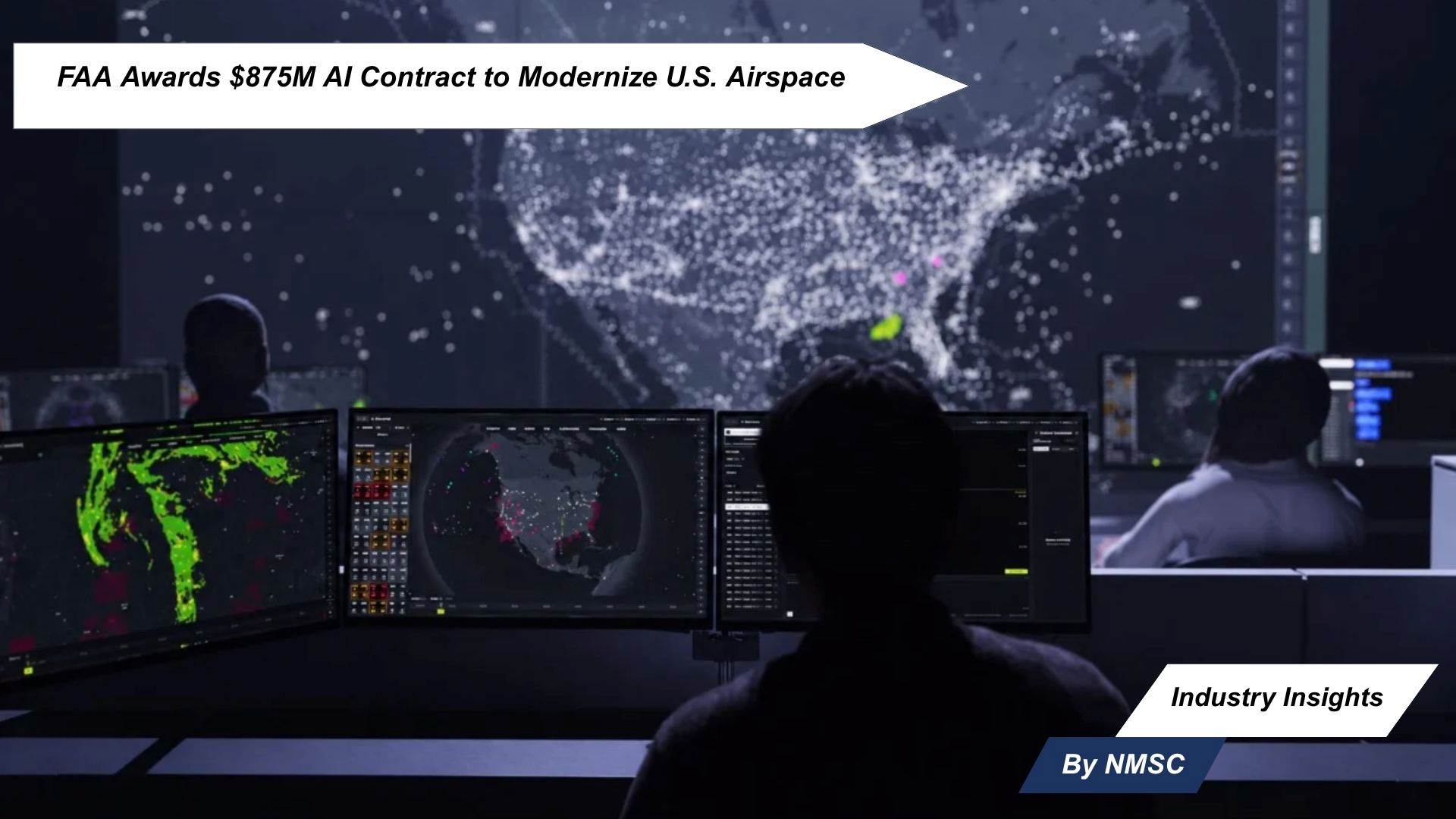
FAA Awards $875M Contract to Air Space Intelligence to Deploy AI-Driven SMART Airspace System
WASHINGTON, United States — August 10, 2026 — The U.S. Federal Aviation Administration has awarded an $875 million contract to artificial intelligence startup Air Space Intelligence (ASI) to build and deploy the SMART system — Strategic Management of Airspace, Routes, and Trajectories — a development that signals a decisive federal commitment to AI-powered airspace management and carries significant implications for the global smart airport market.
The contract, announced as part of the Trump administration's broader initiative to deliver a modernized national Air Traffic Control system, tasks ASI with developing predictive analytics technology capable of preventing flight delays, reducing congestion, and optimizing airspace capacity across the busiest and most complex airspace system in the world. FAA Administrator Bryan Bedford described the initiative as a transformational opportunity, stating: "I think we've got a real opportunity to do something transformational with AI."
The SMART system builds on ASI's existing Flyways AI platform, which was first deployed by Alaska Airlines in 2021 to assist dispatchers in identifying more efficient and safer flight routes. Alaska Airlines reports that the Flyways system has enabled the carrier to save tens of thousands of flight hours and approximately one million gallons of fuel annually. The platform has since been adopted by Delta Air Lines, United Airlines, the U.S. Army, and the U.S. Air Force, establishing ASI's technology as a proven operational tool across both commercial and defense aviation sectors.
The SMART system is designed to function as a decision-support tool for air traffic controllers — not a replacement. By ingesting real-time data on air traffic, weather patterns, upper-level winds, and flight trajectories, the system will generate predictive recommendations that allow controllers to identify and resolve potential bottlenecks days, weeks, or even months before they materialize. FAA officials have emphasized that the goal is to give controllers a unified, national airspace picture that the current system does not provide.
According to Next Move Strategy Consulting, the global smart airport market is predicted to reach USD 14.91 billion by 2030, registering a CAGR of 13.1% from 2024 to 2030, as airports and aviation regulators worldwide accelerate investments in AI, biometrics, and intelligent traffic management infrastructure.
Key Highlights:
-
$875 Million Federal Investment: The FAA's contract with Air Space Intelligence represents one of the largest single federal commitments to AI-driven airspace modernization in U.S. aviation history, underscoring the government's confidence in predictive analytics as a core operational tool.
-
Proven Commercial Track Record: Alaska Airlines' deployment of Flyways AI since 2021 has delivered measurable results — approximately one million gallons of fuel saved annually and tens of thousands of flight hours recovered — providing a validated foundation for national-scale deployment.
-
Multi-Sector Adoption: ASI's technology is already operational across Delta Air Lines, United Airlines, the U.S. Army, and the U.S. Air Force, demonstrating cross-sector scalability that strengthens the case for FAA-wide implementation.
-
Unified National Airspace View: The SMART system will, for the first time, provide air traffic controllers with a centralized, real-time visualization of the entire U.S. national airspace, overlaying weather patterns and flight paths into a single operational picture.
Analyst Insight:
According to analysts at Next Move Strategy Consulting, the FAA's $875 million commitment to AI-powered airspace management represents a structural inflection point for the smart airport market. Federal adoption of predictive analytics at the national airspace level is expected to accelerate procurement cycles for AI-integrated airport operations platforms, as airport authorities align their ground-side infrastructure with the intelligence capabilities being deployed at the airspace management level.
NMSC analysts note that the Flyways AI model — built collaboratively with airline operators and validated through years of commercial deployment — offers a replicable framework for other aviation regulators globally. As the smart airport market advances toward USD 14.91 billion by 2030 at a CAGR of 13.1%, government-led AI mandates of this scale are likely to serve as demand catalysts, drawing increased private investment into airport automation, biometric systems, and real-time data infrastructure.
Industry Outlook:
The FAA's deployment of the SMART system marks a pivotal shift in how national airspace is managed — from reactive, controller-dependent decision-making to proactive, AI-assisted trajectory optimization. For the smart airport market, this development reinforces the growing convergence of airside and groundside intelligence, where predictive data flows from airspace management systems directly into airport operations platforms.
As aviation regulators in Europe, Asia-Pacific, and the Middle East monitor the U.S. rollout, similar AI-driven airspace modernization programs are likely to follow, creating a global demand wave for integrated smart airport technologies. The FAA's initiative signals that AI is no longer a supplementary feature in aviation infrastructure — it is becoming the operational backbone of the modern airspace system.
Source: NPR via Lakeshore Public Media
For More Information: Download FREE Sample on Smart Airport Market Report
Prepared By: Sanyukta Deb
About the Author
 Sanyukta Deb
— Sanyukta Deb is Digital Marketing Team Lead at Next Move Strategy Consulting, where she has led content strategy and technical SEO for the firm's B2B market research publications for over 2 years. Her editorial process translates NextMSC's primary and secondary research — spanning technology, industrial, and consumer sectors — into commercial narratives, backed by search-intent, keyword, and competitive analysis. She brings 5 years of overall experience in digital marketing and content strategy.
Sanyukta Deb
— Sanyukta Deb is Digital Marketing Team Lead at Next Move Strategy Consulting, where she has led content strategy and technical SEO for the firm's B2B market research publications for over 2 years. Her editorial process translates NextMSC's primary and secondary research — spanning technology, industrial, and consumer sectors — into commercial narratives, backed by search-intent, keyword, and competitive analysis. She brings 5 years of overall experience in digital marketing and content strategy.
About the Reviewer
 Debashree Dey
— Debashree Dey is Assistant Manager at Next Move Strategy Consulting, where she supports cross-vertical market content and communications across diverse industries for 6 years. Her professional background includes senior content writing, communications, and published manuscript authorship, with experience developing audience-focused business narratives and maintaining clear, consistent messaging. Her role supports research-led content development and editorial quality across NextMSC publications.
Debashree Dey
— Debashree Dey is Assistant Manager at Next Move Strategy Consulting, where she supports cross-vertical market content and communications across diverse industries for 6 years. Her professional background includes senior content writing, communications, and published manuscript authorship, with experience developing audience-focused business narratives and maintaining clear, consistent messaging. Her role supports research-led content development and editorial quality across NextMSC publications.

















Add Comment