FAA Delays Boeing 737 MAX 10 Over Flight Control Software
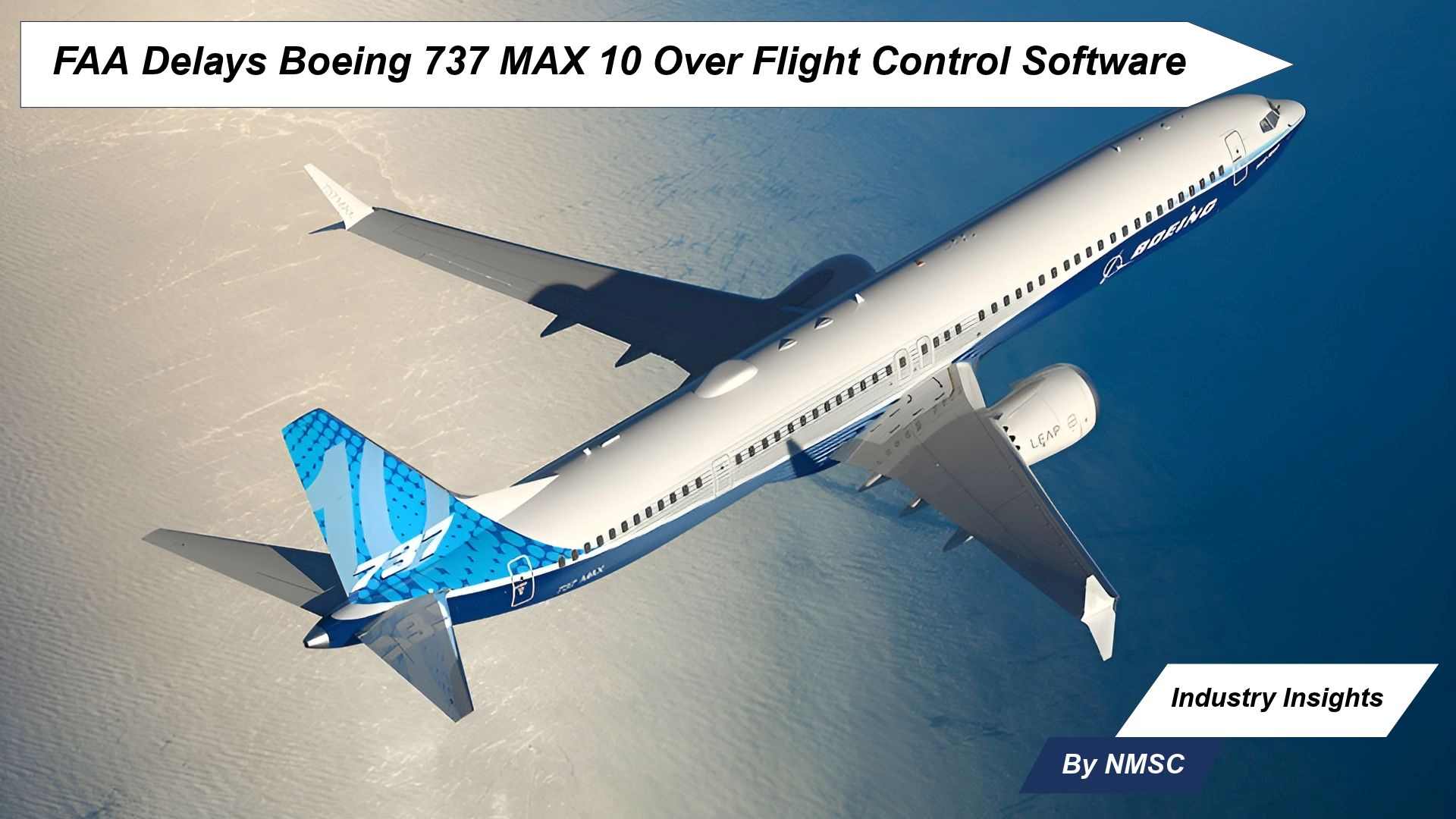
FAA Halts Boeing 737 MAX 10 Certification Over Flight Management Computer Software Fault
WASHINGTON, D.C., United States September 30, 2026, the U.S. Federal Aviation Administration (FAA) has delayed certification of Boeing's 737 MAX 10 the largest variant of the 737 MAX family after a software fault was identified in the aircraft's flight management system that can cause pilots to lose automated vertical flight guidance during a specific missed-approach procedure. The development represents a significant regulatory setback with direct implications for the global Aircraft Flight Control System Market, which is projected to reach USD 34.56 billion by 2030, according to Next Move Strategy Consulting.
FAA Administrator Bryan Bedford confirmed the delay on September 28, 2026, stating the agency would not proceed with certification "until we're satisfied that we don't have an issue here." The announcement was made at an event at Reagan Washington National Airport, with Bedford declining to provide a revised timetable for approval. The FAA has since convened a Corrective Action Review Board (CARB) to formally assess whether the software behavior poses an unreasonable safety risk.
The software fault affects the Vertical Navigation (VNAV) function within the aircraft's flight management computer. The issue manifests after pilots abandon a landing attempt and subsequently modify their pre-programmed flight path, causing the VNAV system to disengage and revert to a less sophisticated form of automated pitch guidance. Boeing has stated that existing procedures allow flight crews to manage the condition safely and that the autopilot remains available through secondary automation modes.
The delay compounds years of setbacks surrounding the MAX 10, which Boeing is relying upon to compete with Airbus's A321neo in the higher-capacity single-aisle market. Boeing shares closed nearly 7% lower following the announcement, reflecting investor concern over further disruption to an aircraft central to the company's commercial recovery. The FAA had certified the smaller 737 MAX 7 on August 3, 2026, and Boeing CEO Kelly Ortberg had indicated earlier in September that MAX 10 certification was imminent. Dozens of airlines, including major U.S. carriers, hold sizeable orders for the type.
Key Highlights:
-
FAA Administrator Bryan Bedford confirmed on September 28, 2026, that Boeing 737 MAX 10 certification will be delayed pending resolution of a flight management computer software fault affecting the VNAV automated guidance function
-
The fault increases pilot workload during go-around procedures by disengaging vertical navigation under a specific sequence of events, though Boeing maintains pilots retain full control of the aircraft
-
Boeing shares fell approximately 7% following the announcement, reflecting market concern over further delays to a key aircraft in the company's single-aisle competitive strategy against Airbus
-
The FAA has convened a Corrective Action Review Board (CARB) to determine whether the software poses an unreasonable safety risk, with no revised certification timeline announced as of September 30, 2026
Analyst Insight:
According to analysts at Next Move Strategy Consulting, the FAA's intervention underscores the intensifying regulatory scrutiny applied to flight management computer software a segment that is central to the broader aircraft flight control system market's growth trajectory. NMSC analysts note that while the certification delay introduces near-term uncertainty for Boeing's delivery schedule and airline fleet planning, it simultaneously reinforces the long-term demand for rigorously validated, safety-certified flight control technologies. This dynamic is consistent with the market's projected expansion at a CAGR of 8.3% through 2030, driven by the aviation industry's continued investment in advanced automation, fly-by-wire systems, and AI-integrated flight control solutions. The episode also highlights the growing importance of software supply chain accountability, given that the affected software was developed by GE Aerospace rather than Boeing directly.
Industry Outlook:
The FAA's decision to delay Boeing 737 MAX 10 certification places the reliability and regulatory compliance of flight management computer software under renewed industry scrutiny. As aviation regulators worldwide intensify oversight of automated flight guidance technologies, manufacturers and software suppliers face heightened pressure to deliver solutions that satisfy increasingly stringent airworthiness standards. The outcome of the FAA's Corrective Action Review Board process will be closely monitored by airlines, investors, and aerospace suppliers, as it may establish precedents for how regulators approach software-related certification challenges across the commercial aviation sector. For the aircraft flight control system market, the episode reinforces the imperative for sustained investment in software reliability, cybersecurity resilience, and human factors engineering as the industry advances toward greater levels of automation and digital integration.
Source: Aerospace Global News
For More Information: Download FREE Sample on Aircraft Flight Control System Market Report
Prepared By: Sanyukta Deb
About the Author
 Sanyukta Deb
— Sanyukta Deb is Digital Marketing Team Lead at Next Move Strategy Consulting, where she has led content strategy and technical SEO for the firm's B2B market research publications for over 2 years. Her editorial process translates NextMSC's primary and secondary research — spanning technology, industrial, and consumer sectors — into commercial narratives, backed by search-intent, keyword, and competitive analysis. She brings 5 years of overall experience in digital marketing and content strategy.
Sanyukta Deb
— Sanyukta Deb is Digital Marketing Team Lead at Next Move Strategy Consulting, where she has led content strategy and technical SEO for the firm's B2B market research publications for over 2 years. Her editorial process translates NextMSC's primary and secondary research — spanning technology, industrial, and consumer sectors — into commercial narratives, backed by search-intent, keyword, and competitive analysis. She brings 5 years of overall experience in digital marketing and content strategy.
About the Reviewer
 Debashree Dey
— Debashree Dey is Assistant Manager at Next Move Strategy Consulting, where she supports cross-vertical market content and communications across diverse industries for 6 years. Her professional background includes senior content writing, communications, and published manuscript authorship, with experience developing audience-focused business narratives and maintaining clear, consistent messaging. Her role supports research-led content development and editorial quality across NextMSC publications.
Debashree Dey
— Debashree Dey is Assistant Manager at Next Move Strategy Consulting, where she supports cross-vertical market content and communications across diverse industries for 6 years. Her professional background includes senior content writing, communications, and published manuscript authorship, with experience developing audience-focused business narratives and maintaining clear, consistent messaging. Her role supports research-led content development and editorial quality across NextMSC publications.


















Add Comment