Army Stores 10,000 IVAS Headsets as Wearable Military Computer Demand Moves
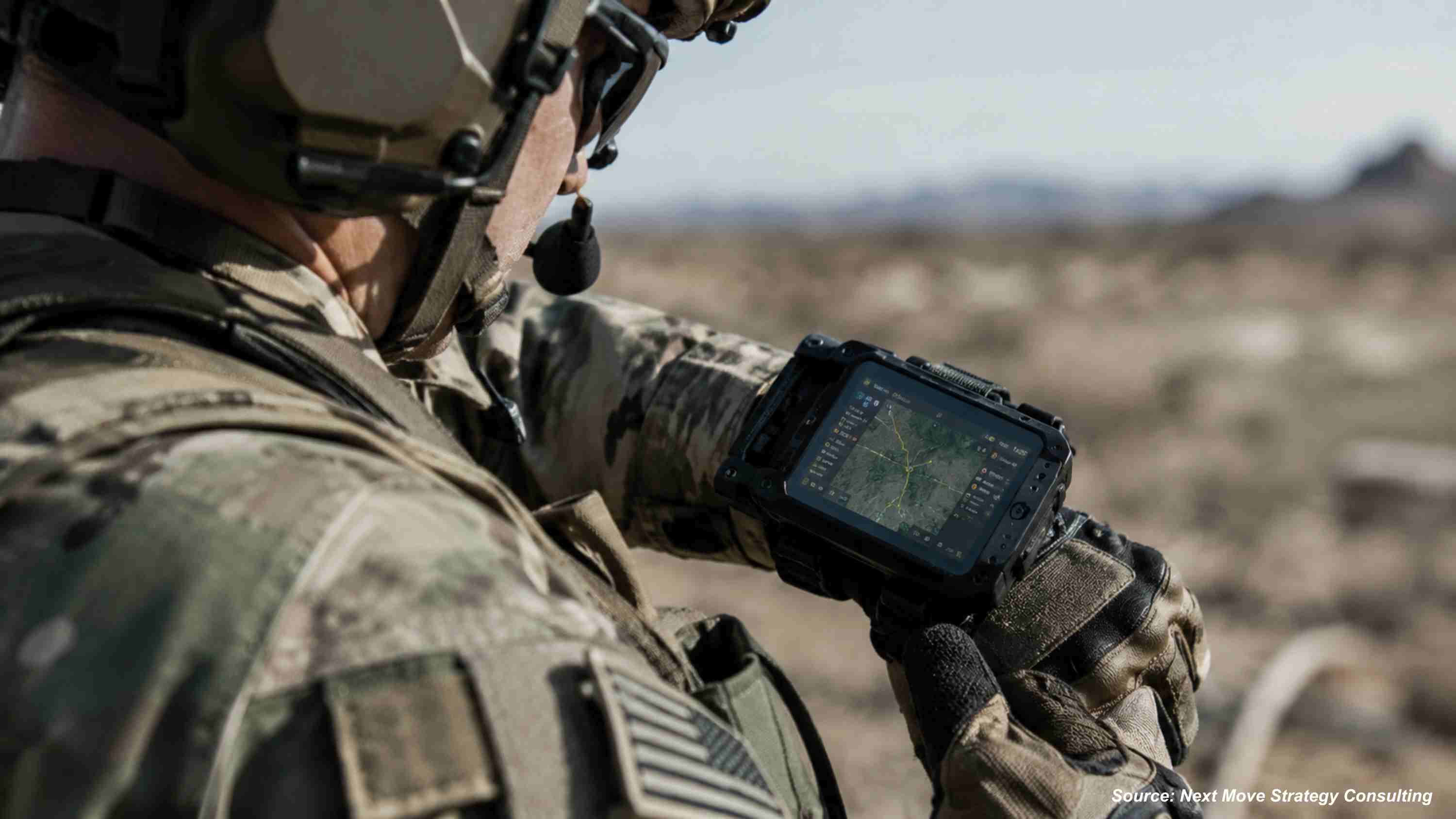
GAO's 9 June Finding on 10,000 Stored IVAS Headsets, Anduril's Phase-Two Redesign and Germany's EUR 1.04 Billion IdZ-ES Order Show Soldier-Worn Computing Moving From Prototype Spending to Funded Programs
On 9 June 2026, the U.S. Government Accountability Office reported in Weapon Systems Acquisition: Beyond Business as Usual (GAO-26-109135) that the Army's Integrated Visual Augmentation System (IVAS), a programme meant to give close-combat soldiers augmented-reality headgear, has yet to deliver operational capability after three acquisition efforts over eight years. The agency found that nearly 10,000 units of the first two versions do not meet soldiers' needs and will go into storage, with some potentially used for testing rather than fielded. Task & Purpose reported on 12 June 2026 that the Defense Department spent about USD 1.8 billion on the programme, a figure GAO officials confirmed matches their own estimate. The finding redirects U.S. soldier-worn computing spending to the Army's Soldier Borne Mission Command (SBMC) rapid prototyping effort, where Anduril Industries, Rivet Industries and Elbit Systems of America hold prototype awards.
According to Next Move Strategy Consulting's Wearable Military Computer Market report, the global wearable military computer market was valued at USD 1,130.00 million in 2025 and is projected to reach USD 3,950.00 million by 2035, growing at a CAGR of 13.2% from 2026 to 2035. NextMSC primary research and analysis estimates the market at USD 1,290.00 million in 2026 and identifies record defence budgets, national soldier-system programmes and tactical-edge AI demand as the principal drivers, with North America holding approximately 43% of 2025 revenue.
For More Information: Download FREE Sample on Wearable Military Computer Market Report
The Financial Logic: Record Defence Budgets Meet a Costly Prototype Reset
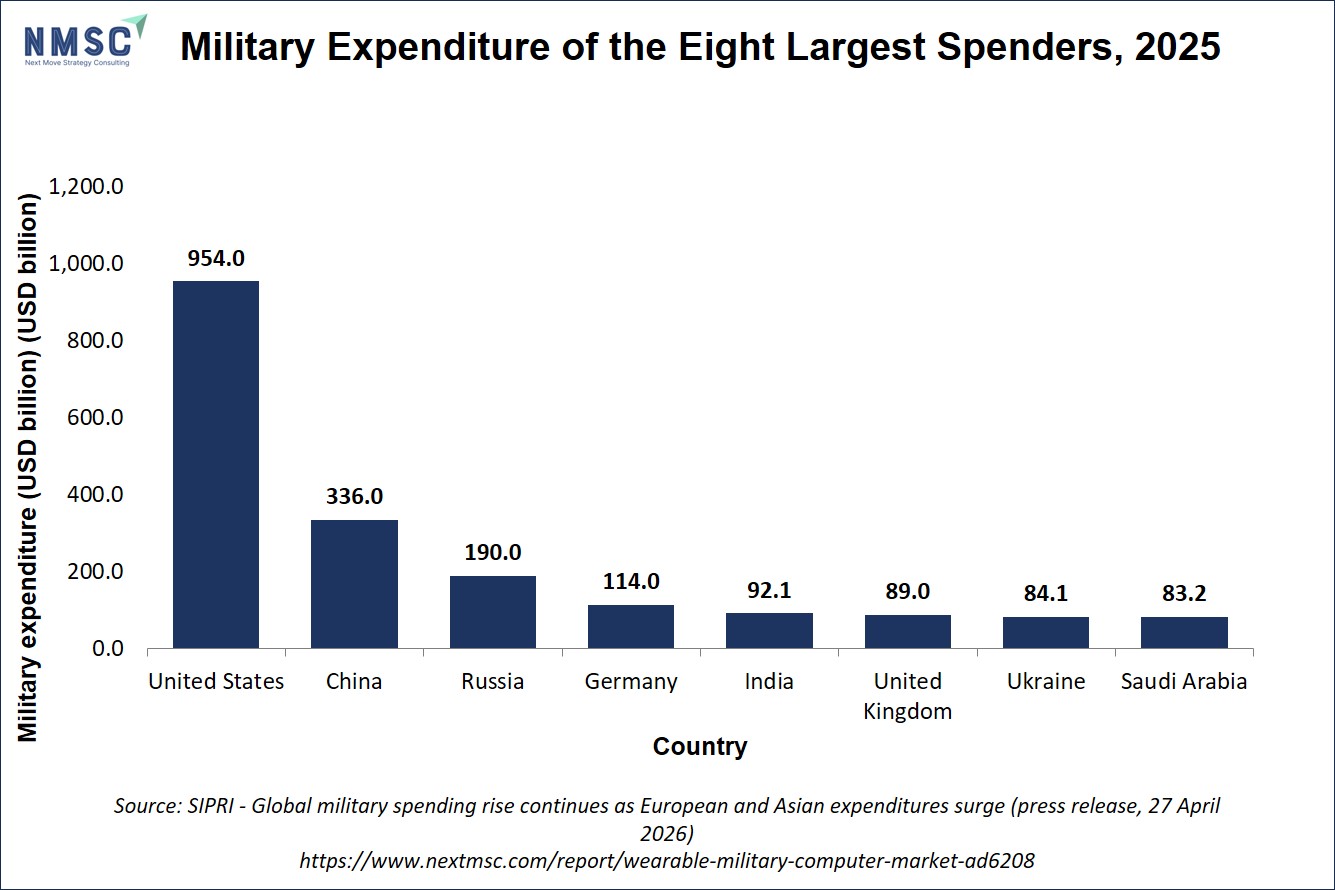
The funding base behind soldier modernisation keeps expanding. The Stockholm International Peace Research Institute (SIPRI) reported on 27 April 2026 that world military expenditure reached USD 2,887 billion in 2025, a 2.9% real-terms increase and the 11th consecutive annual rise, lifting the global military burden to 2.5% of GDP, the highest since 2009. European spending rose 14% to USD 864 billion, spending in Asia and Oceania rose 8.1% to USD 681 billion, and Germany, the largest military spender among European NATO members, raised its budget 24% to USD 114 billion, or 2.3% of its GDP.
The United States remains the largest spender at USD 954 billion, although SIPRI recorded a 7.5% decline in 2025 because no new financial military assistance for Ukraine was approved that year. SIPRI's Nan Tian, Programme Director of its Military Expenditure and Arms Production Programme, said in the release that Congress-approved spending for 2026 has risen above USD 1 trillion. For wearable computing suppliers, the budget signal is that dismounted-soldier programmes compete for funding from a rising total, while the GAO finding shows that U.S. funding now follows demonstrated user acceptance rather than prototype ambition. NextMSC primary research and analysis attributes a +3.1% impact on the market's CAGR to record defence budgets and rearmament.
Key Industry Developments: Dated Awards and Orders That Define Procurement
The Army has been explicit about why it changed course. Army spokesperson Ellen Lovett told Task & Purpose on 12 June 2026 that more than 400 IVAS 1.2 prototypes improved low-light sensor performance and reliability with minor form-factor changes, but were assessed as unaffordable to produce at scale. Military Times reported on 8 July 2026 that GAO found problems reported with versions 1.0 and 1.1, including poor low-light performance and added weight on helmets, were not adequately addressed in version 1.2, and that about 400 version 1.2 goggles will inform the design of SBMC under a contract now held by Anduril.
“The Army decided to pivot to the Soldier Borne Mission Command System…”
— Ellen Lovett, Spokesperson, U.S. Army, statement to Task & Purpose, 12 June 2026.
DefenseScoop reported on 17 August 2026 that Anduril is moving from phase one to phase two of SBMC prototyping. Quay Barnett, Anduril's general manager of warfighter systems, told reporters that the government approved a new phase-two design with a digital night-vision interface, that Anduril will deliver 170 phase-two prototypes with testing slated for late January or early February, and that a downselect and production award could come in fiscal 2028. Anduril later clarified to DefenseScoop that its phase-one systems remain company-owned and were not formal contractual deliveries. Wearable elements of the phase-one product include glasses, a sensor bar, an edge compute device, a battery and a controller.
Europe offers the contrasting model of committed volume. Rheinmetall announced on 27 April 2026 that Germany's procurement office called off further Infantry Soldier of the Future – Enhanced System (IdZ-ES) systems worth about EUR 1.04 billion gross from a framework agreement signed in February 2025 with a maximum value of EUR 3.1 billion and a term to 2030. Another 8,600 soldiers receive the equipment, the Bundeswehr will operate 353 platoon systems comprising more than 12,000 individual equipment sets, deliveries run from November 2027 to December 2029, and Rheinmetall coordinates more than 30 subcontractors.
Soldier-Worn Computing Awards and Orders in the Current Cycle
|
Award or order |
Date |
Value and scale |
|
Anduril Industries, SBMC prototyping, U.S. Army |
September 2025 |
USD 159 million initial prototyping contract |
|
Rivet Industries, SBMC prototyping, U.S. Army |
September 2025 |
USD 195 million agreement |
|
Elbit Systems of America, SBMC other transaction agreement, U.S. Army |
10 March 2026 |
USD 120.5 million; Booz Allen builds the software backbone |
|
Rheinmetall, IdZ-ES call-off, Bundeswehr |
27 April 2026 |
EUR 1.04 billion gross; 8,600 additional soldiers; deliveries November 2027 to December 2029 |
The three U.S. awards sum to USD 474.5 million (USD 159 million plus USD 195 million plus USD 120.5 million, NextMSC calculation from the announced values), a fraction of the USD 22 billion ceiling once associated with IVAS, which the Congressional Research Service notes was expected to cost that amount. Elbit Systems of America, the SBMC awardee, rebranded as Twenty-Six Defense on 9 September 2026, according to the Twenty-Six Defense newsroom.
Segment Dynamics: Head-Mounted Systems and Software Outgrow the Core Computer
According to NextMSC primary research and analysis, body-worn core computers form the largest product segment, rising from USD 535.62 million in 2025 to USD 1,619.50 million by 2035 at an 11.7% CAGR. Head-mounted display computing systems are the fastest-growing product segment at 16.5% CAGR, expanding from USD 267.8 million to USD 1,303.5 million, because helmet-mounted units increasingly carry the compute payload as optics, batteries and thermal design mature. Wrist and chest-mounted end-user devices grow at 12.3% CAGR, from USD 326.6 million to USD 1,027.0 million.
Wearable Military Computer Market by Product Type (USD Million)
|
Product type |
2025 |
2035 |
CAGR |
|
Body worn core computers |
535.6 |
1,619.5 |
11.7% |
|
Head mounted display computing systems |
267.8 |
1,303.5 |
16.5% |
|
Wrist and chest mounted end user devices |
326.6 |
1,027.0 |
12.3% |
By application, situational awareness and navigation is the largest segment, rising from USD 435.05 million in 2025 to USD 1,224.50 million by 2035, while targeting and sensor fusion is the fastest-growing at 16.92% CAGR. By component, hardware leads at USD 807.95 million in 2025 and reaches USD 2,330.50 million by 2035, while software is the fastest-growing at 17.28% CAGR. NextMSC primary research and analysis estimates that software and services will lift their combined share of revenue from 28.5% in 2025 to 41.0% by 2035, which matches the Army's decision to buy staged prototypes built around a software architecture rather than a single hardware design.
Regional Outlook
NextMSC primary research and analysis places North America at USD 485.90 million in 2025, or approximately 43.0% of global revenue, rising to USD 1,520.75 million by 2035 at a 12.0% CAGR, with SBMC prototyping as the primary regional driver. The U.S. market is estimated at USD 408.16 million in 2025 and USD 1,216.60 million by 2035 at 11.5% CAGR. Europe is estimated at USD 322.05 million in 2025, a 28.5% share, reaching USD 1,106.00 million by 2035 at 12.8% CAGR; for Germany, NextMSC estimates USD 96.62 million in 2025 and USD 309.68 million by 2035 at 12.0% CAGR, supported by the IdZ-ES call-off schedule.
Asia-Pacific is the fastest-growing region at a 16.5% CAGR, from USD 209.05 million in 2025 (18.5% share) to USD 967.75 million by 2035. India is the fastest-growing country market in NextMSC's analysis at 21.6% CAGR, from USD 18.81 million to USD 135.49 million, and SIPRI reported that India raised military spending 8.9% to USD 92.1 billion in 2025. Middle East and Africa is estimated at USD 71.19 million in 2025 (6.3% share) and USD 233.05 million by 2035 at 12.4% CAGR, and Latin America at USD 41.81 million (3.7% share) and USD 122.45 million at 12.5% CAGR.
Wearable Military Computer Market by Region (USD Million)
|
Region |
2025 |
2035 |
CAGR |
|
North America |
485.90 |
1,520.75 |
12.0% |
|
Europe |
322.05 |
1,106.00 |
12.8% |
|
Asia-Pacific |
209.05 |
967.75 |
16.5% |
|
Middle East & Africa |
71.19 |
233.05 |
12.4% |
|
Latin America |
41.81 |
122.45 |
12.5% |
Growth Drivers and Restraints
Wearable Military Computer Market: Growth Catalyst and Risk Assessment Matrix
|
Factor |
Type |
Impact on CAGR |
Geography |
Timeline |
|
Record defense budgets and rearmament |
Driver |
+3.1% |
Europe, North America, Asia-Pacific |
2026–2035 |
|
National soldier system programs |
Driver |
+2.8% |
North America, Europe |
2026–2032 |
|
Edge AI and sensor fusion demand |
Driver |
+2.2% |
Global |
2026–2035 |
|
Drone and robot control from the soldier |
Driver |
+1.4% |
North America, Asia-Pacific, Middle East |
2027–2035 |
|
Program cancellations and prototype volatility |
Restraint |
−1.9% |
North America |
2026–2028 |
|
Soldier comfort, weight and battery limits |
Restraint |
−1.5% |
Global |
2026–2031 |
|
Cybersecurity and electromagnetic signature risk |
Restraint |
−1.1% |
Global |
2026–2035 |
|
Export controls and sovereign sourcing rules |
Restraint |
−0.8% |
Middle East, Asia-Pacific |
2026–2035 |
The restraint ranked first in the matrix, program cancellations and prototype volatility at −1.9% for North America over 2026 to 2028, is the one the GAO finding has now made concrete. The agency's report that IVAS did not adequately incorporate user feedback, and moved into production with limited operational-environment testing, explains why NextMSC primary research and analysis weights soldier comfort, weight and battery limits as the second-largest restraint at −1.5%.
NMSC Strategic Perspective: Funded Frameworks Now Outrank Prototype Headlines
NextMSC primary research and analysis reads the IVAS outcome as a repricing of programme risk rather than a loss of demand. The U.S. Army has consolidated the competition into SBMC, whose phase-two hardware reaches testing in early 2027 with a production decision possibly in fiscal 2028, while Germany's IdZ-ES call-off converts a 2025 framework into delivery obligations from November 2027 to December 2029. NextMSC distinguishes these two forms of revenue: framework call-offs give suppliers committed volume and visibility, whereas prototype-stage awards fund development and carry the risk that no volume order follows.
NextMSC's analysis further indicates that the value inside a wearable computer is moving from the box to the software and the head-mounted display. Software is the fastest-growing component at 17.28% CAGR, head-mounted display computing systems are the fastest-growing product type at 16.5% CAGR, and targeting and sensor fusion is the fastest-growing application at 16.92% CAGR. These three segments share a trait: they are bought as part of an integrated soldier system, so their revenue depends on a supplier holding a position in a funded national programme rather than on stand-alone catalogue sales.
For suppliers, NextMSC's strategic recommendation is to anchor positions in funded national programmes, build open software that other armies can adopt, and design for lower weight and power from the start, because the Army's stated reasons for abandoning the first two IVAS versions were wearability, performance and cost at scale. For investors, NextMSC identifies an incremental revenue opportunity of USD 2,660.00 million between 2026 and 2035, and advises discounting companies that depend on a single unproven prototype award while favouring suppliers with committed programme positions and diversified customers. The timing of the SBMC downselect and the IdZ-ES delivery window are, in NextMSC's analysis, the two dated catalysts that most affect near-term hardware volumes.
Competitive Landscape
NextMSC primary research and analysis identifies Rheinmetall, Anduril, Elbit Systems, Safran and General Micro Systems as the five verified key players, and finds that competition centres on programme awards rather than catalogue sales. Rheinmetall relies on its role as general contractor for the German soldier system, as its 27 April 2026 press release confirms. Anduril builds a partner team around its Lattice software platform and, according to DefenseScoop, worked with Meta and Oakley's Standard Issue brand on the phase-one glasses and with a company sensor bar for night use. Elbit Systems of America announced on 10 March 2026 that it will develop SBMC with Booz Allen building the software backbone, extending its see-through display and night-vision heritage into mission command.
Each of these positions rests on a dated, traceable event, and each carries a different risk. A national prime integrator such as Rheinmetall holds committed deliveries to 2029, a technology entrant such as Anduril holds a prototype contract with a possible fiscal 2028 production decision, and a subsidiary such as Elbit Systems of America holds a third prototype award in the same competition. NextMSC primary research and analysis treats the partnership model, rather than acquisition, as the faster route into this market, because every award described in this article was won by a team of named partners.
Bottom Line
The global wearable military computer market is moving from prototype headlines to funded programme delivery. The U.S. Government Accountability Office's 9 June 2026 finding that nearly 10,000 Integrated Visual Augmentation System headsets will go into storage, after about USD 1.8 billion of spending, has pushed U.S. soldier-worn computing into Soldier Borne Mission Command, where Anduril's general manager of warfighter systems said a downselect and production award could come in fiscal 2028. Germany's EUR 1.04 billion IdZ-ES call-off, with deliveries from November 2027 to December 2029, shows the other model: a framework contract with committed volume. According to NextMSC primary research and analysis, the market will grow from USD 1,130.00 million in 2025 to USD 3,950.00 million by 2035 at a 13.2% CAGR, with head-mounted systems growing at 16.5%, software at 17.28% and Asia-Pacific at 16.5%. Suppliers with open software, lighter power designs and positions in funded national programmes are best placed to capture the USD 2,660.00 million of incremental revenue forecast between 2026 and 2035.
About Next Move Strategy Consulting
Next Move Strategy Consulting is a premier market research and management consulting firm that has been committed to provide strategically analysed well documented latest research reports to its clients. The research industry is flooded with many firms to choose from, what makes NMSC different from the rest is its top-quality research and the obsession of turning data into knowledge by dissecting every bit of it and providing fact-based research recommendation that is supported by information collected from over 500 million websites, paid databases, industry journals and one on one consultations with industry experts across a diverse range of industry sectors. The high-quality customized research reports with actionable insights and excellent end-to-end customer service help our clients to take critical business decisions that enables them to move beyond time and have competitive edge in the industry.
We have been servicing over 1000 customers globally that includes 90% of the Fortune 500 companies over a decade. Our analysts are constantly tracking various high growth markets and identifying hidden opportunities in each sector or the industry. We provide one of the industry’s best quality syndicate as well as custom research reports across 10 different industry verticals. We are committed to deliver high quality research solutions in accordance to your business needs. Our industry standard delivery solutions that ranges from the pre consultation to after-sales services, provide an excellent client experience and ensure right strategic decision making for businesses.
For more information, please contact:
Next Move Strategy Consulting
5th Floor 867 Boylston St, STE 500,
Boston, MA 02116, U.S.
E-Mail: [email protected]
Direct: +1-217-650-7991
Website: www.nextmsc.com
About the Author
 Sanyukta Deb
— Sanyukta Deb is Digital Marketing Team Lead at Next Move Strategy Consulting, where she has led content strategy and technical SEO for the firm's B2B market research publications for over 2 years. Her editorial process translates NextMSC's primary and secondary research — spanning technology, industrial, and consumer sectors — into commercial narratives, backed by search-intent, keyword, and competitive analysis. She brings 5 years of overall experience in digital marketing and content strategy.
About the Reviewer
 Debashree Dey
— Debashree Dey is Assistant Manager at Next Move Strategy Consulting, where she supports cross-vertical market content and communications across diverse industries for 6 years. Her professional background includes senior content writing, communications, and published manuscript authorship, with experience developing audience-focused business narratives and maintaining clear, consistent messaging. Her role supports research-led content development and editorial quality across NextMSC publications.















Add Comment