FAA Opens the High Seas to Commercial Drones While Part 108 Stays Pending
FAA's first coastline-to-platform BVLOS waiver, Walmart's 300-site Zipline order and a USD 21.5 billion valuation show operators committing capital while the final Part 108 rule sits in White House review
On November 9, 2026, the Federal Aviation Administration issued the first authorization for a drone to fly beyond the operator's visual line of sight from the U.S. coastline over the Gulf of America, clearing Austin-based Skyways to operate its autonomous V2 aircraft from a Shell Pipeline Company facility in Gibson, Louisiana, to a Shell platform offshore, the FAA newsroom said in its release of that date. The flight will combine a pipeline right-of-way inspection with a simulated equipment delivery. The decision arrives while the wider beyond-visual-line-of-sight (BVLOS) framework, known as Part 108, remains unpublished.
According to Next Move Strategy Consulting's Commercial & Industrial Drone Market report, the global commercial and industrial drone market was valued at USD 12.60 billion in 2025 and is projected to reach USD 38.50 billion by 2035, growing at a CAGR of 11.6% from 2026 to 2035. NextMSC primary research and analysis places the 2026 value at USD 14.30 billion, with Asia-Pacific holding about 41% of 2025 revenue and hardware about 51%.
For More Information: Download FREE Sample on Commercial & Industrial Drone Market Report
What the FAA Authorized, and What Remains Unsettled
Skyways described the aircraft and its record in a November 9, 2026 announcement distributed through PR Newswire. The V2 pairs electric vertical takeoff and landing with a heavy-fuel cruise engine and satellite-based command and control. Skyways reported 3,500 autonomous flights and about 90,000 kilometers flown worldwide, including cargo missions for the U.S. Navy, the Japanese Ministry of Defense, DSV, Skyports Drone Services and All Nippon Airways.
The authorization is narrower than a rule. It covers one planned mission, and Skyways described recurring paid offshore work as an objective the waiver should support, not as an operation already under way. The FAA newsroom release said the agency used Section 927 of the FAA Reauthorization Act of 2024, which lets it approve certain drone operations by waiver rather than through rulemaking or an exemption.
The rule that would make such flights routine has not published. The Office of Information and Regulatory Affairs lists the FAA's final rule, titled Normalizing Unmanned Aircraft Systems Beyond Visual Line of Sight Operations, as received on July 10, 2026 with a status of Pending Review in the record consulted for this article, and the Federal Register published the original proposal on August 7, 2025. Until the final text appears, operators depend on waivers and exemptions, including the Section 927 route used for Skyways.
“This authorization opens up a much larger operating envelope for us in the US”
- Charles Acknin, Co-founder and Chief Executive Officer, Skyways, Skyways announcement distributed through PR Newswire, November 9, 2026.
The Financial Logic: Capital Is Moving Ahead of the Rule
Investors and retailers reached their own conclusions in the same week. On November 5, 2026, TechCrunch reported that Zipline raised USD 1.5 billion at a USD 21.5 billion valuation in a round led by Paradigm, WCM Investment Management and Layer Global, and that the company plans to spend the proceeds on U.S. manufacturing and hiring for a nationwide delivery network. TechCrunch also reported that Zipline and Walmart agreed a multi-year deal to add 300 drone delivery sites, against the 21 active sites the two companies operate together today.
Walmart's own release of November 5, 2026 gives the operating base behind that order: more than 2 million drone deliveries completed, and Zipline's 150 million commercial autonomous miles flown without a major safety incident. Walmart also noted that 90% of Americans live within 10 miles of one of its stores, the distribution logic for placing launch sites at existing store locations. The 300 additions are more than 14 times the 21 sites now active, a NextMSC calculation from the two reported figures. Zipline's share of delivery revenue rose from 10.8% to 34.9% between March and October, the company said, according to TechCrunch.
Alphabet's Wing made a parallel commitment. Dallas Innovates reported on November 10, 2026 that Wing chief executive Adam Woodworth announced on November 6 up to USD 125 million of U.S. manufacturing investment over two years, anchored by a 15,000-square-foot Fort Worth plant with up to 100 jobs and capacity for tens of thousands of drones a year. Wing said its drones completed more than 1 million home deliveries this year from nearly 70 Walmart stores in five U.S. metros and that it aims to serve more than 270 Walmart stores. Wing described the investment as production capacity ahead of anticipated FAA regulation.
Demand Base: What the FAA Registry Shows
The FAA's own fleet data show a commercial base that is large but growing more slowly. The Federal Aviation Administration's Compendium to FAA Aerospace Forecast 2026-2046 reports 424,516 active nonrecreational small aircraft under Part 107 at the end of 2025, up 24,000 from a year earlier. New registrations peaked in 2024 at an average of 11,300 a month and slipped to about 10,500 a month in 2025, while monthly expirations and cancellations rose from 8,110 to 8,510. The base forecast reaches 540,845 aircraft by 2030, a 5.0% CAGR, and remote pilot certifications, which stood at 493,396 in December 2025, reach 628,600.
FAA Forecast: Active Nonrecreational Small UAS Fleet Under Part 107, Units (2025 Actual, 2026-2030 Forecast)
|
Calendar year |
Low |
Base |
High |
|
2025 (actual) |
424,516 |
424,516 |
1,074,451 |
|
2026 |
443,860 |
457,437 |
1,170,593 |
|
2027 |
455,680 |
484,154 |
1,258,383 |
|
2028 |
463,127 |
506,644 |
1,340,109 |
|
2029 |
468,229 |
525,422 |
1,417,922 |
|
2030 |
470,039 |
540,845 |
1,491,153 |
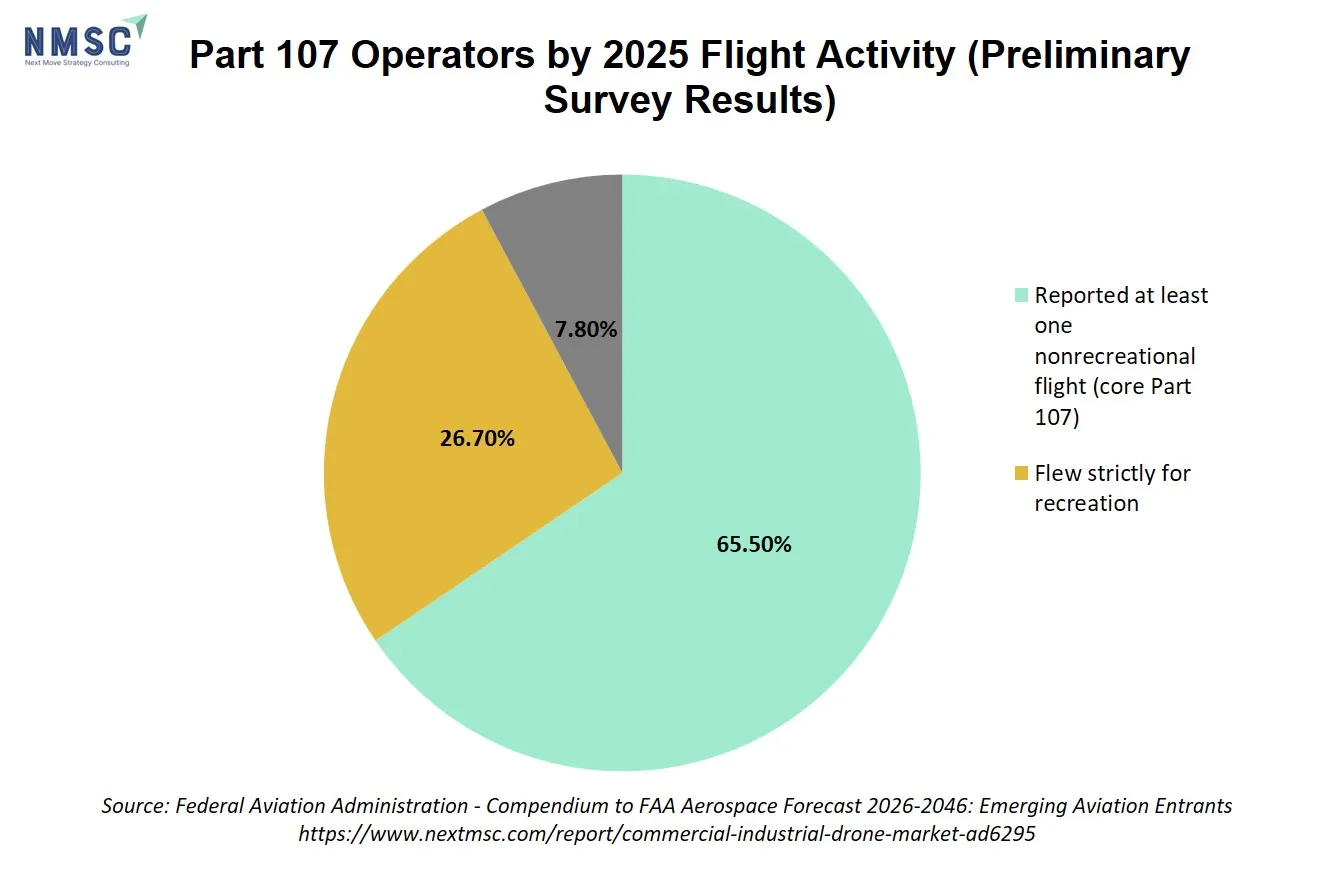
The FAA's 2025 UAS Operator Survey adds a caution about what the registry counts. The preliminary results, drawn from just under 70,000 respondents, show that 65.9% of Part 107 operators reported at least one nonrecreational flight, 26.6% flew strictly for recreation and 7.5% reported no flights, so about one in three registered operators flies for no commercial purpose.
Supply Chain: A Reset in Where U.S. Commercial Drones Come From
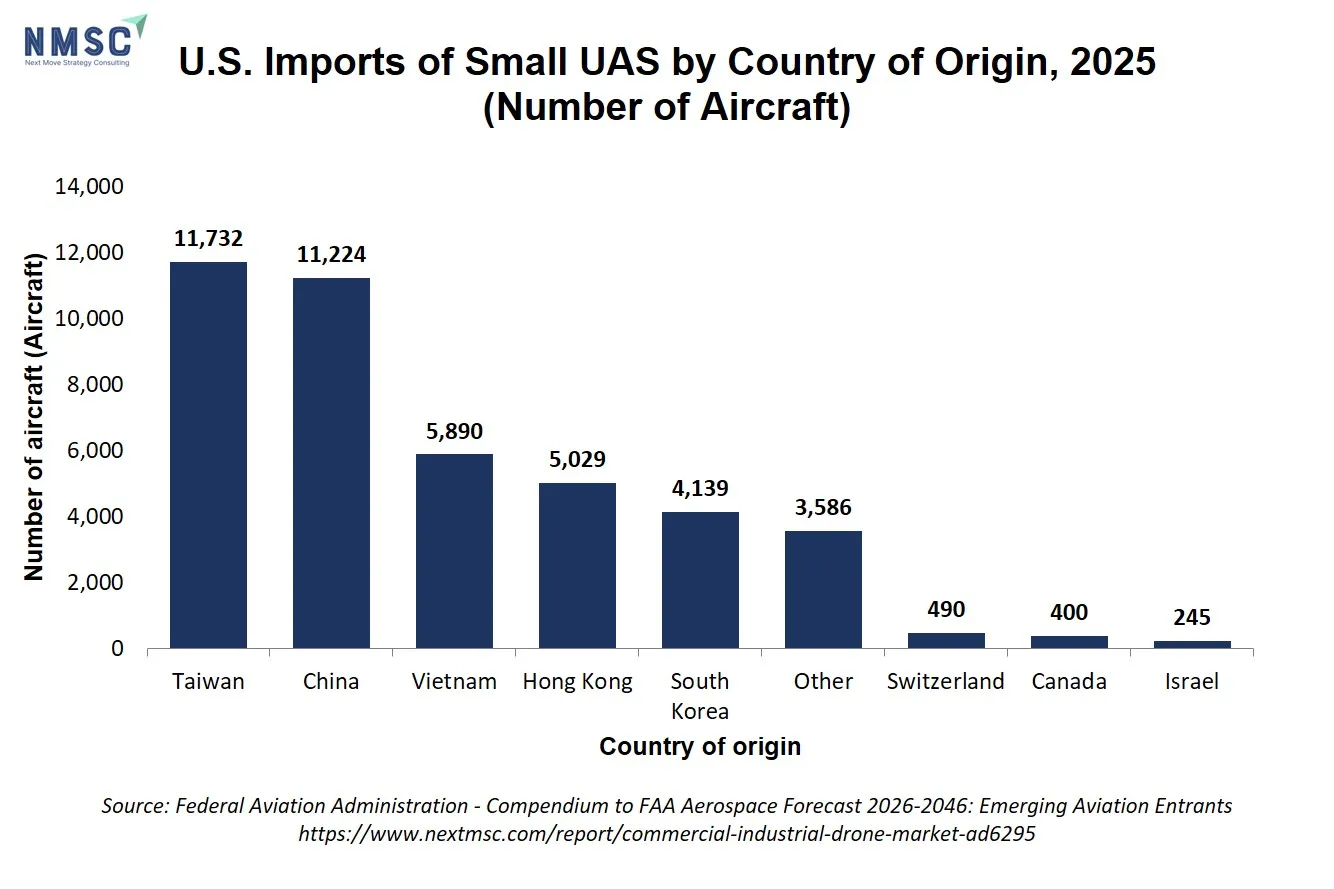
Supply is shifting as quickly as demand. The FAA compendium reports that the United States imported more than 56,000 unmanned aircraft in 2025 with a declared value of USD 260 million, with both volume and value down nearly 75% from 2024. Small drone imports fell from 155,000 units to 42,000, while the average declared value per imported aircraft across all weight classes rose from USD 1,800 to USD 4,600. Taiwan, China and Vietnam were the largest sources of small drones by unit count, and Canada led by value at USD 25.39 million on 400 aircraft.
Large drones, those above 55 pounds, show a sharper break. Imports fell 25%, from 5,144 aircraft in 2024 to 3,787 in 2025, and shipments from China dropped from 3,765 to 894 aircraft, with the value of Chinese large drone imports down 92%, the compendium says. The FAA also reports that new agricultural spraying registrations among large drones fell 58.7%, from 1,432 to 592, while non-agricultural large drone registrations rose 204%, from 1,368 to 4,161.
U.S. Imports of Large UAS (Over 55 Pounds) by Country of Origin, 2025
|
Country of origin |
Value (USD millions) |
Aircraft |
Average price per aircraft (USD) |
|
United Kingdom |
6.35 |
123 |
51,589 |
|
France |
0.24 |
90 |
2,655 |
|
Croatia |
0.02 |
468 |
36 |
|
Switzerland |
0.96 |
79 |
12,205 |
|
Canada |
0.58 |
80 |
7,221 |
|
China |
1.55 |
894 |
1,738 |
|
Spain |
0.88 |
57 |
15,516 |
|
Thailand |
0.11 |
1,645 |
64 |
|
Japan |
0.29 |
142 |
2,050 |
|
Other |
0.69 |
209 |
3,304 |
Policy is reinforcing the reset. The Federal Communications Commission fact sheet of December 22, 2025 added foreign-produced drones and critical components to its Covered List, which prevents new equipment authorizations while leaving ongoing use of previously authorized drones undisturbed. The FAA compendium notes that China controls roughly 90% of the global commercial UAS market and that most U.S. manufacturers still depend on Chinese batteries, motors, flight controllers and printed circuit boards, so final assembly in the United States does not yet mean supply independence.
Segment Dynamics: Services and Software Gain Share
According to NextMSC primary research and analysis, hardware held about 51% of 2025 revenue at USD 6.40 billion and grows at 9.5% CAGR to USD 15.90 billion by 2035. Services are valued at USD 4.90 billion in 2025 and reach USD 16.40 billion by 2035 at 12.5% CAGR, overtaking hardware, while software and analytics, the fastest-growing offering at 16.7% CAGR, rises from USD 1.30 billion to USD 6.20 billion. Together, software and services reach 59% of 2035 revenue in NextMSC's model, which fits the operating pattern behind the Zipline and Skyways announcements: buyers pay for flights completed and data delivered rather than airframes owned.
By platform, multirotor aircraft held USD 9.70 billion in 2025 and reach USD 24.00 billion by 2035, while hybrid VTOL is the fastest-growing platform at 18.5% CAGR from 2026 to 2035, the architecture Skyways uses for its V2. By application, inspection, mapping and surveying held the largest share at USD 4.30 billion in 2025, and delivery and logistics grows fastest at 22.6% CAGR, rising from USD 1.25 billion in 2026 to USD 7.80 billion by 2035. These are NextMSC proprietary estimates and are kept separate from the externally sourced figures elsewhere in this article.
Regional Outlook: Asia-Pacific Leads, Middle East and Africa Grows Fastest
NextMSC primary research and analysis puts Asia-Pacific at USD 5.20 billion in 2025, about 41% of the total, rising to USD 16.20 billion by 2035 at 11.8% CAGR. North America generated USD 3.60 billion in 2025 and reaches USD 10.50 billion by 2035 at 11.3% CAGR, Europe moves from USD 2.50 billion to USD 7.30 billion at 11.2%, and Latin America from USD 0.60 billion to USD 1.90 billion at 10.9%. Middle East and Africa is the fastest-growing region at 14.0% CAGR, from USD 0.80 billion in 2026 to USD 2.60 billion by 2035. India is projected to grow from USD 0.55 billion in 2025 to USD 2.20 billion by 2035 at 14.5% CAGR. NextMSC also finds that North American fleet value keeps rising while unit registrations flatten, which the FAA registration data above are consistent with.
Growth Drivers and Restraints: An Evidence Matrix
The matrix below lists the dated, externally sourced evidence behind each force. It deliberately excludes NextMSC's CAGR-impact figures so that every entry can be checked against its named origin.
Commercial Drone Growth Drivers and Restraints: Dated External Evidence
|
Factor |
Type |
Dated evidence |
|
Routine BVLOS rule |
Driver, pending |
Proposal published August 7, 2025; final rule received for White House review July 10, 2026, status Pending Review |
|
Waiver pathway |
Driver |
First coastline-to-Gulf BVLOS authorization issued November 9, 2026 under Section 927 |
|
Retail drone delivery scale |
Driver |
300 additional Zipline sites agreed with Walmart November 5, 2026; more than 2 million Walmart drone deliveries completed |
|
Limits on foreign-produced equipment |
Restraint |
FCC Covered List update of December 22, 2025 bars new authorizations for foreign-produced drones and critical components |
|
Import dependence |
Restraint |
China holds roughly 90% of the global commercial UAS market; most U.S. makers still use Chinese batteries, motors, flight controllers and circuit boards |
|
Slowing small-drone registrations |
Restraint |
New Part 107 registrations averaged about 10,500 a month in 2025 versus 11,300 in 2024 |
NMSC Strategic Perspective: Capital Is Pricing Waivers Before the Rule Exists
NextMSC primary research and analysis reads the Skyways waiver as evidence that BVLOS capability is being priced before the Part 108 rule exists. The sequence supports that reading: Zipline's USD 1.5 billion round and Walmart's 300-site agreement were announced on November 5, Wing's USD 125 million manufacturing plan on November 6 and the FAA waiver on November 9, all while the final rule sat in Pending Review. Capital is concentrating in operators that already hold flight records and approvals, which raises entry barriers for smaller vendors.
The mechanism is operator-specific approval. A Section 927 waiver is granted to a named operator for a defined mission, so it favors fleets that can document safety performance, such as Skyways with 3,500 autonomous flights and Zipline with 150 million autonomous miles. In NextMSC's model this moves spending from airframes to flight services: services grow at 12.5% CAGR against 9.5% for hardware, and software and analytics grow at 16.7%.
Supply is the second pressure point. FAA data show Chinese large drone shipments to the United States falling from 3,765 to 894 aircraft in a year while the average declared import value per aircraft rose from USD 1,800 to USD 4,600. NextMSC primary research and analysis expects this to keep North American fleet value rising faster than unit counts, favoring suppliers of docks, batteries and flight controllers that can qualify as domestic or allied.
The main risk is timing. If the final rule publishes later than operators assume, routine BVLOS stays dependent on case-by-case waivers, and the revenue the delivery segment adds in NextMSC's model, USD 6.55 billion between 2026 and 2035, concentrates among the few operators with approvals. If the final text differs materially from the 2025 proposal, operators that built their programs around waivers would also need to requalify their procedures.
Competitive Landscape
Competition is dividing into scale hardware makers, operated delivery networks and specialist long-range platforms. NextMSC's report profiles six companies: SZ DJI Technology, Zipline International, Skydio, Alphabet, Parrot and ideaForge Technology. The events in this article concern the delivery and long-range operators within that group and their customers.
Among operated networks, TechCrunch reported that Zipline's Platform 2 home delivery drone carries up to eight pounds within a 10-mile radius and that its larger Platform 1 aircraft covers 120 miles round trip for enterprise customers. Dallas Innovates reported that Wing's drones fly 150 feet above ground at up to 60 mph, travel as far as 12 miles round trip, and can be supervised several at a time by one pilot. Wing's U.S. partners include DoorDash, Lowe's, Papa Johns, PepsiCo and Walgreens alongside Walmart.
In long-range and industrial work, Skyways is the operator named in the FAA waiver and Shell Pipeline Company is its customer. Wesley Stewart, president of Shell Pipeline Company, said in the Skyways announcement that the waiver lets the company use uncrewed aircraft to streamline offshore inspections, maintenance and logistics. The Journal of Petroleum Technology reported in September 2026 that Shell became the first operator in the U.S. Gulf with FAA approval to self-authorize BVLOS drone flights from any of its Gulf facilities, after a drone-in-a-box trial at its Mars floating production unit in April 2026. The two programs start from different points, platform and coast, and both now carry FAA approval.
Bottom Line
The November 9, 2026 FAA waiver gives long-range drone operations their first approved route from a U.S. shoreline to offshore infrastructure, but it covers one planned Skyways mission and does not replace the Part 108 rule, which has been in White House review since July 10, 2026. Capital is not waiting. Zipline raised USD 1.5 billion at a USD 21.5 billion valuation, Walmart committed to 300 additional Zipline sites and Wing committed up to USD 125 million to U.S. manufacturing within four days. FAA data show the supply base being rebuilt, with small drone imports down from 155,000 to 42,000 units and Chinese large drone shipments down from 3,765 to 894 aircraft. NextMSC primary research and analysis projects the commercial and industrial drone market to grow from USD 12.60 billion in 2025 to USD 38.50 billion by 2035, with services and software gaining share as operators build flight records ahead of the final rule.
About Next Move Strategy Consulting
Next Move Strategy Consulting is a premier market research and management consulting firm that has been committed to provide strategically analysed well documented latest research reports to its clients. The research industry is flooded with many firms to choose from, what makes NMSC different from the rest is its top-quality research and the obsession of turning data into knowledge by dissecting every bit of it and providing fact-based research recommendation that is supported by information collected from over 500 million websites, paid databases, industry journals and one on one consultations with industry experts across a diverse range of industry sectors. The high-quality customized research reports with actionable insights and excellent end-to-end customer service help our clients to take critical business decisions that enables them to move beyond time and have competitive edge in the industry.
We have been servicing over 1000 customers globally that includes 90% of the Fortune 500 companies over a decade. Our analysts are constantly tracking various high growth markets and identifying hidden opportunities in each sector or the industry. We provide one of the industry’s best quality syndicate as well as custom research reports across 10 different industry verticals. We are committed to deliver high quality research solutions in accordance to your business needs. Our industry standard delivery solutions that ranges from the pre consultation to after-sales services, provide an excellent client experience and ensure right strategic decision making for businesses.
For more information, please contact:
Next Move Strategy Consulting
5th Floor 867 Boylston St, STE 500,
Boston, MA 02116, U.S.
E-Mail: [email protected]
Direct: +1-217-650-7991
Website: www.nextmsc.com
About the Author
 Sanyukta Deb
— Sanyukta Deb is Digital Marketing Team Lead at Next Move Strategy Consulting, where she has led content strategy and technical SEO for the firm's B2B market research publications for over 2 years. Her editorial process translates NextMSC's primary and secondary research — spanning technology, industrial, and consumer sectors — into commercial narratives, backed by search-intent, keyword, and competitive analysis. She brings 5 years of overall experience in digital marketing and content strategy.
About the Reviewer
 Debashree Dey
— Debashree Dey is Assistant Manager at Next Move Strategy Consulting, where she supports cross-vertical market content and communications across diverse industries for 6 years. Her professional background includes senior content writing, communications, and published manuscript authorship, with experience developing audience-focused business narratives and maintaining clear, consistent messaging. Her role supports research-led content development and editorial quality across NextMSC publications.













Add Comment