Commercial & Industrial Drone Market Analysis and Forecast (2026–2035)

Valued at USD 12.60 Billion in 2025, the Commercial & Industrial Drone Market is projected to reach USD 38.50 Billion by 2035 at an 11.6% CAGR from 2026 to 2035, led by Asia-Pacific and driven by BVLOS rules, agricultural spraying and autonomous docks.

Download Free Sample PDF
Base Year (2025)
$12.60 Billion
Forecast (2035)
$38.50 Billion
CAGR (2026-2035)
11.6%
Top Region
Asia-Pacific

What Is the Commercial & Industrial Drone Market Size?

The global Commercial & Industrial Drone Market was valued at USD 12.60 Billion in 2025, is estimated at USD 14.30 Billion in 2026, and is forecast to reach USD 38.50 Billion by 2035, growing at an 11.6% CAGR from 2026 to 2035. Asia-Pacific led with about 41% share in 2025, while hardware held roughly 51%.

We observed that the Commercial & Industrial Drone Market is shifting from hardware led sales toward recurring software and service revenue, although hardware still anchors demand. During our market evaluation, we noticed that agricultural spraying in Asia-Pacific, autonomous docks for public safety and delivery networks in the United States now attract buyers well beyond traditional surveying firms. These buyers value uptime and data outputs over airframe specifications, which lifts the revenue share of analytics and field operations.

Our findings suggest that segment leadership and regional momentum now diverge, as the table below shows.

Commercial & Industrial Drone Market Analysis and Forecast (2026–2035) Revenue Forecast

Values in USD Billion

2025 $12.60 Billion
2025
2026 $14.30 Billion
2026
2027 $15.96 Billion
2027
2028 $17.81 Billion
2028
2029 $19.88 Billion
2029
2030 $22.18 Billion
2030
2031 $24.75 Billion
2031
2032 $27.63 Billion
2032
2033 $30.83 Billion
2033
2034 $34.41 Billion
2034
2035 $38.50 Billion
2035

Key Takeaways

By Offering: Hardware held the largest share, expanding from USD 6.40 Billion in 2025 to USD 15.90 Billion by 2035; Software and analytics is the fastest growing at 16.7% CAGR from 2026–2035.

By Application: Inspection, Mapping & Surveying held the largest share, expanding from USD 4.30 Billion in 2025 to USD 11.20 Billion by 2035; Delivery and logistics is the fastest growing at 22.6% CAGR from 2026–2035.

By Platform: Multirotor held the largest share, expanding from USD 9.70 Billion in 2025 to USD 24.00 Billion by 2035; Hybrid VTOL is the fastest growing at 18.5% CAGR from 2026–2035.

Dominant Region: Asia-Pacific held about 41% share in 2025, valued at USD 5.20 Billion.

Fastest-Growing Region: Middle East & Africa at 14.0% CAGR from 2026–2035, rising from USD 0.80 Billion in 2026 to USD 2.60 Billion by 2035.

Dominant Country: China contributed an estimated USD 3.10 Billion in 2025.

Fastest-Growing Country: Saudi Arabia at 15.6% CAGR from 2026–2035, expanding to USD 0.70 Billion by 2035.

The Commercial & Industrial Drone Market offers an absolute opportunity of about USD 24.20 Billion between 2026 and 2035 for investors.

According to NMSC analysis, delivery and logistics adds USD 6.55 Billion between 2026 and 2035, the largest incremental gain of any application.

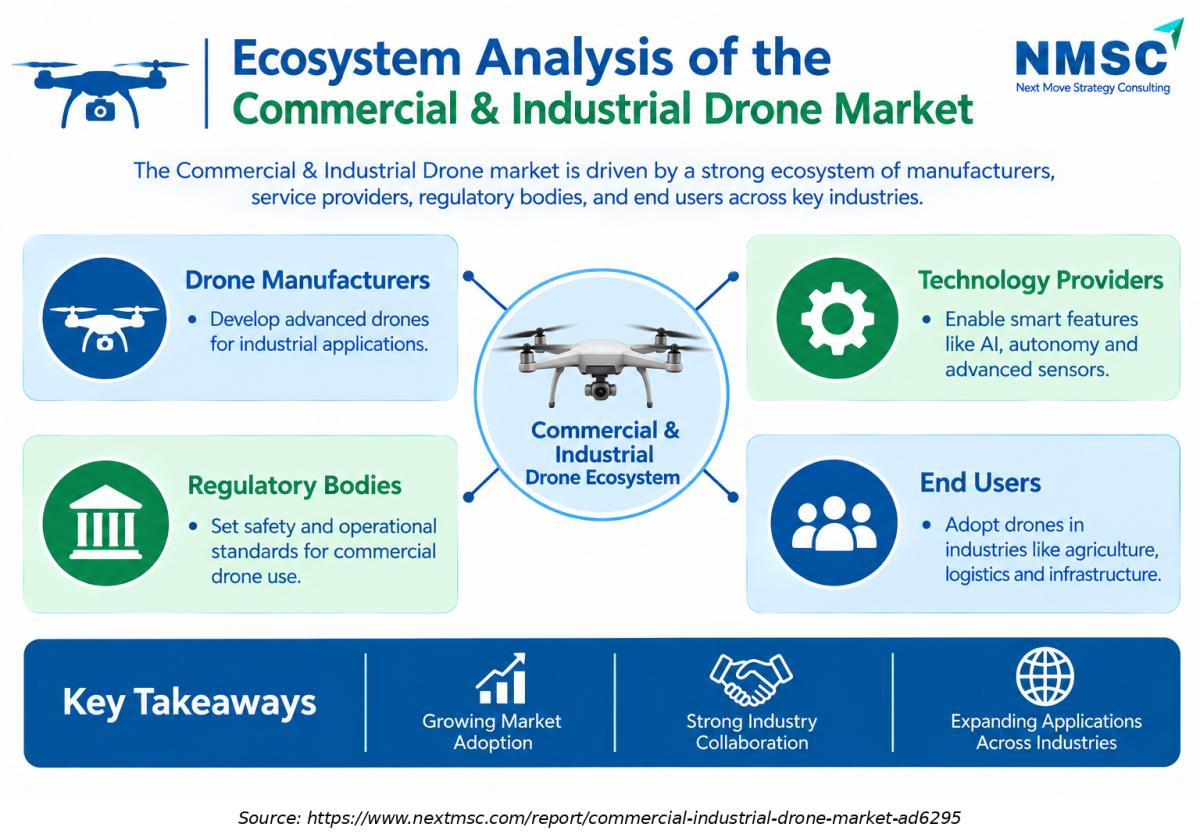
Ecosystem Analysis of the Commercial & Industrial Drone Market

The infographic outlines the Ecosystem Analysis of the Commercial & Industrial Drone Market, highlighting key stakeholders such as drone manufacturers, technology providers, regulatory bodies, and end users. It emphasizes how advanced drone development, AI integration, regulatory compliance, and industry collaboration support wider adoption across agriculture, logistics, infrastructure, and other industrial applications

What Does the Commercial & Industrial Drone Market Encompass?

The Commercial & Industrial Drone Market covers unmanned aerial vehicles that businesses and public agencies buy or operate for revenue generating or mission critical work, together with the software and services that turn flight data into decisions. We define scope to include agricultural spraying and spreading, inspection, mapping & surveying, delivery & likewise logistics, public safety & security, and media production. Consumer toys, recreational flying, military procurement and passenger carrying aircraft sit outside this scope.

Regulation shapes this market more than any single technology. In the United States, FAA Part 107 governs visual line of sight work, and the proposed Part 108 would open routine flying beyond visual line of sight once the final rule publishes. Our analysis shows that the FAA counted 424,516 active Part 107 aircraft at the end of 2025, which gives a measurable base for commercial adoption, while India applies a liberalised rulebook that opens most of its airspace to low altitude flying.

Market Drivers & Dynamics

Interactive Dataset
BVLOS rule making under FAA Part 108 driver +1.8% North America, with global spillover 2027–2035
Agricultural spraying adoption driver +1.4% Asia-Pacific, Latin America 2026–2032
Delivery network scale up by Zipline and Wing driver +1.2% North America 2026–2033
Autonomous docks for public safety and industry driver +0.9% North America, Europe 2026–2031
Onboard AI and analytics subscriptions driver +0.7% Global 2026–2035
FCC Covered List on foreign produced drones restraint −1.5% North America 2026–2029
Airspace integration and detect and avoid gaps restraint −0.8% Global 2026–2030
Dependence on Chinese batteries, motors and boards restraint -0.6% North America, Europe 2026–2030
Source: Next Move Strategy Consulting

Growth Drivers

What Is the Primary Growth Driver of the Commercial & Industrial Drone Market?

Agricultural spraying is the strongest volume driver. DJI Agriculture reported global shipments above 200,000 units in 2025 and more than 600,000 of its agricultural drones in operation by the end of that year, which shows how quickly farm contractors adopted the technology. We estimate agriculture at USD 3.00 Billion in 2025, led by spraying hardware and contract services. Farmers value lower labour and chemical use per hectare, and makers benefit from replacement cycles in the agricultural drone segment.

How Is Regulatory Normalisation Driving Commercial & Industrial Drone Market Growth?

Policy now moves faster than at any point in the past decade. Executive Order 14307 directed agencies to speed drone integration, and the FAA reported 493,396 remote pilot certifications by December 2025, with a base forecast of 628,600 by 2030. India shows the same pattern, because its 2021 airspace map opened about 90% of airspace as green zone up to 400 feet and its production incentive pays 20% of value addition. Clearer rules cut approval time and compliance cost for operators.

Growth Inhibitors

What Is Restraining the Commercial & Industrial Drone Market?

Supply chain security is the sharpest restraint. On December 22, 2025, the FCC added foreign-produced drones and critical components to its Covered List, which blocks new equipment authorizations, although existing models remain usable. The FAA estimates that Chinese manufacturers account for approximately 90% of the global commercial small-UAS market. It also identifies U.S. dependence on Chinese batteries, motors, flight controllers and circuit boards as a supply-chain vulnerability.We estimate a negative 1.5% effect on CAGR as buyers delay purchases while domestic output scales.

What Are the Growth Opportunities?

How Can Operators Capture the BVLOS Delivery Opportunity?

Retail, restaurant and healthcare delivery networks represent the largest new revenue pool, rising from USD 1.25 Billion in 2026 to USD 7.80 Billion by 2035. Operators with approved safety cases, hub networks and retailer integrations capture the earliest volume, while airframe makers benefit from fleet orders. Publication of Part 108 would let organisations scale routes without per flight waivers, which supports the delivery and logistics segment directly.

What Opportunity Does Software and Analytics Create?

Software and analytics grow from USD 1.55 Billion in 2026 to USD 6.20 Billion by 2035, the fastest rate among offerings. Fleet management, flight planning and computer vision turn flights into reports that asset owners request every month. Software vendors are the main beneficiaries, because subscription pricing lifts retention, while hardware makers that bundle analytics defend margins against low priced airframes.

Where Do Domestic Manufacturing Programmes Create Openings?

Restrictions on foreign produced equipment create a protected niche for domestic and allied makers. The FCC exempted Blue UAS Cleared List and Buy American products until January 1, 2027, and India offers production incentives of 20% of value addition. Makers of docks, batteries and flight controllers gain procurement preference, while integrators that qualify components early shorten sales cycles in public safety and critical infrastructure.

Segmentation Analysis

2025 (USD Billion)
2035 (USD Billion)
Hardware 2025: $6.40 Billion | 2035: $15.90 Billion
Hardware
Software and analytics 2025: $1.30 Billion | 2035: $6.20 Billion
Software and
Services 2025: $4.90 Billion | 2035: $16.40 Billion
Services
Hardware $6.40 Billion $15.90 Billion 9.5%
Software and analytics $1.30 Billion $6.20 Billion 16.7%
Services $4.90 Billion $16.40 Billion 12.5%

Which Offering Leads the Commercial & Industrial Drone Market?

Hardware led in 2025 at USD 6.40 Billion, about 51% of revenue, because airframes, payloads and docks remain the entry ticket for every deployment. Software and analytics is the fastest growing offering at 16.7% CAGR from 2026 to 2035 as flight planning, fleet management and photogrammetry move to subscriptions. Services reach USD 16.40 Billion by 2035 on inspection, spraying and delivery contracts. Our analysis shows that services edge past hardware by 2035, and drone software vendors capture the steepest growth.

2025 (USD Billion)
2035 (USD Billion)
Category A
Category B
Category C
Category D
Segment Item 2025 (USD Billion) 2035 (USD Billion) CAGR
Category A $10.0 USD Billion $40.0 USD Billion 18.0%
Category B $17.1 USD Billion $51.1 USD Billion 16.0%
Category C $24.2 USD Billion $62.2 USD Billion 22.0%
Category D $31.3 USD Billion $73.3 USD Billion 12.0%

Segment-wise data is locked

Unlock complete segment-wise numbers for By Application.

Unlock Full Data
2025 (USD Billion)
2035 (USD Billion)
Category A
Category B
Category C
Category D
Segment Item 2025 (USD Billion) 2035 (USD Billion) CAGR
Category A $10.0 USD Billion $40.0 USD Billion 22.0%
Category B $17.1 USD Billion $51.1 USD Billion 12.0%
Category C $24.2 USD Billion $62.2 USD Billion 22.0%
Category D $31.3 USD Billion $73.3 USD Billion 8.0%

Segment-wise data is locked

Unlock complete segment-wise numbers for By Platform.

Unlock Full Data
2025 (USD Billion)
2035 (USD Billion)
Category A
Category B
Category C
Category D
Segment Item 2025 (USD Billion) 2035 (USD Billion) CAGR
Category A $10.0 USD Billion $40.0 USD Billion 10.0%
Category B $17.1 USD Billion $51.1 USD Billion 8.0%
Category C $24.2 USD Billion $62.2 USD Billion 18.0%
Category D $31.3 USD Billion $73.3 USD Billion 8.0%

Segment-wise data is locked

Unlock complete segment-wise numbers for By Region.

Unlock Full Data

Growth Opportunities

We found that three opportunities offer the clearest beneficiary segments through 2035.

How Can Operators Capture the BVLOS Delivery Opportunity?

Retail, restaurant and healthcare delivery networks represent the largest new revenue pool, rising from USD 1.25 Billion in 2026 to USD 7.80 Billion by 2035. Operators with approved safety cases, hub networks and retailer integrations capture the earliest volume, while airframe makers benefit from fleet orders. Publication of Part 108 would let organisations scale routes without per flight waivers, which supports the delivery and logistics segment directly.

What Opportunity Does Software and Analytics Create?

Software and analytics grow from USD 1.55 Billion in 2026 to USD 6.20 Billion by 2035, the fastest rate among offerings. Fleet management, flight planning and computer vision turn flights into reports that asset owners request every month. Software vendors are the main beneficiaries, because subscription pricing lifts retention, while hardware makers that bundle analytics defend margins against low priced airframes.

Where Do Domestic Manufacturing Programmes Create Openings?

Restrictions on foreign produced equipment create a protected niche for domestic and allied makers. The FCC exempted Blue UAS Cleared List and Buy American products until January 1, 2027, and India offers production incentives of 20% of value addition. Makers of docks, batteries and flight controllers gain procurement preference, while integrators that qualify components early shorten sales cycles in public safety and critical infrastructure.

Regional Outlook

2025 (USD Billion)
2035 (USD Billion)
North Americ
Europe
Asia-Pacific
Middle East
Latin Americ
Region 2025 (USD Billion) 2035 (USD Billion) CAGR (%)
North America $10.0 USD Billion $40.0 USD Billion 9.0%
Europe $17.1 USD Billion $51.1 USD Billion 27.0%
Asia-Pacific $24.2 USD Billion $62.2 USD Billion 25.0%
Middle East & Africa $31.3 USD Billion $73.3 USD Billion 23.0%
Latin America $38.4 USD Billion $84.4 USD Billion 12.0%

Regional data is locked

Unlock complete regional numbers for this market.

Unlock Full Data

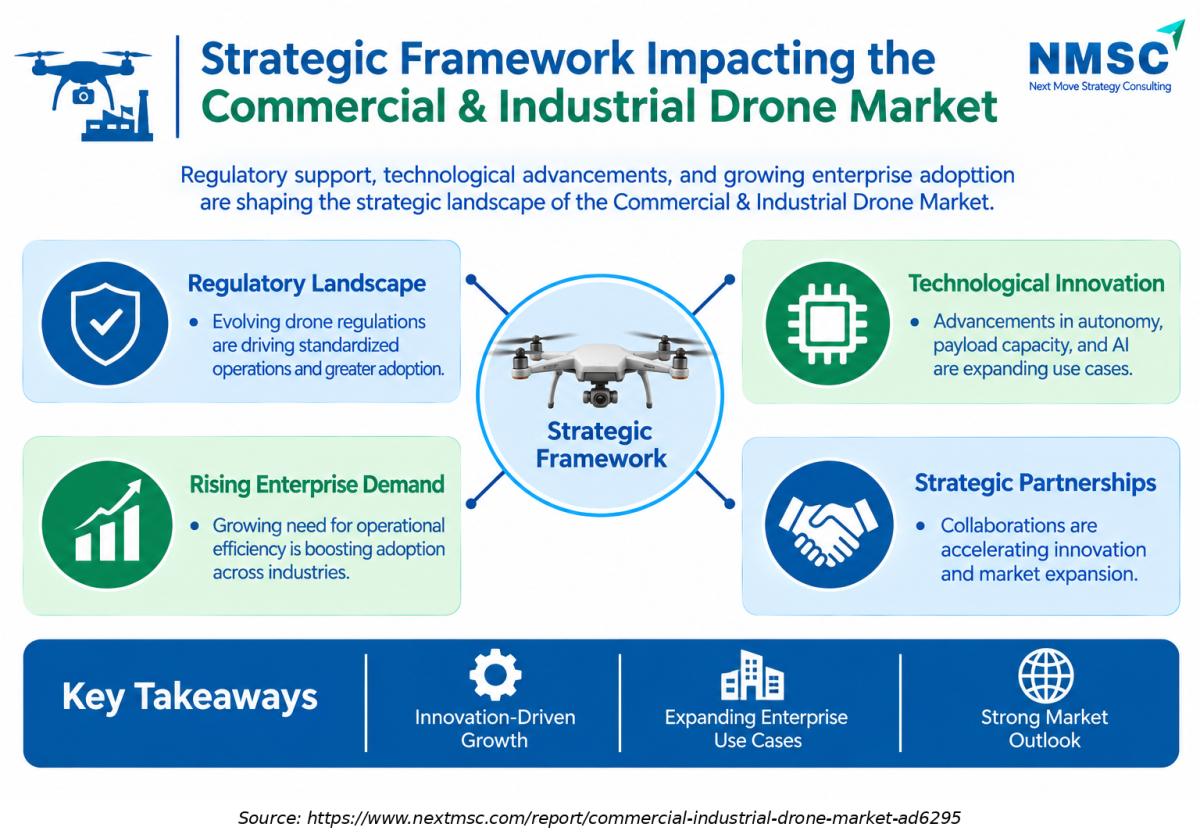
Strategic Framework Impacting the Commercial & Industrial Drone Market

Strategic Framework Impacting the Commercial & Industrial Drone Market
The infographic highlights the Strategic Framework Impacting the Commercial & Industrial Drone Market, focusing on regulatory developments, technological innovation, rising enterprise demand, and strategic partnerships. It illustrates how advancements in autonomous operations, AI capabilities, increased payload capacity, and collaborations among industry players support expanding commercial applications, innovation-led growth, and long-term market expansion

Competitive Landscape

During our market evaluation, we noticed that competition splits between hardware scale and trusted supply.

How Do Companies Compete in the Commercial & Industrial Drone Market?

Leaders compete on a mix of price, reliability and trust. DJI wins on scale and breadth, from spraying platforms to enterprise cameras, while Western vendors compete on security, autonomy and procurement eligibility. Delivery operators such as Zipline and Wing compete on routes, retailer partnerships and regulatory approvals. We found that geographic expansion now follows regulation, with Houston, Phoenix and Seattle named as 2026 launch markets, and pricing shifts from unit sales to subscriptions.

Which Competitor Archetypes Dominate the Commercial & Industrial Drone Market?

Five archetypes dominate. Scale hardware makers such as DJI serve volume buyers, autonomy specialists such as Skydio target public safety, and delivery networks led by Zipline and Alphabet build operating moats. Parrot represents European specialists in micro-UAVs and photogrammetry, while ideaForge participates in civil, commercial and defence-related UAV markets. Only its commercial and industrial applications are relevant to this report's market scope; military procurement is excluded from market sizing. Differentiation themes are autonomy, compliance and data.

How Do Leaders Differentiate Through Innovation?

Innovation centres on autonomy that removes the pilot from routine work. Skydio pairs onboard AI with a dock, Parrot built AI based navigation that works without satellite signals, and Zipline reports median flight times of three minutes. Our assessment indicates that software features, such as fleet orchestration and automated reports, now decide renewals, because airframes are becoming easier to copy while data workflows are harder to replace.

How Active Are Mergers, Acquisitions and Funding Rounds?

Among the profiled companies, the most visible 2026 activity was private funding rather than acquisition. Zipline raised more than USD 0.60 Billion at a USD 7.60 Billion valuation in January and extended the round to USD 0.80 Billion in March. Skydio raised USD 0.11 Billion at a USD 4.40 Billion valuation in April. Based on research conducted by NMSC, we found that capital is concentrating in autonomy and delivery leaders, which raises entry barriers for smaller vendors.

Key Market Players

Based on research conducted by NMSC, we found that six companies met our verification threshold, ranked below by commercial scale.

SZ DJI Technology Co., Ltd. Zipline International Inc. Skydio, Inc. Alphabet Inc. Parrot SA ideaForge Technology Limited

Latest Developments

Our analysis shows that policy and funding events defined the period from mid-2025 to October 2026.

Date Event
November 2025 DJI Agriculture announced that 2025 global shipments had passed 200,000 units.

Expert Insights

Adam Bry

Co-founder & CEO | Skydio

"I think that stuff will ultimately end up being the biggest segment in the business."

Analyst Interpretation

The comment highlights the growing commercial potential of infrastructure monitoring and inspection applications. Utilities and transportation agencies are increasingly using drones to inspect power networks, monitor critical assets, and identify maintenance requirements. The ability to conduct remote inspections and respond to infrastructure problems more quickly could make these applications an important source of long-term demand for autonomous commercial drones.

Investment Opportunities

Where Are Capital Inflows Concentrating?

Capital is flowing to autonomy and delivery leaders. Zipline's USD 0.80 Billion Series H and Skydio's USD 0.11 Billion Series F show investor appetite for platforms that combine hardware, software and operations. Our findings suggest that publication of Part 108 would extend this appetite to service operators and component makers, while public listings of drone makers in India show that regional equity markets also reward profitable growth.

Which Infrastructure Investments Support Growth?

Docks, delivery hubs, traffic management services and domestic component lines need the most capital. The FAA expects its active large UAS fleet to climb to 55,509 aircraft by 2030, a 46.3% CAGR, which requires charging, maintenance and airspace services. FCC exemptions for Blue UAS and Buy American products until January 1, 2027 reward investors who localise batteries, motors and flight controllers early.

What ESG Considerations Matter for Drone Investors?

Environmental gains are measurable but vendor reported. DJI Agriculture states that agricultural drones saved 410 million tons of water and cut 51 million tons of carbon emissions, so investors should seek independent verification. Social issues include privacy, noise and public acceptance of delivery flights. Governance issues include data security and supply chain provenance, which now influence procurement eligibility under the FCC Covered List.

Key Benefits for Stakeholders

How Does This Report Help Enterprise and Industry Leaders?

Enterprise buyers in agriculture, utilities, construction and logistics can use the segment forecasts to size drone programmes and choose between hardware ownership and contracted services. The report shows services reaching USD 16.40 Billion by 2035, which supports outsourcing decisions, and it compares platforms by mission range. Leaders also gain regional and country benchmarks that help schedule rollouts around regulatory milestones such as Part 108.

What Value Does the Analysis Offer Investors and Financial Analysts?

Investors receive a reconciled forecast with 2025, 2026 and 2035 values, segment growth rates and a growth catalyst matrix that quantifies drivers and restraints. The USD 24.20 Billion opportunity between 2026 and 2035 gives a base for return modelling, while the competitive section shows where funding concentrates. Analysts can test scenarios around the FCC Covered List and BVLOS timing without rebuilding the market structure.

How Does the Report Support Drone Vendors and Product Teams?

Vendors and product teams gain a view of where revenue pools are moving, from airframes toward software and services. The segmentation shows that hybrid VTOL grows at 18.5% CAGR and delivery at 22.6%, which guides roadmap choices. Regional chapters flag procurement preferences, such as trusted supply in North America and data sovereignty in Europe, helping teams set certification, pricing and partnership priorities.

Key Market Segments Evaluated

By Offering

  • Hardware
  • Software and analytics
  • Services

By Application

  • Agriculture
  • Inspection, Mapping & Surveying
  • Delivery and logistics
  • Public safety and security
  • Media and entertainment

By Platform

  • Multirotor
  • Fixed wing
  • Hybrid VTOL

By Region

  • North America 
    • U.S.
    • Canada
    • Mexico
  • Europe 
    • UK
    • Germany
    • France
    • Italy
    • Spain
    • Sweden
    • Denmark
    • Finland
    • Netherlands
    • Rest of Europe
  • Asia-Pacific 
    • China
    • India
    • Japan
    • South Korea
    • Taiwan
    • Indonesia
    • Vietnam
    • Australia
    • Philippines
    • Malaysia
    • Rest of APAC
  • Middle East & Africa 
    • Saudi Arabia
    • UAE
    • Egypt
    • Israel
    • Turkey
    • Nigeria
    • South Africa
    • Rest of MEA
  • Latin America 
    • Brazil
    • Argentina
    • Chile
    • Colombia
    • Rest of LATAM

Conclusion & Recommendations

What Is the Long-Term Outlook for the Commercial & Industrial Drone Market?

The Commercial & Industrial Drone Market is forecast to grow from USD 14.30 Billion in 2026 to USD 38.50 Billion by 2035, an 11.6% CAGR. Growth moves from early adopter spending to routine operations as regulation, autonomy and delivery networks mature. Our analysis shows that the mix changes more than the total, with software and services together outgrowing hardware and reaching 59% of revenue by 2035.

What Strategic Positioning Recommendations Does NMSC Offer?

NMSC recommends that vendors choose a clear position: scale hardware, trusted domestic supply, autonomy and docks, or operated networks. Companies should qualify components for Blue UAS and Buy American status, build BVLOS safety cases early, and bundle analytics to defend margins. Buyers should favour suppliers with certified systems and transparent supply chains, and should contract services where utilisation is low.

What Does Investment Attractiveness Look Like for the Commercial & Industrial Drone Market?

Attractiveness is highest in delivery and logistics, software and analytics, and hybrid VTOL platforms, which grow at 22.6%, 16.7% and 18.5% CAGR respectively. Asia-Pacific offers scale and Middle East and Africa offers the fastest regional growth at 14.0%, though from a small base. Investors should weigh these rates against regulatory timing, since Part 108 and trade restrictions can shift revenue between regions.

What Market Shifts and Key Risks Will Shape the Commercial & Industrial Drone Market?

Key shifts include the move from airframe sales to subscriptions, the rise of docks and the regionalisation of supply chains. Risks include delayed publication of Part 108, extension of FCC restrictions to more equipment types, battery and component shortages, and weaker spraying demand if farm incomes fall. Our assessment indicates that vendors with diversified applications and regional supply options carry the lowest risk.

What Are the Primary Growth Pathways Through 2035?

Four pathways stand out. Agricultural spraying keeps adding volume in Asia-Pacific and Latin America, delivery networks scale across American metros, public safety agencies adopt docks, and asset owners expand inspection programmes using digital models. Together these pathways explain most of the USD 24.20 Billion increase between 2026 and 2035, and each can be tracked through registrations, delivery counts and procurement awards.

Delivered Customizations

We have successfully delivered the following deep-dive customizations:

Client Request Customization Delivered Value Adds
Country-Wise Drone Trade Assessment
  • Country-wise import and export analysis of finished commercial and industrial drones and key components (flight controllers, payloads, batteries) using UN Comtrade and WITS data.
  • Identifies supply-dependency risks and high-import markets to guide sourcing, localization, and export-entry decisions.
Historical Shipment and Revenue Analysis
  • Historical shipments and revenue across offerings (hardware, software, services) and key applications, with growth trends by region.
  • Shows which offering and application segments have scaled fastest, supporting prioritization of product and service investments.
Company-Level Platform Share Analysis
  • Company-level share of fixed-wing, rotary-wing, and hybrid VTOL platforms, based on annual reports, filings, and company disclosures.
  • Reveals competitive positioning by platform type and highlights where share is concentrated, informing portfolio and partnership strategy.
Application-Platform Fit Assessment
  • Mapping of platform types (fixed-wing, rotary-wing, hybrid VTOL) against application use cases such as mapping, inspection, delivery, and agricultural spraying, using payload, endurance, and range specifications from public OEM datasheets.
  • Pinpoints the platform configurations best suited to each application, guiding product development and targeted go-to-market focus.
Regional BVLOS Readiness Assessment
  • Region-wise comparison of beyond-visual-line-of-sight (BVLOS) approval frameworks (e.g., FAA Part 108, EASA U-space, India Drone Rules) and their status for commercial operations.
  • Ranks regions by operational readiness for long-range drone services, supporting geographic expansion and timing of market entry.
Infrastructure Inspection Demand Mapping
  • Estimated inspection demand by industrial asset class (power transmission lines, wind turbines, pipelines, telecom towers) linked to installed asset bases by region from government and utility data.
  • Quantifies addressable inspection demand by asset type and region, supporting customer targeting and industrial service offering design.

FAQs

Sources & References

1.

Federal Aviation Administration, Compendium to FAA Aerospace Forecast 2026–2046: Emerging Aviation Entrants

faa.gov
2.

Federal Aviation Administration, FAA Aerospace Forecasts

faa.gov
3.

Federal Communications Commission, Fact Sheet on Covered List update for foreign UAS (December 22, 2025)

docs.fcc.gov
4.

Federal Communications Commission, Fact Sheet on UAS exemptions (January 7, 2026)

docs.fcc.gov
5.

Federal Register, Normalizing Unmanned Aircraft Systems Beyond Visual Line of Sight Operations (Part 108 proposal)

federalregister.gov
6.

U.S. Government Publishing Office, Executive Order 14307 Unleashing American Drone Dominance

govinfo.gov
7.

Shenzhen Municipal Government, DJI Agriculture 2025 shipments announcement

sz.gov.cn
8.

DJI Agriculture, Agricultural Drone Industry Insight Report 2025/2026 (press release)

farms.com
9.

Parrot SA, FY2025 conference call presentation

parrot.com
10.

ideaForge Technology Limited, Q4 and FY26 results press release (republished)

suasnews.com
11.

ideaForge Technology Limited, CEO statement on FY26 results (republished)

aviation-defence-universe.com
12.

Zipline International Inc., funding and delivery milestone announcement (January 2026, republished)

therobotreport.com
13.

Zipline International Inc., Series H extension (March 2026, republished)

pulse2.com
14.

Skydio, Inc., Series F announcement (April 2026, republished)

dronexl.co
15.

Skydio, Inc., blog (Dock for X10 and company announcements)

skydio.com
16.

Press Information Bureau, Government of India, Drone Rules 2021 and PLI scheme release

pib.gov.in
17.

Press Information Bureau, Government of India, Namo Drone Didi and drone policy factsheet

pib.gov.in
18.

Federal Aviation Administration rulemaking status for Part 108 (final rule sent to OIRA, July 10, 2026), as summarised by Knobbe Martens

knobbe.com

About the Author

Mayurima Roy

Mayurima Roy

Mayurima Roy is Research Analyst at Next Move Strategy Consulting, where she has spent 4 years working across the firm's full industry coverage rather than a single fixed vertical. Her work centers on structured research, ongoing trend tracking, competitive assessment, and insight-led content development, translating complex market data into clear, decision-ready narratives that support informed client decision-making across diverse global industries, market sectors, and world regions every day.

About the Reviewer

Supradip Baul

Supradip Baul

Supradip Baul is an accomplished business consultant and strategist with over a decade of rich experience in market intelligence, strategy, technology, and business transformation. His work has included rigorous qualitative and quantitative analysis across multiple industries, helping clients shape investment decisions and long-term roadmaps. Earlier in his career, he was associated with Gartner, where he contributed to industry-leading reports and market share analyses. He has worked with leading global companies and holds an MBA with a dual specialization in Marketing and Finance.

Download Free Sample

Mohit Agarwal

MOHIT AGARWAL

Chief Manager

DryChem India Pvt. Ltd.

Next Move Strategy Consulting is an amazing team of consultants. We required a market study report for our investors on top priority and the team went above and beyond our expectations to deliver the same with ample supporting data within a short time span enabling us to secure the investments and keep our project timeline maintained. Their professionalism, attention to detail, and timely delivery of actionable recommendations have left a lasting impression on our organization.

Melanie Samko

MELANIE SAMKO

Director of Marketing

TOSOH BIOSCIENCE, INC.

The information provided by NMSC is incredibly valuable, thank you so much for such a excellent work. I really appreciate it. I will make sure to reference all of it, in my summary document.

Gustaf Hummel Burstrom

GUSTAF HUMMEL BURSTROM

Founder

Revline Tools AB

Joseph and the team at Next Move Strategy Consulting have been excellent to work with, in supplying us with relevant market data and forecasts for our specific category. We had some special requirements and they were able to do a custom package to suit our needs. We would definitely recommend them to any other company needing market data and forecasts

Semih Kavaklioglu

SEMIH KAVAKLIOGLU

Co-Founder & Sales Manager

Decortie

I work a lot in the marketing industry and I know that research is an essential part of any campaign. I have used Market research reports for my own products and I found them to be very informative and well-researched. The team here produces insightful reports for a good price

Robert Sean Trevino

ROBERT SEAN TREVINO

Sr. Director, Head of Strategic Insights & Analytics

Foundation Medicine

I realized that it was a reliable source of information. These days, there are many people who are looking for authentic data, and this is one of the only sources that can offer them with what they need;

Custom Market Research Services

We will customize the research for you if the listed report does not fully match your requirements.

Get 30% Free Customization

Select License

This website uses cookies to ensure you get the best experience on our website. Learn more

✖