FAA Part 108 BVLOS Rule Nears Finalization as UTM Market Gains Momentum

FAA Part 108 BVLOS Final Rule Nears Completion as FAA and EASA Converge on Low-Altitude Airspace Strategy at Commercial UAV Expo 2026
At the Commercial UAV Expo in Las Vegas this month, senior officials from the U.S. Federal Aviation Administration (FAA) and the European Union Aviation Safety Agency (EASA) delivered a landmark joint assessment of where global UAS Traffic Management (UTM) regulation stands — and where it must go. The session, titled "Two Skies, One Conversation: Comparing FAA and EASA Approaches to BVLOS Drone Operations," brought together Robert Reckert, Acting Division Manager of the FAA's Emerging Technologies Division in Flight Standards, and Dan Dousi, Head of Department for Innovative Air Mobility at EASA, in a direct comparison of two of the world's most consequential regulatory frameworks for drone airspace integration. The discussion arrived at a pivotal moment: the FAA's proposed Part 108 rule — designed to replace the current case-by-case BVLOS waiver system with a scalable, performance-based regulatory pathway — is, in the FAA's own characterization, on the "ten-yard line."
According to Next Move Strategy Consulting's UAS Traffic Management (UTM) Market report, the global UTM market was valued at USD 737.7 million in 2024 and is projected to reach USD 3,308.5 million by 2030, growing at a CAGR of 28.2% from 2025 to 2030. This trajectory is directly tied to the regulatory maturation now unfolding across North America and Europe — where the transition from individual BVLOS waivers to codified, interoperable UTM frameworks is converting a fragmented operational landscape into a structured, commercially scalable ecosystem.
For More Information: Download FREE Sample on UAS Traffic Management (UTM) Market Report
The Regulatory Inflection Point: Part 108 and the End of the Waiver Era
The FAA's August 7, 2025 Notice of Proposed Rulemaking (NPRM), formally titled Normalizing Unmanned Aircraft Systems Beyond Visual Line of Sight Operations (90 Fed. Reg. 38212), represents the most consequential structural shift in U.S. drone regulation since Part 107 was enacted in 2016. The proposed rule mandates detect-and-avoid technology, Remote ID compliance, and real-time position reporting for all BVLOS operations — requirements that directly expand the addressable market for UTM software platforms, surveillance infrastructure, and UAS Service Suppliers (USS) that provide strategic deconfliction services.
As of December 2025, the FAA had approved over 1,000 waivers for BVLOS operations across commercial, public safety, and research operators. Each of those waivers required individual safety risk management documentation, a process the FAA itself has acknowledged is resource-intensive and non-scalable. Part 108's performance-based framework is designed to replace this bottleneck with standardized compliance pathways — a structural change that, once finalized, will allow UTM service providers to serve a dramatically larger operator base without the per-operation regulatory overhead that currently constrains commercial drone deployment.
Speaking at Commercial UAV Expo in September 2026, Reckert was direct about the limits of rulemaking alone: "One of the big challenges going forward is how do we communicate policies. Just because the rule [Part 108] is done doesn't mean that the work is done." He added: "We as a regulator can't do it alone. We can't write enough rules to make the congestion manageable." The statement signals that the FAA views Part 108 not as a terminus but as the foundation for a collaborative, industry-driven UTM governance model — one in which USS providers, operators, and regulators share real-time airspace data through distributed API-based networks rather than voice communications with air traffic controllers.
The Dallas-Fort Worth Proving Ground: UTM at Operational Scale
The FAA's UTM Operational Evaluation (OE) in the Dallas-Fort Worth area has become the primary real-world laboratory for the interoperable UTM architecture that Part 108 will eventually codify nationally. The consortium — comprising drone operators, UAS Service Suppliers, and Supplemental Data Service Providers — has implemented a federated governance model using industry consensus standards, enabling multiple BVLOS operators to share airspace through automated strategic deconfliction rather than manual coordination.
A February 2026 U.S. Government Accountability Office (GAO) report (GAO-26-107648), Transforming Aviation: FAA Planning Efforts Should Address How Drones Will Communicate with and Avoid Other Aircraft, confirmed that the North Texas operational evaluation represents "the first near-term implementation of BVLOS operations leveraging UTM services for strategic coordination." The GAO report further noted that the FAA's BVLOS NPRM itself acknowledged that "industry can effectively self-govern many aspects of standing up and running a UTM system" — a finding derived directly from the DFW consortium's operational data.
The GAO report also issued a formal recommendation to the FAA Administrator to develop and begin implementing specific actions — including clear federal and nonfederal roles and technical milestones — to ensure drones can communicate with and detect and avoid other aircraft within an information-centric National Airspace System (NAS). The U.S. Department of Transportation concurred with the recommendation. The FAA's own planning documents forecast initial information-centric NAS capabilities to be operational by approximately 2035, establishing a decade-long investment horizon for UTM infrastructure providers.
Europe's U-Space and SORA 2.5: A Parallel Regulatory Architecture
Europe has pursued a structurally distinct but functionally convergent path. The U-space regulatory framework — adopted in 2021 and applicable since 2023 — establishes mandatory services including network identification, geo-awareness, flight authorization, and traffic information within designated U-space airspace. EASA adopted the updated SORA 2.5 (Specific Operations Risk Assessment) methodology in 2025, making the risk-proportionality framework more granular by incorporating population density variables that change by time of day and day of week.
At Commercial UAV Expo, EASA's Dousi acknowledged the structural complexity of Europe's multi-jurisdictional environment: "SORA was a good compromise," noting that the framework must function across 31 member states and at least 31 aviation authorities. Despite the different regulatory architectures, Reckert identified the underlying alignment: "I don't think that our methodology and outcomes are that different — the framework is different. The idea of assessing risk is the same, we talk about it differently."
This convergence has direct commercial implications. In December 2024, Thales Group partnered with Avinor, Norway's air navigation service provider, to deploy Norway's next-generation nationwide UTM system, featuring the Topsky-UAS platform powered by AstraUTM. The system enables real-time traffic management, compliance monitoring, and safe integration of unmanned and manned aircraft, fully compliant with EU U-space regulations. The Norway deployment illustrates how U-space compliance requirements are converting national airspace modernization mandates into direct procurement contracts for UTM platform vendors.
Global Regulatory Momentum: Beyond the U.S. and Europe
The regulatory acceleration is not confined to the transatlantic corridor. In March 2026, the Ghana Civil Aviation Authority hosted a strategic engagement session focused on the feasibility of UTM integration — reflecting the expanding geographic footprint of structured drone traffic management frameworks into emerging markets. Japan's Ministry of Land, Infrastructure, Transport and Tourism (MLIT) continued publishing updates to its drone regulatory framework in support of expanded operations and national airspace integration. Australia's Civil Aviation Safety Authority (CASA) opened consultation on AUS SORA — a locally calibrated adaptation of the European SORA methodology — and launched a separate consultation on drone operations over people, both of which will define the compliance requirements that UTM service providers must satisfy to operate in the Asia-Pacific market.
In April 2026, the FAA launched a new enforcement programme specifically designed to accelerate action against drone violations, signaling that the U.S. regulatory environment is transitioning from framework-building to active compliance enforcement — a shift that increases the operational necessity of certified UTM services for commercial operators.
The Detect-and-Avoid Technology Gap: A Structural Demand Driver for UTM Software
The GAO's February 2026 report identified a critical technology gap that underpins the long-term demand for UTM software and AI-powered airspace management: existing ADS-B infrastructure was not designed to accommodate the projected scale of drone operations. The U.S. Department of Transportation confirmed in December 2025 that ADS-B signal congestion, cooperative-only detection limitations, and GPS spoofing vulnerabilities make ADS-B alone an insufficient detect-and-avoid solution for a national airspace shared by over one million commercial drones.
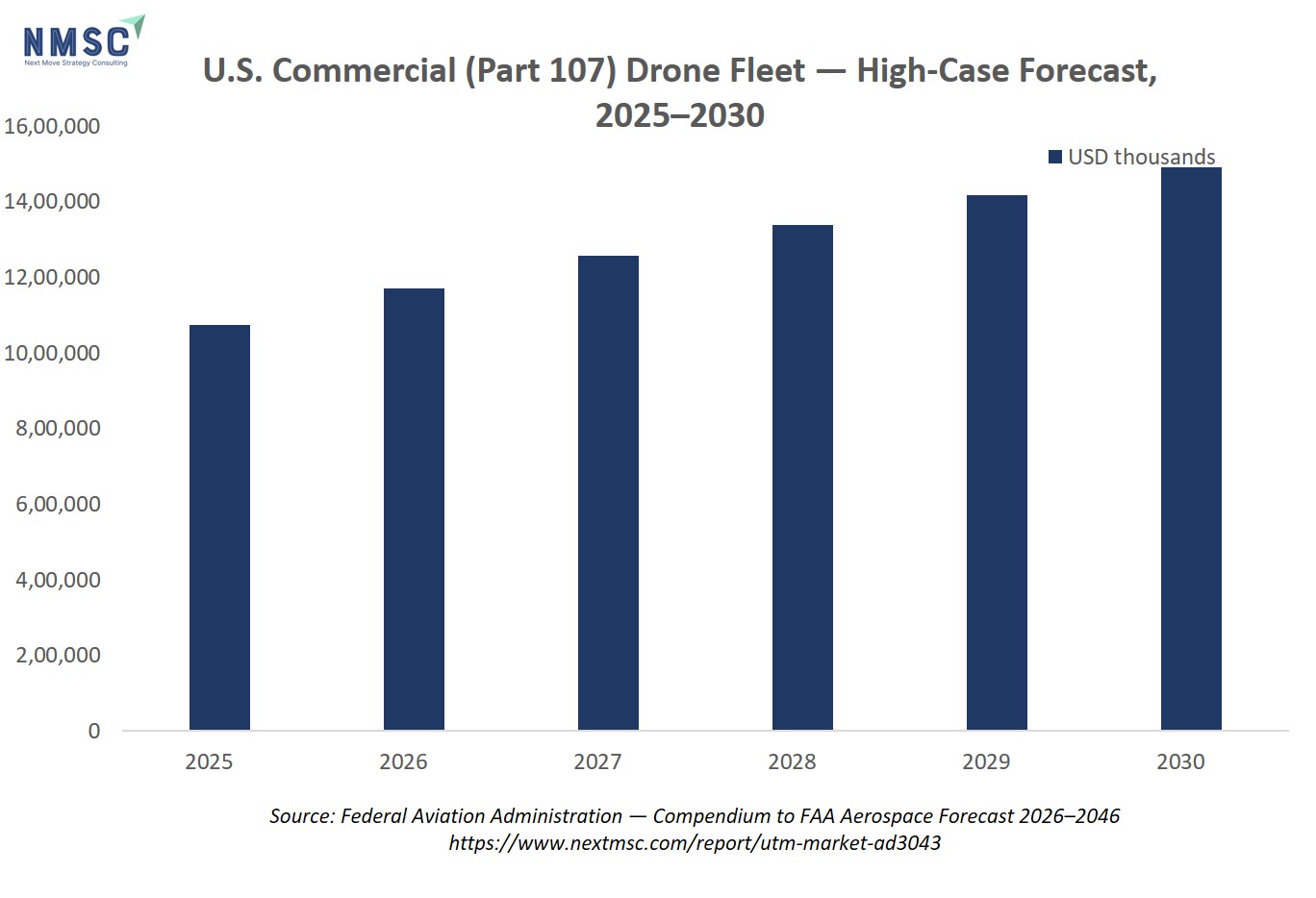
The FAA forecasted that the U.S. commercial drone fleet would exceed one million aircraft by the end of 2025 and grow to 1.18 million by 2029. At that density, the transition from ADS-B-centric detect-and-avoid to a fully networked, two-way communication architecture — the FAA's stated vision for the information-centric NAS — requires UTM platforms capable of processing real-time telemetry, conformance monitoring, and dynamic conflict resolution at machine speed. This is precisely the capability gap that AI-powered UTM software, dynamic airspace modelling tools, and federated USS networks are positioned to fill — and it is the primary mechanism through which software development is converting from a supporting function into the central value driver of the UTM market.
NMSC Strategic Perspective: The Regulatory-Commercial Feedback Loop
NextMSC primary research and analysis identifies a structural feedback loop that distinguishes the UTM market's growth trajectory from conventional aerospace infrastructure cycles. Unlike hardware-led markets where procurement follows certification, the UTM market's expansion is being driven by a regulatory-commercial feedback loop in which operational data from approved BVLOS deployments directly informs rulemaking, which in turn expands the addressable operator base, which generates more operational data.
The FAA's UTM Operational Evaluation in Dallas-Fort Worth is the clearest expression of this dynamic: the consortium's real-world deconfliction data is simultaneously enabling commercial drone delivery operations today and providing the evidentiary basis for Part 108's performance standards. Once Part 108 is finalized, the waiver-by-waiver approval process — which currently limits UTM service provider revenue to a narrow pool of pre-approved operators — will be replaced by a standardized compliance pathway accessible to any qualified operator. This structural change will convert UTM from a bespoke, high-touch service into a scalable platform business.
NMSC's analysis further identifies BVLOS operations as the segment with the highest near-term revenue concentration. The transition from VLOS-only to BVLOS operations is not merely a regulatory milestone — it is the event that makes UTM services operationally mandatory rather than optionally beneficial. A drone operating within visual line of sight can be managed by a human observer; a drone operating beyond visual line of sight in shared airspace cannot. Every BVLOS operation, by definition, requires a UTM service layer. As Part 108 and its international equivalents normalize BVLOS operations across logistics, agriculture, public safety, and infrastructure inspection, the UTM service layer transitions from a regulatory accommodation to a non-negotiable operational prerequisite.
The competitive landscape is consolidating around this insight. Established defense and aerospace primes — Raytheon Technologies, Lockheed Martin, Thales Group, and Airbus — are investing in UTM capabilities not as standalone products but as integration layers for broader airspace management platforms. Simultaneously, purpose-built UTM specialists including ANRA Technologies, Altitude Angel, and Terra Drone Corporation are competing on software agility and interoperability standards compliance. The market's 28.2% CAGR through 2030, as projected by NMSC proprietary research and estimates, reflects the compounding effect of regulatory normalization, fleet growth, and the software-led shift in UTM value creation.
Competitive Landscape
The UTM market's competitive structure reflects the dual nature of the technology: it is simultaneously a regulated infrastructure service and a software platform business. Tier-1 defense and aerospace integrators — including Raytheon Technologies Corporation, Lockheed Martin Corporation, Thales Group S.A., Airbus SE, Honeywell International Inc., and L3Harris Technologies — bring systems integration capability, regulatory relationships, and existing airspace management infrastructure. Purpose-built UTM specialists — including ANRA Technologies, Altitude Angel, Terra Drone Corporation, OneSky Systems, and Aloft — compete on software interoperability, USS certification speed, and API-native architecture suited to the federated UTM governance model.
In December 2024, Thales Group partnered with Avinor to deploy Norway's nationwide UTM system using the Topsky-UAS platform powered by AstraUTM, establishing full EU U-space regulatory compliance and real-time manned-unmanned traffic integration. The Norway deployment is a template for the national-scale UTM contracts that will emerge as U-space operational areas expand from designated zones to broader European airspace.
In May 2025, Flytrex and Wing launched the first UTM-enabled drone delivery collaboration in the United States, demonstrating that interoperable UTM services can support simultaneous commercial delivery operations from competing operators in shared airspace — the precise use case that the FAA's UTM OE governance framework was designed to enable.
Bottom Line
The UAS Traffic Management market is undergoing a structural transition from a regulatory experiment to a commercial infrastructure category. The FAA's Part 108 BVLOS rulemaking — now in its final stages following the August 2025 NPRM — will replace the current waiver-by-waiver approval system with a standardized compliance framework that makes UTM services operationally mandatory for every BVLOS operator in the United States. Europe's parallel U-space architecture and EASA's SORA 2.5 methodology are producing the same structural outcome through a different regulatory path. The convergence of these two frameworks — confirmed by FAA and EASA officials at Commercial UAV Expo in September 2026 — signals that the global UTM market is approaching the regulatory threshold at which commercial scale becomes self-reinforcing. The GAO's February 2026 recommendation for FAA to develop specific technical milestones for an information-centric NAS, concurred with by the Department of Transportation, further anchors a decade-long federal investment horizon for UTM infrastructure. According to NextMSC proprietary research and estimates, the global UTM market is projected to grow from USD 737.7 million in 2024 to USD 3,308.5 million by 2030 at a 28.2% CAGR — a trajectory that reflects not speculative demand, but the compounding effect of regulatory normalization, fleet growth, and the irreversible shift toward BVLOS operations as the commercial standard for drone deployment.
About Next Move Strategy Consulting
Next Move Strategy Consulting is a premier market research and management consulting firm that has been committed to provide strategically analysed well documented latest research reports to its clients. The research industry is flooded with many firms to choose from, what makes NMSC different from the rest is its top-quality research and the obsession of turning data into knowledge by dissecting every bit of it and providing fact-based research recommendation that is supported by information collected from over 500 million websites, paid databases, industry journals and one on one consultations with industry experts across a diverse range of industry sectors. The high-quality customized research reports with actionable insights and excellent end-to-end customer service help our clients to take critical business decisions that enables them to move beyond time and have competitive edge in the industry.
We have been servicing over 1000 customers globally that includes 90% of the Fortune 500 companies over a decade. Our analysts are constantly tracking various high growth markets and identifying hidden opportunities in each sector or the industry. We provide one of the industry's best quality syndicate as well as custom research reports across 10 different industry verticals. We are committed to deliver high quality research solutions in accordance to your business needs. Our industry standard delivery solutions that ranges from the pre consultation to after-sales services, provide an excellent client experience and ensure right strategic decision making for businesses.
For more information, please contact:
Next Move Strategy Consulting
5th Floor 867 Boylston St, STE 500,
Boston, MA 02116, U.S.
E-Mail: [email protected]
Direct: +1-217-650-7991
Website: www.nextmsc.com
About the Author
 Sanyukta Deb
— Sanyukta Deb is Digital Marketing Team Lead at Next Move Strategy Consulting, where she has led content strategy and technical SEO for the firm's B2B market research publications for over 2 years. Her editorial process translates NextMSC's primary and secondary research — spanning technology, industrial, and consumer sectors — into commercial narratives, backed by search-intent, keyword, and competitive analysis. She brings 5 years of overall experience in digital marketing and content strategy.
Sanyukta Deb
— Sanyukta Deb is Digital Marketing Team Lead at Next Move Strategy Consulting, where she has led content strategy and technical SEO for the firm's B2B market research publications for over 2 years. Her editorial process translates NextMSC's primary and secondary research — spanning technology, industrial, and consumer sectors — into commercial narratives, backed by search-intent, keyword, and competitive analysis. She brings 5 years of overall experience in digital marketing and content strategy.
About the Reviewer
 Debashree Dey
— Debashree Dey is Assistant Manager at Next Move Strategy Consulting, where she supports cross-vertical market content and communications across diverse industries for 6 years. Her professional background includes senior content writing, communications, and published manuscript authorship, with experience developing audience-focused business narratives and maintaining clear, consistent messaging. Her role supports research-led content development and editorial quality across NextMSC publications.
Debashree Dey
— Debashree Dey is Assistant Manager at Next Move Strategy Consulting, where she supports cross-vertical market content and communications across diverse industries for 6 years. Her professional background includes senior content writing, communications, and published manuscript authorship, with experience developing audience-focused business narratives and maintaining clear, consistent messaging. Her role supports research-led content development and editorial quality across NextMSC publications.


















Add Comment