Food Robotics Accelerates as Automation Hits Record Highs
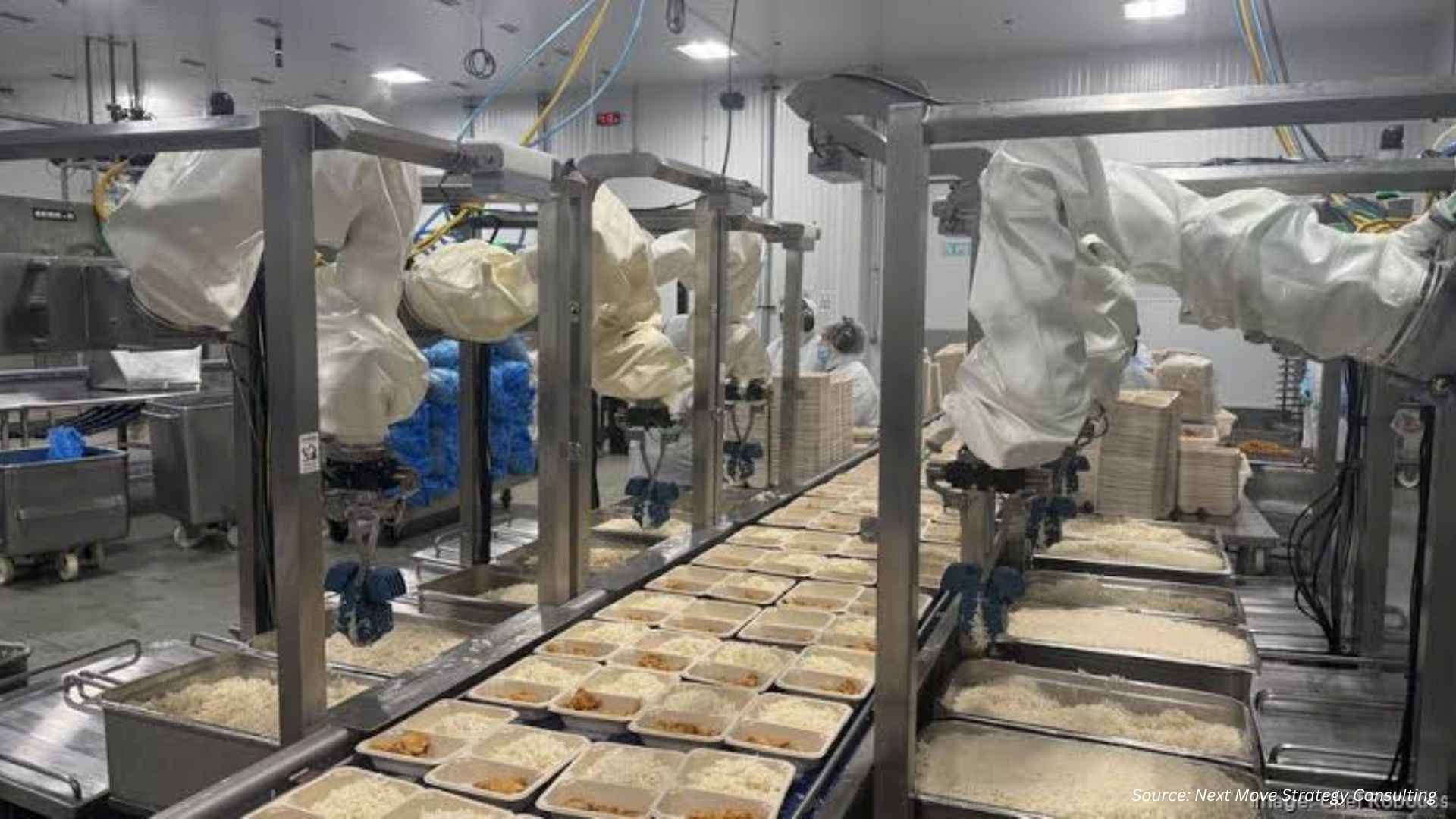
FANUC's Automate 2026 Debut Signals a Structural Shift in Global Food Automation as Robotics Investment Reaches a $20 Billion All-Time High
In a demonstration that encapsulates the accelerating convergence of artificial intelligence, hygienic engineering, and industrial automation, FANUC America debuted its dedicated "Cobot and Go" booth at Automate 2026 — held June 22–26 at McCormick Place in Chicago — showcasing pre-engineered collaborative robot systems designed for rapid deployment across food and beverage manufacturing environments. The exhibition, one of North America's most consequential industrial automation events, underscored a broader structural realignment underway across the global food production landscape: automation is no longer a discretionary capital expenditure but an operational imperative driven by persistent labour shortages, tightening food safety regulations, and the accelerating integration of AI-enabled vision systems into production lines.
The timing of FANUC's Automate 2026 showcase is not incidental. It arrives against a backdrop of record-breaking robotics investment globally. According to F-Prime Capital's State of Robotics 2026 report, total venture and institutional investment into robotics reached $20 billion in 2025 — an all-time high — with 80% of capital directed toward companies headquartered in the Americas. The report further documented that median revenue growth among public robotics companies reached 24%, while private robotics unicorn enterprise values surged 87% over the same period. These figures reflect a market that has moved decisively beyond proof-of-concept into commercial-scale deployment, with food automation emerging as one of the most strategically active verticals.
Global Robot Demand Doubles Over a Decade, Food Sector Accelerates
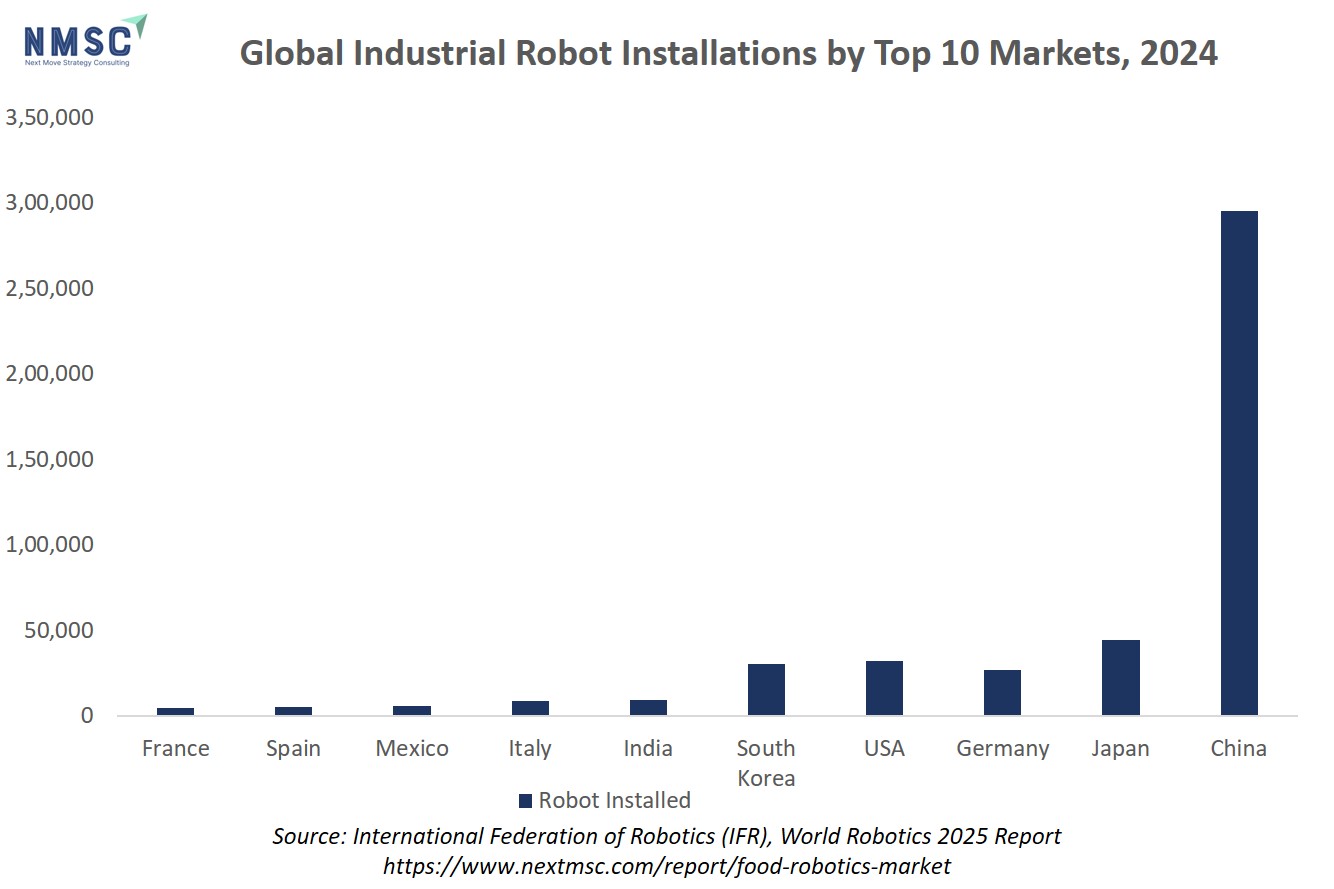
The macroeconomic foundation underpinning food automation investment is substantial. According to the International Federation of Robotics (IFR) World Robotics 2025 report, published in September 2025, 542,000 industrial robots were installed globally in 2024 — more than double the number installed a decade earlier, and the fourth consecutive year in which annual installations exceeded 500,000 units. The total operational stock of industrial robots worldwide reached 4,664,000 units in 2024, representing a 9% year-on-year increase.
Asia accounted for 74% of new global deployments in 2024, with China alone representing 54% of the global total at 295,000 units installed — the highest annual figure ever recorded for a single country. Europe accounted for 16% of installations, while the Americas contributed 9%, with the United States recording 34,200 units.
The IFR projects global robot installations will grow 6% to approximately 575,000 units in 2025, with the 700,000-unit threshold expected to be surpassed by 2028.
Food and Beverage Manufacturing: A Sector at an Automation Inflection Point
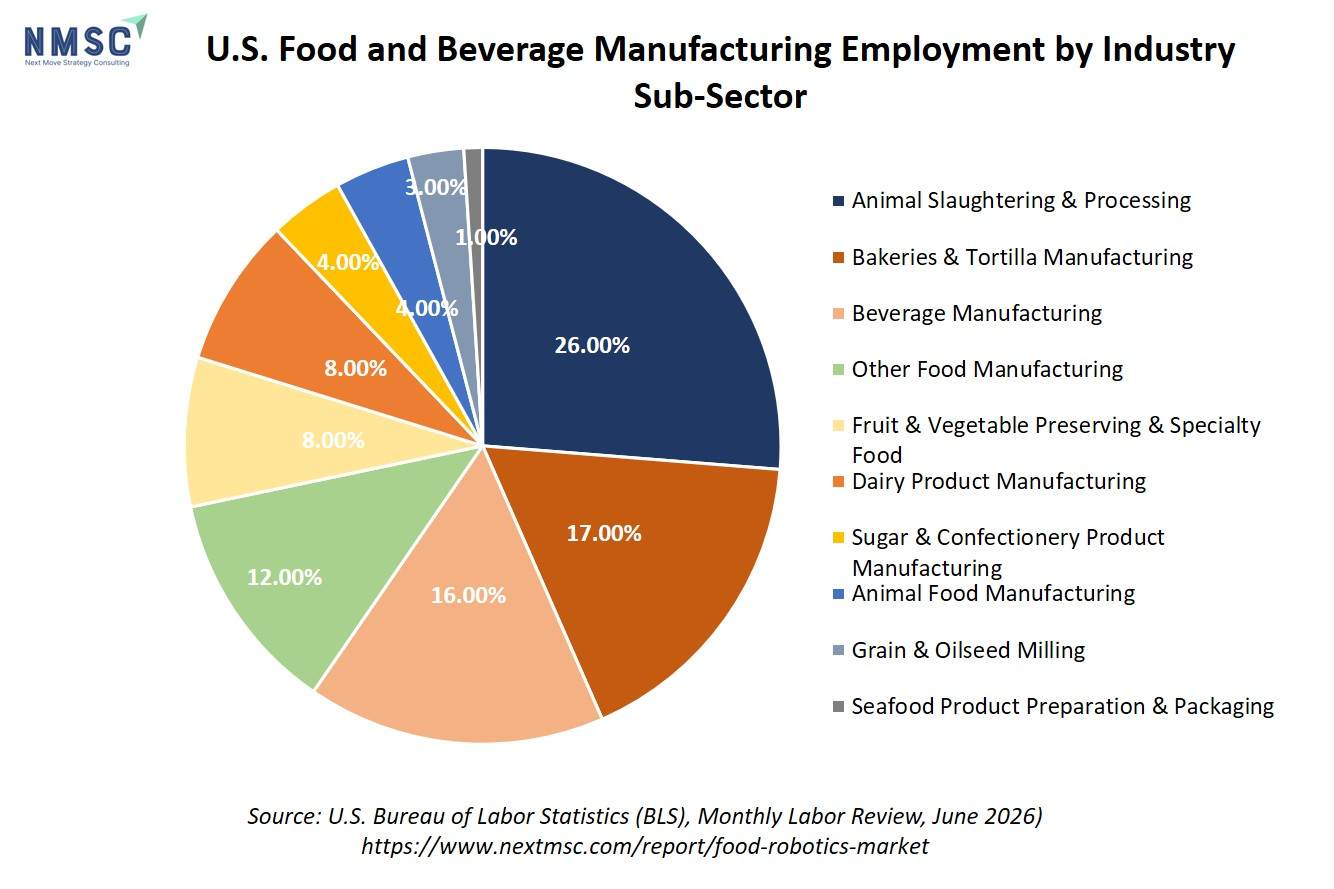
The food and beverage manufacturing sector is simultaneously one of the largest employers in the U.S. manufacturing economy and one of the most actively automating. According to the U.S. Bureau of Labor Statistics (BLS) Monthly Labor Review published in June 2026, food and beverage manufacturing employed approximately 2.1 million workers in 2024, representing 16% of all U.S. manufacturing employment — the largest share of any manufacturing sector. The sector is projected to add 130,000 new jobs between 2024 and 2034, the highest absolute job creation of any manufacturing sector, with output expected to surpass $1 trillion by 2034.
Critically, the BLS analysis confirms that the total robot stock in food and beverage manufacturing recorded 227.5% growth over the 2010–2020 decade, and that approximately 6.6% of food manufacturing plants used robots in 2022, with nearly a quarter of sector employees exposed to robotic systems in their work. The BLS projects that continued automation adoption will bolster food and beverage manufacturing output by approximately 22% from 2024 to 2034, even as it moderates employment growth in specific sub-industries such as grain milling, seafood processing, and fruit and vegetable preservation.
These structural dynamics — expanding output, persistent labour demand, and accelerating technology adoption — form the macroeconomic substrate upon which the global Food Robotics Market is advancing at a compound annual growth rate of 15.89% through 2035.
For More Information: Download FREE Sample on Food Robotics Market Report
FANUC's Automate 2026 Showcase: Hygienic Robotics Enters a New Commercial Phase
FANUC America's Automate 2026 debut was notable not merely for its scale but for the specificity of its food-grade engineering. The company's "Cobot and Go" booth featured pre-engineered collaborative robot systems designed for rapid deployment — a direct response to the capital access constraints facing small and mid-sized food manufacturers. The demonstration lineup included the CRX-20iA/L food-grade cobot for bakery cookie handling, the CRX-30iA for palletizing packaged food boxes, the LR Mate/10-11A Food/Clean robot for frozen protein bag packing, and the SR-12iA/C SCARA robot for brownie cutting — all equipped with NSF-H1 food-safe grease, IP67 or IP69K washdown ratings, and FANUC's iRVision 3D camera systems for real-time product tracking.
"FANUC continues to lead the industry in developing food-grade cobot and robot solutions that meet the highest standards for hygiene, reliability and performance," said Eric Potter, General Manager of Robot Application Engineering at FANUC America. "Our technologies help food manufacturers automate safely and efficiently to overcome labour challenges, boost productivity and maintain consistent quality in demanding environments."
The Automate 2026 showcase follows FANUC's November 2025 commercial launch of the LR Mate 10-11A Food/Clean robot — a 10-kilogram cleanroom-ready and food-safe model featuring stainless steel wrist flanges, NSF-H1 grease, and IP67 protection — designed specifically for high-speed pick-and-place operations in cold chain and frozen food packaging environments. These consecutive product launches reflect a deliberate strategic posture: as food manufacturers face intensifying regulatory scrutiny and labour market pressures, robotics OEMs are accelerating the commercialisation of application-specific, hygienic automation platforms.
Market Intelligence: Structural Drivers and Investment Dynamics
According to Next Move Strategy Consulting's analysis, the global food robotics market was valued at USD 3.64 billion in 2025 and is projected to reach USD 17.85 billion by 2035, expanding at a CAGR of 15.89% over the forecast period. In volume terms, the market stood at 126,000 units in 2025 and is anticipated to reach 759,000 units by 2035, reflecting a volume CAGR of 18.20%.
The NMSC report identifies three primary structural drivers: severe labour shortages across meat processing, bakery, and packaging lines; the strong presence of robotics OEMs and system integrators enabling turnkey deployment; and the expansion of automation adoption in emerging markets driven by urbanisation, export compliance requirements, and government-backed manufacturing incentives.
Asia-Pacific commands the largest regional share at 40%, driven by China's scale-intensive manufacturing ecosystem, Japan's precision-oriented automation culture, and India's expanding food processing infrastructure. North America accounts for 21.45% of the global market, underpinned by advanced automation readiness, venture capital participation, and stringent FDA and USDA compliance requirements. Japan alone holds a 12.29% share, reflecting its acute demographic pressures and leadership in compact, high-precision robotic systems.
The M&A landscape further validates the sector's investment momentum. F-Prime Capital's State of Robotics 2026 report documented that LG Electronics acquired a 51% stake in Bear Robotics — a food service robotics specialist — for $600 million in January 2025, one of the most significant food robotics transactions in recent years. The report also confirmed that global robotics investment reached $20 billion in 2025, with vertical robotics — encompassing food, logistics, manufacturing, and agriculture — representing a substantial and growing share of total capital deployment.
Technology Architecture: AI, Cobots, and the Modular Automation Paradigm
The competitive differentiation within food robotics is increasingly determined by technology stack depth rather than hardware specifications alone. NMSC's analysis identifies three converging technology layers reshaping the market: the perception layer (machine vision, 3D cameras, hyperspectral imaging, force/tactile sensors), the intelligence layer (AI/ML algorithms, deep learning models, predictive analytics), and the control and integration layer (real-time execution, ERP connectivity, cloud platforms, digital twins).
Collaborative robots (cobots) — which accounted for a 24.98% share of the food robotics market in 2025 — are central to this transformation. Unlike traditional industrial robots requiring safety cages and segregated workspaces, cobots operate alongside human workers through advanced force-limiting technologies and machine vision, enabling safe and responsive interaction in food preparation, packaging, and quality control environments. The Robot-as-a-Service (RaaS) business model is projected to register the highest CAGR within the market, as small and mid-sized food enterprises adopt subscription-based automation to circumvent high upfront capital requirements.
The BLS confirms that AI applications in food manufacturing are already delivering measurable operational improvements: automated mixing, forming, compacting, filling, packing, and palletising equipment is reducing labour dependency in specific sub-industries, while AI-powered vision systems are enabling real-time quality inspection, contamination detection, and predictive maintenance at scale.
Competitive Landscape: OEM Giants, Specialist Integrators, and Strategic Consolidation
The competitive architecture of the food robotics market is defined by the coexistence of global industrial automation leaders and specialised food processing system integrators. KUKA AG, FANUC Corporation, ABB, Yaskawa Electric Corporation, and Kawasaki Heavy Industries dominate the robotic arm and motion control segment, deploying high-speed articulated robots, SCARA systems, and vision-enabled platforms across palletising, pick-and-place, sorting, and inspection operations. GEA Group, Krones AG, Syntegon Technology, and Tetra Pak International hold strong positions in fully integrated food processing and packaging automation, particularly across dairy, beverage, meat, and packaged food segments.
Collaborative robotics providers — Universal Robots, OMRON Corporation, and Techman Robot — are expanding their footprint in small and mid-sized food facilities, while specialised players including JBT Corporation, Middleby Corporation, DENSO Corporation, Staubli International, Epson Robots, Festo, Mayekawa Manufacturing, and Pudu Technology contribute to niche and application-specific growth segments.
Strategic mergers and acquisitions are accelerating consolidation. The LG Electronics–Bear Robotics transaction exemplifies a broader trend in which consumer electronics and industrial conglomerates are acquiring food robotics specialists to gain immediate access to proprietary technology, customer relationships, and deployment expertise. F-Prime Capital's analysis confirms that M&A activity in the robotics sector is recovering, with six transactions exceeding $250 million recorded in 2024 and 2025 combined.
Regulatory and Geopolitical Dimensions
The regulatory environment is a dual-edged force in the food robotics market. In the United States, USDA and FDA sanitation standards — including requirements for NSF-H1 food-grade lubricants, IP69K washdown protection, and ISO cleanroom compliance — are directly shaping product specifications and procurement criteria. In the European Union, stringent food safety directives, traceability mandates, and sustainability regulations are compelling manufacturers to prioritise certified, energy-efficient, and interoperable robotic platforms.
Geopolitical dynamics are also reshaping supply chain strategies. The IFR notes that robot demand in Europe has benefited from the nearshoring trend, as manufacturers seek to reduce dependency on extended global supply chains. China's domestic robotics manufacturers have, for the first time, captured more than 50% of their home market — a 57% domestic market share in 2024, up from approximately 28% a decade earlier — signalling a structural shift in the global robotics supply chain that will have long-term implications for pricing, technology transfer, and competitive positioning.
Trade and tariff regulations governing the import and export of robotic kitchen equipment and components remain a critical variable, particularly for manufacturers operating across multiple jurisdictions. Companies that have invested in localised manufacturing capabilities, regional service networks, and regulatory compliance infrastructure are demonstrably better positioned to navigate these headwinds.
Bottom Line
The global food robotics market is at a structural inflection point, driven by the convergence of record-breaking robotics investment, accelerating AI integration, persistent labour market pressures, and tightening food safety compliance requirements. FANUC's Automate 2026 showcase and the broader $20 billion robotics investment environment of 2025 confirm that food automation has transitioned from an emerging opportunity to a mainstream industrial priority. With the market projected to expand from USD 3.64 billion in 2025 to USD 17.85 billion by 2035 at a CAGR of 15.89%, the investment case is supported by durable macroeconomic tailwinds: a global operational robot stock exceeding 4.6 million units, food and beverage manufacturing output projected to surpass $1 trillion in the United States alone by 2034, and robot adoption in food plants growing at historically unprecedented rates.
For investors, the most defensible opportunities lie in companies combining AI-enabled vision systems, hygienic cobot platforms, modular RaaS deployment models, and robust system integration capabilities. For food manufacturers, the strategic imperative is clear: those that delay automation investment risk compounding labour cost disadvantages, compliance exposure, and throughput inefficiencies relative to peers who are already deploying next-generation robotic systems at scale. The risk of inaction now materially exceeds the risk of capital deployment.
About Next Move Strategy Consulting
Next Move Strategy Consulting is a premier market research and management consulting firm that has been committed to provide strategically analysed well documented latest research reports to its clients. The research industry is flooded with many firms to choose from, what makes NMSC different from the rest is its top-quality research and the obsession of turning data into knowledge by dissecting every bit of it and providing fact-based research recommendation that is supported by information collected from over 500 million websites, paid databases, industry journals and one on one consultations with industry experts across a diverse range of industry sectors. The high-quality customized research reports with actionable insights and excellent end-to-end customer service help our clients to take critical business decisions that enables them to move beyond time and have competitive edge in the industry.
We have been servicing over 1000 customers globally that includes 90% of the Fortune 500 companies over a decade. Our analysts are constantly tracking various high growth markets and identifying hidden opportunities in each sector or the industry. We provide one of the industry's best quality syndicate as well as custom research reports across 10 different industry verticals. We are committed to deliver high quality research solutions in accordance to your business needs. Our industry standard delivery solutions that ranges from the pre consultation to after-sales services, provide an excellent client experience and ensure right strategic decision making for businesses.
For more information, please contact:
Next Move Strategy Consulting
5th Floor 867 Boylston St, STE 500,
Boston, MA 02116, U.S.
E-Mail: [email protected]
Direct: +1-217-650-7991
Website: www.nextmsc.com
About the Author
 Sanyukta Deb
— Sanyukta Deb is Digital Marketing Team Lead at Next Move Strategy Consulting, where she has led content strategy and technical SEO for the firm's B2B market research publications for over 2 years. Her editorial process translates NextMSC's primary and secondary research — spanning technology, industrial, and consumer sectors — into commercial narratives, backed by search-intent, keyword, and competitive analysis. She brings 5 years of overall experience in digital marketing and content strategy.
Sanyukta Deb
— Sanyukta Deb is Digital Marketing Team Lead at Next Move Strategy Consulting, where she has led content strategy and technical SEO for the firm's B2B market research publications for over 2 years. Her editorial process translates NextMSC's primary and secondary research — spanning technology, industrial, and consumer sectors — into commercial narratives, backed by search-intent, keyword, and competitive analysis. She brings 5 years of overall experience in digital marketing and content strategy.
About the Reviewer
 Debashree Dey
— Debashree Dey is Assistant Manager at Next Move Strategy Consulting, where she supports cross-vertical market content and communications across diverse industries for 6 years. Her professional background includes senior content writing, communications, and published manuscript authorship, with experience developing audience-focused business narratives and maintaining clear, consistent messaging. Her role supports research-led content development and editorial quality across NextMSC publications.
Debashree Dey
— Debashree Dey is Assistant Manager at Next Move Strategy Consulting, where she supports cross-vertical market content and communications across diverse industries for 6 years. Her professional background includes senior content writing, communications, and published manuscript authorship, with experience developing audience-focused business narratives and maintaining clear, consistent messaging. Her role supports research-led content development and editorial quality across NextMSC publications.


















Add Comment