Ford Aluminum Supply Recovery Delayed After Novelis Fire
Industry Insights from Next Move Strategy Consulting
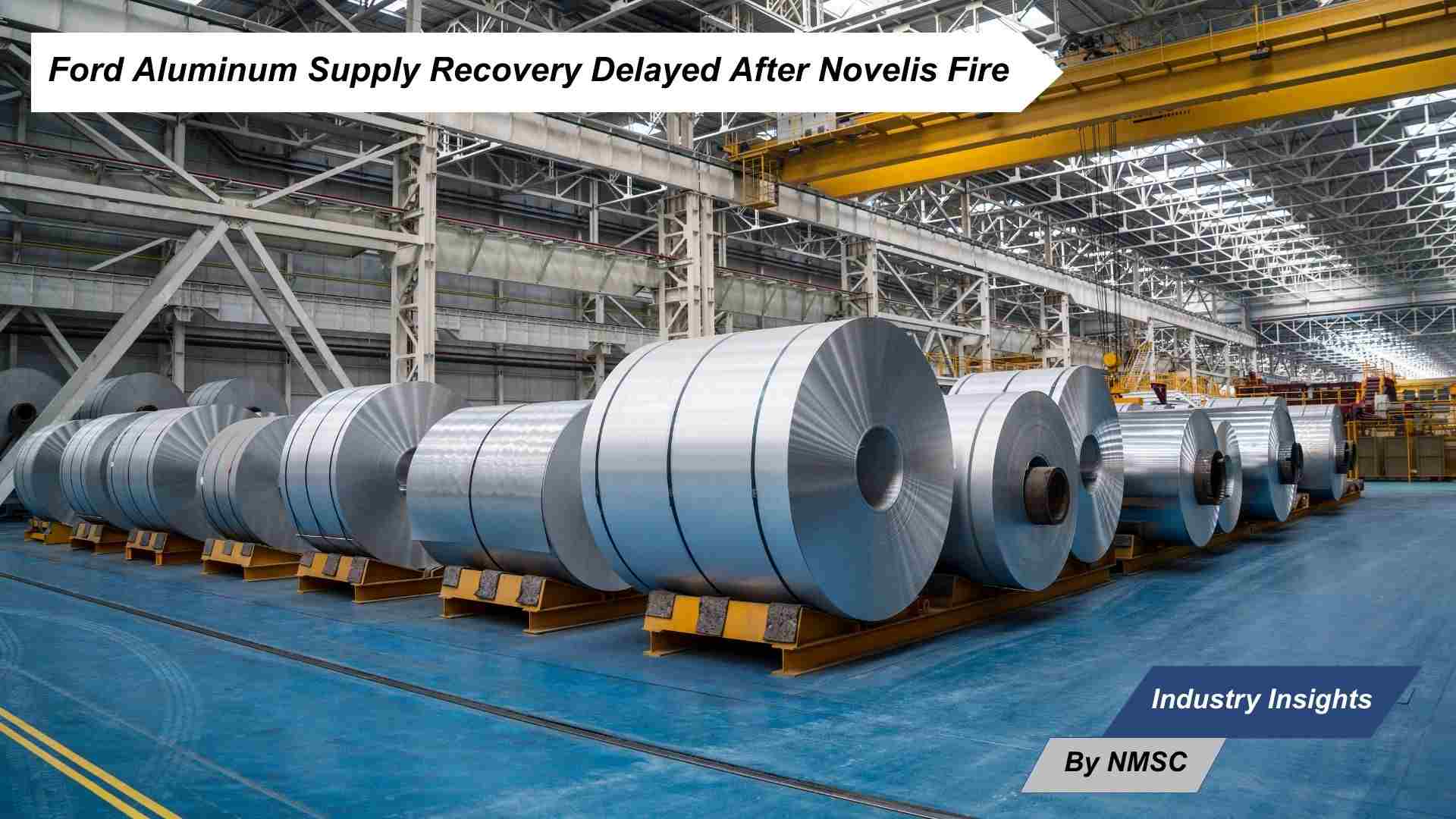
More than four months after a major fire disrupted aluminum production, Ford Motor Co. supplier Novelis has yet to fully restore output, extending uncertainty across Ford’s most profitable vehicle programs. The prolonged recovery underscores the operational and financial risks tied to concentrated material supply chains in the automotive sector.
Fire-Driven Disruptions Continue to Ripple
A fire at Novelis’ New York facility in September significantly curtailed aluminum supply to Ford, particularly affecting its full-size pickup trucks. In response, Ford revised its 2025 profit outlook and disclosed that the disruption could result in the loss of production of up to 100,000 F-Series trucks through the end of 2025, with an estimated impact of as much as $2 billion. The company indicated it planned to offset roughly half of that impact.
Novelis initially expected to return to full production by the end of December. However, a second fire in late November disrupted that timeline, leaving the facility’s hot mill still offline and raising questions about the effect on Ford’s fourth-quarter and first-quarter results.
Mitigation Efforts and Ongoing Uncertainty
Ford has stated it will provide further updates when it reports fourth-quarter earnings on February 10. In the interim, the automaker has sourced aluminum from other Novelis facilities, leveraging the supplier’s broader network. Novelis has reiterated that it continues to use alternate sources, including its global plants and industry peers, to mitigate the impact of the shutdown.
Despite these measures, the prolonged interruption highlights the vulnerability of high-volume vehicle programs to single-site disruptions. Ford’s F-Series lineup, including the F-150 and Super Duty models, represents the company’s top-selling vehicles and generates the majority of its global profit. The trucks rely heavily on aluminum bodies, making supply continuity critical.
Strategic Production Adjustments
To recover some of the lost output, Ford announced plans to increase production of its F-150 and Super Duty trucks by more than 50,000 vehicles in 2026 at its Dearborn and Louisville, Kentucky plants. At the same time, the company has discontinued production of the F-150 Lightning electric truck, which also used aluminum from Novelis, as part of a $19.5 billion write-down related to its electric vehicle programs. Novelis has estimated that rebuilding damaged areas and equipment at the affected plant will cost approximately $255 million, according to its application for financial assistance from Oswego County, New York.
Next Move Strategy Consulting’s Viewpoint
According to Next Move Strategy Consulting’s view, the Aluminium Market incident illustrates how material supply disruptions can cascade into production losses, profit volatility, and strategic realignments for automakers. The situation reinforces the importance of diversified sourcing strategies and resilient supplier networks, particularly for critical materials such as aluminum that underpin high-margin vehicle segments. As automakers continue to balance cost efficiency with operational resilience, supplier recovery timelines and contingency planning are likely to remain under close scrutiny.
Source: Detroit News
Prepared by: Next Move Strategy Consulting
About the Author
 Sanyukta Deb
— Sanyukta Deb is Digital Marketing Team Lead at Next Move Strategy Consulting, where she has led content strategy and technical SEO for the firm's B2B market research publications for over 2 years. Her editorial process translates NextMSC's primary and secondary research — spanning technology, industrial, and consumer sectors — into commercial narratives, backed by search-intent, keyword, and competitive analysis. She brings 5 years of overall experience in digital marketing and content strategy.
Sanyukta Deb
— Sanyukta Deb is Digital Marketing Team Lead at Next Move Strategy Consulting, where she has led content strategy and technical SEO for the firm's B2B market research publications for over 2 years. Her editorial process translates NextMSC's primary and secondary research — spanning technology, industrial, and consumer sectors — into commercial narratives, backed by search-intent, keyword, and competitive analysis. She brings 5 years of overall experience in digital marketing and content strategy.
About the Reviewer
 Debashree Dey
— Debashree Dey is Assistant Manager at Next Move Strategy Consulting, where she supports cross-vertical market content and communications across diverse industries for 6 years. Her professional background includes senior content writing, communications, and published manuscript authorship, with experience developing audience-focused business narratives and maintaining clear, consistent messaging. Her role supports research-led content development and editorial quality across NextMSC publications.
Debashree Dey
— Debashree Dey is Assistant Manager at Next Move Strategy Consulting, where she supports cross-vertical market content and communications across diverse industries for 6 years. Her professional background includes senior content writing, communications, and published manuscript authorship, with experience developing audience-focused business narratives and maintaining clear, consistent messaging. Her role supports research-led content development and editorial quality across NextMSC publications.

















Add Comment