GE HealthCare’s 72-Hour Forecast Tool Targets Hospital Capacity Bottlenecks
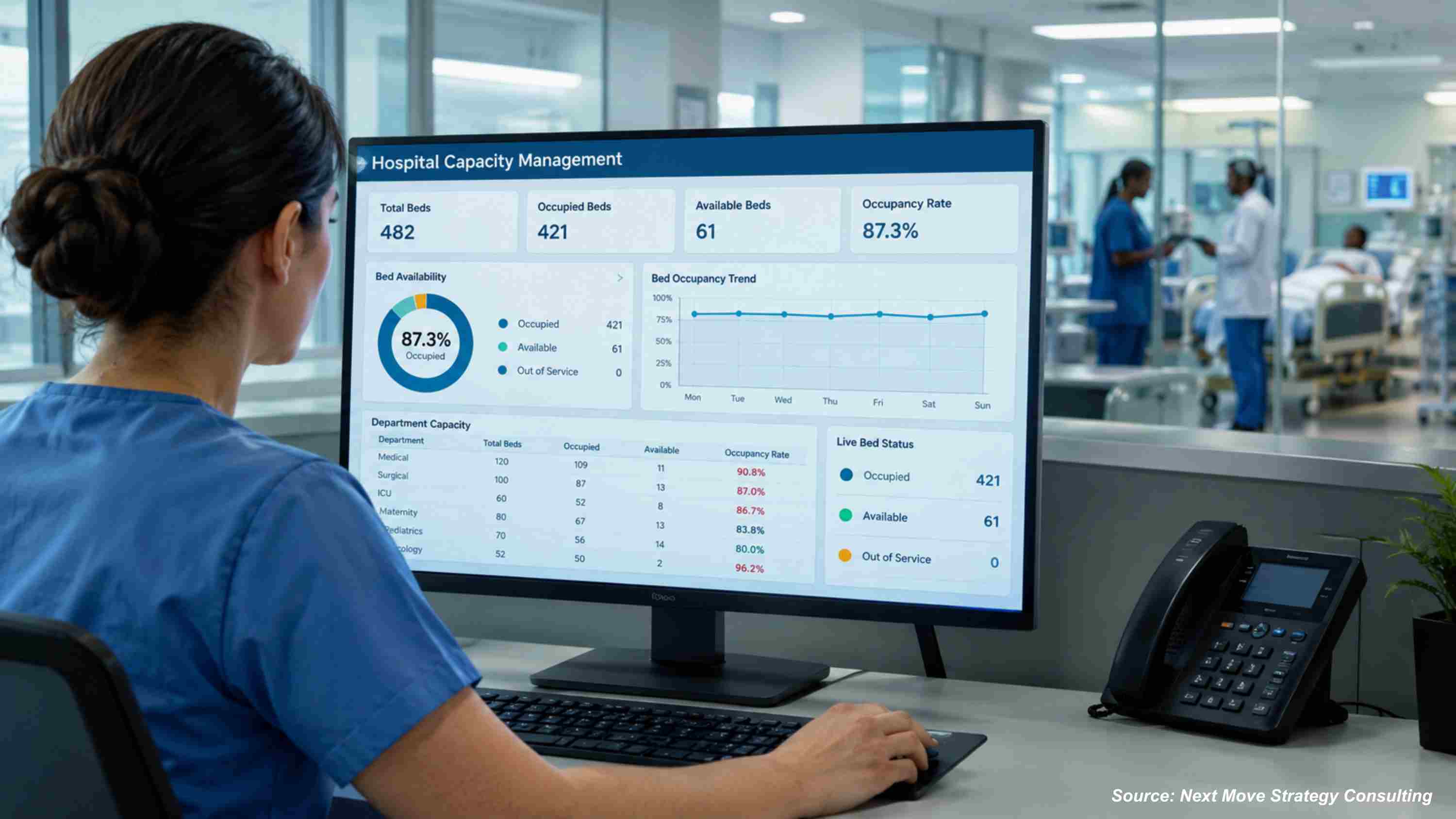
GE HealthCare’s September 15 forecasting launch and LeanTaaS’s September 1 Aidin acquisition move hospital capacity software from occupancy dashboards to prescriptive, admission-to-placement control
On September 15, 2026, GE HealthCare announced CareIntellect for Operations, a cloud-based software application that forecasts hospital capacity constraints up to 72 hours ahead and recommends the next operational step, with Duke Health in North Carolina and The Queen’s Health Systems in Hawaii named as the first two implementation sites. According to GE HealthCare’s announcement, the tool analyzes hundreds of patient-level and operational data points, including bed availability, staffing, wait times and patient delays, through two proprietary models: Pressure Forecast, which projects strain at unit, department and enterprise level, and Estimated Day of Discharge, which refreshes each patient’s likely discharge time every hour. The launch matters beyond one vendor’s roadmap. It moves a capacity product from showing where occupancy stands today to telling operations leaders what to do about the next three days, at a moment when the American Hospital Association reports that U.S. inpatient volumes rose 5.3% in 2025.
According to Next Move Strategy Consulting’s Hospital Capacity Management Solution Market report, the global hospital capacity management solution market was valued at USD 4.20 billion in 2025 and is projected to reach USD 13.70 billion by 2035, growing at a CAGR of 12.5% from 2026 to 2035. NextMSC primary research and analysis puts 2026 revenue at USD 4.75 billion, with software accounting for approximately 68% of 2025 spending and North America holding approximately 40% of global revenue. The September announcements from GE HealthCare and LeanTaaS illustrate the product direction behind those numbers: platforms that predict constraints and coordinate the work needed to relieve them.
For More Information: Download FREE Sample on Hospital Capacity Management Solution Market Report
The Financial Logic: Rising Volumes, Full Wards and the Cost of Standing Capacity
The pressure behind these products is documented in hospital operating data. The American Hospital Association’s Costs of Caring report, published in March 2026, found that U.S. inpatient volumes rose 5.3% in 2025 while outpatient visits rose 9.8%, and that total hospital expenses grew 7.5%, more than twice the rate of hospital price growth. The same report attributes about 36% of hospital expense growth between 2019 and 2024 to treating more patients and about 19% to treating sicker, more complex patients. Payment shortfalls leave little room to absorb the cost of staffed beds that sit blocked: the association also reports that Medicare reimbursed hospitals 83 cents on the dollar in 2024, an underpayment of more than USD 100 billion. NextMSC primary research and analysis identifies rising inpatient volumes and occupancy pressure as the largest single driver of demand for capacity management software, weighted at a +2.6% impact on CAGR.
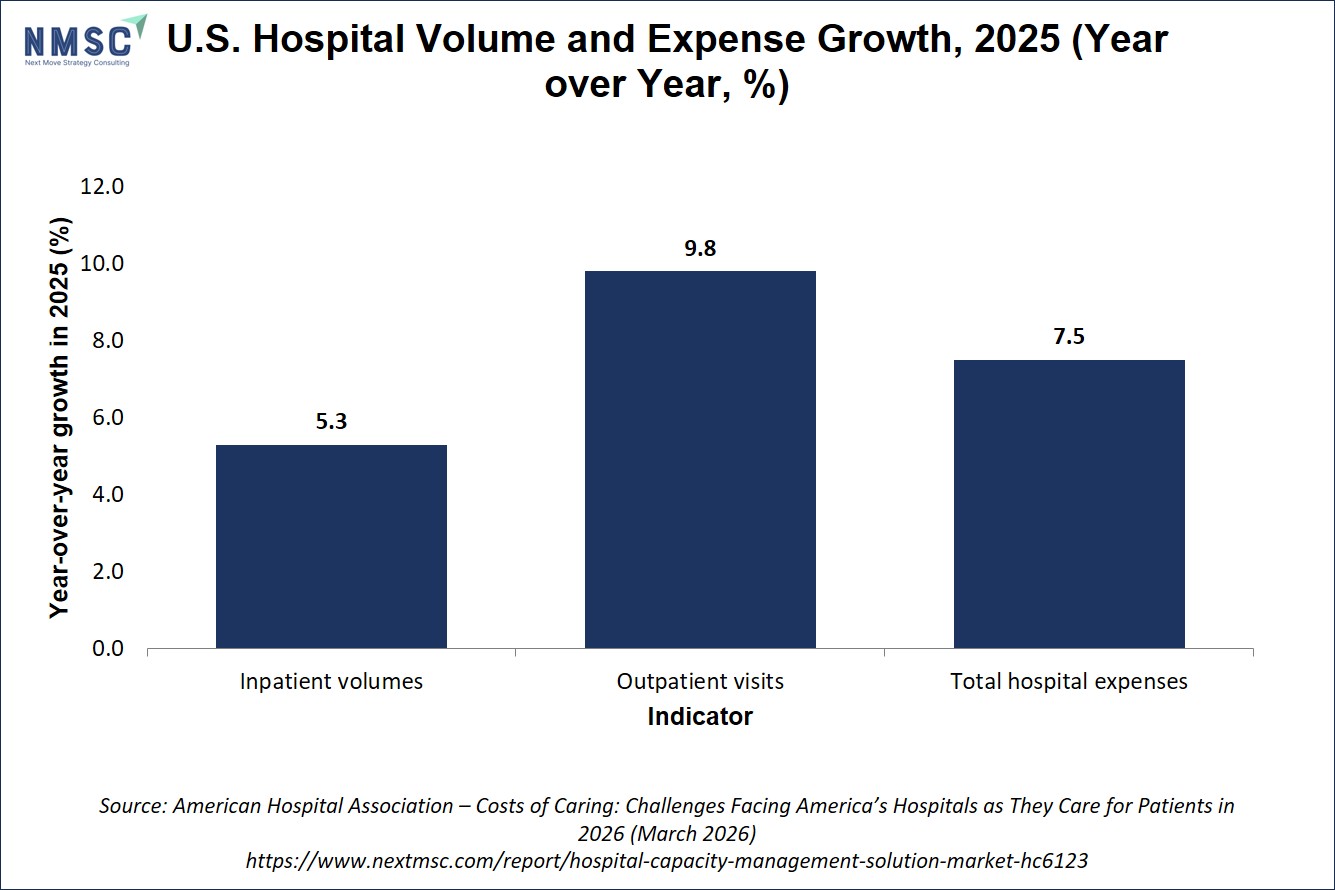
The chart plots three 2025 year-over-year changes reported in the American Hospital Association’s Costs of Caring report: inpatient volumes, outpatient visits and total hospital expenses.
At the largest U.S. operators, adding physical capacity is a multi-billion-dollar line item. HCA Healthcare’s chief financial officer, Mike Marks, told the TD Cowen Health Care Conference on March 3, 2026 that the company adds about 600 to 700 inpatient beds a year, and acknowledged that hospitals running 80% to 90% full begin to strain operations and draw extra attention to length of stay, according to Fierce Healthcare’s report of the session. Fierce Healthcare also reported that HCA’s capital spending reached USD 4.9 billion in 2025, with 2026 guidance of USD 5 billion to USD 5.5 billion.
The constraint is not confined to the United States. NHS England data compiled by The NHS Alliance show that in the week commencing 2 March 2026, 95.2% of adult general and acute beds in England were occupied, above both the 90% level in the NICE 2018 guideline and the 92% target in 2023/24 planning guidance, while 13,967 beds a day were filled with patients who no longer met the criteria to reside in hospital. The OECD’s Health at a Glance 2025, published in November 2025, reported an average of 4.2 hospital beds per 1,000 population across member countries in 2023, against 12.6 in Korea and 12.5 in Japan, a threefold gap that shows how unevenly physical capacity is distributed across health systems.
Key Industry Developments: Three Dated Moves Shaping Capacity Software
GE HealthCare sells CareIntellect for Operations as a software-as-a-service application that runs on Amazon Web Services and is available directly and through the AWS Marketplace. The company says the product builds on its Command Center software, used by nearly 500 hospitals and facilities worldwide, and cites customer-reported results from that earlier platform of up to USD 20 million in first-year cost savings, a length-of-stay reduction of more than one day, and capacity for 19,000 additional patients a year. GE HealthCare notes that results vary by user, record system and level of adoption.
“move beyond reacting to capacity challenges”
— Alex Wroe, Chief Operating Officer, The Queen’s Medical Center, GE HealthCare press release, “GE HealthCare Announces CareIntellect for Operations”, September 15, 2026.
Two weeks earlier, on September 1, 2026, LeanTaaS announced the acquisition of Aidin, a care-transition platform that, according to LeanTaaS, serves more than 200 hospitals across about 20 health systems and coordinates more than two million referrals a year across a network of over 21,000 post-acute providers. LeanTaaS states that roughly 40% of discharged Medicare patients need post-acute care but account for more than 55% of avoidable hospital days, and that Aidin reduces length of stay by 0.86 days on average and cuts placement time by 50%. These are company-reported figures, and the announcement did not state a purchase price. LeanTaaS says its software is used by nearly 200 health systems across more than 1,200 hospitals, centers and clinics.
“central nervous system for health systems”
— Mohan Giridharadas, Founder and Chief Executive Officer, LeanTaaS, LeanTaaS press release, “LeanTaaS Acquires Aidin to Orchestrate Patient Flow from Admission Through Transition”, September 1, 2026.
Three Dated Developments at a Glance
|
Development |
Date |
Detail |
|
GE HealthCare launches CareIntellect for Operations |
September 15, 2026 |
72-hour capacity forecast at unit, department and enterprise level; Duke Health and The Queen’s Health Systems are the first implementation sites |
|
LeanTaaS acquires Aidin |
September 1, 2026 |
Care-transition platform serving more than 200 hospitals; 0.86-day average length-of-stay reduction reported by LeanTaaS; price not stated |
|
HCA Healthcare outlines capacity strategy |
March 3, 2026 |
About 600 to 700 inpatient beds added a year; USD 4.9 billion capital spending in 2025; 2026 guidance of USD 5 billion to USD 5.5 billion |
Segment Dynamics: Software Anchors Spending While Services Scale Faster
NextMSC primary research and analysis shows software held approximately 68% of 2025 revenue, equal to USD 2.86 billion, reflecting hospital preference for centralized platforms spanning patient flow, emergency department, perioperative and command center functions. Services are the fastest-growing offering at 16.0% CAGR from 2026 to 2035, as health systems rely on consulting, implementation and managed services to connect capacity platforms to existing electronic health record infrastructure. Cloud deployment accounted for approximately 52% of 2025 revenue, or USD 2.18 billion, while hybrid deployment is the fastest-growing model at 16.4%, as large health systems balance cloud analytics with on-premises data-residency requirements for patient location and clinical workflow data.
By care setting, acute care held approximately 58% of 2025 revenue, or USD 2.44 billion, and ambulatory care is the fastest-growing setting at 16.4%. By revenue model, subscription held approximately 55%, or USD 2.31 billion, with managed services growing fastest at 17.0%. Among customers, community hospitals held approximately 34%, or USD 1.43 billion, while ambulatory surgery centers are the fastest-growing group at 17.5%. The September announcements follow this pattern: GE HealthCare’s application is delivered as software-as-a-service, and LeanTaaS’s Aidin extends inpatient flow into post-acute placement workflows.
Hospital Capacity Management Solution Market by Offering (USD Billion)
|
Offering |
2025 |
2035 |
|
Software |
2.86 |
8.77 |
|
Hardware |
0.84 |
3.01 |
|
Services |
0.50 |
1.92 |
Regional Outlook: North America Leads While Asia-Pacific Grows Fastest
North America accounted for approximately 40% of 2025 revenue, or USD 1.68 billion, with the United States at approximately USD 1.43 billion. NextMSC primary research and analysis identifies Asia-Pacific as the fastest-growing region at a 17.4% CAGR from 2026 to 2035, and India as the fastest-growing country at 20.4%, rising from approximately USD 0.13 billion in 2025 to approximately USD 0.71 billion by 2035. Capacity conditions differ sharply within the region. The OECD reports the highest hospital bed densities among member countries in South Korea and Japan, yet NextMSC projects South Korea’s market growing from approximately USD 0.10 billion in 2025 to approximately USD 0.39 billion by 2035, and Japan’s from approximately USD 0.15 billion to approximately USD 0.46 billion.
Hospital Capacity Management Solution Market by Region (USD Billion)
|
Region |
2025 |
2035 |
|
North America |
1.68 |
4.80 |
|
Europe |
1.09 |
3.15 |
|
Asia-Pacific |
0.84 |
3.56 |
|
Middle East & Africa |
0.34 |
1.23 |
|
Latin America |
0.25 |
0.96 |
Growth Drivers and Restraints
Drivers and Restraints Weighted in the NextMSC Forecast
|
Factor |
Type |
Impact on CAGR |
Geography |
Timeline |
|
Rising inpatient volumes and hospital occupancy pressure |
Driver |
+2.6% |
Global |
2026-2035 |
|
Growing adoption of AI-driven predictive discharge planning |
Driver |
+2.1% |
North America, Europe |
2026-2035 |
|
Expansion of command center and workflow orchestration platforms |
Driver |
+1.7% |
Global |
2026-2035 |
|
Rising real-time location system adoption for asset and patient tracking |
Driver |
+1.3% |
North America, Asia-Pacific |
2026-2035 |
|
Growing healthcare digitalization investment in emerging markets |
Driver |
+1.0% |
Asia-Pacific, MEA, Latin America |
2026-2035 |
|
Government hospital capacity reporting and modernization initiatives |
Driver |
+0.7% |
North America, Asia-Pacific |
2026-2035 |
|
High implementation cost and integration complexity with legacy EHR systems |
Restraint |
-1.4% |
Global |
2026-2035 |
|
Limited IT budgets among smaller community hospitals |
Restraint |
-0.8% |
Asia-Pacific, MEA, Latin America |
2026-2032 |
|
Clinical workflow resistance to new capacity management tools |
Restraint |
-0.5% |
Global |
2026-2030 |
The restraint rows bear directly on both September announcements. NextMSC primary research and analysis assigns its largest negative weight, -1.4%, to implementation cost and legacy electronic health record integration. GE HealthCare’s application draws on real-time data from the electronic medical record, and the value of Aidin depends on referral workflows that span hospitals, payers and post-acute providers, so integration depth, not model accuracy alone, is likely to set adoption pace.
NMSC Strategic Perspective: From Occupancy Dashboards to Prescriptive Capacity Control
NextMSC primary research and analysis finds that hospitals are consolidating standalone bed management, patient flow and staffing tools into unified command center platforms, a shift that favors vendors with integrated portfolios over single-function point solutions. The two September announcements are consistent with that finding. GE HealthCare’s application adds a 72-hour forecast and prescriptive actions to a Command Center base used at nearly 500 facilities, while LeanTaaS’s purchase of Aidin connects discharge-readiness intelligence to the referral and placement work that decides whether a discharge-ready patient actually leaves.
The measurable stakes appear in vendor-reported figures and public data. LeanTaaS reports that Aidin shortens stays by 0.86 days on average. With U.S. inpatient volumes up 5.3% in 2025 according to the American Hospital Association, each avoided inpatient day returns a staffed bed to the schedule without construction, which is the economic claim this category of software rests on. NextMSC’s forecast weights AI-driven predictive discharge planning at a +2.1% impact on CAGR, second only to occupancy pressure itself, and shows managed services and ambulatory care growing at 17.0% and 16.4% respectively, faster than the overall 12.5%.
Evidence remains uneven. GE HealthCare described Duke Health and The Queen’s Health Systems as clinical evaluation sites and published no outcome data for CareIntellect for Operations itself; the savings it cites come from its earlier Command Center software. The Aidin figures are likewise company-reported. Independent, multi-site outcome data is therefore the next test for the category.
Competitive Landscape: Platform Providers and Specialists Converge
NextMSC primary research and analysis describes the industry as moderately consolidated, with two archetypes. Diversified health IT platform providers such as Epic Systems Corporation and Oracle Corporation combine electronic health record scale with embedded capacity modules, while specialized vendors such as LeanTaaS, Inc. and Qventus, Inc. compete on purpose-built predictive analytics. GE HealthCare Technologies Inc. and TeleTracking Technologies, Inc. are also among the companies NextMSC profiles. The September 2026 announcements show two players extending their reach: GE HealthCare from command center visibility toward prescriptive forecasting, and LeanTaaS from inpatient flow toward post-acute placement. Competition in the software category, according to NextMSC primary research and analysis, centers on predictive analytics accuracy, platform integration breadth and implementation speed.
Bottom Line
GE HealthCare’s September 15, 2026 launch of CareIntellect for Operations and LeanTaaS’s September 1 acquisition of Aidin point the same way: hospital capacity software is moving from showing occupancy to forecasting constraints and coordinating the work that clears them. The demand case rests on public data, including a 5.3% rise in U.S. inpatient volumes in 2025 reported by the American Hospital Association and 95.2% adult general and acute bed occupancy in England in early March 2026. NextMSC primary research and analysis values the market at USD 4.20 billion in 2025 and USD 13.70 billion by 2035, a 12.5% CAGR, with software leading today and services, hybrid deployment and ambulatory settings growing faster. The main caution is evidence: outcome figures cited by vendors are company-reported, and CareIntellect for Operations has no published results yet. Buyers and investors should watch independent multi-site outcomes, integration depth with electronic health records, and whether platform consolidation continues across inpatient, post-acute and ambulatory care.
About Next Move Strategy Consulting
Next Move Strategy Consulting is a premier market research and management consulting firm that has been committed to provide strategically analysed well documented latest research reports to its clients. The research industry is flooded with many firms to choose from, what makes NMSC different from the rest is its top-quality research and the obsession of turning data into knowledge by dissecting every bit of it and providing fact-based research recommendation that is supported by information collected from over 500 million websites, paid databases, industry journals and one on one consultations with industry experts across a diverse range of industry sectors. The high-quality customized research reports with actionable insights and excellent end-to-end customer service help our clients to take critical business decisions that enables them to move beyond time and have competitive edge in the industry.
We have been servicing over 1000 customers globally that includes 90% of the Fortune 500 companies over a decade. Our analysts are constantly tracking various high growth markets and identifying hidden opportunities in each sector or the industry. We provide one of the industry’s best quality syndicate as well as custom research reports across 10 different industry verticals. We are committed to deliver high quality research solutions in accordance to your business needs. Our industry standard delivery solutions that ranges from the pre consultation to after-sales services, provide an excellent client experience and ensure right strategic decision making for businesses.
For more information, please contact:
Next Move Strategy Consulting
5th Floor 867 Boylston St, STE 500,
Boston, MA 02116, U.S.
E-Mail: [email protected]
Direct: +1-217-650-7991
Website: www.nextmsc.com
About the Author
 Sanyukta Deb
— Sanyukta Deb is Digital Marketing Team Lead at Next Move Strategy Consulting, where she has led content strategy and technical SEO for the firm's B2B market research publications for over 2 years. Her editorial process translates NextMSC's primary and secondary research — spanning technology, industrial, and consumer sectors — into commercial narratives, backed by search-intent, keyword, and competitive analysis. She brings 5 years of overall experience in digital marketing and content strategy.
About the Reviewer
 Debashree Dey
— Debashree Dey is Assistant Manager at Next Move Strategy Consulting, where she supports cross-vertical market content and communications across diverse industries for 6 years. Her professional background includes senior content writing, communications, and published manuscript authorship, with experience developing audience-focused business narratives and maintaining clear, consistent messaging. Her role supports research-led content development and editorial quality across NextMSC publications.















Add Comment