Hospital Capacity Management Solution Market Global Industry Analysis and Forecast (2026-2035)

Hospital Capacity Management Solution Market size was USD 4.20 billion in 2025, projected to reach USD 13.70 billion by 2035, growing at a CAGR of 12.5% from 2026 to 2035. Key drivers include rising inpatient volumes and hospital occupancy pressure, increasing adoption of AI-driven predictive analytics, and expansion of command center and workflow orchestration platforms, with North America leading the market.

Download Free Sample PDF
Base Year (2025)
$4.20 Billion
Forecast (2035)
$13.70 Billion
CAGR (2026-2035)
12.5%
Top Region
North America

What Is the Hospital Capacity Management Solution Market Size?

The global Hospital Capacity Management Solution market size was valued at USD 4.20 billion in 2025 and is estimated at USD 4.75 billion in 2026, forecast to reach USD 13.70 billion by 2035, expanding at a 12.5% CAGR between 2026 and 2035. North America leads with approximately 40% share, while software dominates all other offerings with approximately 68% share.

We observed that growth is broad-based across every segmentation axis, with cloud deployment and AI-enabled predictive analytics driving the dominant structural shifts through 2035.

Hospital Capacity Management Solution Market Global Industry Analysis and Forecast (2026-2035) Revenue Forecast

Values in USD Billion

2025 $4.20 Billion
2025
2026 $4.75 Billion
2026
2027 $5.34 Billion
2027
2028 $6.01 Billion
2028
2029 $6.76 Billion
2029
2030 $7.61 Billion
2030
2031 $8.56 Billion
2031
2032 $9.63 Billion
2032
2033 $10.83 Billion
2033
2034 $12.19 Billion
2034
2035 $13.70 Billion
2035

Key Takeaways

By Offering: Software held the largest share of approximately 68% (USD 2.86 billion) in 2025; Services is the fastest-growing sub-segment at 16.0% CAGR from 2026–2035.

By Deployment Model: Cloud held the largest share of approximately 52% (USD 2.18 billion) in 2025; Hybrid is the fastest-growing sub-segment at 16.4% CAGR from 2026–2035.

By Care Type: Acute Care held the largest share of approximately 58% (USD 2.44 billion) in 2025; Ambulatory Care is the fastest-growing sub-segment at 16.4% CAGR from 2026–2035.

By Revenue Model: Subscription held the largest share of approximately 55% (USD 2.31 billion) in 2025; Managed Services is the fastest-growing sub-segment at 17.0% CAGR from 2026–2035.

By Customer Type: Community Hospitals held the largest share of approximately 34% (USD 1.43 billion) in 2025; Ambulatory Surgery Centers is the fastest-growing sub-segment at 17.5% CAGR from 2026–2035.

By Sales Channel: Direct Sales held the largest share of approximately 62% (USD 2.60 billion) in 2025; Channel Partners is the fastest-growing sub-segment at 15.5% CAGR from 2026–2035.

Dominant Region: North America dominated with approximately 40% revenue share (USD 1.68 billion) in 2025.

Fastest-Growing Region: Asia-Pacific is expected to register the highest CAGR of 17.4% during 2026–2035.

Dominant Country: U.S. led with approximately USD 1.43 billion in 2025.

Fastest-Growing Country: India is the fastest-growing country at approximately 20.4% CAGR from 2026–2035.

Market Opportunity: The Hospital Capacity Management Solution market is expected to create an absolute dollar opportunity of USD 8.95 billion between 2026 and 2035, presenting significant investment potential across cloud-based command center platforms, predictive analytics, and real-time location system technology.

According to NMSC analysis, hospitals are increasingly consolidating standalone bed management, patient flow, and staffing tools into unified command center platforms, a shift that favors vendors with integrated software portfolios over single-function point solutions as health systems face mounting occupancy pressure through 2035.

What Does the Hospital Capacity Management Solution Market Encompass?

The Hospital Capacity Management Solution market encompasses software, hardware, and services that help hospitals optimize bed management, patient flow, emergency department throughput, perioperative scheduling, infusion capacity, and workforce allocation. Our assessment indicates that the scope spans cloud, on-premises, and hybrid deployment models supplied to academic medical centers, community hospitals, government hospitals, integrated delivery networks, specialty hospitals, and ambulatory surgerycenters across acute, ambulatory, specialty, and post-acute care settings worldwide.
The category has evolved from standalone bed-tracking spreadsheets into integrated command center platforms combining real-time location systems, predictive analytics, and workflow orchestration. The Organisation for Economic Co-operation and Development reported in November 2025 that OECD member countries averaged 4.2 hospital beds per 1,000 population as of 2023, with South Korea and Japan reporting the highest density at 12.6 and 12.5 beds per 1,000 population respectively, underscoring wide variation in capacity pressure across markets. We observed that technology adoption is shifting toward AI-driven predictive discharge and command center orchestration. NMSC's analysis indicates that this structural shift, combined with rising inpatient volumes, is redefining procurement priorities across the Hospital Capacity Management Solution market.

Market Drivers & Dynamics

Interactive Dataset
Rising inpatient volumes and hospital occupancy pressure driver +2.6% Global 2026-2035
Growing adoption of AI-driven predictive discharge planning driver +2.1% North America, Europe 2026-2035
Expansion of command center and workflow orchestration platforms driver +1.7% Global 2026-2035
Rising real-time location system adoption for asset and patient tracking driver +1.3% North America, Asia-Pacific 2026-2035
Growing healthcare digitalization investment in emerging markets driver +1.0% Asia-Pacific, MEA, Latin America 2026-2035
Government hospital capacity reporting and modernization initiatives driver +0.7% North America, Asia-Pacific 2026-2035
High implementation cost and integration complexity with legacy EHR systems restraint -1.4% Global 2026-2035
Limited IT budgets among smaller community hospitals restraint -0.8% Asia-Pacific, MEA, Latin America 2026-2032
Clinical workflow resistance to new capacity management tools restraint -0.5% Global 2026-2030
Source: Next Move Strategy Consulting

Growth Drivers

What Is the Primary Growth Driver of the Hospital Capacity Management Solution Market?

Rising inpatient volumes and hospital occupancy pressure is the primary driver of the market. The Organisation for Economic Co-operation and Development reported in November 2025 that OECD countries averaged 4.2 hospital beds per 1,000 population as of 2023, with several high-density markets including South Korea and Japan facing sustained capacity strain. We observed that this occupancy pressure, reinforced by aging populations and rising chronic disease prevalence, continues to anchor baseline demand for bed management and patient flow software across developed and emerging economies alike.

How Is AI-Driven Predictive Analytics Adoption Driving Hospital Capacity Management Solution Market Growth?

Expansion of AI-driven predictive discharge and demand forecasting tools is accelerating market growth by enabling health systems to anticipate capacity constraints before they occur. TeleTracking Technologies, Inc.'s November 2025 launch of Decision IQ and LeanTaaS, Inc.'s iQueue Autopilot generative AI solution illustrate how vendors are embedding predictive and prescriptive capabilities directly into operational workflows. Our assessment indicates that this technology shift is compressing adoption timelines among health systems seeking measurable throughput improvement.

Growth Inhibitors

What Is Restraining Hospital Capacity Management Solution Market Expansion?

High implementation cost and integration complexity with legacy electronic health record systems restrain broader adoption among smaller and resource-constrained hospitals. The U.S. Centers for Medicare & Medicaid Services' interoperability and health information technology requirements add compliance complexity to new system deployments. We found that these integration barriers, combined with limited IT budgets among community hospitals, are moderating adoption pace outside large academic medical centers and integrated delivery networks.

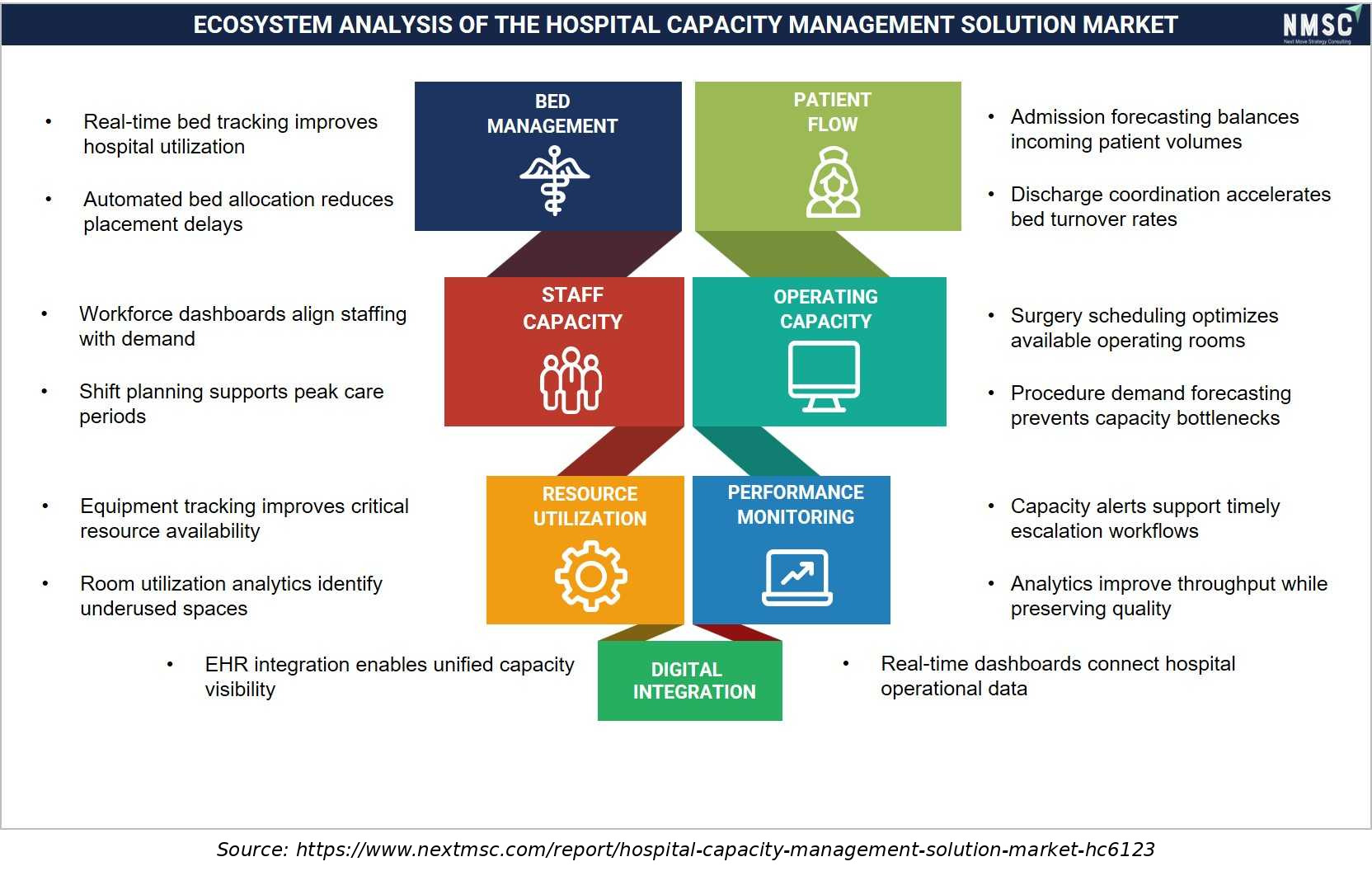
Ecosystem Analysis of the Hospital Capacity Management Solution Market

The ecosystem analysis illustrates how hospital capacity management solutions connect bed management, patient flow, staff capacity, operating capacity, resource utilization, and performance monitoring through digital integration. These interconnected functions enable healthcare organizations to coordinate capacity more effectively, improve operational visibility, optimize resource allocation, and support timely patient movement while strengthening overall hospital performance.

Segmentation Analysis

2025 (USD Billion)
2035 (USD Billion)
Software 2025: $2.86 Billion | 2035: $8.77 Billion
Software
Hardware 2025: $0.84 Billion | 2035: $3.01 Billion
Hardware
Services 2025: $0.50 Billion | 2035: $1.92 Billion
Services
Software $2.86 Billion $8.77 Billion 13.3%
Hardware $0.84 Billion $3.01 Billion 15.3%
Services $0.50 Billion $1.92 Billion 16.0%

Which Offering Dominates the Hospital Capacity Management Solution Market?

Software dominates the offering segmentation with approximately 68% share, reflecting hospitals' preference for centralized platforms spanning patient flow, emergency department, perioperative, and command center management functions. We observed that services are the fastest-growing sub-segment at 16.0% CAGR, as health systems increasingly rely on consulting, implementation, and managed services to integrate capacity management platforms with existing electronic health record infrastructure and sustain optimization gains post-deployment.

2025 (USD Billion)
2035 (USD Billion)
Cloud
On premises
Hybrid
Segment Item 2025 (USD Billion) 2035 (USD Billion) CAGR
Cloud $10.0 USD Billion $40.0 USD Billion 25.0%
On premises $17.1 USD Billion $51.1 USD Billion 11.0%
Hybrid $24.2 USD Billion $62.2 USD Billion 25.0%

Segment-wise data is locked

Unlock complete segment-wise numbers for By Deployment Model.

Unlock Full Data

Which Deployment Model Is Fastest-Growing in the Hospital Capacity Management Solution Market?

Cloud deployment held the largest share of the deployment model segmentation in 2025 at approximately 52%, reflecting hospitals' preference for lower upfront capital investment and faster implementation timelines. Our findings suggest that hybrid deployment is the fastest-growing sub-segment at 16.4% CAGR, as large health systems balance cloud-based analytics and command center functionality with on-premises data residency requirements for sensitive patient location and clinical workflow data.

2025 (USD Billion)
2035 (USD Billion)
Acute care
Ambulatory c
Specialty ca
Post-acute c
Segment Item 2025 (USD Billion) 2035 (USD Billion) CAGR
Acute care $10.0 USD Billion $40.0 USD Billion 27.0%
Ambulatory care $17.1 USD Billion $51.1 USD Billion 9.0%
Specialty care $24.2 USD Billion $62.2 USD Billion 19.0%
Post-acute care $31.3 USD Billion $73.3 USD Billion 17.0%

Segment-wise data is locked

Unlock complete segment-wise numbers for By Care Type.

Unlock Full Data

Which Care Type Leads the Hospital Capacity Management Solution Market?

Acute care leads care type segmentation with approximately 58% share, reflecting the concentration of bed management, emergency department, and perioperative capacity challenges within inpatient hospital settings. We found that ambulatory care is the fastest-growing care type at 16.4% CAGR, as vendors including TeleTracking Technologies, Inc. extend command center visibility beyond hospital walls into outpatient and ambulatory surgery center settings amid broader care delivery shifts toward lower-acuity venues.

2025 (USD Billion)
2035 (USD Billion)
Subscription
Perpetual li
Hardware sal
Professional
Managed serv
Segment Item 2025 (USD Billion) 2035 (USD Billion) CAGR
Subscription $10.0 USD Billion $40.0 USD Billion 14.0%
Perpetual license $17.1 USD Billion $51.1 USD Billion 24.0%
Hardware sales $24.2 USD Billion $62.2 USD Billion 22.0%
Professional services $31.3 USD Billion $73.3 USD Billion 12.0%
Managed services $38.4 USD Billion $84.4 USD Billion 27.0%

Segment-wise data is locked

Unlock complete segment-wise numbers for By Revenue Model.

Unlock Full Data
2025 (USD Billion)
2035 (USD Billion)
Academic med
Community ho
Government h
Integrated d
Specialty ho
Segment Item 2025 (USD Billion) 2035 (USD Billion) CAGR
Academic medical centers $10.0 USD Billion $40.0 USD Billion 24.0%
Community hospitals $17.1 USD Billion $51.1 USD Billion 22.0%
Government hospitals $24.2 USD Billion $62.2 USD Billion 20.0%
Integrated delivery networks $31.3 USD Billion $73.3 USD Billion 22.0%
Specialty hospitals $38.4 USD Billion $84.4 USD Billion 13.0%

Segment-wise data is locked

Unlock complete segment-wise numbers for By Customer Type.

Unlock Full Data
2025 (USD Billion)
2035 (USD Billion)
Direct sales
Channel part
System integ
OEM
Segment Item 2025 (USD Billion) 2035 (USD Billion) CAGR
Direct sales $10.0 USD Billion $40.0 USD Billion 23.0%
Channel partners $17.1 USD Billion $51.1 USD Billion 9.0%
System integrators $24.2 USD Billion $62.2 USD Billion 19.0%
OEM $31.3 USD Billion $73.3 USD Billion 13.0%

Segment-wise data is locked

Unlock complete segment-wise numbers for By Sales Channel.

Unlock Full Data

Growth Opportunities

NMSC's analysis indicates that three whitespace opportunities stand out for vendors and technology providers positioning for the next phase of market expansion.

How Can Generative AI Decision Support Unlock Prescriptive Value?

Extending predictive analytics into generative AI-powered prescriptive recommendations offers vendors a path to differentiate beyond dashboard-based visibility tools. This opportunity benefits command center software providers and academic medical centers seeking measurable throughput and length-of-stay improvement.

What Opportunity Does Ambulatory Platform Extension Present for Vendors?

Extending capacity management platforms into ambulatory surgery centers and outpatient settings creates opportunity for vendors to capture demand from lower-acuity care delivery shifts. This mechanism benefits software vendors and ambulatory surgery centers seeking integrated visibility across the full care continuum.

How Can Managed Services Expand Reach Among Community Hospitals?

Expanding managed and optimization services tailored to resource-constrained community hospitals creates opportunity for vendors to reach smaller health systems unable to support extensive internal IT teams. This mechanism benefits services providers and community hospitals seeking capacity optimization without large upfront technology investment.

Regional Outlook

2025 (USD Billion)
2035 (USD Billion)
North Americ
Europe
Asia-Pacific
Middle East
Latin Americ
Region 2025 (USD Billion) 2035 (USD Billion) CAGR (%)
North America $10.0 USD Billion $40.0 USD Billion 9.0%
Europe $17.1 USD Billion $51.1 USD Billion 27.0%
Asia-Pacific $24.2 USD Billion $62.2 USD Billion 25.0%
Middle East & Africa $31.3 USD Billion $73.3 USD Billion 23.0%
Latin America $38.4 USD Billion $84.4 USD Billion 12.0%

Regional data is locked

Unlock complete regional numbers for this market.

Unlock Full Data

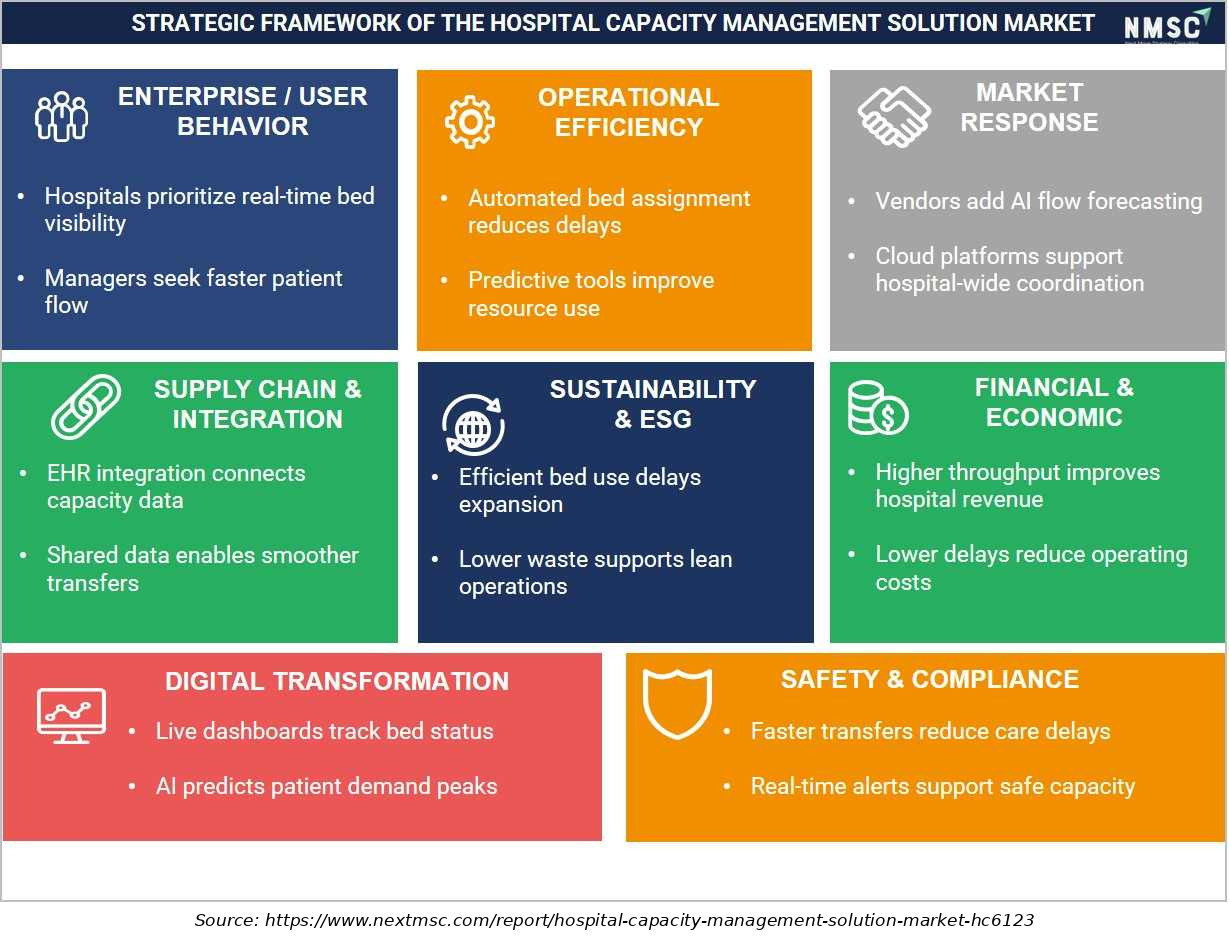
Strategic Framework of the Hospital Capacity Management Solution Market

Strategic Framework of the Hospital Capacity Management Solution Market
The strategic framework examines the factors shaping hospital capacity management solutions across enterprise behavior, operational efficiency, market response, supply chain integration, sustainability, financial performance, digital transformation, and safety. Real-time bed visibility, predictive analytics, EHR integration, cloud coordination, and AI-enabled forecasting support improved resource utilization, reduced delays, stronger hospital throughput, and more efficient capacity management.

Competitive Landscape

Our findings suggest that the Hospital Capacity Management Solution industry is moderately consolidated, with established health IT platform providers competing alongside specialized capacity optimization vendors.

Dimension Description
Market Structure Moderately consolidated, with the top ten companies accounting for the majority share of global capacity management software revenue.
Innovation Focus AI-driven predictive analytics, generative AI decision support, and command center platform consolidation.
M&A Activity Active, including LeanTaaS, Inc.'s acquisition of Hospital IQ, which created a combined company valuation exceeding USD 1 billion.

How Do Companies Compete in the Hospital Capacity Management Solution Market?

Companies compete primarily on predictive analytics accuracy, platform integration breadth, and implementation speed across bed management, patient flow, and perioperative scheduling categories. NMSC's analysis indicates that vendors differentiate through proprietary AI models, EHR integration depth, and command center consolidation capability. Competitive rivalry is most intense in the software offering category, where multiple established vendors offer comparable core patient flow functionality, pushing differentiation toward predictive and prescriptive analytics capability.

Which Competitive Archetypes Dominate the Hospital Capacity Management Solution Market?

Two archetypes dominate: diversified health IT platform providers such as Epic Systems Corporation and Oracle Corporation that combine electronic health record scale with embedded capacity modules, and specialized capacity optimization vendors such as LeanTaaS, Inc. and Qventus, Inc. that compete on purpose-built predictive analytics depth. Our analysis shows that scale advantages favor diversified platform providers in enterprise EHR-integrated accounts, while specialists retain share in health systems prioritizing best-of-breed capacity optimization.

What Innovation and Differentiation Strategies Define Market Leadership?

Leading vendors are investing in generative AI decision support, real-time location system integration, and command center consolidation to differentiate beyond dashboard-based visibility tools alone. We observed that TeleTracking Technologies, Inc.'s Decision IQ launch and LeanTaaS, Inc.'s iQueue Autopilot illustrate how established players are embedding predictive and prescriptive AI directly into daily operational workflows to deepen customer engagement and demonstrate measurable throughput outcomes.

How Active Is M&A Activity in the Hospital Capacity Management Solution Market?

M&A and partnership activity remains active, exemplified by LeanTaaS, Inc.'s acquisition of Hospital IQ, which combined AI-driven capabilities to optimize capacity and workflows, and its subsequent strategic partnership with Siemens Healthineers AG. We found that similar capacity platform consolidation and technology partnerships are likely to continue as vendors seek to expand predictive analytics capabilities across additional care settings and geographies.

Key Market Players

Our assessment identifies the following companies as the leading participants shaping competitive dynamics in the Hospital Capacity Management Solution market.

Epic Systems Corporation Oracle Corporation TeleTracking Technologies, Inc. GE HealthCare Technologies Inc. KoninklijkePhilips N.V. LeanTaaS, Inc. Dedalus S.p.A. Qventus, Inc. Alcidion Group Limited Care Logistics, LLC Siemens Healthineers AG HealthStream, Inc. CenTrak, Inc. Securitas Healthcare LLC Sonitor Technologies AS About Healthcare, Inc. IQVIA Holdings Inc. ORTEC B.V. Midmark Corporation WellSky Corporation

Latest Developments

We observed the following recent developments shaping competitive positioning across the Hospital Capacity Management Solution industry.

Date Event
November 2025 TeleTracking launched Decision IQ, an AI-driven solution designed to manage hospital patient flow at scale. University of Louisville Health became an early adopter, using forecasting and simulation to anticipate throughput bottlenecks, coordinate departments and address system-wide capacity constraints before they affect patient access.
June 2025 LeanTaaS launched iQueue for Surgical Clinics, extending its capacity-management platform upstream from hospital operating rooms into surgical clinics. The system integrates case-building, management and scheduling capabilities with clinic EHRs, aiming to improve patient access and coordinate surgical demand before cases reach hospital operating rooms.

Expert Insights

Robin Wood

Robin Wood

Vice President for System Capacity and Patient Flow | Penn Medicine

"We want to have the capacity to care for patients that need specific care, whether it’s transplant care at the Hospital of the University of Pennsylvania (HUP) or trauma care at Lancaster General Hospital. To have the capacity for the sickest of the sick, we need to make sure our supply is matching our demand."

Analyst Interpretation

This statement highlights the movement toward enterprise-wide capacity orchestration rather than hospital-by-hospital bed management. Health systems increasingly need software that can match patient demand with capacity across multiple facilities based on both clinical requirements and real-time availability. This creates opportunities for centralized command-center platforms, predictive analytics, transfer optimization, and network-level capacity management solutions.

Investment Opportunities

Where Are Capital Inflows Concentrated in the Hospital Capacity Management Solution Market?

Capital inflows are concentrated in generative AI and predictive analytics development, as vendors seek to differentiate beyond basic dashboard visibility. We observed that Bain Capital's significant growth investment in LeanTaaS, Inc., which became the company's majority shareholder, reflects continued private capital interest in AI-driven hospital operations platforms as the category matures.

How Significant Is Infrastructure Investment in Supporting Market Growth?

Hospital IT infrastructure investment, particularly cloud migration and real-time location system deployment, is expanding the addressable base for capacity management platforms. Our assessment indicates that health systems continuing to modernize legacy electronic health record infrastructure are creating parallel demand for integrated capacity management software, directly supporting vendor revenue growth over the forecast period.

What ESG Considerations Are Shaping Investment in Hospital Capacity Management Solutions?

Environmental, social, and governance considerations increasingly favor vendors demonstrating measurable improvements in patient access and care equity through capacity optimization. We found that investors are prioritizing platforms showing reduced emergency department boarding times and improved rural and underserved community hospital access, aligning capital allocation with broader healthcare equity expectations across the value chain.

Key Benefits for Stakeholders

How Does This Report Benefit Industry Leaders and Enterprise Decision-Makers?

This report equips hospital and health system leadership with segmented demand data, competitive benchmarking, and regional growth projections to prioritize capital allocation across capacity management technology investments. NMSC's analysis indicates that decision-makers can use the segmentation and driver-restraint analysis to align procurement timing with occupancy pressure and technology maturity shaping their specific care setting and geography.

How Does This Report Benefit Investors and Financial Analysts?

Investors and financial analysts gain access to independently derived market sizing, CAGR trajectories, and competitive landscape analysis supporting valuation and diligence work across health IT platform providers and specialized capacity optimization vendors. Our assessment indicates that the regional and segment-level detail supports comparative analysis of growth exposure across public and private company portfolios.

How Does This Report Benefit Technology Vendors and Product Teams?

Technology vendors and product teams can use the segmentation by deployment model, care type, and revenue model to identify underserved product categories and prioritize predictive analytics versus services investment. We observed that the driver-restraint and opportunity analysis directly informs go-to-market sequencing across regions with differing regulatory and adoption maturity.

Key Market Segments Evaluated

By Offering

  • Software 
    • Patient flow management
      • Admission management
      • Bed management
      • Patient placement
      • Transfer center management
      • Discharge management
    • Emergency department flow management
      • Triage management
      • Queue management
      • Boarding management
      • Throughput optimization
    • Perioperative capacity management
      • Operating room scheduling
      • Operating room utilization
      • Procedure coordination
      • Recovery capacity management
    • Infusion capacity management
      • Chair scheduling
      • Capacity optimization
      • Resource allocation
    • Command center software
      • Operational dashboard
      • Capacity visualization
      • Workflow orchestration
      • Alert management
    • Predictive analytics
      • Capacity forecasting
      • Demand prediction
      • Scenario simulation
      • Decision support
    • Real-time location system applications
      • Patient tracking
      • Staff tracking
      • Asset tracking
      • Location analytics
    • Workforce capacity management
      • Staff scheduling
      • Labor planning
      • Float pool management
      • Staffing analytics
    • Communication and workflow
      • Task management
      • Notification management
      • Escalation management
      • Clinical coordination
    • Other capacity management software
  • Hardware 
    • RTLS tags
    • RTLS badges
    • RTLS sensors
    • RTLS anchors
    • RTLS gateways
    • Digital displays
    • Interactive kiosks
    • Other capacity management hardware
  • Services 
    • Consulting
    • Implementation
    • System integration
    • Training
    • Support and maintenance
    • Managed services
    • Optimization services
    • Other services

By Deployment Model

  • Cloud
  • On premises
  • Hybrid

By Care Type

  • Acute care
  • Ambulatory care
  • Specialty care
  • Post-acute care

By Revenue Model

  • Subscription
  • Perpetual license
  • Hardware sales
  • Professional services
  • Managed services

By Customer Type

  • Academic medical centers
  • Community hospitals
  • Government hospitals
  • Integrated delivery networks
  • Specialty hospitals
  • Ambulatory surgery centers
  • Other healthcare providers

By Sales Channel

  • Direct sales
  • Channel partners
  • System integrators
  • OEM

By Region

  • North America 
    • U.S.
    • Canada
    • Mexico.
  • Europe 
    • UK
    • Germany
    • France
    • Italy
    • Spain
    • Sweden
    • Denmark
    • Finland
    • Netherlands
    • Rest of Europe.
  • Asia-Pacific 
    • China
    • India
    • Japan
    • South Korea
    • Taiwan
    • Indonesia
    • Vietnam
    • Australia
    • Philippines
    • Malaysia
    • Rest of APAC.
  • Middle East & Africa 
    • Saudi Arabia
    • UAE
    • Egypt
    • Israel
    • Turkey
    • Nigeria
    • South Africa
    • Rest of MEA.
  • Latin America 
    • Brazil
    • Argentina
    • Chile
    • Colombia
    • Rest of LATAM.

Conclusion & Recommendations

The long-term outlook remains strongly positive, with the market expected to nearly triple from USD 4.75 billion in 2026 to USD 13.70 billion by 2035 at a 12.5% CAGR. We observed that structural drivers, including rising inpatient volumes and AI-driven predictive analytics adoption, are durable rather than cyclical, supporting sustained double-digit growth across cloud-based and command center platform categories through the forecast period.

What Strategic Positioning Should Vendors Pursue?

Vendors should prioritize generative AI decision support and command center consolidation that address fragmented tool environments, while expanding managed services to reach resource-constrained community hospitals. Our assessment indicates that companies combining predictive analytics depth with EHR integration breadth, following the LeanTaaS and Siemens Healthineers partnership model, will be best positioned to defend share as competitive intensity rises.

How Attractive Is the Market for New Investment?

The market presents attractive investment characteristics given its high growth trajectory, recurring subscription revenue potential, and exposure to durable hospital occupancy pressure. We found that managed services and ambulatory surgery centers, growing at 17.0% and 17.5% CAGR respectively, represent the most attractive entry points for growth-focused investors and strategic acquirers.

What Market Shifts and Key Risks Should Stakeholders Monitor?

Stakeholders should monitor the shift toward AI-embedded prescriptive analytics and the platform consolidation reshaping vendor selection industry-wide. Our analysis shows that high implementation cost and legacy EHR integration complexity remain key risks to adoption pace, while limited IT budgets among smaller community hospitals continue to constrain premium platform adoption in certain markets.

What Growth Pathways Should Companies Prioritize?

Companies should prioritize growth pathways centered on generative AI decision support, ambulatory platform extension, and geographic expansion into Asia-Pacific and Latin American healthcare digitalization markets. NMSC's analysis indicates that these pathways offer the most direct route to capturing the USD 8.95 billion absolute dollar opportunity identified between 2026 and 2035.

FAQs

About the Author

Mihul Sharma

Mihul Sharma

Mihul Sharma is Research Associate at Next Move Strategy Consulting, where he has covered technology, industrial, and healthcare markets for 3 years. His work applies structured business research, market analysis, and secondary-source review to assess market trends, competitive developments, and growth opportunities. He supports report development by fully synthesizing industry data, company information, and market signals into concise findings for strategy and investment-focused research teams.

About the Reviewer

Supradip Baul

Supradip Baul

Supradip Baul is an accomplished business consultant and strategist with over a decade of rich experience in market intelligence, strategy, technology, and business transformation. His work has included rigorous qualitative and quantitative analysis across multiple industries, helping clients shape investment decisions and long-term roadmaps. Earlier in his career, he was associated with Gartner, where he contributed to industry-leading reports and market share analyses. He has worked with leading global companies and holds an MBA with a dual specialization in Marketing and Finance.

Download Free Sample

Nishant Awate

NISHANT AWATE

Business Development Global Sales

Zehnder Group Deutschland GmbH

Our experience working with Next Move Strategy Consulting was positive. The team was responsive, professional, and open to incorporating our specific requirements throughout the project. The India AHU market study was comprehensive and well structured, covering market value and volume forecasts, product and application segments, and key industry trends. The inclusion of both AHU and residential MVHR market insights made the study particularly relevant for our strategic market assessment. Overall, the report provides a solid foundation for evaluating market potential, identifying priority segments, and supporting business-development decisions in India.

Semih Kavaklioglu

SEMIH KAVAKLIOGLU

Co-Founder & Sales Manager

Decortie

I work a lot in the marketing industry and I know that research is an essential part of any campaign. I have used Market research reports for my own products and I found them to be very informative and well-researched. The team here produces insightful reports for a good price

Mohit Agarwal

MOHIT AGARWAL

Chief Manager

DryChem India Pvt. Ltd.

Next Move Strategy Consulting is an amazing team of consultants. We required a market study report for our investors on top priority and the team went above and beyond our expectations to deliver the same with ample supporting data within a short time span enabling us to secure the investments and keep our project timeline maintained. Their professionalism, attention to detail, and timely delivery of actionable recommendations have left a lasting impression on our organization.

Ross J Mckenzie

ROSS J MCKENZIE

Business Insight Manager

Staysure Group

“Next MSC have been incredibly helpful in providing detailed & robust information on our market, alongside quantifying growth by different segments. The process to procure was simple and easy, with sample reports and regular contact to ensure we had what we needed. Succinct detail on their sources & methodologies is also greatly received, allowing transparency in this respect helps build trust in the detail you pay for. Joseph in particular was fantastic, and helped ensure efficient provision of the insight pack – thank you NMSC!”.

Kishu Kanda

KISHU KANDA

Strategy Analyst

Accenture

We purchased the AI Consumer Market Report from this company. Not only did they customize the report to meet our specific requirements, but they also showed great flexibility in accommodating our budget. The report we received fully met our expectations. Additionally, they provided prompt and thorough responses to both our pre-purchase and follow-up questions. We look forward to working with this company again in the future.

Custom Market Research Services

We will customize the research for you if the listed report does not fully match your requirements.

Get 30% Free Customization

Select License

This website uses cookies to ensure you get the best experience on our website. Learn more

✖