GM Renewable Move Signals Energy Market Update
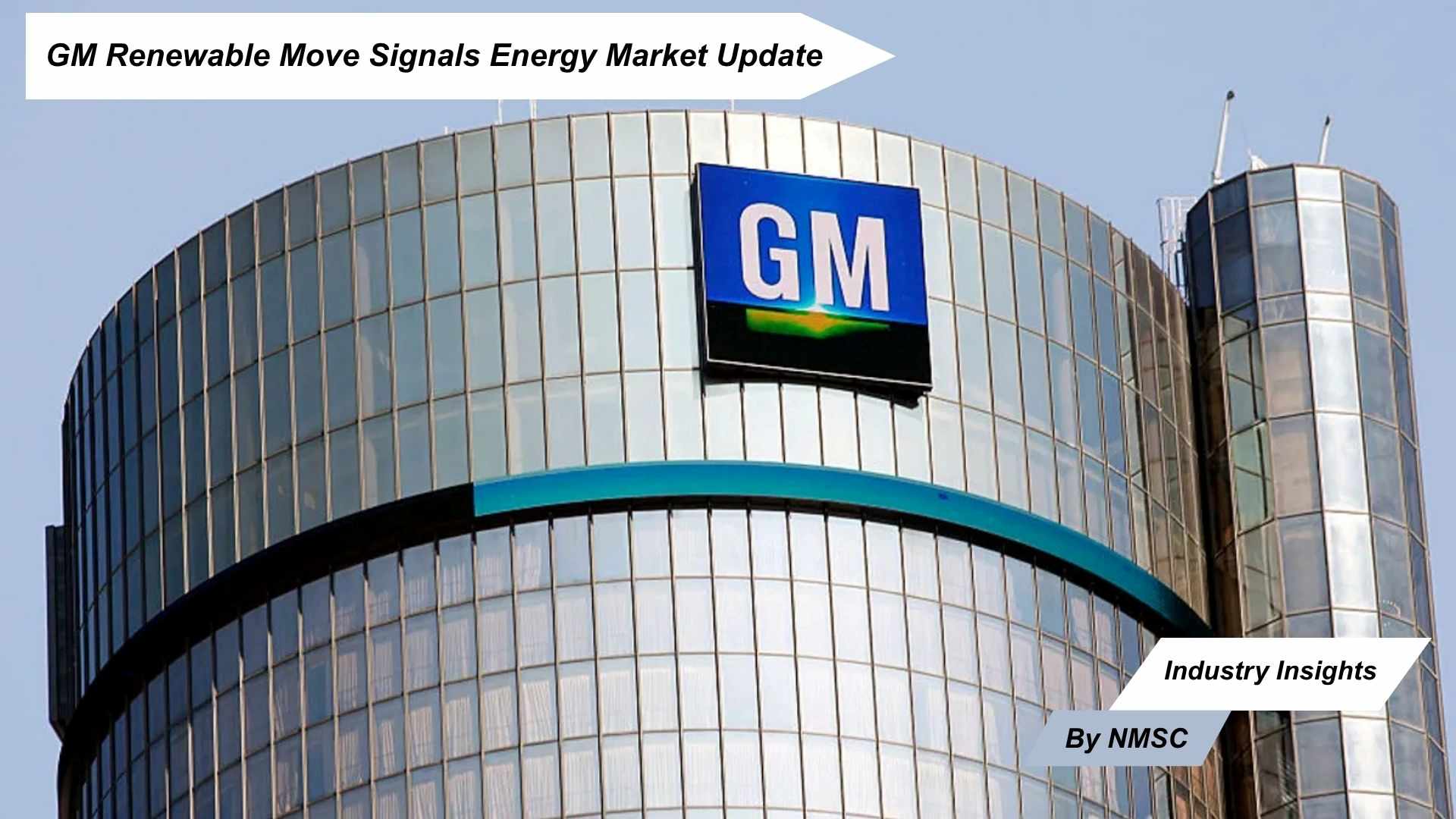
GM’s 100% U.S. Renewable Power Shift Reshapes Industrial Energy Market Outlook
DETROIT, United States — April 29, 2026 — General Motors has formally emerged as the first U.S. automaker to match all electricity consumed across its domestic facilities with renewable energy, a milestone achieved in 2025 and publicly detailed in its April 21 sustainability disclosure ahead of Earth Day. The announcement is being viewed by industrial analysts as a decisive inflection point for corporate clean-power procurement across heavy manufacturing sectors.
The development moves renewable sourcing beyond a symbolic ESG commitment and into the realm of operational competitiveness, where long-term electricity contracts, emissions compliance, and supply chain decarbonization are becoming central to manufacturing economics.
According to analysts tracking the global energy transition, the scale and timing of GM’s move could materially accelerate procurement activity across the broader Renewable Energy Market, particularly among industrial buyers with energy-intensive footprints.
A Landmark Break from Conventional Industrial Power Procurement
GM confirmed that it now contracts enough clean electricity to offset every kilowatt-hour used across all U.S. offices, assembly plants, parts facilities, and technical centers. The company relied on a blended procurement strategy involving:
-
Clean-energy utility sourcing programs
-
Virtual power purchase agreements (VPPAs)
-
Renewable energy credits
-
Limited on-site generation and landfill gas projects
This model enabled the automaker to achieve full domestic electricity matching while reducing dependence on volatile conventional grid pricing.
More importantly, the announcement signals that renewable energy purchasing is no longer confined to technology companies and hyperscale data centers; it is now entering the industrial manufacturing mainstream at automotive scale.
Why the Announcement Matters Beyond GM
The U.S. automotive industry remains one of the most electricity-intensive manufacturing ecosystems, with stamping, battery processing, robotics, painting, and assembly lines requiring uninterrupted large-scale power consumption.
By proving that full renewable electricity matching is feasible at this level, GM has effectively created a benchmark that peers will be pressured to respond to—both from investors and from downstream procurement partners seeking low-carbon sourcing credentials.
“Industrial renewable procurement has now crossed from pilot ambition to enterprise necessity,” notes Sikha Haritwal, Senior Research Analyst at Next Move Strategy Consulting. “When a manufacturer with GM’s national plant footprint can fully match domestic electricity demand with renewables, it changes boardroom assumptions about cost feasibility, reliability, and implementation speed.”
NMSC analysts further indicate that this event is likely to stimulate:
-
Higher demand for long-duration industrial PPAs
-
Faster corporate solar and wind contracting activity
-
Expanded utility green tariff programs for manufacturers
-
Increased supplier pressure to disclose renewable sourcing ratios
Economic Signals Behind the Sustainability Milestone
GM disclosed that its domestic renewable investments have already generated nearly $1.9 billion in U.S. GDP impact since 2015, while contracted projects through 2026 are projected to contribute an additional $333 million and support construction activity across multiple states.
This is particularly significant because it reframes renewable procurement as an industrial growth engine rather than merely a carbon accounting strategy.
Recent operational data also shows:
-
GM matched 70% of its global electricity use with renewables in 2025
-
Operational Scope 1 and Scope 2 emissions have fallen 52% since 2018
-
Long-term target remains 100% global renewable electricity by 2035
Such figures suggest that large manufacturers are increasingly using renewable contracts as a hedge against long-run energy cost instability while simultaneously strengthening ESG capital positioning.
Renewable Energy Market Faces New Industrial Demand Cycle
According to proprietary assessment from Next Move Strategy Consulting, GM’s move is not an isolated sustainability headline but a strong indicator of where industrial energy procurement is heading next.
Automotive, aerospace, semiconductors, chemicals, and advanced materials manufacturers are now under simultaneous pressure from:
-
Carbon disclosure mandates
-
Investor decarbonization scrutiny
-
Electrified production expansion
-
Volatile fossil-linked utility costs
That combination is expected to drive a fresh wave of utility-scale renewable contracting over the next 24 to 36 months.
As one of America’s most visible industrial corporations redraws its electricity sourcing model, the Renewable Energy Market is entering a more aggressive corporate adoption phase—one led less by climate rhetoric and more by hard infrastructure economics.
GM’s announcement therefore stands not simply as an environmental milestone, but as one of the clearest industrial signals yet that clean electricity is becoming foundational to next-generation manufacturing competitiveness.
Source: Facilities Dive report
Prepared By: Joydeep Dey
About the Author
 Sanyukta Deb is Digital Marketing Team Lead at Next Move Strategy Consulting, where she has led content strategy and technical SEO for the firm's B2B market research publications for over 2 years. Her editorial process translates NextMSC's primary and secondary research — spanning technology, industrial, and consumer sectors — into commercial narratives, backed by search-intent, keyword, and competitive analysis. She brings 5 years of overall experience in digital marketing and content strategy.
About the Reviewer
 Debashree Dey is Assistant Manager at Next Move Strategy Consulting, where she supports cross-vertical market content and communications across diverse industries for 6 years. Her professional background includes senior content writing, communications, and published manuscript authorship, with experience developing audience-focused business narratives and maintaining clear, consistent messaging. Her role supports research-led content development and editorial quality across NextMSC publications.
















Add Comment