Google’s Confidential TPU and a NEAR AI Breach Test Privacy-Preserving AI

Google’s TPU 8tx Moves Confidential Inference Into Silicon, While the NEAR AI SGLang Breach Shows Why Verification Must Reach the Software Inside the Enclave
On November 9, 2026, Google announced TPU 8tx, an eighth-generation Tensor Processing Unit system that builds confidential computing into the accelerator hardware itself, together with TPU 8i Max, a dual-chip system for very long context windows. In a blog post titled Our newest TPUs: 8tx and 8i Max, built for the agentic era, Amin Vahdat, Google’s SVP and Chief Technologist for AI and Infrastructure, described TPU 8tx as built for regulated enterprises and governments that run frontier or proprietary models and autonomous agents alongside their most sensitive data, and said Google’s TPU business now serves nearly 100 customers, including frontier labs, trading firms, retailers and universities.
According to Next Move Strategy Consulting’s Privacy-Preserving AI Market report, the global privacy-preserving AI market was valued at USD 8.36 billion in 2025 and is projected to reach USD 66.58 billion by 2035, growing at a CAGR of 18.74% from 2026 to 2035. NextMSC primary research and analysis places 2026 revenue at USD 14.19 billion and identifies confidential execution, cloud delivery and regulated industries as the anchors of current demand, a buyer profile that overlaps with the regulated enterprises Google named when it positioned TPU 8tx.
For More Information: Download FREE Sample on Privacy-Preserving AI Market Report
Confidential Inference Moves From a Software Option to a Silicon Feature
Google’s announcement frames the problem in one sentence: data is normally encrypted when stored or sent over a network, but has to be unlocked in memory while a computer processes it. TPU 8tx, which Google describes as built on the same silicon as its TPU 8t training system and paired with 5th Generation AMD EPYC CPU hosts, builds security into the hardware layer so that sensitive data and model weights stay protected and isolated while in active use. Google states that TPU 8tx delivers up to 2x lower latency than TPU 8t with a near-zero performance penalty. Those are Google’s own performance claims, and the announcement does not cite an independent measurement.
Google also stated that pairing training-grade compute with a low-latency network lets organisations fine-tune models on private data, distill large models into smaller ones and train agents through reinforcement learning without migrating sensitive data between separate clusters. For a regulated buyer, removing the data transfer step removes one of the points at which confidentiality is usually lost. NextMSC primary research and analysis treats performance overhead and limited confidential GPU capacity as two of the restraints that keep many deployments in pilot stage, which is why a near-zero penalty, if it holds in production, bears directly on adoption.
Google’s Eighth-Generation TPU Portfolio After the November 9 Announcement
|
System |
Role stated by Google |
Details given by Google |
|
TPU 8t |
Large-scale training |
Built for massive foundation models; up to 2.7 times better training performance than the previous TPU generation |
|
TPU 8i |
Low-latency reasoning |
Cuts inter-chip communication delays by up to half; up to 80% better inference price performance than the previous generation |
|
TPU 8tx |
Secure and confidential inference |
Hardware-level confidential compute; 5th Generation AMD EPYC CPU hosts; up to 2x lower latency than TPU 8t with a near-zero performance penalty |
|
TPU 8i Max |
Massive context windows |
Two TPU 8i chips in one package; double the compute, double the SRAM and double the HBM bandwidth of TPU 8i |
“…some highly regulated customers are asking for specialized encryption capabilities for unique workloads.”
- Amin Vahdat, SVP and Chief Technologist, AI and Infrastructure, Google, Google blog post, Our newest TPUs: 8tx and 8i Max, built for the agentic era, November 9, 2026.
The NEAR AI Breach Defines What an Enclave Does Not Cover
One day before Google’s announcement, on November 8, 2026, an attacker exploited a remote code execution vulnerability in SGLang, the open-source inference engine running on NEAR AI’s servers. According to NEAR AI’s incident report dated November 9, 2026, as reported by The Block on November 10, the attacker gained code execution on one inference server and reached an internal system behind a deprecated Private Chat feature. From there the attacker downloaded account details, including email addresses, names and in some cases plan and balance information, for about 100 users, and accessed chat histories, settings and logs for 18 agents on a legacy NEAR AI Agents deployment that was not running in the company’s confidential computing environment. API keys belonging to two NEAR AI Cloud customers were exposed in logs and have since been revoked.
The detail most relevant to confidential computing buyers is that the report says the attacker could have observed user requests being processed on the compromised server on November 8, including requests in confidential mode. NEAR AI found no indication that stored Private Chat conversations or uploaded files were accessed. The company stated that confidential computing protects data from the operator and the host but does not protect against a vulnerability in the software running inside the environment. NEAR AI patched the flaw across all inference servers, restored NEAR AI Cloud and said its security reviews will now treat inference software and the services around the enclave with the same rigour as the enclave itself.
The Cloud Security Alliance’s CISO Daily Briefing of November 11, 2026 placed the NEAR AI incident beside a second disclosure from the same week: on November 9, Fireworks AI widened its October incident disclosure to include customer datasets, secrets and partial model weights. Taken together, the two disclosures show that the exposure in AI serving infrastructure sits in the software and credentials around the model as much as in the memory the model occupies.
Enterprise Adoption Widens the Population of Regulated Workloads
Eurostat’s release of December 11, 2025 reported that 20.0% of EU enterprises with 10 or more employees used artificial intelligence technologies in 2025, a rise of 6.5 percentage points from 13.5% in 2024, against 8.1% in 2023 and 7.7% in 2021. The highest shares were recorded in Denmark (42.0%), Finland (37.8%) and Sweden (35.0%), and the lowest in Romania (5.2%), Poland (8.4%) and Bulgaria (8.5%). Eurostat identified analysing written language (11.8%) as the most common AI technology in use, followed by generating pictures, video or audio (9.5%) and generating written or spoken language (8.8%).
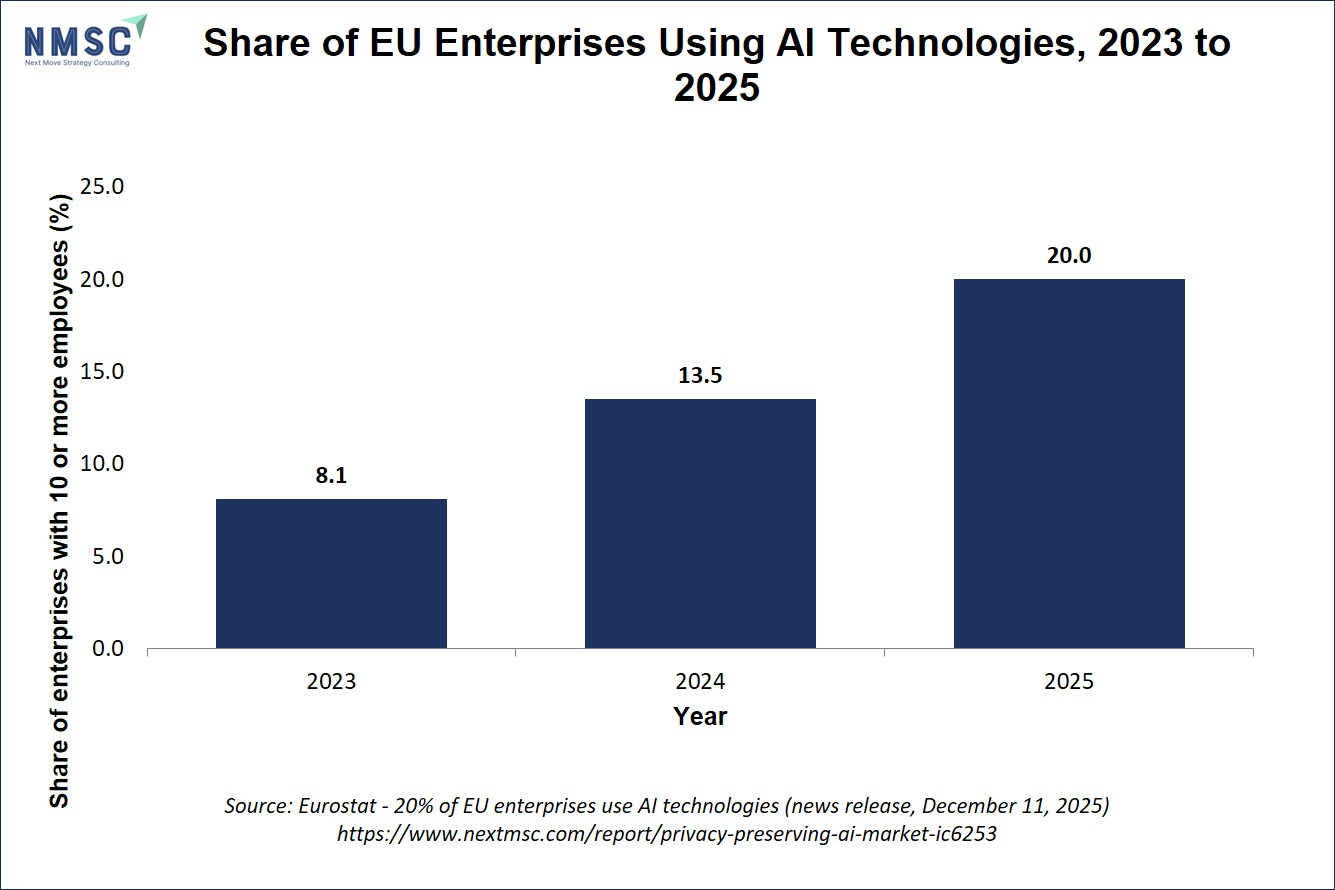
Share of Enterprises Using AI Technologies, Selected EU Countries and EU Total, 2025
|
Country or aggregate |
Share of enterprises (10 or more employees) |
Position among EU member states |
|
Denmark |
42.0% |
Highest in the EU |
|
Finland |
37.8% |
Second highest |
|
Sweden |
35.0% |
Third highest |
|
EU total |
20.0% |
EU aggregate |
|
Bulgaria |
8.5% |
Third lowest |
|
Poland |
8.4% |
Second lowest |
|
Romania |
5.2% |
Lowest in the EU |
ENISA Data Shows AI Applications Becoming a Target Class
ENISA’s Threat Landscape 2026, published on September 22, 2026, analysed 8,257 incidents recorded in the European Union between January 1 and December 31, 2025. DDoS accounted for 51.3% of recorded incidents and unauthorised access for 39.5%. ENISA states that the integration of AI systems into enterprise environments creates a new attack surface, and that AI applications are increasingly targeted, particularly where they have access to files, credentials, browser sessions or development environments. Among unauthorised access incidents for which ENISA could identify an intrusion vector (5.2% of them), 60.4% involved the exploitation of a vulnerability and 20.7% involved misconfiguration or accidental exposure.
The financial sector is where the confidentiality stakes concentrate. Finance and banking accounted for 5.6% of all events ENISA recorded and for the largest share of observed data breach activity (15.4%). Across financially motivated claims, ENISA recorded ransomware at 47.3%, data breaches at 36% and fraud and impersonation at 13.3%.
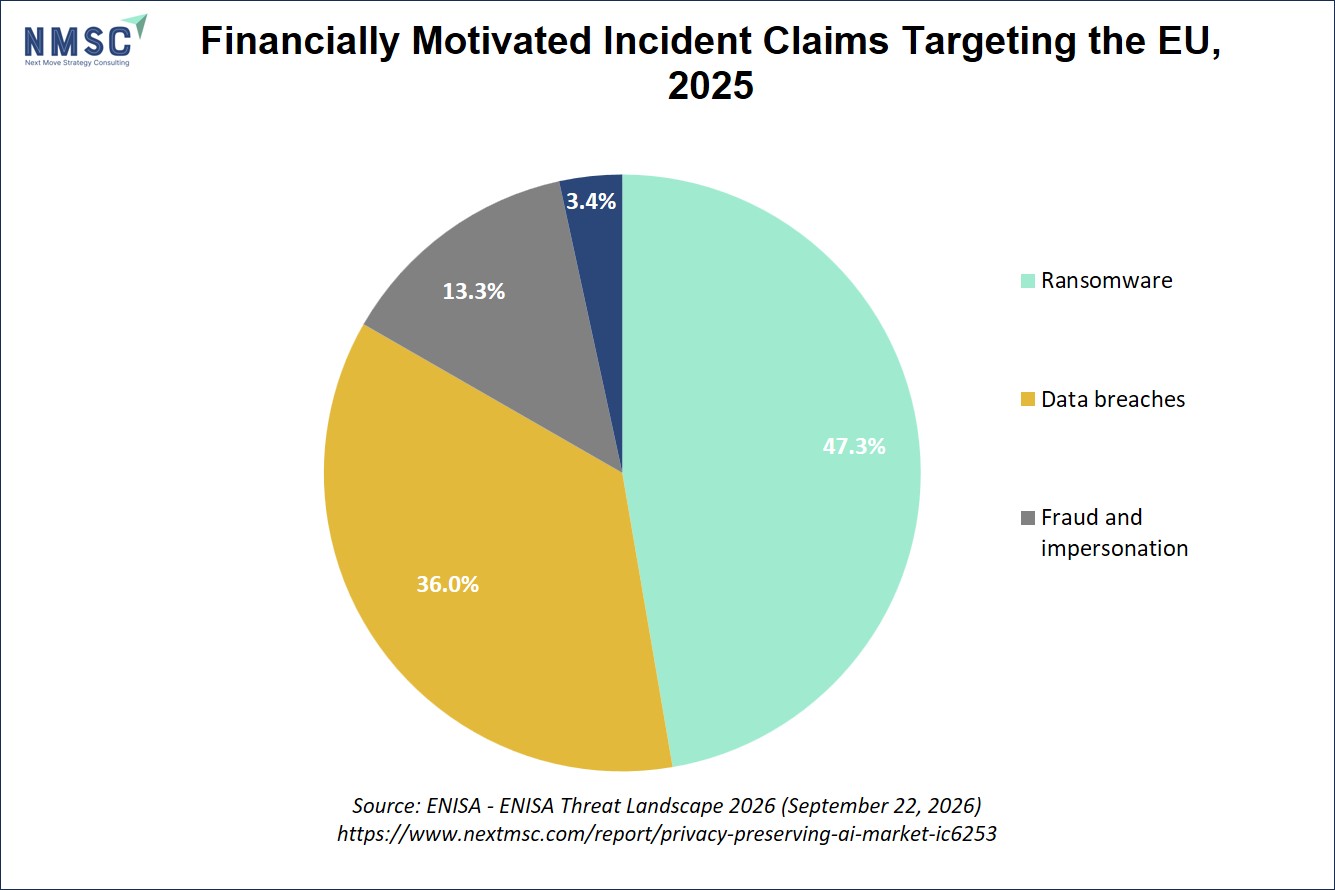
Selected ENISA Findings on EU Incidents Recorded in 2025
|
Metric |
Value reported by ENISA |
|
Incidents recorded and analysed, January 1 to December 31, 2025 |
8,257 |
|
DDoS share of recorded incidents |
51.3% |
|
Unauthorised access share of recorded incidents |
39.5% |
|
Unauthorised access incidents with an identified intrusion vector |
5.2% |
|
Of those, share that exploited a vulnerability |
60.4% |
|
Of those, share involving misconfiguration or accidental exposure |
20.7% |
|
Finance and banking share of all recorded events |
5.6% |
|
Finance and banking share of observed data breach activity |
15.4% |
Segment Dynamics: Where Spending Concentrates
NextMSC primary research and analysis shows Confidential AI Execution as the largest offering segment, growing from USD 2.20 billion in 2025, about 26% of revenue, to USD 21.52 billion by 2035 at a CAGR of 21.18%. Trusted Execution Environments and Confidential Computing is the largest technology segment, expanding from USD 2.21 billion in 2025 to USD 21.41 billion by 2035, which is the category that TPU 8tx enters. The fastest-growing offering is AI Privacy Governance and Assurance at a CAGR of 23.48% from 2026 to 2035, with AI Privacy Audit and Attestation growing at 25.09%. Fully Homomorphic Encryption is the fastest-growing technology at 24.09%, and Edge or Device is the fastest-growing deployment model at 23.30%. Banking, Financial Services and Insurance is the largest end user, rising from USD 2.27 billion in 2025 to USD 17.03 billion by 2035, while Healthcare and Life Sciences is the fastest-growing at 21.02%.
Regional Outlook: North America Leads, Asia-Pacific Closes the Gap
NextMSC primary research and analysis shows North America leading in 2025 with USD 3.14 billion, about 38% of global revenue, and reaching USD 20.37 billion by 2035 at a CAGR of 16.26%. Asia-Pacific is the fastest-growing region at a CAGR of 22.24%, rising from USD 2.04 billion in 2025 to USD 21.63 billion by 2035, which would put it ahead of North America as the largest regional revenue pool at the end of the forecast period. Europe contributed USD 2.32 billion in 2025, about 28% of revenue, and is projected to reach USD 16.73 billion at a CAGR of 17.56%. The U.S. led all countries in 2025 at USD 2.64 billion, while India is the fastest-growing country at a CAGR of 26.06%.
NMSC Strategic Perspective: The Enclave Becomes Table Stakes, Whole-Stack Assurance Becomes the Product
NextMSC primary research and analysis reads the events of November 8 and 9 as two halves of one shift. TPU 8tx moves confidential execution from a software configuration to an accelerator-level default on a hyperscale platform, which narrows the differentiation of point products that sell isolation alone. Google’s near-zero performance penalty claim speaks to the overhead restraint, and the largest NextMSC offering segment, Confidential AI Execution, is where that pressure lands first.
The NEAR AI breach shows the limit of that default. By NEAR AI’s account, the attacker did not need to break the hardware protection: the flaw sat in the inference engine running inside the protected environment. ENISA’s data shows why that path is common: where an intrusion vector could be identified, 60.4% of unauthorised access incidents exploited a vulnerability. A buyer who verifies the hardware but not the software stack has verified only part of the trust boundary. NextMSC primary research and analysis finds that buyers secure execution first and then add evidence, which explains why AI Privacy Governance and Assurance, at a CAGR of 23.48%, and AI Privacy Audit and Attestation, at 25.09%, are the fastest-growing parts of the market. The practical consequence for vendors is that attestation must extend from the processor to the model server, its dependencies and its credentials.
Eurostat’s adoption data adds a sequencing signal. With 20.0% of EU enterprises using AI in 2025 but only 5.2% in Romania against 42.0% in Denmark, the regulated workload base is widening unevenly. NextMSC primary research and analysis suggests vendors will win first where adoption is deepest and where regulation already demands evidence, then extend into faster-growing regions such as Asia-Pacific as national data protection requirements mature.
Competitive Landscape: Clouds, Data Platforms and Specialists Converge
NextMSC primary research and analysis identifies three competitive archetypes: hyperscale cloud platforms led by Amazon Web Services, Google and Microsoft; data cloud platforms led by Databricks and Snowflake; and specialist vendors including OPAQUE Systems, Duality Technologies, Enveil, Zama and Anjuna Security. Google’s TPU 8tx gives one hyperscaler a confidential option at the silicon layer, while NEAR AI, a specialist operator of confidential inference, has now documented the software-layer exposure in public.
Activity elsewhere in the same week points the same way. The Confidential Computing Consortium’s news report of November 12, 2026 listed a Red Hat blog post of November 9 on stronger security for applications and AI in OpenShift 5, a November 12 PR Newswire announcement by Rafay and Fortanix on helping neoclouds, sovereign AI clouds and enterprises deliver confidential AI as a service, and commentary on NVIDIA’s Confidential Bare Metal offering built around Rubin and DSX OS. Each of these positions confidential execution as a platform capability, which raises the bar for vendors that compete on isolation alone.
Bottom Line
Google’s November 9 launch of TPU 8tx adds hardware-level confidential computing to its accelerator portfolio, and the NEAR AI breach of November 8 shows what that protection does not cover: software running inside the protected environment. For buyers, the evaluation question has widened from whether data is encrypted while in use to whether the entire inference stack can be verified. Eurostat places enterprise AI use in the European Union at 20.0% in 2025, up from 13.5% a year earlier, and ENISA found that vulnerabilities were the intrusion vector in 60.4% of the unauthorised access incidents whose vector it could identify. NextMSC primary research and analysis values the privacy-preserving AI market at USD 8.36 billion in 2025, rising to USD 66.58 billion by 2035 at a CAGR of 18.74%, with confidential execution the largest offering and governance and assurance the fastest-growing. Vendors that pair isolation with verifiable, stack-wide evidence are best placed to capture the next increment of regulated spending.
About Next Move Strategy Consulting
Next Move Strategy Consulting is a premier market research and management consulting firm that has been committed to provide strategically analysed well documented latest research reports to its clients. The research industry is flooded with many firms to choose from, what makes NMSC different from the rest is its top-quality research and the obsession of turning data into knowledge by dissecting every bit of it and providing fact-based research recommendation that is supported by information collected from over 500 million websites, paid databases, industry journals and one on one consultations with industry experts across a diverse range of industry sectors. The high-quality customized research reports with actionable insights and excellent end-to-end customer service help our clients to take critical business decisions that enables them to move beyond time and have competitive edge in the industry.
We have been servicing over 1000 customers globally that includes 90% of the Fortune 500 companies over a decade. Our analysts are constantly tracking various high growth markets and identifying hidden opportunities in each sector or the industry. We provide one of the industry’s best quality syndicate as well as custom research reports across 10 different industry verticals. We are committed to deliver high quality research solutions in accordance to your business needs. Our industry standard delivery solutions that ranges from the pre consultation to after-sales services, provide an excellent client experience and ensure right strategic decision making for businesses.
For more information, please contact:
Next Move Strategy Consulting
5th Floor 867 Boylston St, STE 500,
Boston, MA 02116, U.S.
E-Mail: [email protected]
Direct: +1-217-650-7991
Website: www.nextmsc.com
About the Author
 Priyanshu Das
— Priyanshu Das is SEO Executive at Next Move Strategy Consulting, where he has led on-page and off-page SEO, keyword research, and SEO audits for the firm's B2B market research publications for 2 years. His audit process combines technical crawl analysis, backlink profile review, and competitor keyword gap mapping — using tools including Screaming Frog and Google Search Console — to prioritize fixes by organic search-visibility impact, informed by his own prior in-house and agency SEO experience.
About the Reviewer
 Sanyukta Deb
— Sanyukta Deb is Digital Marketing Team Lead at Next Move Strategy Consulting, where she has led content strategy and technical SEO for the firm's B2B market research publications for over 2 years. Her editorial process translates NextMSC's primary and secondary research — spanning technology, industrial, and consumer sectors — into commercial narratives, backed by search-intent, keyword, and competitive analysis. She brings 5 years of overall experience in digital marketing and content strategy.

















Add Comment