Privacy-Preserving AI Market Global Industry Analysis and Forecast (2026–2035)

Privacy-Preserving AI Market size was USD 14.19 billion in 2026, projected to reach USD 66.58 billion by 2035, growing at a CAGR of 18.74% from 2026 to 2035. Key drivers include enterprise AI deployment on sensitive data, tightening privacy regulations, and cloud-based confidential computing, with North America leading the market.

Download Free Sample PDF
Base Year (2025)
$8.36 Billion
Forecast (2035)
$66.58 Billion
CAGR (2026-2035)
18.7%
Top Region
North America

What Is the Privacy-Preserving AI Market Size?
The global Privacy-Preserving AI Market reached USD 8.36 Billion in 2025 and is estimated at USD 14.19 Billion in 2026, forecast to reach USD 66.58 Billion by 2035 at a CAGR of 18.74% from 2026 to 2035. North America leads with approximately 38% share, while Confidential AI Execution dominates with approximately 26% share.
NMSC's analysis indicates that confidential execution, cloud delivery and regulated industries anchor current demand, while governance tooling and Asia-Pacific set the pace of expansion.

Privacy-Preserving AI Market Global Industry Analysis and Forecast (2026–2035) Revenue Forecast
Values in USD Billion

2025 $8.36 Billion
2025
2026 $14.19 Billion
2026
2027 $16.85 Billion
2027
2028 $20.01 Billion
2028
2029 $23.76 Billion
2029
2030 $28.21 Billion
2030
2031 $33.49 Billion
2031
2032 $39.77 Billion
2032
2033 $47.22 Billion
2033
2034 $56.07 Billion
2034
2035 $66.58 Billion
2035

Key Takeaways

By Offering: Confidential AI Execution held the largest share, expanding from USD 2.20 Billion in 2025 to USD 21.52 Billion by 2035; AI Privacy Governance and Assurance is the fastest growing at 23.48% CAGR from 2026–2035.

By Technology: Trusted Execution Environments and Confidential Computing held the largest share, expanding from USD 2.21 Billion in 2025 to USD 21.41 Billion by 2035; Fully Homomorphic Encryption is the fastest growing at 24.09% CAGR from 2026–2035.

By Deployment Model: Vendor-Hosted Public Cloud held the largest share, expanding from USD 3.18 Billion in 2025 to USD 24.56 Billion by 2035; Edge or Device is the fastest growing at 23.30% CAGR from 2026–2035.

By Commercial Pricing Model: Subscription held the largest share, expanding from USD 2.49 Billion in 2025 to USD 19.97 Billion by 2035; Usage-Based API or Compute Fees is the fastest growing at 25.26% CAGR from 2026–2035.

By Buyer Type: Security, IT and Cloud Operations held the largest share, expanding from USD 1.84 Billion in 2025 to USD 14.79 Billion by 2035; Data Partnerships and Collaboration is the fastest growing at 22.31% CAGR from 2026–2035.

By Sales Channel: Direct Enterprise Sales held the largest share, expanding from USD 3.48 Billion in 2025 to USD 22.71 Billion by 2035; Cloud Marketplace is the fastest growing at 23.31% CAGR from 2026–2035.

By End User Industry: Banking, Financial Services and Insurance held the largest share, expanding from USD 2.27 Billion in 2025 to USD 17.03 Billion by 2035; Healthcare and Life Sciences is the fastest growing at 21.02% CAGR from 2026–2035.

Dominant Region: North America led with USD 3.14 Billion in 2025 (approximately 38% share), rising to USD 20.37 Billion by 2035.

Fastest-Growing Region: Asia-Pacific is expanding at 22.24% CAGR from 2026–2035, growing from USD 2.04 Billion in 2025 to USD 21.63 Billion by 2035.

Dominant Country: The U.S. led with USD 2.64 Billion in 2025, projected to reach USD 17.03 Billion by 2035.

Fastest-Growing Country: India is expanding at 26.06% CAGR from 2026–2035, growing from USD 0.30 Billion in 2025 to USD 4.26 Billion by 2035.

The Privacy-Preserving AI Market presents an absolute investment opportunity of approximately USD 52.39 Billion between 2026 and 2035, signalling sustained capital demand for confidential runtimes, governance tooling and secure collaboration platforms.
According to NMSC analysis, Asia-Pacific is positioned to overtake North America as the largest regional revenue pool by 2035, reaching USD 21.63 Billion against USD 20.37 Billion, as national data protection laws push regional enterprises toward verifiable privacy controls.

Ecosystem Analysis of the Privacy-Preserving AI Market
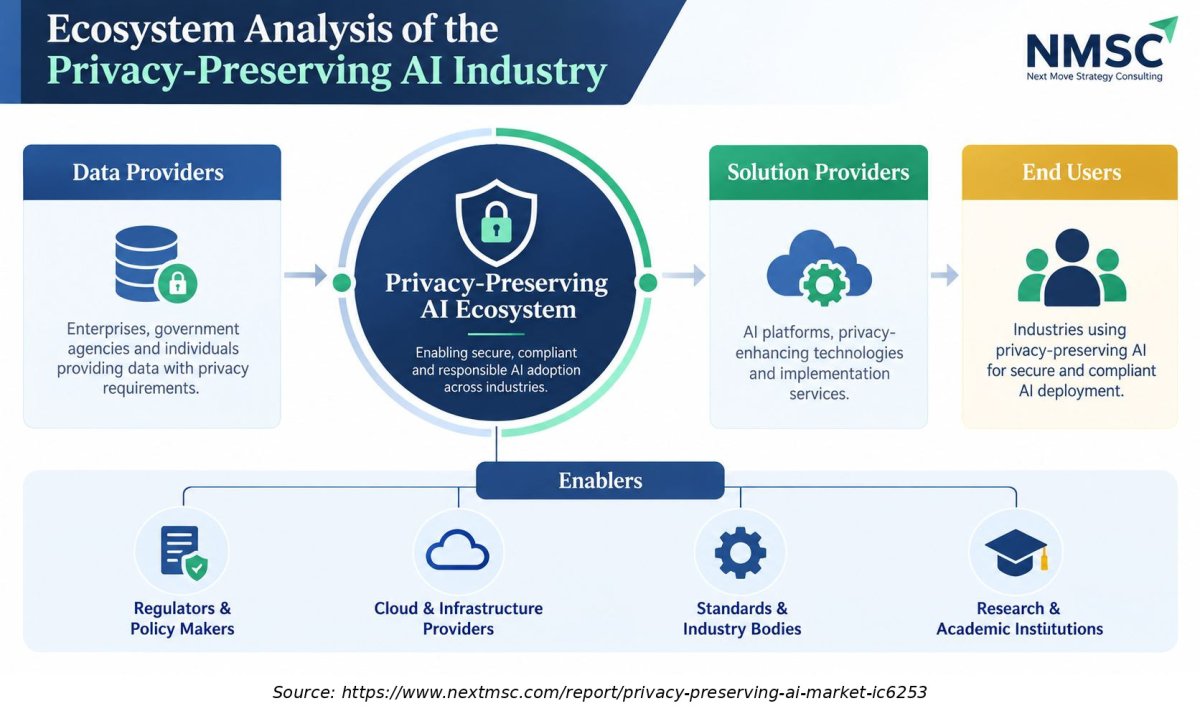
The ecosystem of the privacy-preserving AI Market comprises data providers, technology developers, solution providers, end users, and supporting institutions. These stakeholders collaborate to enable secure data processing, privacy-enhancing technologies, regulatory compliance, and responsible AI adoption across industries such as healthcare, BFSI, government, and telecommunications.

What does the Privacy-Preserving AI Market Encompass?
The Privacy-Preserving AI Market covers commercial software and services that protect personal, proprietary and regulated data while it is prepared, used to train models, processed during execution and shared across parties. Scope spans synthetic data, de-identification, federated learning, differential privacy, encrypted and trusted execution runtimes, data clean rooms, secure matching, governance and assurance tooling, and professional services. This market report excludes general cybersecurity products that lack privacy functions for AI workloads.
The market evolved from academic cryptography and research pilots into enterprise platforms as generative AI raised the exposure of sensitive data. Regulation shapes demand, because the GDPR, the EU AI Act and the finalised NIST guidelines on differential privacy raise evidence expectations for buyers. A provisional May 2026 agreement would apply standalone high risk AI obligations from 2 December 2027. Technology adoption is shifting from standalone tools toward combined PET stacks delivered through major clouds.

Market Drivers & Dynamics

Interactive Dataset
Enterprise generative AI and agent deployment on sensitive data driver +3.4% Global 2026–2032
Tightening privacy and AI regulation across the GDPR, EU AI Act and national laws driver +3.1% Europe, North America, Asia-Pacific 2026–2035
Cloud providers productising confidential computing and clean rooms driver +2.6% North America, Europe, Asia-Pacific 2026–2031
Cross organisation data collaboration in healthcare, finance and advertising driver +2.2% North America, Europe 2026–2033
Rising data breach and model leakage concerns driver +1.8% Global 2026–2030
Performance and cost overhead of FHE, MPC and confidential GPU runtimes restraint −2.4% Global 2026–2030
Integration complexity and shortage of applied cryptography skills restraint −1.9% Global 2026–2032
Unclear standards for anonymisation and privacy guarantee claims restraint −1.3% Europe, Asia-Pacific 2026–2029
Limited supply of confidential GPU and trusted hardware capacity restraint −1.1% Global 2026–2028
Source: Next Move Strategy Consulting

Growth Drivers

What Is the Primary Growth Driver in the Privacy-Preserving AI Industry?

Enterprise AI adoption on sensitive data is the primary demand driver for the Privacy-Preserving AI Market. In 2025, 20.0% of EU enterprises with ten or more employees used AI technologies, up from 13.5% in 2024, and each added workload expands the volume of personal and proprietary data exposed to models. Buyers therefore need controls that let models learn and run without revealing source data, which converts AI budgets into privacy tooling demand.

How Is Regulatory Enforcement Driving Market Growth?

Rules on personal data and AI convert privacy from a policy statement into a technical evidence requirement. NIST finalised SP 800-226 in March 2025 to help organisations evaluate differential privacy claims. EU lawmakers reached a provisional agreement in May 2026 that applies Annex III high risk AI obligations from 2 December 2027. This timeline gives buyers a defined compliance horizon, which favours vendors that supply attestation, audit logs and measurable privacy guarantees.

Growth Inhibitors

What Is Restraining the Privacy-Preserving AI Market?

Performance overhead and integration complexity restrain adoption. Fully homomorphic encryption and secure multiparty computation can run orders of magnitude slower than plaintext processing, an industry-derived estimate, and confidential GPU capacity remains limited. Applied cryptography skills are scarce, and buyers must connect new runtimes to existing data platforms. These factors lengthen proof of concept cycles and keep many deployments in pilot stage, which tempers near term growth.

What Are the Growth Opportunities?

Can Verifiable Privacy Evidence Become a Standalone Product for Regulated AI Buyers?

Verifiable privacy evidence is moving from a feature to a product. AI Privacy Audit and Attestation is the fastest growing sub segment at 25.09% CAGR from 2026 to 2035, and Privacy, Legal and Compliance buyers expand at 20.35%. Runtime attestation and audit logs let regulated enterprises prove controls to supervisors, which benefits governance and assurance vendors and the attestation modules offered by confidential computing platforms.

Will Cloud Marketplaces Unlock Usage Based Demand for Encrypted Inference?

Cloud marketplaces give mid sized AI engineering teams a procurement path that avoids lengthy enterprise contracts. Cloud Marketplace distribution is growing at 23.31% CAGR and Usage-Based API or Compute Fees at 25.26% from 2026 to 2035. Encrypted inference APIs and confidential model serving gateways suit this pay as you go model, benefiting inference service vendors and platform partners.

Can Sovereign and Public Sector Programmes Open a Distinct Confidential AI Vertical?

Sovereign cloud and public sector programmes can open a distinct confidential AI vertical. Government and Defence is growing at 20.02% CAGR from 2026 to 2035, and procurement increasingly requires attested, locally operated environments. This mechanism benefits runtime and sovereign deployment specialists, particularly in the Middle East and Europe, where national cloud strategies fund secure AI infrastructure and domestic vendor partnerships.

Segmentation Analysis

2025 (USD Billion)
2035 (USD Billion)
Privacy-Preserving Data Preparation 2025: $1.47 Billion | 2035: $9.04 Billion
Privacy-Pres
Privacy-Preserving Model Development 2025: $1.40 Billion | 2035: $10.93 Billion
Privacy-Pres
Confidential AI Execution 2025: $2.20 Billion | 2035: $21.52 Billion
Confidential
Privacy-Preserving Analytics and Collaboration 2025: $1.41 Billion | 2035: $9.77 Billion
Privacy-Pres
AI Privacy Governance and Assurance 2025: $0.65 Billion | 2035: $7.61 Billion
AI Privacy G
Privacy-Preserving AI Professional and Managed Services 2025: $0.95 Billion | 2035: $6.33 Billion
Privacy-Pres
Other In-Scope Privacy-Preserving AI Software 2025: $0.28 Billion | 2035: $1.38 Billion
Other In-Sco
Privacy-Preserving Data Preparation $1.47 Billion $9.04 Billion 15.66%
Privacy-Preserving Model Development $1.40 Billion $10.93 Billion 18.51%
Confidential AI Execution $2.20 Billion $21.52 Billion 21.18%
Privacy-Preserving Analytics and Collaboration $1.41 Billion $9.77 Billion 17.10%
AI Privacy Governance and Assurance $0.65 Billion $7.61 Billion 23.48%
Privacy-Preserving AI Professional and Managed Services $0.95 Billion $6.33 Billion 16.51%
Other In-Scope Privacy-Preserving AI Software $0.28 Billion $1.38 Billion 12.98%

Which Offering Segment Leads the Privacy-Preserving AI Market?

Confidential AI Execution leads with approximately 26% share in 2025 at USD 2.20 Billion, led by Trusted Execution and Confidential AI Runtimes at USD 1.24 Billion. AI Privacy Governance and Assurance is the fastest growing group at 23.48% CAGR from 2026 to 2035, with AI Privacy Audit and Attestation expanding at 25.09%. We found that buyers secure execution first and then add evidence, which explains the sequencing of spending.

Supply Chain Analysis of the Privacy-Preserving AI Market

Supply Chain Analysis of the Privacy-Preserving AI Market

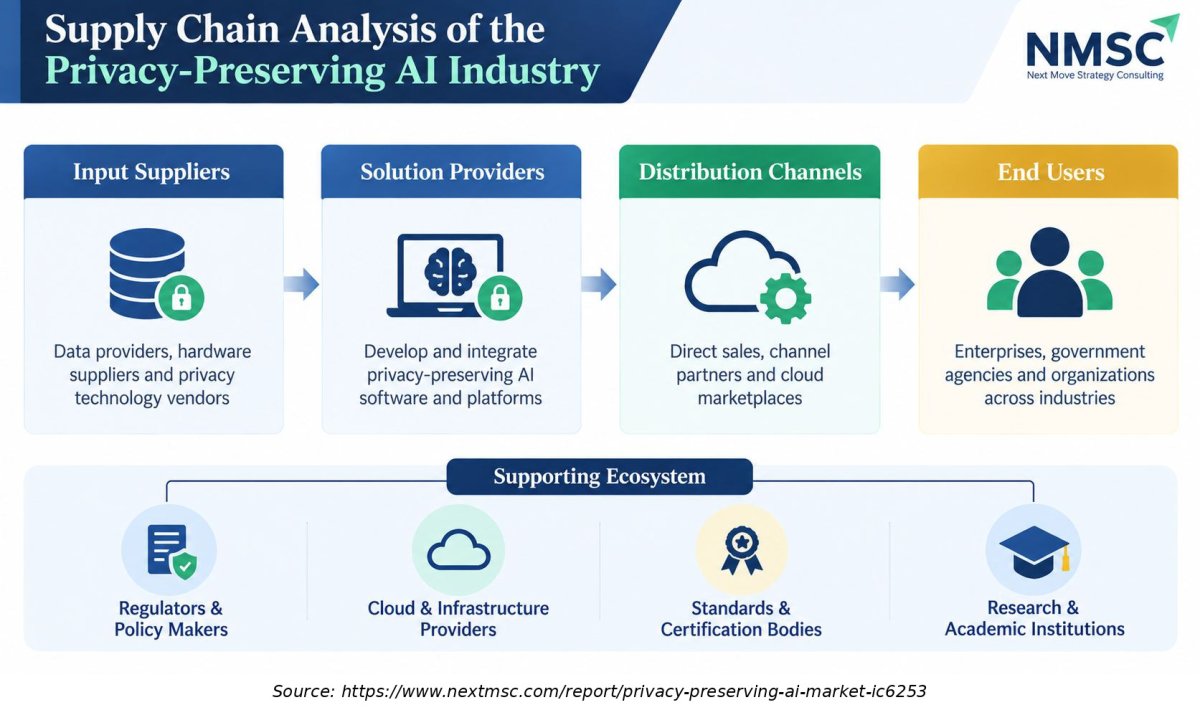
The supply chain of the privacy-preserving AI Market begins with data, computing hardware, cloud infrastructure, and privacy technologies, followed by AI platform development and solution integration. Solutions reach end users through direct sales, channel partners, and cloud marketplaces, while regulators, standards bodies, research institutions, and investors support innovation, security, and industry adoption.

Growth Opportunities

Based on research conducted by NMSC, we found that three whitespace opportunities offer above average growth for vendors that align product and channel strategy.

Can Verifiable Privacy Evidence Become a Standalone Product for Regulated AI Buyers?

Verifiable privacy evidence is moving from a feature to a product. AI Privacy Audit and Attestation is the fastest growing sub segment at 25.09% CAGR from 2026 to 2035, and Privacy, Legal and Compliance buyers expand at 20.35%. Runtime attestation and audit logs let regulated enterprises prove controls to supervisors, which benefits governance and assurance vendors and the attestation modules offered by confidential computing platforms.

Will Cloud Marketplaces Unlock Usage Based Demand for Encrypted Inference?

Cloud marketplaces give mid sized AI engineering teams a procurement path that avoids lengthy enterprise contracts. Cloud Marketplace distribution is growing at 23.31% CAGR and Usage-Based API or Compute Fees at 25.26% from 2026 to 2035. Encrypted inference APIs and confidential model serving gateways suit this pay as you go model, benefiting inference service vendors and platform partners.

Can Sovereign and Public Sector Programmes Open a Distinct Confidential AI Vertical?

Sovereign cloud and public sector programmes can open a distinct confidential AI vertical. Government and Defence is growing at 20.02% CAGR from 2026 to 2035, and procurement increasingly requires attested, locally operated environments. This mechanism benefits runtime and sovereign deployment specialists, particularly in the Middle East and Europe, where national cloud strategies fund secure AI infrastructure and domestic vendor partnerships.

Regional Outlook

2025 (USD Billion)
2035 (USD Billion)
North Americ
Asia-Pacific
Europe
Middle East
Latin Americ
Region 2025 (USD Billion) 2035 (USD Billion) CAGR (%)
North America $10.0 USD Billion $40.0 USD Billion 9.0%
Asia-Pacific $17.1 USD Billion $51.1 USD Billion 27.0%
Europe $24.2 USD Billion $62.2 USD Billion 25.0%
Middle East & Africa $31.3 USD Billion $73.3 USD Billion 23.0%
Latin America $38.4 USD Billion $84.4 USD Billion 12.0%

Regional data is locked

Unlock complete regional numbers for this market.

Unlock Full Data

Competitive Landscape

Our findings suggest that the Privacy-Preserving AI Industry is fragmented, with specialist PET vendors, hyperscale cloud platforms and data cloud providers competing on assurance, integration depth and ease of deployment.

Dimension Description
Market Structure Fragmented; specialist PET vendors lead cryptography and confidential runtimes, while Amazon Web Services, Google, Microsoft, Databricks and Snowflake lead distribution through cloud and data platforms.
Innovation Focus Verifiable runtime attestation, confidential GPU inference, differential privacy tooling, federated training frameworks and governance dashboards.
M&A Activity Selective; funding rounds at Zama in June 2025 and OPAQUE in February 2026 sustain independents, while platform providers add PET capabilities through launches and partnerships.

How Do Companies Compete in the Privacy-Preserving AI Market?

Companies compete on verifiable assurance, performance overhead, integration depth and pricing flexibility. Buyers test whether a platform proves how data was handled, runs at acceptable cost and connects to existing data warehouses and AI pipelines. Usage based and subscription pricing dominate, and vendors expand geographically through cloud marketplaces and integrator partnerships. We observed that proof of concept success, rather than list price, usually decides contracts.

Which Competitive Archetypes Dominate the Privacy-Preserving AI Market?

Three archetypes dominate. Hyperscale cloud platforms, led by Amazon Web Services, Google and Microsoft, compete on bundled confidential computing and clean room features. Data cloud platforms, led by Databricks and Snowflake, compete on governed collaboration. Specialist vendors, including OPAQUE Systems, Duality Technologies, Enveil, Zama and Anjuna Security, compete on cryptographic and attestation depth, while Tonic.ai and Private AI compete on data fidelity and detection accuracy.

What Innovation and Differentiation Strategies Are Companies Pursuing?

Our assessment indicates that innovation concentrates on confidential GPU inference, hardware attested agent execution, hardware acceleration for fully homomorphic encryption, differentially private fine tuning and federated training of large models. Vendors differentiate through open source communities, as Flower Labs does, and through evidence packages for auditors. Product teams also bundle several PETs into one workflow, which reduces integration effort for AI engineering buyers and supports premium positioning.

What M&A and Partnership Activity Is Shaping the Market?

Capital activity remains selective. Zama raised a Series B in June 2025 at a valuation above USD 1 Billion, and OPAQUE raised a Series B in February 2026 at approximately USD 0.30 Billion. Platform providers extend PET capabilities mainly through partnerships and product launches, such as Google's Private AI Compute in November 2025. NMSC's analysis indicates that acquisitions will increase as clouds and data platforms seek proven cryptography and governance assets.

Key Market Players

Based on research conducted by NMSC, the following 20 companies represent the validated leadership set across privacy preserving AI software, platforms and services.

OPAQUE Systems, Inc. Duality Technologies Enveil, Inc. Anonos, Inc. Zama SAS Syntho Tonic.ai Private AI Tune Insight SA Decentriq AG TripleBlind Flower Labs GmbH DataCebo, Inc. Anjuna Security, Inc. Apheris Amazon Web Services, Inc. Google LLC Microsoft Corporation Databricks, Inc. Snowflake Inc.

Latest Developments

During our market evaluation, we noticed that 2025–2026 activity centres on guidance, funding and platform launches that make privacy evidence a purchasing criterion.

Date Event
May 2026 The Council of the EU and the European Parliament reached a provisional agreement to amend the AI Act, deferring standalone high risk AI obligations to 2 December 2027.
March 2026 Red Hat published guidance on scaling enterprise federated AI with Flower and Open Cluster Management.
February 2026 OPAQUE raised a USD 0.024 Billion Series B led by Walden Catalyst, valuing the company at approximately USD 0.30 Billion.
November 2025 Google introduced Private AI Compute, a hardware secured cloud environment for processing Gemini workloads privately.

Investment Opportunities

Where Are Capital Inflows Concentrating in the Privacy-Preserving AI Market?

Capital inflows concentrate in confidential AI platforms and cryptographic infrastructure. Zama's Series B in June 2025 made it the first fully homomorphic encryption unicorn by its own description, and OPAQUE's February 2026 Series B brought total funding to approximately USD 0.06 Billion, with Intel Capital participating. Investors favour vendors whose pilots convert to production, because subscription and usage revenue improves visibility across the forecast period.

How Is Infrastructure Investment Shaping Capacity in the Privacy-Preserving AI Industry?

Infrastructure investment is moving toward attested cloud capacity. Google built Private AI Compute on its own TPUs with hardware enclaves, and OPAQUE is expanding into sovereign cloud environments. Operators need trusted execution capable processors, confidential GPUs, key management and attestation services, which raises capital intensity for platform providers. We found that sovereign cloud programmes in Europe and the Gulf will add capacity that favours vendors with certified, locally operable stacks.

What ESG Considerations Are Influencing Investment in the Privacy-Preserving AI Market?

Environmental, Social, and Governance considerations support the investment case. Social value arises from protecting individual health and financial data, while governance value comes from auditable controls and evidence for regulators. Environmental trade offs exist because encrypted computation can consume more energy per task than plaintext processing, an industry-derived estimate (no publicly verifiable dataset available), whereas federated learning can reduce bulk data transfers. Investors should request energy and assurance disclosures from vendors.

Key Benefits for Stakeholders

How Does This Report Benefit Enterprise Leaders and Data Owners?

Enterprise leaders and data owners gain segment sizing across offering, technology, deployment, buyer type and end user industry, which helps them benchmark budgets and select architectures. The regional outlook shows where regulation accelerates procurement. Leaders in banking and healthcare can compare confidential execution, federated learning and clean room options against cost and assurance needs, and prioritise pilots that move quickly into production.

How Does This Report Benefit Investors and Financial Analysts?

Investors and financial analysts receive a reconciled model that moves from USD 8.36 Billion in 2025 to USD 66.58 Billion in 2035. Segment CAGRs, regional shares and the growth matrix identify where returns concentrate, such as AI Privacy Governance and Assurance at 23.48%. Country level insights and the competitive landscape also support screening of vendors, platform exposure and potential acquisition targets.

How Does This Report Benefit Technology Vendors and Product Teams?

Technology vendors and product teams gain visibility into which technologies, deployment models and pricing structures attract spending. Findings on usage based fees, cloud marketplaces and attestation evidence guide roadmap and go to market choices. Competitive archetype analysis and regional assessments help teams decide where to localise offerings, which partners to prioritise and how to price against hyperscale bundles.

Key Market Segments Evaluated

By Privacy-Preserving Data Preparation

  • Synthetic Data Generation 
    • Structured and Relational Synthetic Data
    • Text and Document Synthetic Data
    • Image, Audio and Multimodal Synthetic Data
  • Data De-identification and Redaction 
    • Structured Data Masking, Tokenisation and Pseudonymisation
    • Text and Document Redaction
    • Image, Audio and Video Redaction

By Privacy-Preserving Model Development

  • Federated Learning Platforms 
    • Cross-Silo Federated Learning
    • Cross-Device Federated Learning
  • Differential Privacy Software 
    • Differentially Private Training and Fine-Tuning
    • Differentially Private Model Evaluation and Release
  • Secure Model Validation and Collaboration 
    • Privacy-Preserving Model Testing and Validation
    • Secure Multi-Party Model Development

By Confidential AI Execution

  • Encrypted Computation Runtimes 
    • Fully Homomorphic Encryption
    • Secure Multi-Party Computation
  • Trusted Execution and Confidential AI Runtimes 
    • Confidential Training and Fine-Tuning
    • Confidential Inference and AI-Agent Execution
  • Privacy-Preserving Inference Services 
    • Encrypted Inference APIs
    • Confidential Model-Serving Gateways

By Privacy-Preserving Analytics and Collaboration

  • Data Clean Rooms 
    • Multi-Party Analytics Clean Rooms
    • Audience and Activation Clean Rooms
  • Federated Analytics and Distributed Query 
    • Federated Statistical and Cohort Analytics
    • Privacy-Preserving Cross-Party Search and Query
  • Secure Matching and Aggregation 
    • Private Set Intersection and Encrypted Record Linkage
    • Secure Aggregation and Protected Result Release

By AI Privacy Governance and Assurance

  • AI-Specific Privacy Policy Enforcement 
    • Purpose Limitation and Permitted-Use Controls
    • AI Workflow Privacy Guardrails
  • AI Privacy Risk Assessment 
    • Dataset and Model Privacy-Risk Assessment
    • Membership-Inference and Privacy-Leakage Testing
  • AI Privacy Audit and Attestation 
    • Runtime Attestation and Execution Evidence
    • AI Privacy Audit Logs and Compliance Evidence

By Privacy-Preserving AI Professional and Managed Services

  • Implementation and Integration Services
  • Custom Privacy-Protocol and Model Engineering
  • Managed Privacy-Preserving AI Operations
  • Training, Maintenance and Premium Support Services

By Other In-Scope Privacy-Preserving AI Software

  • Other Documented Commercial Privacy-Preserving AI Software

By Technology

  • Federated Learning and Federated Analytics
  • Differential Privacy
  • Fully Homomorphic Encryption
  • Secure Multi-Party Computation and Private Set Intersection
  • Trusted Execution Environments and Confidential Computing
  • Synthetic Data Privacy Techniques
  • De-identification and Tokenisation
  • Hybrid or Multi-Technology PET Implementation
  • Other Documented Privacy-Enhancing Technologies
  • Technology Not Publicly Specified

By Deployment Model

  • Vendor-Hosted Public Cloud
  • Dedicated or Private Cloud
  • Customer-Hosted On-Premises
  • Edge or Device
  • Hybrid or Multi-Cloud
  • Deployment Not Publicly Specified

By Commercial Pricing Model

  • Annual or Term Licence
  • Subscription
  • Usage-Based API or Compute Fees
  • Per-Transaction or Per-Job Fees
  • Fixed-Price Project or Milestone Fees
  • Recurring Managed-Service Fees
  • Maintenance and Support Fees
  • Contract Basis Not Publicly Specified

By Buyer Type

  • AI and Machine Learning Engineering
  • Data Platform and Analytics
  • Privacy, Legal and Compliance
  • Security, IT and Cloud Operations
  • Data Partnerships and Collaboration
  • Scientific Research and Development
  • Public-Sector Procurement
  • Other Identifiable Budget Owners
  • Buyer Type Not Publicly Specified

By Sales Channel

  • Direct Enterprise Sales
  • Cloud Marketplace
  • System Integrator or Consulting Partner
  • Technology or Platform Partner
  • OEM, Embedded or White-Label
  • Sales Channel Not Publicly Specified

By End User Industry

  • Healthcare and Life Sciences
  • Banking, Financial Services and Insurance
  • Government and Defence
  • Technology, Media and Telecommunications
  • Retail, Consumer and Advertising
  • Manufacturing, Energy and Industrial
  • Professional Services and Research
  • Other Identifiable Industries
  • Cross-Industry Customers
  • Customer Industry Not Publicly Specified

By Region

  • North America 
    • U.S.
    • Canada
    • Mexico
  • Europe 
    • UK
    • Germany
    • France
    • Italy
    • Spain
    • Sweden
    • Denmark
    • Finland
    • Netherlands
    • Rest of Europe
  • Asia-Pacific 
    • China
    • India
    • Japan
    • South Korea
    • Taiwan
    • Indonesia
    • Vietnam
    • Australia
    • Philippines
    • Malaysia
    • Rest of APAC
  • Middle East & Africa 
    • Saudi Arabia
    • UAE
    • Egypt
    • Israel
    • Turkey
    • Nigeria
    • South Africa
    • Rest of MEA
  • Latin America 
    • Brazil
    • Argentina
    • Chile
    • Colombia
    • Rest of LATAM

Conclusion & Recommendations

The Privacy-Preserving AI Market is set to expand from USD 14.19 Billion in 2026 to USD 66.58 Billion by 2035, an 18.74% CAGR. Growth rests on regulated AI deployment, confidential execution and verifiable evidence. By 2035, Asia-Pacific is expected to lead regional revenue, and AI Privacy Governance and Assurance should gain share as audit expectations mature across industries.

What Strategic Positioning Recommendations Does NMSC Offer?

Vendors should pair a core technology with attestation evidence, expose APIs through cloud marketplaces and offer usage based pricing for pilots. Enterprises should align privacy controls with workload risk, starting with confidential inference and synthetic data. Our assessment indicates that partnerships with hyperscalers and integrators extend reach faster than direct sales alone, particularly in Asia-Pacific and the Middle East.

What Is the Investment Attractiveness of the Privacy-Preserving AI Market?

Investment attractiveness is high, supported by a USD 52.39 Billion absolute opportunity between 2026 and 2035 and regulatory visibility through 2027. Segments with faster growth, including Fully Homomorphic Encryption and Cloud Marketplace distribution, offer higher upside but greater execution risk. Diversified exposure across confidential execution, governance tooling and managed services balances growth and resilience.

What Are the Market Shifts and Key Risks in the Privacy-Preserving AI Industry?

Key shifts include the move from experimentation to production, the bundling of PETs inside cloud platforms and rising demand for evidence. Risks include performance overhead, limited confidential GPU supply, regulatory delays and the possibility that cloud providers commoditise point solutions. Based on research conducted by NMSC, we found that vendors without distribution partnerships face the greatest pricing pressure.

What Are the Primary Growth Pathways Through 2035?

Primary growth pathways include confidential inference for AI agents, governance and attestation products, cloud marketplace distribution, Asia-Pacific expansion and sector specific offerings for healthcare and financial services. Hybrid PET workflows that combine federated learning, differential privacy and trusted execution also widen addressable use cases, supporting the Privacy-Preserving AI Market trajectory toward USD 66.58 Billion by 2035.

FAQs

Sources & References

1.

National Institute of Standards and Technology (NIST): news release on SP 800-226

nist.gov
2.

NIST Computer Security Resource Center: SP 800-226 publication record

csrc.nist.gov
3.

Eurostat: Use of artificial intelligence in enterprises

ec.europa.eu
4.

Council of the European Union: press release on AI Act simplification agreement

consilium.europa.eu
5.

EUR-Lex: Regulation (EU) 2024/1689 (AI Act)

eur-lex.europa.eu
6.

Google: Private AI Compute announcement

blog.google
7.

Zama: Series B press release

theblock.co
8.

Zama: company website

zama.ai
9.

Intel Capital: OPAQUE Series B press release

intelcapital.com
10.

Red Hat Developer: enterprise federated AI with Flower and Open Cluster Management

developers.redhat.com
11.

Flower Labs: company website

flower.ai
12.

Next Move Strategy Consulting (NMSC)

nextmsc.com

About the Author

Liza Phukan

Liza Phukan

Liza Phukan is Research Associate at Next Move Strategy Consulting, where she has covered emerging industries and market research across sectors for 3.5 years. Her work includes analyzing industry developments, validating market data, and developing structured business content from research findings. She uses secondary research and data-validation practices to turn complex market information into clear decision-useful market analysis for business audiences and support report development and B2B.

About the Reviewer

Supradip Baul

Supradip Baul

Supradip Baul is an accomplished business consultant and strategist with over a decade of rich experience in market intelligence, strategy, technology, and business transformation. His work has included rigorous qualitative and quantitative analysis across multiple industries, helping clients shape investment decisions and long-term roadmaps. Earlier in his career, he was associated with Gartner, where he contributed to industry-leading reports and market share analyses. He has worked with leading global companies and holds an MBA with a dual specialization in Marketing and Finance.

Download Free Sample

Melanie Samko

MELANIE SAMKO

Director of Marketing

TOSOH BIOSCIENCE, INC.

The information provided by NMSC is incredibly valuable, thank you so much for such a excellent work. I really appreciate it. I will make sure to reference all of it, in my summary document.

Pratyush Kumar Das

PRATYUSH KUMAR DAS

Assistant Manager

Polycab India Limited

We would like to express our appreciation for the data and insights provided by nextmsc. We are very pleased with the quality and depth of the information, which has proven to be highly valuable and beneficial for our business decision-making.

Semih Kavaklioglu

SEMIH KAVAKLIOGLU

Co-Founder & Sales Manager

Decortie

I work a lot in the marketing industry and I know that research is an essential part of any campaign. I have used Market research reports for my own products and I found them to be very informative and well-researched. The team here produces insightful reports for a good price

Gaurav Jaiswal

GAURAV JAISWAL

Founder & CEO

Yano Charge Private Limited

The EV Charging market research report provided by the NextMSC was exceptionally detailed and insightful. It offered a comprehensive analysis that proved to be a game-changer for our strategic planning. Truly a testament to the NextMSC’s expertise and thoroughness in EV market landscape & analysis.

Amos Chang

AMOS CHANG

Strategy Consultant

Kardex Group

I have bought the intralogistics market reports from NMSC two times so far. Joseph and his team are always very helpful and flexible in responding to any customization requirements on the report. Their expertise in market reports really helps us steer the day-to-day business. I will definitely recommend and come back myself whenever there is a need.

Custom Market Research Services

We will customize the research for you if the listed report does not fully match your requirements.

Get 30% Free Customization

Select License

This website uses cookies to ensure you get the best experience on our website. Learn more

✖