Video Switchers Market Global Industry Analysis and Forecast (2026–2035)

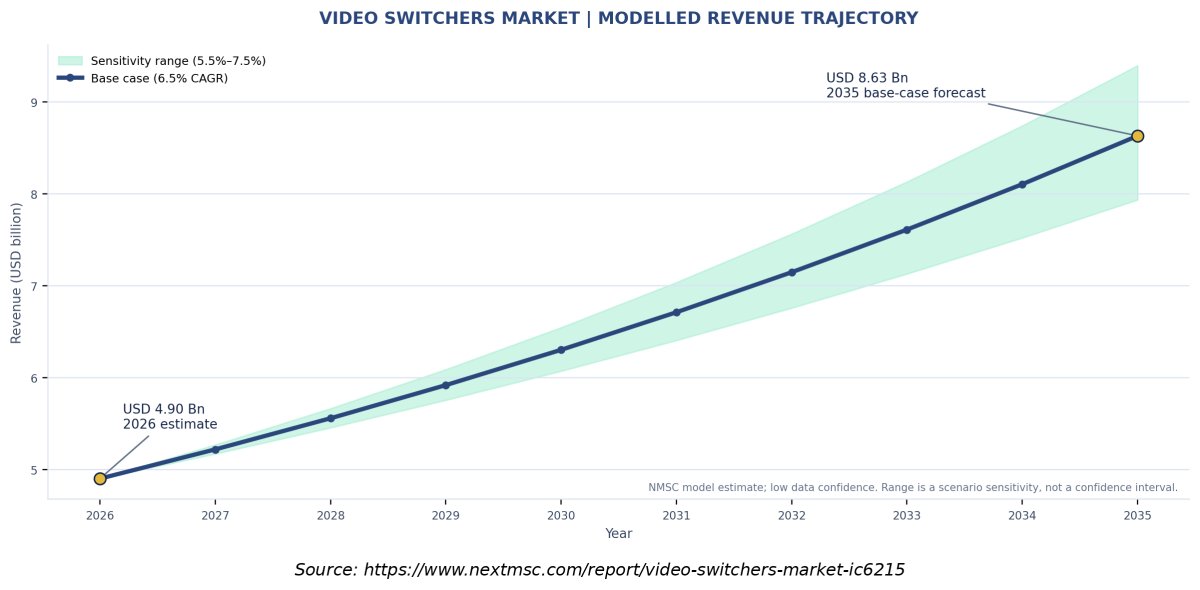
Video Switchers Market size is estimated at USD 4.90 billion in 2026 and is projected to reach USD 8.63 billion by 2035, growing at a CAGR of 6.5% from 2026 to 2035. Key growth themes include broadcast IP modernization, remote and distributed production, software-defined switching, and professional AV upgrades.

Download Free Sample PDF
Base Year (2025)
$4.90 Billion
Forecast (2035)
$8.63 Billion
CAGR (2026-2035)
6.5%
Top Region

What Is the Video Switchers Market Size?

The global Video Switchers Market is modeled at USD 4.60 billion in 2025 and USD 4.90 billion in 2026. On the selected base-case trajectory, the market is forecast to reach USD 8.63 billion by 2035, representing a CAGR of approximately 6.5% between 2026 and 2035. These values are Next Move Strategy Consulting estimates rather than audited industry totals or manufacturer-reported category revenue.

The market estimate aggregates revenue attributable to professional systems that switch, mix, route, process, or transition video sources for live production and distribution. It includes production, master-control, presentation, and matrix/routing switchers, as well as separately identifiable software licenses and directly attributable integration and support services. The model excludes general-purpose network packet switches, standalone converters without a switching function, distribution amplifiers, cameras, displays, cables, editing applications, and broad streaming or video-conferencing services.

The absolute modeled revenue opportunity between 2026 and 2035 is approximately USD 3.73 billion, calculated as the difference between the 2035 forecast and the 2026 estimate. The forecast assumes a steady 6.5% annual growth rate for comparability; actual annual demand is expected to vary with replacement cycles, event calendars, broadcaster capital expenditure, system integration projects, and the pace of IP adoption.

Market-size confidence is low. Publicly available company disclosures do not isolate revenue for the complete set of switcher product families included in this definition, and published market estimates apply inconsistent boundaries. The central estimate is therefore a modeled synthesis and should be interpreted directionally. No company market shares or product-type revenue shares are presented because a verifiable primary-source basis was not available.

Video Switchers Market Global Industry Analysis and Forecast (2026–2035) Revenue Forecast

Values in USD Billion

2025 $4.60 Billion
2025
2026 $4.90 Billion
2026
2027 $5.22 Billion
2027
2028 $5.56 Billion
2028
2029 $5.92 Billion
2029
2030 $6.30 Billion
2030
2031 $6.71 Billion
2031
2032 $7.15 Billion
2032
2033 $7.61 Billion
2033
2034 $8.11 Billion
2034
2035 $8.63 Billion
2035

Key Takeaways

2025 Market Size: USD 4.60 billion (modeled estimate; low confidence).

2026 Market Size: USD 4.90 billion (modeled estimate; low confidence).

2035 Revenue Forecast: USD 8.63 billion (base-case forecast).

CAGR (2026–2035): 6.5%, calculated over nine annual intervals.

Scope: Production, master-control, presentation, and matrix/routing switchers plus attributable software and services.

Structural Themes: IP migration, hybrid SDI/IP workflows, remote production, software-defined systems, and AV system integration.

Competitive Landscape: Fragmented specialist and diversified AV/broadcast suppliers; market-share ranking not established.

Confidence: Low for aggregate market sizing; no defensible public revenue split by segment or country.

Ecosystem Analysis of the Video Switchers Industry

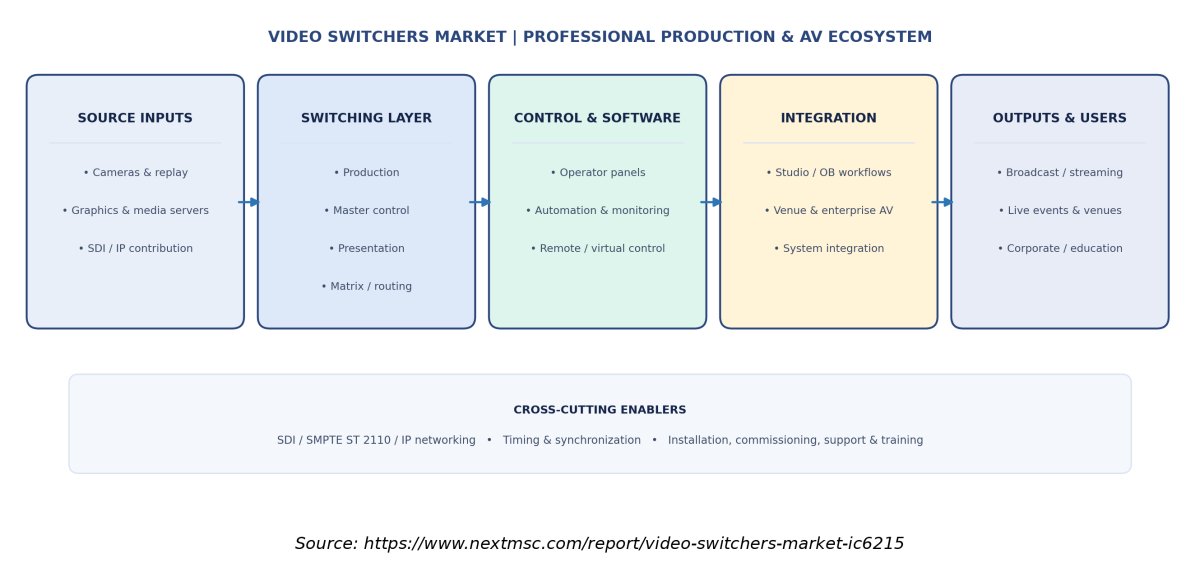
The Video Switchers Market sits between source acquisition and the final production, display, or distribution workflow. The core switching product selects and manages multiple video signals, while control software, signal transport, synchronization, system integration, and ongoing engineering services determine how the switcher performs inside a complete production or AV environment.

Figure 2. Professional video switcher ecosystem and value-chain interfaces. Source: Next Move Strategy Consulting analysis.

The ecosystem is supported by cameras, replay and graphics systems, playback servers, media gateways, SDI and IP interfaces, timing systems, multiview monitoring, control panels, automation, and network infrastructure. Integrators and specialist engineering teams configure these elements into studios, outside-broadcast vehicles, event venues, corporate experience spaces, educational facilities, and command environments. These adjacent products are not automatically counted as switcher-market revenue.

What Does the Video Switchers Market Encompass?

The Video Switchers Market comprises professional systems and software that receive multiple video inputs and select, route, mix, transition, or combine them into one or more outputs. The market includes systems used to produce live programmes, control final channel outputs, manage display canvases, and route signals among professional AV devices. Revenue is counted once at the manufacturer or software-provider level; reseller resale value is excluded to avoid channel double counting.

Included Products and Services
• Production switchers: live multi-camera and multi-source switching, transitions, keying, compositing, and programme output for broadcast, sports, events, and streaming production.
• Master-control switchers: final channel switching, scheduled or manual source changes, branding insertion, and channel output control.
• Presentation switchers: professional switching, scaling, image composition, and source management for projection, LED walls, conference spaces, and event displays.
• Matrix and routing switchers: configurable selection and routing of video inputs to multiple outputs, where the device performs a primary switching function.
• Software and virtualized switchers: separately identifiable software systems that perform live video switching or production functions.
• Directly attributable services: installation, configuration, commissioning, integration, maintenance, technical support, training, and separately priced licenses.

Excluded Products and Boundary Rules
• General-purpose Ethernet and data-network switches that do not perform video switching as a primary function.
• Standalone format converters, SDI/IP gateways, distribution amplifiers, cables, cameras, displays, projectors, LED panels, and audio-only equipment.
• Video editing, media asset management, streaming platforms, content delivery networks, and video conferencing as complete service categories.
• Consumer television input selectors, gaming console switches, and products designed primarily for home entertainment.
• Embedded components and bundled functions are counted once within the complete switcher system; the same value is not counted again as a separate module.

A product is included only when its primary commercial function is switching, mixing, transitioning, or routing professional video sources. Where a device offers several functions, the system is assigned to one primary product type based on its principal marketed use and revenue treatment. Secondary features are not treated as separate market sales.

Market Drivers & Dynamics

Interactive Dataset
Expansion of live sports, entertainment, and event production creates demand for multi-source switching and show control. driver Positive Global; strongest in established event and media ecosystems 2026–2035
IP migration and hybrid SDI/IP refreshes create upgrade opportunities in production and routing infrastructure. driver Positive Global 2026–2035
Remote and distributed production increases demand for network-aware switching and remote operation. driver Positive Global 2026–2035
Corporate, education, and venue AV modernization supports presentation and matrix-switching requirements. driver Positive Global; market context varies by country 2026–2035
Long equipment lifecycles and installed SDI infrastructure can defer replacement investment. restraint Negative Global Near to medium term
Integration complexity across signal formats, networks, timing, and control systems increases deployment cost. restraint Negative Global 2026–2035
Capital expenditure cyclicality and event/broadcast budget constraints can delay large projects. restraint Negative Global Near to medium term
Interoperability, cybersecurity, support coverage, and skills requirements complicate IP-based deployments. restraint Negative Global 2026–2035
Source: Next Move Strategy Consulting

Growth Drivers

Growth Inhibitors

Segmentation Analysis

2025 (USD Billion)
2035 (USD Billion)
Production S
Master-Contr
Presentation
Matrix and R
Segment Item 2025 (USD Billion) 2035 (USD Billion) CAGR
Production Switchers $10.0 USD Billion $40.0 USD Billion 14.0%
Master-Control Switchers $17.1 USD Billion $51.1 USD Billion 8.0%
Presentation Switchers $24.2 USD Billion $62.2 USD Billion 14.0%
Matrix and Routing Switchers $31.3 USD Billion $73.3 USD Billion 20.0%

Segment-wise data not detailed in this view

Unlock complete segment-wise numbers for By Product Type.

Unlock Full Data

Production switchers form a highly visible part of the professional broadcast and live-production ecosystem, supporting multi-camera programmes, sports, concerts, and streaming production. Master-control switchers serve final channel output and playout environments. Presentation switchers are common in corporate, education, venue, and event AV systems, while matrix/routing switchers manage flexible signal distribution across studios and integrated AV facilities. Public primary-source disclosures do not provide a defensible revenue split across these four types; no leading-share claim is made.

2025 (USD Billion)
2035 (USD Billion)
Hardware-Bas
Software-Bas
Hybrid Hardw
Segment Item 2025 (USD Billion) 2035 (USD Billion) CAGR
Hardware-Based $10.0 USD Billion $40.0 USD Billion 25.0%
Software-Based / Virtualized $17.1 USD Billion $51.1 USD Billion 11.0%
Hybrid Hardware and Software $24.2 USD Billion $62.2 USD Billion 25.0%

Segment-wise data is locked

Unlock complete segment-wise numbers for By Technology Architecture.

Unlock Full Data

Hardware-based systems remain important where reliability, I/O density, processing, and operator control are central. Software-based and virtualized solutions can offer flexible configuration and remote operation. Hybrid systems bridge hardware and software capabilities and are relevant during gradual modernization. Baseband, IP-native, and hybrid signal categories reflect a similar transition pattern: many users must protect existing investment while preparing for networked workflows.

2025 (USD Billion)
2035 (USD Billion)
Baseband-Onl
IP-Native
Hybrid Baseb
Segment Item 2025 (USD Billion) 2035 (USD Billion) CAGR
Baseband-Only $10.0 USD Billion $40.0 USD Billion 27.0%
IP-Native $17.1 USD Billion $51.1 USD Billion 9.0%
Hybrid Baseband / IP $24.2 USD Billion $62.2 USD Billion 19.0%

Segment-wise data is locked

Unlock complete segment-wise numbers for By Signal Transport.

Unlock Full Data
2025 (USD Billion)
2035 (USD Billion)
SD / HD
UHD / 4K
8K and Above
Segment Item 2025 (USD Billion) 2035 (USD Billion) CAGR
SD / HD $10.0 USD Billion $40.0 USD Billion 14.0%
UHD / 4K $17.1 USD Billion $51.1 USD Billion 24.0%
8K and Above $24.2 USD Billion $62.2 USD Billion 22.0%

Segment-wise data is locked

Unlock complete segment-wise numbers for By Resolution Capability.

Unlock Full Data
2025 (USD Billion)
2035 (USD Billion)
On-Premises
Cloud / Remo
Hybrid
Segment Item 2025 (USD Billion) 2035 (USD Billion) CAGR
On-Premises $10.0 USD Billion $40.0 USD Billion 24.0%
Cloud / Remote Virtualized $17.1 USD Billion $51.1 USD Billion 22.0%
Hybrid $24.2 USD Billion $62.2 USD Billion 20.0%

Segment-wise data is locked

Unlock complete segment-wise numbers for By Deployment Topology.

Unlock Full Data
2025 (USD Billion)
2035 (USD Billion)
Broadcast an
Live Events
Corporate an
Education an
Government
Segment Item 2025 (USD Billion) 2035 (USD Billion) CAGR
Broadcast and Media $10.0 USD Billion $40.0 USD Billion 23.0%
Live Events and Staging $17.1 USD Billion $51.1 USD Billion 9.0%
Corporate and Enterprise AV $24.2 USD Billion $62.2 USD Billion 19.0%
Education and House of Worship $31.3 USD Billion $73.3 USD Billion 13.0%
Government $38.4 USD Billion $84.4 USD Billion 10.0%

Segment-wise data is locked

Unlock complete segment-wise numbers for By End-Use Vertical.

Unlock Full Data

Broadcast and media organizations procure production and master-control systems for studios, control rooms, and outside-broadcast operations. Live-event operators and staging companies use production and presentation switchers for concerts, sports, conferences, and large-scale displays. Corporates and educational institutions require reliable presentation and matrix switching in meeting rooms, auditoriums, classrooms, and control spaces. Government and public-safety users apply switching in command and monitoring centres. No public dataset was identified that quantifies these end-use shares for the complete market scope.

2025 (USD Billion)
2035 (USD Billion)
Hardware
Software and
Integration
Segment Item 2025 (USD Billion) 2035 (USD Billion) CAGR
Hardware $10.0 USD Billion $40.0 USD Billion 21.0%
Software and Licenses $17.1 USD Billion $51.1 USD Billion 23.0%
Integration and Support Services $24.2 USD Billion $62.2 USD Billion 25.0%

Segment-wise data is locked

Unlock complete segment-wise numbers for By Revenue Stream.

Unlock Full Data
2025 (USD Billion)
2035 (USD Billion)
Direct
Distributor
System Integ
Segment Item 2025 (USD Billion) 2035 (USD Billion) CAGR
Direct $10.0 USD Billion $40.0 USD Billion 9.0%
Distributor or Reseller $17.1 USD Billion $51.1 USD Billion 23.0%
System Integrator / AV Contractor $24.2 USD Billion $62.2 USD Billion 9.0%

Segment-wise data is locked

Unlock complete segment-wise numbers for By Sales Channel.

Unlock Full Data
2025 (USD Billion)
2035 (USD Billion)
North Americ
Canada
Mexico
Europe: UK
Germany
Segment Item 2025 (USD Billion) 2035 (USD Billion) CAGR
North America: U.S. $10.0 USD Billion $40.0 USD Billion 23.0%
Canada $17.1 USD Billion $51.1 USD Billion 21.0%
Mexico $24.2 USD Billion $62.2 USD Billion 15.0%
Europe: UK $31.3 USD Billion $73.3 USD Billion 9.0%
Germany $38.4 USD Billion $84.4 USD Billion 10.0%

Segment-wise data is locked

Unlock complete segment-wise numbers for By Region.

Unlock Full Data

Supply Chain Analysis of the Video Switchers Industry

The supply chain begins with semiconductor, FPGA, processor, memory, connector, power, chassis, and network-interface suppliers. Switcher manufacturers combine these elements with proprietary hardware, firmware, software, user interfaces, and control protocols. Distribution partners and system integrators then configure the product into studios, OB vehicles, venues, corporate AV systems, and institutional environments.
Value-Chain Stage Role in the Market Revenue Treatment
Electronic and signal components Supply processing, switching, memory, interface, power, and connectivity components. Not included unless sold as part of an eligible complete switcher or separately identifiable switching product.
Switcher OEMs and software providers Design, manufacture, license, and support production, master-control, presentation, and matrix/routing systems. Core market revenue basis.
Control and workflow software Provide control panels, automation, monitoring, remote management, and licensed switching features. Included when separately identifiable and directly attributable.
Distributors and resellers Make systems available through regional and specialist channels. Reseller mark-up excluded from manufacturer/provider market revenue.
System integrators and AV contractors Design, install, configure, commission, and maintain complete systems. Only directly attributable services included; do not duplicate product resale.
End users Broadcast networks, production houses, venues, enterprises, schools, government, and institutions. Demand source; their downstream content or event revenue is excluded.

Growth Opportunities

The most attractive opportunities are concentrated where a switcher upgrade addresses a wider operational problem: the need to expand production capacity, connect distributed teams, support IP workflows, or modernize a venue or institution without rebuilding every part of the signal chain.

Can Hybrid SDI/IP Switchers Capture the Installed-Base Upgrade Cycle?

Hybrid platforms can address customers who need new IP functionality but cannot replace all SDI equipment in one investment cycle. Vendors that provide clear migration paths, strong format interoperability, redundant operation, and predictable commissioning requirements may be better positioned to win phased upgrade projects.

Can Software-Defined Switching Expand the Addressable Buyer Base?

Software-defined production can support more flexible deployments where workflows change frequently or require distributed operation. Product strategies that simplify licensing, remote configuration, system monitoring, and integration with existing production tools may help lower barriers for smaller broadcasters, production companies, and event operators. Buyers will still evaluate latency, reliability, security, and support.

Can Corporate, Education, and Venue AV Create Diversified Demand?

Professional AV demand is broader than broadcast. Auditoriums, higher education, corporate experience spaces, houses of worship, control rooms, and event venues require reliable switching across multiple displays and source types. AVIXA’s broader industry outlook identifies broadcast AV and experience-led use cases as relevant areas of pro AV development, but its overall market totals should not be confused with video-switcher revenue.

Can Integration and Lifecycle Services Increase Customer Value?

As systems become more networked, customers need design, commissioning, operator training, technical support, firmware management, and ongoing interoperability testing. Vendors and integrators can differentiate through lifecycle services, particularly where switchers are part of mission-critical broadcast, event, or command-centre workflows.

Regional Outlook

2025 (USD Billion)
2035 (USD Billion)
North Americ
Europe
Asia-Pacific
Middle East
Latin Americ
Region 2025 (USD Billion) 2035 (USD Billion) CAGR (%)
North America $10.0 USD Billion $40.0 USD Billion 9.0%
Europe $17.1 USD Billion $51.1 USD Billion 27.0%
Asia-Pacific $24.2 USD Billion $62.2 USD Billion 25.0%
Middle East & Africa $31.3 USD Billion $73.3 USD Billion 23.0%
Latin America $38.4 USD Billion $84.4 USD Billion 12.0%

Regional data is locked

Unlock complete regional numbers for this market.

Unlock Full Data

Competitive Landscape

The competitive landscape includes diversified broadcast and AV technology suppliers as well as specialists focused on a particular switching category. Product breadth, format support, I/O density, latency, reliability, control software, installed-base compatibility, service coverage, and integration partner networks shape supplier positioning. Publicly available evidence does not support a consistent market-share ranking across the frozen market definition; the following companies are an eligible supplier universe, not a ranked top-20 list. Company | Relevant Portfolio Evidence | Primary Category AJA Video Systems | KUMO family video routers and professional signal infrastructure. | Matrix / routing Analog Way | Zenith, Eikos and Pulse presentation switcher portfolio. | Presentation Barco | Event Master presentation switching and image-processing ecosystem. | Presentation Blackmagic Design | ATEM live-production switcher portfolio, including IP-oriented configurations. | Production Datavideo | SE-series production switchers and iCAST live production/presentation systems. | Production / presentation Evertz Microsystems | Broadcast routing, master-control and infrastructure switching products. | Master control / routing Extron Electronics | DXP matrix and DTP CrossPoint AV switching products. | Matrix / presentation FOR-A | HVS production switcher family and software-oriented live-production solutions. | Production Grass Valley | K-Frame production switcher family and IP-enabled production systems. | Production Imagine Communications | Versio software-based master-control and channel playout capabilities. | Master control Kramer Electronics | Professional AV matrix and presentation switching portfolio. | Matrix / routing Lightware Visual Engineering | Taurus universal switchers and MMX matrix switchers. | Matrix / presentation Panasonic | KAIROS IT/IP live production platform. | Production RGB Spectrum | Linx family video matrix switching systems. | Matrix / routing RGBlink | Compact live production and streaming switcher systems. | Production Roland Corporation | V-series video switchers and XS-series matrix switching products. | Production / matrix Ross Video | Carbonite production switchers and Ultrix converged routing/switching systems. | Production / routing Sony | XVS, MVS, MLS-X1 and software-based live production switcher systems. | Production Utah Scientific | Professional video routing and master-control switching systems. | Routing / master control Vizrt | TriCaster live production systems and software-defined production workflows. | Production

Competitive Dynamics and M&A Landscape

Recent strategic moves, partnerships, and acquisitions shaping the Video Switchers Market Global Industry Analysis and Forecast (2026–2035).

2024 Sony Development or Signal Supports the relevance of hybrid modernization and flexible production infrastructure.
2025 Ross Video Development or Signal Illustrates continued product investment in scalable production switching.
2025 Grass Valley / Texas A&M Development or Signal Provides a customer deployment example for IP-enabled live production.
2025 AVIXA Development or Signal Provides adjacent demand context for corporate, live-event, and broadcast AV.
2026 Haivision Development or Signal Shows mixed SDI/IP installed base and demand for remote production workflows.
2026 Blackmagic Design Development or Signal Shows vendor response to IP-based production infrastructure.
2026 FOR-A Development or Signal Signals experimentation with automation and software-enabled production.

Key Market Players

AJA Video Systems Analog Way Barco Blackmagic Design Datavideo Evertz Microsystems Extron Electronics FOR-A Grass Valley Imagine Communications Kramer Electronics Lightware Visual Engineering Panasonic RGB Spectrum RGBlink Roland Corporation Ross Video Sony Utah Scientific Vizrt

Recent Industry Developments and Signals

Recent product activity shows continued investment in broadcast production, IP-capable systems, and software-led workflows. Product announcements are evidence of supplier strategy and product development; they do not by themselves establish market penetration or incremental market revenue.
Period Company / Organization Development or Signal Market Relevance
2024 Sony At IBC 2024, Sony highlighted professional production workflows spanning IP, SDI and 4K system requirements. Supports the relevance of hybrid modernization and flexible production infrastructure.
2025 Ross Video Introduced Carbonite HyperMax at the 2025 NAB Show. Illustrates continued product investment in scalable production switching.
2025 Grass Valley / Texas A&M A Texas A&M athletics production deployment documented IP-enabled Grass Valley solutions, including K-Frame X switchers. Provides a customer deployment example for IP-enabled live production.
2025 AVIXA Published a pro AV outlook forecasting broad industry revenue growth through 2030. Provides adjacent demand context for corporate, live-event, and broadcast AV.
2026 Haivision 2026 Broadcast Transformation Report surveyed more than 1,300 broadcast professionals and reported adoption/priority indicators for IP and remote production. Shows mixed SDI/IP installed base and demand for remote production workflows.
2026 Blackmagic Design Announced an ATEM 4 M/E Constellation IP model with native SMPTE ST 2110 capability. Shows vendor response to IP-based production infrastructure.
2026 FOR-A Presented new AI- and software-oriented live-production functionality at NAB 2026. Signals experimentation with automation and software-enabled production.

Expert and Customer Perspectives

The following observations are paraphrased from named industry and customer sources. They represent the views or experiences of the individuals and organizations identified, not a statistically representative consensus of all market participants.
Expert / Organization Source Context Report Interpretation
Sean Wargo, Vice President of Market Insight, AVIXA AVIXA’s 2025 pro AV outlook discussed the hybrid workplace, experience economy, and ongoing technology change. Broad professional AV demand is shaped by experience-led use cases and enterprise/venue investment; this is adjacent industry context.
Marcus Schioler, Vice President of Marketing, Haivision Haivision’s 2026 Broadcast Transformation Report and associated discussion of broadcast technology priorities. Broadcasters are balancing modernization with the practical need to operate existing infrastructure.
Nigel Spratling, Ross Video Ross Video’s Carbonite HyperMax announcement at the 2025 NAB Show. Switcher vendors are emphasizing flexibility, scale, and configurable production workflows.
Olivier Bovis, Sony Sony’s IBC 2024 discussion of professional production workflows and system evolution. Hybrid SDI/IP requirements remain relevant as customers upgrade broadcast environments.
Michael Bergeron, Panasonic Panasonic’s KAIROS IT/IP live-production platform launch and product positioning. Software-defined architecture is an important design direction for live-production systems.
Yasuyuki Sakurai, Mainichi Broadcasting System Panasonic’s KAIROS customer case study. Customer deployment material highlights remote and flexible production workflow requirements.
Jonathan Kerr, Texas A&M Athletics Grass Valley’s case study on IP-enabled athletics production. A major live-production customer case demonstrates migration to IP-enabled switching infrastructure.
Grant Petty, Blackmagic Design Industry coverage of Blackmagic Design’s ATEM 4 M/E Constellation IP announcement. Native ST 2110 switching and high-capacity IP connectivity are becoming product differentiators.

Market Structure and Procurement Considerations

What Determines the Economics of a Video Switcher Purchase?

Total project value depends on the switcher chassis or software license, input/output configuration, processing capability, control surfaces, interface cards, redundancy, monitoring, integration, commissioning, training, and support. A product’s headline price is therefore not always comparable with another system that serves a different channel count or workflow complexity. Bundled licences and services should be allocated only once in the market model.

What Do Professional Buyers Evaluate?

• Input/output count, signal formats, frame rates, resolution, and conversion requirements.
• Processing latency, reliability, redundancy, failover, and operational availability.
• Compatibility with SDI, IP, SMPTE ST 2110 and the facility’s existing network and timing architecture.
• Control surface ergonomics, automation, multiview monitoring, remote operation, and operator training.
• Integration effort, cybersecurity, lifecycle support, availability of local service, and total cost of ownership.

Market Maturity and Investment Assessment

The market is mature in the sense that professional switching is an established production and AV function with long-lived installed equipment and recognized supplier portfolios. It continues to evolve through IP migration, software-defined operation, remote production, higher-resolution workflows, and integration with networked AV systems. The resulting investment profile is better characterized as a combination of refresh and capability expansion than as a wholly new technology adoption cycle.

Conclusion & Recommendations

The Video Switchers Market is expected to expand from a modeled USD 4.90 billion in 2026 to USD 8.63 billion by 2035 at a base-case CAGR of 6.5%. The outlook reflects continued demand for live video production, broadcast and AV system modernization, remote workflows, and networked production architecture. The aggregate estimate has low data confidence because companies do not disclose a consolidated revenue category that matches the complete market scope.

What Strategic Positioning Recommendations Does NMSC Offer?

• Prioritize hybrid SDI/IP roadmaps and standards-aligned interoperability so customers can modernize in phases without abandoning reliable installed systems.
• Invest in remote operation, software-defined control, monitoring, automation, and flexible licensing while maintaining predictable latency and operational resilience.
• Differentiate through workflow integration, commissioning, training, support coverage, and long-term product compatibility—not only hardware specifications.
• Develop product packages for live-event venues, education, corporate AV, and smaller production teams alongside traditional broadcast customers.
• Use transparent product boundaries and revenue allocation when measuring performance across production, master-control, presentation, and matrix/routing portfolios.

How Attractive Is the Market for Investment?

The market offers a recurring refresh and systems-integration opportunity, but investment cases should account for long replacement cycles, project-based purchasing, strong installed-base relationships, and technical service requirements. Software and services can strengthen customer relationships, while hardware remains critical for high-performance and mission-critical workflows. Given the low confidence in aggregate market sizing, investors and suppliers should validate addressable revenue using product-level shipment, pricing, installed-base, and channel data before making company-specific forecasts.

Key Market Segments Evaluated

By Product Type

  • Production Switchers
  • Master-Control Switchers
  • Presentation Switchers
  • Matrix and Routing Switchers

By Technology Architecture

  • Hardware-Based
  • Software-Based / Virtualized
  • Hybrid Hardware and Software

By Signal Transport

  • Baseband-Only
  • IP-Native
  • Hybrid Baseband / IP

By Resolution Capability

  • SD / HD
  • UHD / 4K
  • 8K and Above

By Deployment Topology

  • On-Premises
  • Cloud / Remote Virtualized
  • Hybrid

By End-Use Vertical

  • Broadcast and Media
  • Live Events and Staging
  • Corporate and Enterprise AV
  • Education and House of Worship
  • Government, Public Safety and Command Centres
  • Other Professional Production

By Revenue Stream

  • Hardware
  • Software and Licenses
  • Integration and Support Services

By Sales Channel

  • Direct
  • Distributor or Reseller
  • System Integrator / AV Contractor

By Region

  • North America 
    • U.S.
    • Canada
    • Mexico
  • Europe 
    • UK
    • Germany
    • France
    • Italy
    • Spain
    • Netherlands
    • Sweden
    • Denmark
    • Finland
    • Rest of Europe
  • Asia-Pacific 
    • China
    • India
    • Japan
    • South Korea
    • Taiwan
    • Indonesia
    • Vietnam
    • Australia
    • Philippines
    • Malaysia
    • Rest of APAC
  • Middle East & Africa 
    • Saudi Arabia
    • UAE
    • Egypt
    • Israel
    • Turkey
    • Nigeria
    • South Africa
    • Rest of MEA
  • Latin America 
    • Brazil
    • Argentina
    • Chile
    • Colombia
    • Rest of LATAM

FAQs

Sources & References

1.

Publisher

Reference | Relevance | Source Link
3.

Haivision

haivision.com
4.

AVIXA

avixa.org
5.

Ross Video

rossvideo.com
6.

Sony

pro.sony
7.
8.
9.

Grass Valley

grassvalley.com
10.

Blackmagic Design / Church Production

churchproduction.com
11.

Sony

pro.sony
12.
13.

Ross Video

rossvideo.com

Expert Insights

Sean Wargo

Vice President of Market Insight | AVIXA

"AVIXA’s 2025 pro AV outlook discussed the hybrid workplace, experience economy, and ongoing technology change."

Analyst Interpretation

Broad professional AV demand is shaped by experience-led use cases and enterprise/venue investment; this is adjacent industry context.

Marcus Schioler

Vice President of Marketing | Haivision

"Haivision’s 2026 Broadcast Transformation Report and associated discussion of broadcast technology priorities."

Analyst Interpretation

Broadcasters are balancing modernization with the practical need to operate existing infrastructure.

Nigel Spratling

Ross Video

"Ross Video’s Carbonite HyperMax announcement at the 2025 NAB Show."

Analyst Interpretation

Switcher vendors are emphasizing flexibility, scale, and configurable production workflows.

Olivier Bovis

Sony

"Sony’s IBC 2024 discussion of professional production workflows and system evolution."

Analyst Interpretation

Hybrid SDI/IP requirements remain relevant as customers upgrade broadcast environments.

Michael Bergeron

Panasonic

"Panasonic’s KAIROS IT/IP live-production platform launch and product positioning."

Analyst Interpretation

Software-defined architecture is an important design direction for live-production systems.

Yasuyuki Sakurai

Mainichi Broadcasting System

"Panasonic’s KAIROS customer case study."

Analyst Interpretation

Customer deployment material highlights remote and flexible production workflow requirements.

Jonathan Kerr

Texas A&M Athletics

"Grass Valley’s case study on IP-enabled athletics production."

Analyst Interpretation

A major live-production customer case demonstrates migration to IP-enabled switching infrastructure.

Grant Petty

Blackmagic Design

"Industry coverage of Blackmagic Design’s ATEM 4 M/E Constellation IP announcement."

Analyst Interpretation

Native ST 2110 switching and high-capacity IP connectivity are becoming product differentiators.

About the Author

Debashree Dey

Debashree Dey

Debashree Dey is Assistant Manager at Next Move Strategy Consulting, where she supports cross-vertical market content and communications across diverse industries for 6 years. Her professional background includes senior content writing, communications, and published manuscript authorship, with experience developing audience-focused business narratives and maintaining clear, consistent messaging. Her role supports research-led content development and editorial quality across NextMSC publications.

About the Reviewer

Supradip Baul

Supradip Baul

Supradip Baul is an accomplished business consultant and strategist with over a decade of rich experience in market intelligence, strategy, technology, and business transformation. His work has included rigorous qualitative and quantitative analysis across multiple industries, helping clients shape investment decisions and long-term roadmaps. Earlier in his career, he was associated with Gartner, where he contributed to industry-leading reports and market share analyses. He has worked with leading global companies and holds an MBA with a dual specialization in Marketing and Finance.

Download Free Sample

Melanie Samko

MELANIE SAMKO

Director of Marketing

TOSOH BIOSCIENCE, INC.

The information provided by NMSC is incredibly valuable, thank you so much for such a excellent work. I really appreciate it. I will make sure to reference all of it, in my summary document.

Semih Kavaklioglu

SEMIH KAVAKLIOGLU

Co-Founder & Sales Manager

Decortie

I work a lot in the marketing industry and I know that research is an essential part of any campaign. I have used Market research reports for my own products and I found them to be very informative and well-researched. The team here produces insightful reports for a good price

Amos Chang

AMOS CHANG

Strategy Consultant

Kardex Group

I have bought the intralogistics market reports from NMSC two times so far. Joseph and his team are always very helpful and flexible in responding to any customization requirements on the report. Their expertise in market reports really helps us steer the day-to-day business. I will definitely recommend and come back myself whenever there is a need.

Kishu Kanda

KISHU KANDA

Strategy Analyst

Accenture

We purchased the AI Consumer Market Report from this company. Not only did they customize the report to meet our specific requirements, but they also showed great flexibility in accommodating our budget. The report we received fully met our expectations. Additionally, they provided prompt and thorough responses to both our pre-purchase and follow-up questions. We look forward to working with this company again in the future.

Robert Sean Trevino

ROBERT SEAN TREVINO

Sr. Director, Head of Strategic Insights & Analytics

Foundation Medicine

I realized that it was a reliable source of information. These days, there are many people who are looking for authentic data, and this is one of the only sources that can offer them with what they need;

Custom Market Research Services

We will customize the research for you if the listed report does not fully match your requirements.

Get 30% Free Customization

Select License

This website uses cookies to ensure you get the best experience on our website. Learn more

✖