HTS Degaussing Enters Fleet Deployment as NATO and U.S. Expand Naval Plans
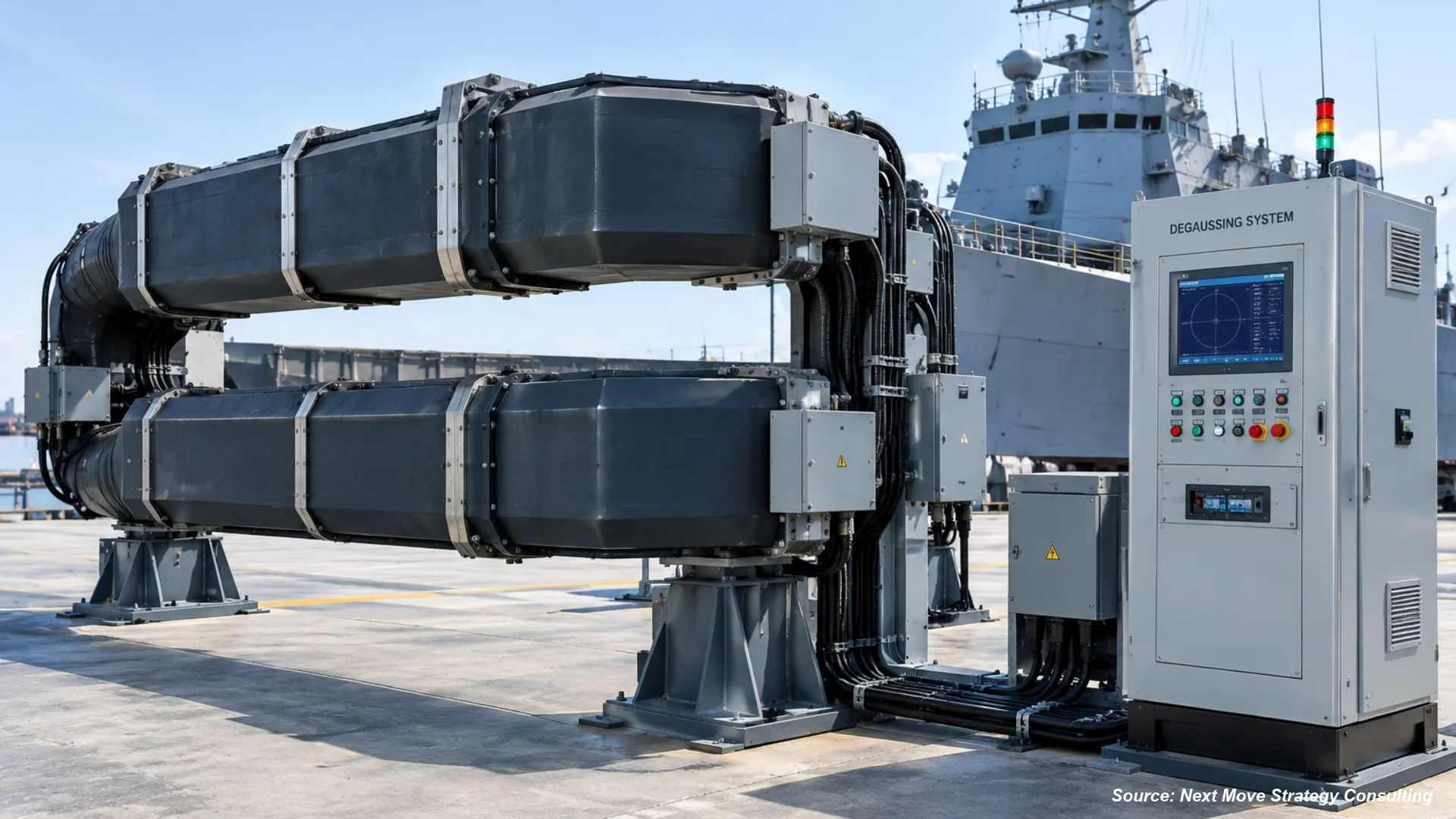
HTS Degaussing Breaks into Fleet-Wide Deployment as NATO Navies Commission New Mine Countermeasure Vessels and U.S. Shipbuilding Plan Targets 364 New Hulls Through 2054
American Superconductor Corporation (AMSC) disclosed in its Annual Report on Form 10-K for the fiscal year ended March 31, 2026 — filed with the U.S. Securities and Exchange Commission on May 27, 2026 — that it delivered a second High-Temperature Superconducting (HTS)-based Ship Protection System (SPS) degaussing unit in 2025, this time for the USS Richard M. McCool Jr., following the first San Antonio-class deployment aboard the USS Fort Lauderdale in January 2022. The disclosure marks a concrete inflection point: HTS degaussing technology, long confined to prototype and limited-platform trials, is now entering serial delivery across one of the U.S. Navy's most strategically active amphibious warfare ship classes.
According to Next Move Strategy Consulting's Degaussing System Market report, the global degaussing system market is projected to reach USD 1.47 billion by 2030, growing at a CAGR of 3.6% from 2022 to 2030. NMSC's proprietary research and analysis identifies the convergence of naval fleet modernization programs, the accelerating qualification of HTS-based systems for surface combatants, and the proliferation of magnetically activated mine threats in contested littoral zones as the three structural forces sustaining this trajectory — each of which is now producing measurable procurement activity across multiple allied navies simultaneously.
For More Information: Download FREE Sample on Degaussing System Market Report
Naval Procurement Surge Provides the Structural Demand Base
The U.S. Navy's 2025 Shipbuilding Plan, published by the Department of Defense in May 2026, calls for the procurement of 364 ships over the 2025–2054 period — comprising 293 combat ships and 71 combat logistics and support ships — with the Navy's FY27 budget request signaling further upward revision to both ship counts and spending levels. AMSC's 10-K filing quantifies the addressable opportunity directly: the company estimates more than USD 47 billion in U.S. federal investment in military ship systems and capabilities, a figure that encompasses power management, propulsion, and signature protection — the last of which is the primary commercial domain of degaussing system suppliers.
Every steel-hulled combatant added to the fleet represents a mandatory degaussing requirement. Steel-hulled warships generate magnetic anomaly signatures that are detectable by Magnetic Anomaly Detection (MAD) systems and that can trigger magnetically activated mines — a threat that has grown more acute as adversary mine inventories have expanded in the South China Sea, the Baltic, and the Persian Gulf. Degaussing systems neutralize this vulnerability by running precisely calibrated electrical currents through coils installed around the ship's hull, generating a compensating magnetic field that cancels the vessel's inherent signature. The technology is not optional for combat-ready surface combatants; it is a survivability requirement embedded in naval construction standards.
NATO's rMCM Programme Delivers Second Vessel, Validates Low-Signature Architecture
On February 27, 2026, the HNLMS Vlissingen — the second mine countermeasure vessel (MCV) of the Belgian-Dutch Remotely Controlled Mine Countermeasures (rMCM) programme and the first vessel delivered to the Royal Netherlands Navy under the programme — was formally handed over in Den Helder. The vessel, built by Belgium Naval & Robotics — the consortium of Naval Group and Exail — is specifically engineered to maintain very low acoustic, electrical, and magnetic signatures, a design requirement that directly mandates advanced degaussing integration across all 12 vessels in the programme.
Vincent Martinot-Lagarde, Executive Vice President for Naval Group surface ships, described the delivery as "a world premiere, as Belgium delivers for the first time a vessel for another nation, an ally," underscoring the programme's significance as a model for European defence industrial cooperation.
Jérôme Bendell, Director of the Exail Maritime Business Line, confirmed the programme's operational scope: "This milestone reflects our recognized expertise in autonomous mine countermeasure systems and our commitment to supporting the Royal Netherlands Navy with advanced, fully integrated unmanned capabilities. Together, we are contributing to strengthening NATO's maritime security and European operational readiness."
The rMCM vessels are equipped with a fully robotic mine detection, classification, identification, and neutralization system — including surface drones, autonomous underwater vehicles, and towed sonars — and are designed to increase mine clearance speed tenfold compared to conventional methods. The magnetic signature management requirements for vessels operating in active mine warfare environments are among the most stringent in naval architecture, making the rMCM programme a direct demand driver for high-performance degaussing systems across the 12-hull build schedule.
U.S. Navy Accelerates MCM Mission Package Procurement
The U.S. Naval Sea Systems Command (NAVSEA) has awarded a series of contracts under Program Executive Office, Unmanned and Small Combatants (PEO USC) to equip Littoral Combat Ships (LCS) with next-generation Mine Countermeasures (MCM) Mission Packages. The awards include a USD 7.7 million Advanced Material Order to Bollinger Shipyards for MCM Unmanned Surface Vehicle (USV) improvements, a USD 18.3 million production contract to Raytheon Technologies for five Minehunt Payload Delivery Systems, and a USD 12.1 million contract to Textron Systems for four Minesweep Payload Delivery Systems — the last of which provides acoustic and magnetic minesweeping capabilities.
Rear Admiral Kevin Smith, PEO USC Program Executive Officer, stated: "As we continue to face evolving threats in the littoral environment, these investments not only enhance our operational readiness but also demonstrate our commitment to safeguarding our Sailors and maintaining a competitive edge. By modernizing and expanding our MCM mission packages, we are providing our forces with the tools necessary to maintain access to key maritime regions and keep global shipping lanes safe."
Captain Matthew Lehmann, LCS Mission Modules Program Manager, added: "These contract awards ensure our Littoral Combat Ships will continue to receive the modernized MCM equipment needed to conduct their missions, allowing our Sailors to operate safely and stay outside of the minefield."
The magnetic minesweeping capability embedded in the MS PDS is operationally dependent on the LCS platform's own magnetic signature management — a direct link between MCM mission effectiveness and the degaussing systems installed aboard the host vessel.
HTS Technology Redefines the Performance Ceiling for Shipboard Degaussing
The technology underpinning the market's most significant competitive shift — the transition from copper-based to High-Temperature Superconducting degaussing systems — received a major validation in July 2026, when researchers from the Institute of Electrical Engineering, Chinese Academy of Sciences, published a peer-reviewed study in Physica C: Superconductivity and its Applications (Volume 646, Article 1354868) demonstrating a fully functional modular HTS magnet array degaussing architecture.
The prototype, developed by Gongxuan Chen, Lei Wang, and colleagues, operates stably in the 50K temperature regime under dual-cryocooler refrigeration. At a full-load current of 60 amperes, it achieves a central magnetic field strength of 2.0 Tesla and an equivalent magnetic moment of 5,300 A·m² — performance metrics that the authors validated through both ground-level and UAV-based airborne magnetic survey experiments at 100 metres altitude. The study's key architectural innovation is the use of discrete, modular HTS magnet units deployed at critical nodes across the hull, rather than continuous cable loops — a design that eliminates the complex through-bulkhead routing that has historically constrained shipboard degaussing installation and retrofit.
Research published in IEEE Transactions on Applied Superconductivity in March 2026 confirmed that HTS degaussing systems demonstrate an 80% weight reduction over copper-wire equivalents—a figure directly addressing the space and weight constraints naval architects face when integrating degaussing into next-generation hulls.
AMSC's 10-K filing corroborates the commercial significance of this weight advantage: the company's HTS-based SPS degaussing system eliminates an estimated 50–80% of system weight and reduces overall energy consumption versus copper-based systems, and AMSC states it believes it is currently the only company that can offer HTS-based SPS products fully qualified for use aboard U.S. Navy surface combatants.
Regional Analysis: North America Leads, Asia-Pacific Accelerates
North America holds the dominant share of the global degaussing system market, a position sustained by the scale of U.S. Navy procurement, the concentration of qualified HTS system suppliers — principally AMSC — and the breadth of the U.S. Naval Surface Warfare Center's ongoing development programmes. According to NextMSC primary research and analysis, this regional leadership is expected to persist through the forecast period, underpinned by the 364-ship U.S. Navy shipbuilding plan and the continued integration of HTS degaussing into San Antonio-class and future hull programmes.
Asia-Pacific represents the market's most dynamic growth vector. Escalating maritime border tensions in the South China Sea — involving China, the Philippines, Vietnam, and Japan — have driven sustained increases in naval procurement budgets across the region. India's Future Mine Counter Measure Vessels programme, which envisions 12 multi-purpose MCM vessels for the Indian Navy, represents a direct pipeline of degaussing system demand. Japan's Maritime Self-Defense Force and South Korea's naval expansion programmes add further procurement depth to the regional outlook.
Europe is experiencing a structural uplift driven by NATO's post-2022 defence spending commitments and the rMCM programme's 12-vessel build schedule. The Belgian-Dutch programme, awarded to Belgium Naval & Robotics in 2019 and now delivering vessels, is the most visible expression of a broader European MCM fleet renewal that encompasses Germany, France, and the United Kingdom.
Competitive Landscape: Key Players and Recent Developments
|
Company |
Key Capability |
Notable Development |
|
American Superconductor Corporation (AMSC) |
HTS-based SPS degaussing; only fully qualified HTS supplier for U.S. Navy surface combatants |
Delivered HTS SPS for USS Richard M. McCool Jr. (2025); HTS system designed into San Antonio-class platform |
|
L&T (Larsen & Toubro) |
Naval degaussing systems; Indian Navy supplier |
Positioned for India's Future MCM Vessel programme |
|
Ultra Maritime (formerly Ultra Electronics) |
Copper-based degaussing; primary incumbent competitor to AMSC's HTS systems |
Holds bulk of legacy copper-based naval degaussing business |
|
Polyamp |
Degaussing control systems and bipolar amplifiers |
European naval market presence |
|
ECA Group (Exail) |
Integrated MCM systems including magnetic influence dredgers |
Delivered CTM magnetic modules for rMCM programme vessels |
|
IFEN SPA |
Naval degaussing and ranging systems |
European market |
|
Dayatech Merin |
Degaussing systems for naval vessels |
Regional supplier |
|
STL System AG |
Degaussing control and monitoring systems |
European naval market |
NMSC Strategic Perspective: What the HTS Transition Means for Market Structure
NextMSC primary research and analysis identifies the HTS transition as the single most consequential structural shift in the degaussing system market since the technology's introduction in World War II. The implications extend beyond weight savings and energy efficiency — they reshape the competitive landscape, the aftermarket opportunity, and the geographic distribution of demand.
The retrofit market is opening. AMSC's 10-K explicitly identifies the core components of its HTS ship protection system as "common and transferable to other applications being targeted for ship implementation." The modular architecture validated by the July 2026 Chinese Academy of Sciences research — which eliminates through-bulkhead routing and enables plug-and-play installation — means that legacy copper-based systems on existing hulls can be upgraded without the structural modifications that previously made retrofitting cost-prohibitive. This creates an aftermarket opportunity that did not exist at scale under the prior technology paradigm.
The qualification barrier is a durable competitive moat. AMSC's statement that it is currently the only company capable of offering HTS-based SPS products fully qualified for U.S. Navy surface combatants reflects a multi-year, multi-million-dollar qualification process that competitors cannot replicate quickly. This moat is particularly significant given the U.S. Navy's 364-ship procurement pipeline: each new hull that specifies HTS degaussing locks in a qualified supplier relationship that extends through the vessel's operational life.
Asia-Pacific is the next qualification battleground. The July 2026 publication from the Chinese Academy of Sciences — supported by the National Natural Science Foundation of China — signals that China's naval research establishment is actively developing indigenous HTS degaussing capability. For Western suppliers, the window to establish qualification relationships with Indo-Pacific allied navies (India, Japan, South Korea, Australia) before domestic alternatives mature is narrowing. NextMSC analysis indicates that the Asia-Pacific region's degaussing procurement decisions over the next three to five years will be disproportionately influenced by which suppliers can demonstrate operational qualification on allied platforms — not merely laboratory performance.
The ranging and deperming segments are underappreciated. While shipborne degaussing commands the most attention, the ranging (calibration) and deperming (permanent magnetization removal) segments represent recurring revenue streams tied to port infrastructure investment. As new MCM vessels enter service across NATO and Indo-Pacific fleets, the shore-based ranging station networks that support them must be expanded and modernized — a capital expenditure cycle that benefits suppliers across all three solution categories.
Bottom Line
The global degaussing system market is advancing through a technology transition that is simultaneously expanding the addressable market and concentrating competitive advantage. AMSC's serial delivery of HTS-based SPS systems to San Antonio-class amphibious warfare ships — confirmed in its May 2026 SEC filing — establishes HTS degaussing as an operationally proven, fleet-deployable technology rather than a developmental programme. The Belgian-Dutch rMCM programme's delivery of the HNLMS Vlissingen in February 2026, combined with the U.S. Navy's USD 38.1 million in MCM mission package contracts and its 364-ship, 30-year shipbuilding plan, provides the structural procurement pipeline that sustains market growth through the forecast period. The July 2026 publication of validated HTS magnet array degaussing research from the Chinese Academy of Sciences signals that the technology is entering a phase of broader international development, which will intensify competition in Asia-Pacific allied markets. According to NextMSC primary research and analysis, the market is projected to grow from USD 1.07 billion in 2021 to USD 1.47 billion by 2030 at a 3.6% CAGR — a trajectory that is supported by the convergence of fleet expansion, HTS qualification milestones, and the irreducible survivability requirement that degaussing represents for every steel-hulled warship entering contested waters.
About Next Move Strategy Consulting
Next Move Strategy Consulting is a premier market research and management consulting firm that has been committed to provide strategically analysed well documented latest research reports to its clients. The research industry is flooded with many firms to choose from, what makes NMSC different from the rest is its top-quality research and the obsession of turning data into knowledge by dissecting every bit of it and providing fact-based research recommendation that is supported by information collected from over 500 million websites, paid databases, industry journals and one on one consultations with industry experts across a diverse range of industry sectors. The high-quality customized research reports with actionable insights and excellent end-to-end customer service help our clients to take critical business decisions that enables them to move beyond time and have competitive edge in the industry.
We have been servicing over 1000 customers globally that includes 90% of the Fortune 500 companies over a decade. Our analysts are constantly tracking various high growth markets and identifying hidden opportunities in each sector or the industry. We provide one of the industry's best quality syndicate as well as custom research reports across 10 different industry verticals. We are committed to deliver high quality research solutions in accordance to your business needs. Our industry standard delivery solutions that ranges from the pre consultation to after-sales services, provide an excellent client experience and ensure right strategic decision making for businesses.
For more information, please contact:
Next Move Strategy Consulting
5th Floor 867
Boylston St, STE 500,
Boston, MA 02116, U.S.
E-Mail: [email protected]
Direct: +1-217-650-7991
Website: www.nextmsc.com
About the Author
 Sanyukta Deb
— Sanyukta Deb is Digital Marketing Team Lead at Next Move Strategy Consulting, where she has led content strategy and technical SEO for the firm's B2B market research publications for over 2 years. Her editorial process translates NextMSC's primary and secondary research — spanning technology, industrial, and consumer sectors — into commercial narratives, backed by search-intent, keyword, and competitive analysis. She brings 5 years of overall experience in digital marketing and content strategy.
Sanyukta Deb
— Sanyukta Deb is Digital Marketing Team Lead at Next Move Strategy Consulting, where she has led content strategy and technical SEO for the firm's B2B market research publications for over 2 years. Her editorial process translates NextMSC's primary and secondary research — spanning technology, industrial, and consumer sectors — into commercial narratives, backed by search-intent, keyword, and competitive analysis. She brings 5 years of overall experience in digital marketing and content strategy.
About the Reviewer
 Debashree Dey
— Debashree Dey is Assistant Manager at Next Move Strategy Consulting, where she supports cross-vertical market content and communications across diverse industries for 6 years. Her professional background includes senior content writing, communications, and published manuscript authorship, with experience developing audience-focused business narratives and maintaining clear, consistent messaging. Her role supports research-led content development and editorial quality across NextMSC publications.
Debashree Dey
— Debashree Dey is Assistant Manager at Next Move Strategy Consulting, where she supports cross-vertical market content and communications across diverse industries for 6 years. Her professional background includes senior content writing, communications, and published manuscript authorship, with experience developing audience-focused business narratives and maintaining clear, consistent messaging. Her role supports research-led content development and editorial quality across NextMSC publications.
















Add Comment