Is the Metallurgical Coal Market Growing? 5 Data Points to Know

After Shanxi's Fatal May Mine Blast, Chinese Coking Coal Imports Run 29% Higher as India's Blast Furnace Pipeline Grows: Five Numbers That Set Metallurgical Coal's Course
On 22 May 2026, a gas explosion at the Liushenyu coal mine in Qinyuan County, Shanxi province, killed at least 82 people, local officials said on 23 May 2026, according to the Associated Press, which described it as China's deadliest mining accident in recent years. Shanxi mined 1.3 billion tons of coal in 2025, almost a third of China's total, the Associated Press reported, so the safety shutdowns that followed carried consequences far beyond the province: Reuters reported on 19 June 2026 that 155 Shanxi coal mines had been shut for safety checks after the accident, sending local coking coal prices sharply higher and pushing Chinese importers toward Canadian and Australian cargoes. By August, Chinese coking coal imports had reached 13.1 million tons, 29% above a year earlier and not far below the record set in December 2025, Bloomberg reported on 23 September 2026, citing customs data. Whether that surge marks a one-off dislocation or a market that is structurally expanding is the question now facing steelmakers, miners and investors, and five data points answer it.
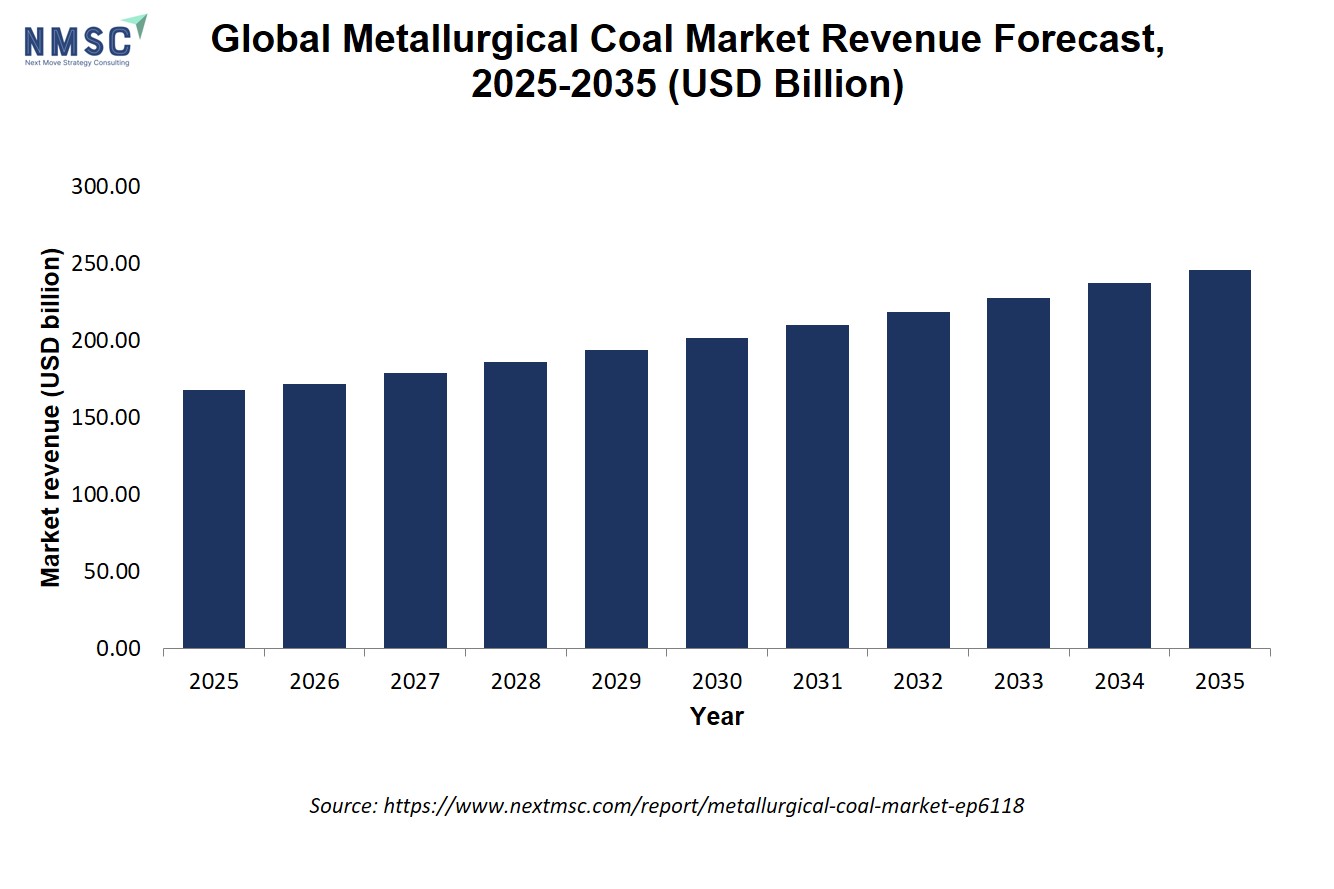
According to Next Move Strategy Consulting's Metallurgical Coal Market report, the global metallurgical coal market was valued at USD 168 billion in 2025 and is projected to reach USD 246 billion by 2035, growing at a CAGR of 4.1% from 2026 to 2035. NextMSC primary research and analysis puts the 2026 market at USD 172 billion and attributes the expansion to rising Indian blast furnace steelmaking capacity, infrastructure-linked steel demand in Southeast Asia and portfolio consolidation toward premium-quality reserves, with Asia-Pacific holding approximately 66% of 2025 revenue. The five data points below test that trajectory against the latest figures from steel industry bodies, customs data, government agencies and the International Energy Agency.
For More Information: Download FREE Sample on Metallurgical Coal Market Report
The Five Data Points at a Glance
Each figure below comes from a named institution or a named publication and is dated; NextMSC's own estimates are labelled as such and kept separate from external statistics. The sections that follow explain what each number means for supply, demand and pricing.
Five Data Points on Metallurgical Coal, October 2026
|
Sl No. |
Data Point |
Latest Figure |
Named Source |
|
1 |
NextMSC market size |
USD 168 billion (2025) to USD 246 billion (2035); 4.1% CAGR from 2026 to 2035 |
NextMSC primary research and analysis |
|
2 |
Benchmark price |
Hard coking coal FOB Australia index at USD 245 per tonne in July 2026, around 30% above 2025 levels |
International Energy Agency, Coal Mid-Year Update 2026 (10 September 2026) |
|
3 |
China coking coal imports |
13.1 million tons in August 2026, up 29% year on year |
Bloomberg, 23 September 2026, citing customs data |
|
4 |
India coking coal imports |
66.252 million mt through major ports in FY 2025-26, up 11.8% year on year |
Indian Ports Association data, reported by SteelOrbis, 7 April 2026 |
|
5 |
Global crude steel output |
144.2 million mt in August 2026, down 1.2% year on year |
World Steel Association (worldsteel) data, reported by SteelOrbis, 24 September 2026 |
Data Point 1: USD 168 Billion to USD 246 Billion, the Growth Pool NextMSC Sees Through 2035
NextMSC primary research and analysis shows the market moving from USD 168.00 billion in 2025 to USD 172.00 billion in 2026 and USD 246.00 billion in 2035, an absolute dollar opportunity of USD 74 billion between 2026 and 2035. Annual revenue passes USD 200 billion in 2030, at USD 201.99 billion. The growth is concentrated in higher-quality coal: premium hard coking coal held the largest share in 2025, approximately 42% or USD 70.56 billion, and NextMSC projects it reaching USD 108.24 billion by 2035, while pulverized coal injection (PCI) coal is the fastest-growing grade at a 4.8% CAGR from 2026 to 2035.
By end use, blast furnace steelmaking held approximately 71% of 2025 revenue, or USD 119.28 billion, according to NextMSC primary research and analysis, while coke production for foundry and industrial use is the fastest-growing end use at a 5.61% CAGR from 2026 to 2035. Asia-Pacific accounted for approximately 66% of 2025 revenue, USD 110.88 billion, and is projected to grow at 4.74% annually, the highest regional rate in the report. China led all countries at approximately USD 45.36 billion in 2025, while India is the fastest-growing national market at approximately 8.9% annually.
Metallurgical Coal Market by Coal Grade, 2025 and 2035
|
Coal Grade |
2025 (USD billion) |
2035 (USD billion) |
CAGR (2026-2035) |
|
Premium hard coking coal |
70.56 |
108.24 |
4.60% |
|
Standard hard coking coal |
40.32 |
56.58 |
3.57% |
|
Semi-soft coking coal |
23.52 |
29.52 |
2.29% |
|
PCI coal |
25.20 |
39.36 |
4.80% |
|
Other grades |
8.40 |
12.30 |
4.06% |
Data Point 2: USD 245 Per Tonne, Prices Sit Well Above 2025 but Official Forecasts Point Lower
The International Energy Agency's Coal Mid-Year Update 2026, released on 10 September 2026, recorded the hard coking coal FOB Australia index at USD 245 per tonne in July, around 30% above 2025 levels. The agency linked part of the metallurgical coal price recovery to the Shanxi accident, which curbed Chinese coal output with a more pronounced effect on coking coal, and noted that the loss of some Iranian gas-based steel output may have raised reliance on coal-based steelmaking elsewhere. The IEA also stressed that coal markets in the first half of 2026 remained more stable than in the crisis years, with prices shaped by regional disruptions and procurement behaviour rather than by a broad-based global shortage.
Australia's Department of Industry, Science and Resources, in its Resources and Energy Quarterly for September 2026, forecasts that metallurgical coal prices will fall from currently elevated levels and then stabilise in real terms through 2031, with supply and demand broadly in balance. The Department projects Australian metallurgical coal export volumes rising by around 1% a year to 2030-31, while export earnings are forecast to ease from A$39 billion in 2025-26 to A$36 billion in 2030-31 in real terms.
The retreat has already started in futures markets. Bloomberg reported on 23 September 2026 that Dalian coking coal futures, which closed at 1,729 yuan (USD 258) a ton on 31 August, the highest in more than two years, had fallen 12% to 1,523.50 yuan. Simon Wu, a senior consultant at Wood Mackenzie, told Bloomberg that steel mills' capacity to absorb persistently high coking coal prices “has reached a breaking point,” with barely 7% of mills operating profitably in September 2026.
Data Point 3: 13.1 Million Tons, China's August Coking Coal Imports Remain 29% Above Last Year
Customs data show demand reaching beyond Shanxi to absorb the shortfall. Chinese coking coal imports eased 4% from July's peak to 13.1 million tons in August but stayed 29% above a year earlier and close to the December 2025 record, Bloomberg reported on 23 September 2026. The National Development and Reform Commission has called for faster resumption of mines suspended after the accident, including lower-risk operations, yet a Mysteel survey of 16 September 2026, cited by Bloomberg, found 75 coking coal mines still shut across Shanxi, representing nearly 73 million tons of annual capacity.
Bloomberg Intelligence's Ortis Fan, writing with colleagues in a note reported on 23 September 2026, expects Shanxi coking coal supply to recover steadily in the fourth quarter but not to normalise fully before the first half of 2027, with rising shipments from Mongolia, Australia and Russia helping but unlikely to close the gap entirely. Reuters reported on 19 June 2026 that Edwin Yeo, a senior manager at trading firm Exen Resources, expected a shortage of 20 million to 30 million tons even after output restarts, concentrated in higher-grade cargoes that Russia and Mongolia cannot supply. Chinese imports were already climbing before the accident: Reuters reported that purchases in the first four months of 2026 rose 20% from a low base a year earlier, even as Chinese steel output slid 4.1%.
“China will eat up much coking coal from overseas.”
— Junxing Zhang, Manager, PT Kinrui New Energy Technologies Indonesia, Reuters, China's coking coal imports set to rise as Shanxi mine disaster hits supply, traders say, 19 June 2026.
Zhang, whose company produces metallurgical coke, added that it cannot compete with Chinese buyers for coals that are popular in China and therefore procures material from regions with lower Chinese demand, including Colombia and the United States, to keep costs competitive.
Data Point 4: 66.252 Million mt, India's Coking Coal Imports Show Where Incremental Demand Sits
India's coking coal imports through its major ports were provisionally estimated at 66.252 million mt in fiscal year 2025-26, up 11.8% from the previous year, according to Indian Ports Association data reported by SteelOrbis on 7 April 2026. The Ministry of Steel's July 2026 sector overview records crude steel production of 170.15 million tonnes in 2025-26 and 56.33 million tonnes in April to July 2026 (provisional), against crude steel capacity of 220.4 million tonnes in 2025-26 and a National Steel Policy target of 300 million tonnes by 2030-31. World Steel Association data for July 2026 show Indian output of 101.1 million tonnes for January to July, up 6.1%.
The Institute for Energy Economics and Financial Analysis reported on 23 April 2026 that India depends on imports for around 90% of its metallurgical coal and that about 64% of the 382 million tonnes per annum of steel capacity under development relies on the blast furnace route. The institute calculated that the 182 million tonnes per annum of blast furnace capacity announced or under construction would need roughly 140 million tonnes of additional metallurgical coal supply against current supply of about 65 million tonnes, assuming 770 kilograms of metallurgical coal per tonne of crude steel. The International Energy Agency's Coal Mid-Year Update 2026 expects Indian coal demand to return to its historical growth trend in 2026 and names India as the main source of growth in global metallurgical coal demand.
Policy is following the import exposure. Construction World reported on 8 October 2026 that the Ministry of Steel had asked state-owned SAIL and NMDC to explore overseas mineral assets, a request the ministry confirmed without naming countries or assets, and that Indian producers including SAIL depend on imports for 85% to 90% of their coking coal, mainly from Australia and Mozambique. NextMSC primary research and analysis projects the Indian market growing from approximately USD 21.5 billion in 2025 to approximately USD 49.1 billion by 2035 at an 8.9% CAGR, the fastest of any country in the report, against approximately USD 45.36 billion to USD 65.14 billion at a 3.7% CAGR for China.
Data Point 5: 1.2% Decline, Global Steel Output Tempers the Growth Case
The World Steel Association reported on 24 September 2026 that crude steel production in its 70 reporting countries fell 1.2% year on year to 144.2 million mt in August 2026, and that January to August output slipped 0.7% to 1.22 billion mt. China's August output fell 3.7% to 74.6 million mt while India's rose 4.6% to 14.8 million mt. India's Ministry of Steel, citing the World Steel Association's April 2026 Short Range Outlook, records forecast global steel demand growth of 0.3% in 2026, to 1,724 million tonnes, and 2.2% in 2027, to 1,762 million tonnes.
The International Energy Agency found that global metallurgical coal demand in 2025 was broadly unchanged from 2024 at 1,174 million tonnes despite a decline in steel production, and expects Chinese metallurgical coal demand to fall very slightly, by less than 1%, in 2026. NextMSC primary research and analysis quantifies the same headwinds: persistent weakness in Chinese property-driven steel demand reduces the market's CAGR by 1.2 percentage points through 2030, and accelerating electric-arc-furnace and hydrogen-based steelmaking in Europe and North America reduces it by 0.9 percentage points between 2028 and 2035.
Growth Drivers and Restraints
Metallurgical Coal Market: Growth Catalyst and Risk Assessment Matrix
|
Factor |
Type |
Impact on CAGR |
Geography |
Timeline |
|
Expanding Indian blast furnace steelmaking capacity |
Driver |
+1.8% |
Asia-Pacific |
2026-2035 |
|
Rising Southeast Asian infrastructure-linked steel demand |
Driver |
+1.1% |
Asia-Pacific |
2026-2035 |
|
Portfolio consolidation toward premium-quality reserves |
Driver |
+0.7% |
Global |
2026-2032 |
|
Growing spot market liquidity and price discovery |
Driver |
+0.5% |
Global |
2026-2032 |
|
Sustained blast furnace dependency of primary steelmaking |
Driver |
+0.4% |
Global |
2026-2035 |
|
Persistent weak Chinese property-driven steel demand |
Restraint |
−1.2% |
Asia-Pacific |
2026-2030 |
|
Accelerating electric-arc-furnace and hydrogen-based steelmaking adoption |
Restraint |
−0.9% |
Europe, North America |
2028-2035 |
|
Constrained new mine investment amid decarbonization scrutiny |
Restraint |
−0.6% |
Australia, North America |
2026-2032 |
|
Rising royalty and regulatory compliance costs in key exporting jurisdictions |
Restraint |
−0.4% |
Australia |
2026-2032 |
NMSC Strategic Perspective: A Two-Speed Market Behind One Growth Rate
NextMSC primary research and analysis reads the period from May to October 2026 as a test of which parts of the metallurgical coal market are structural and which are temporary. The Shanxi accident produced a supply-driven price and import spike, and both the Australian government's price forecast and Dalian futures already show prices easing. The structural layer sits beneath it: NextMSC attributes +1.8 percentage points of CAGR to Indian blast furnace capacity and +1.1 percentage points to Southeast Asian infrastructure-linked steel demand, and neither depends on a mine accident in Shanxi.
NextMSC's analysis indicates that growth is concentrating in quality rather than volume. Seaborne exporters are prioritizing long-life premium assets over intermediate-grade mines as buyers consolidate procurement toward fewer, higher-quality suppliers, a shift that favors miners with large premium hard coking coal reserves as India's blast furnace fleet expands through 2035. The external evidence is consistent with that finding: Reuters reported on 19 June 2026 that the post-accident shortfall was concentrated in higher-grade cargoes, and premium hard coking coal is the largest grade in NextMSC's dataset, rising from USD 70.56 billion in 2025 to USD 108.24 billion by 2035.
For investors, NextMSC's analysis identifies the USD 74 billion absolute dollar opportunity between 2026 and 2035 as weighted toward premium hard coking coal supply and Indian import demand. The spot market is the fastest-growing sales channel at a 5.81% CAGR and trading companies are the fastest-growing buyer type at 8.48%, which signals that procurement is shifting from rigid long-term contracts toward more liquid pricing. The same analysis cautions that new mine investment is constrained by decarbonization scrutiny, which NextMSC quantifies at −0.6 percentage points of CAGR, and that European demand, growing at only 1.51% annually from a USD 16.80 billion base in 2025, is eroding as producers move to electric-arc-furnace and hydrogen-based routes.
Stakeholders should monitor three indicators: the pace of Shanxi mine restarts, which determines when Chinese import demand normalizes; the path of Chinese property-driven steel output, NextMSC's largest restraint at −1.2 percentage points; and Indian blast furnace commissioning, the largest driver. NextMSC's strategic recommendation for producers is to prioritize premium reserve quality and logistics reliability, and to build exposure to PCI coal and foundry coke, the grades and end uses growing fastest.
Competitive Landscape
According to NextMSC primary research and analysis, the metallurgical coal market is moderately consolidated, with large diversified miners competing alongside pure-play coal producers on reserve quality, production scale and logistics reliability. NextMSC's report profiles BHP Group, Glencore, Anglo American, Teck Resources, Warrior Met Coal, Peabody Energy, Whitehaven Coal, Coronado Global Resources, Yancoal Australia, China Shenhua Energy and other producers.
Portfolio reshaping toward premium assets is documented in company announcements. Glencore announced in November 2023 the acquisition of a 77% interest in Teck's steelmaking coal business for USD 6.93 billion, and BNN Bloomberg reported on 11 July 2024 that Teck had closed the sale. Whitehaven Coal announced the completion of its acquisition of BHP's Daunia and Blackwater mines on 2 April 2024. NextMSC's analysis indicates that scaled portfolios of this kind gain negotiating leverage with large steel producer customers.
Bottom Line
The metallurgical coal market is growing, at a measured pace, and the strongest evidence comes from steelmaking demand rather than from prices. According to NextMSC primary research and analysis, the global market will expand from USD 168 billion in 2025 to USD 246 billion by 2035 at a 4.1% CAGR, an absolute opportunity of USD 74 billion from 2026. The evidence gathered between May and October 2026 supports that direction: Chinese coking coal imports ran 29% above the prior year in August after the Shanxi accident, India's blast furnace pipeline keeps lifting import needs, and the International Energy Agency places the hard coking coal price index around 30% above 2025 levels. The caveats are equally clear. Global crude steel output fell 1.2% in August, Australia's Department of Industry, Science and Resources expects prices to ease, and Chinese mills face thin margins. Premium hard coking coal, Indian demand and PCI and foundry coke hold the strongest growth positions through 2035.
About Next Move Strategy Consulting
Next Move Strategy Consulting is a premier market research and management consulting firm that has been committed to provide strategically analysed well documented latest research reports to its clients. The research industry is flooded with many firms to choose from, what makes NMSC different from the rest is its top-quality research and the obsession of turning data into knowledge by dissecting every bit of it and providing fact-based research recommendation that is supported by information collected from over 500 million websites, paid databases, industry journals and one on one consultations with industry experts across a diverse range of industry sectors. The high-quality customized research reports with actionable insights and excellent end-to-end customer service help our clients to take critical business decisions that enables them to move beyond time and have competitive edge in the industry.
We have been servicing over 1000 customers globally that includes 90% of the Fortune 500 companies over a decade. Our analysts are constantly tracking various high growth markets and identifying hidden opportunities in each sector or the industry. We provide one of the industry’s best quality syndicate as well as custom research reports across 10 different industry verticals. We are committed to deliver high quality research solutions in accordance to your business needs. Our industry standard delivery solutions that ranges from the pre consultation to after-sales services, provide an excellent client experience and ensure right strategic decision making for businesses.
For more information, please contact:
Next Move Strategy Consulting
5th Floor 867 Boylston St, STE 500,
Boston, MA 02116, U.S.
E-Mail: [email protected]
Direct: +1-217-650-7991
Website: www.nextmsc.com
About the Author
 Sanyukta Deb
— Sanyukta Deb is Digital Marketing Team Lead at Next Move Strategy Consulting, where she has led content strategy and technical SEO for the firm's B2B market research publications for over 2 years. Her editorial process translates NextMSC's primary and secondary research — spanning technology, industrial, and consumer sectors — into commercial narratives, backed by search-intent, keyword, and competitive analysis. She brings 5 years of overall experience in digital marketing and content strategy.
About the Reviewer
 Debashree Dey
— Debashree Dey is Assistant Manager at Next Move Strategy Consulting, where she supports cross-vertical market content and communications across diverse industries for 6 years. Her professional background includes senior content writing, communications, and published manuscript authorship, with experience developing audience-focused business narratives and maintaining clear, consistent messaging. Her role supports research-led content development and editorial quality across NextMSC publications.













Add Comment