Metallurgical Coal Market Global Industry Analysis and Forecast (2026-2035)

Metallurgical Coal Market size was USD 172 billion in 2026, projected to reach USD 246 billion by 2035, growing at a CAGR of 4.1% from 2026 to 2035. Key drivers include expanding Indian blast furnace steelmaking capacity, rising Southeast Asian infrastructure-linked steel demand, and portfolio consolidation toward premium-quality reserves, with Asia-Pacific leading the market.

Download Free Sample PDF
Base Year (2025)
$168.00 Billion
Forecast (2035)
$246.00 Billion
CAGR (2026-2035)
4.1%
Top Region
Asia-Pacific

What Is the Metallurgical Coal Market Size?

The Metallurgical Coal Market size was valued at USD 168 Billion in 2025 and is estimated at USD 172 Billion in 2026, forecast to reach USD 246 Billion by 2035, expanding at a 4.1% CAGR between 2026 and 2035. Asia-Pacific leads with approximately a 66% share, while Premium Hard Coking Coal dominates all coal grades with approximately a 42% share.

We observed that growth is concentrated in premium hard coking coal grades favored by efficient blast furnace operators, with rising Indian steel capacity offsetting softer Chinese property-driven demand through 2035.

Metallurgical Coal Market Global Industry Analysis and Forecast (2026-2035) Revenue Forecast

Values in USD Billion

2025 $168.00 Billion
2025
2026 $172.00 Billion
2026
2027 $179.05 Billion
2027
2028 $186.39 Billion
2028
2029 $194.04 Billion
2029
2030 $201.99 Billion
2030
2031 $210.27 Billion
2031
2032 $218.89 Billion
2032
2033 $227.87 Billion
2033
2034 $237.21 Billion
2034
2035 $246.00 Billion
2035

Key Takeaways

By Coal Grade: Premium hard coking coal held the largest share of approximately 42% (USD 70.56 Billion) in 2025; PCI coal is the fastest-growing sub-segment at 4.8% CAGR from 2026–2035.

By End Use: Blast furnace steelmaking held the largest share of approximately 71% (USD 119.28 Billion) in 2025; Coke production for foundry and industrial use is the fastest-growing sub-segment at 5.61% CAGR from 2026–2035.

By Mining Method: Surface mining held the largest share of approximately 58% (USD 97.44 Billion) in 2025; Underground mining is the fastest-growing sub-segment at 4.86% CAGR from 2026–2035.

By Sales Channel: Long-term contracts held the largest share of approximately 63% (USD 105.84 Billion) in 2025; the spot market is the fastest-growing sub-segment at 5.81% CAGR from 2026–2035.

By Buyer Type: Integrated steel producers held the largest share of approximately 74% (USD 124.32 Billion) in 2025; Trading companies is the fastest-growing sub-segment at 8.48% CAGR from 2026–2035.

Dominant Region: Asia-Pacific dominated with approximately 66% revenue share (USD 110.88 Billion) in 2025.

Fastest-Growing Region: Asia-Pacific is also expected to register the highest regional CAGR of 4.74% during 2026–2035.

Dominant Country: China led the market with approximately USD 45.36 Billion in 2025.

Fastest-Growing Country: India is expected to register the highest CAGR of approximately 8.9% during 2026–2035.

Market Opportunity: The Metallurgical Coal market is expected to create an absolute dollar opportunity of USD 74 Billion between 2026 and 2035, presenting significant investment potential across premium hard coking coal supply and expanding Indian blast furnace capacity.

According to NMSC analysis, seaborne exporters are increasingly prioritizing long-life, premium-quality assets over intermediate-grade mines as buyers consolidate procurement toward fewer, higher-quality suppliers, a shift that favors miners with large premium hard coking coal reserves over diversified intermediate-grade portfolios as India's blast furnace fleet expands through 2035.

What Does the Metallurgical Coal Market Encompass?

The Metallurgical Coal Market encompasses coking coal grades mined and traded for use as a reductant and carbon source in blast furnace ironmaking and coke production supporting global steel manufacturing. Our assessment indicates that the scope covers premium and standard hard coking coal, semi-soft coking coal, and pulverized coal injection grades traded through long-term contracts and spot markets to integrated steel producers, coke plant operators, and trading companies across surface and underground mining operations.
Regulatory frameworks including Australia's Queensland coal royalty regime and evolving national emissions disclosure requirements increasingly shape mine investment and export economics for metallurgical coal producers. We observed that technology adoption is shifting toward automated longwall and continuous miner systems that improve underground extraction efficiency at higher-cost operations. NMSC's analysis indicates that this structural shift, combined with rising Indian blast furnace capacity, is redefining supply contract structures across the metallurgical coal value chain.

Competitive Landscape

We observed that the Metallurgical Coal market features a moderately consolidated competitive landscape, with large diversified miners competing alongside pure-play coal producers on asset quality, scale, and logistics reliability. Key Takeaways

Dimension Description
Market Structure Moderately consolidated; leading diversified miners and pure-play producers profiled in this report collectively account for a significant share of branded seaborne export volume, while smaller regional producers serve domestic and niche demand.
Innovation Focus Automated underground extraction, premium reserve high-grading, and blended product optimization dominate current innovation pipelines across leading producers.
M&A Activity Selective portfolio consolidation and high-grading, exemplified by Glencore's acquisition of Teck Resources' steelmaking coal business and BHP's divestment of intermediate-grade mines to Whitehaven Coal and Stanmore Resources.

How Do Companies Compete in the Metallurgical Coal Market?

Companies compete primarily on reserve quality, production scale, and logistics reliability across the industry. Diversified miners such as BHP Group and Glencore leverage large, low-cost premium reserves and integrated port and rail infrastructure to serve major Asian steelmakers, while pure-play producers such as Whitehaven Coal and Warrior Met Coal compete on focused operational efficiency and targeted premium-grade product positioning.

Which Competitive Archetypes Dominate the Metallurgical Coal Market?

Two archetypes dominate the market: large diversified miners offering scaled, integrated premium coking coal supply chains, and pure-play coal producers focused on specific mining basins and product grades. BHP Group and Glencore exemplify the diversified archetype through large-scale Queensland and Canadian operations, while Whitehaven Coal and Warrior Met Coal exemplify the pure-play archetype building focused positions in premium hard coking coal supply.

How Are Companies Differentiating Through Innovation in Metallurgical Coal?

Innovation and differentiation strategy increasingly center on portfolio high-grading and automated extraction efficiency. Glencore's formation of Elk Valley Resources and Whitehaven Coal's acquisition of premium Queensland assets both reflect efforts to secure differentiated positioning in premium-quality reserves. Our analysis shows that producers unable to demonstrate consistent premium-grade supply risk losing long-term contract share to better-positioned competitors.

What M&A and Expansion Activity Is Shaping the Metallurgical Coal Market?

Portfolio consolidation and asset high-grading continue to reshape competitive positioning within the industry. Glencore's acquisition of Teck Resources' steelmaking coal business and BHP's sequential divestment of the Daunia, Blackwater, South Walker Creek, and Poitrei mines to Whitehaven Coal and Stanmore Resources illustrate how established miners are actively restructuring portfolios toward higher-quality reserves and away from intermediate-grade assets.

Key Market Players

Our assessment indicates that the following companies are actively shaping reserve quality, production scale, and portfolio strategy within the Metallurgical Coal market.

BHP Group Limited Glencore plc Anglo American plc Teck Resources Limited Warrior Met Coal, Inc. Peabody Energy Corporation Whitehaven Coal Limited Coronado Global Resources Inc. Yancoal Australia Ltd China Shenhua Energy Company Limited Shaanxi Coal Industry Company Limited Arch Resources, Inc. Alpha Metallurgical Resources, Inc. South32 Limited Stanmore Resources Limited Mechel PJSC Bowen Coking Coal Limited Company 18 Company 19 Company 20

Market Drivers & Dynamics

Interactive Dataset
Expanding Indian blast furnace steelmaking capacity driver +1.8% Asia-Pacific 2026-2035
Rising Southeast Asian infrastructure-linked steel demand driver +1.1% Asia-Pacific 2026-2035
Portfolio consolidation toward premium-quality reserves driver +0.7% Global 2026-2032
Growing spot market liquidity and price discovery driver +0.5% Global 2026-2032
Sustained blast furnace-dependency of primary steelmaking driver +0.4% Global 2026-2035
Persistent weak Chinese property-driven steel demand restraint -1.2% Asia-Pacific 2026-2030
Accelerating electric-arc-furnace and hydrogen-based steelmaking adoption restraint -0.9% Europe, North America 2028-2035
Constrained new mine investment amid decarbonization scrutiny restraint -0.6% Australia, North America 2026-2032
Rising royalty and regulatory compliance costs in key exporting jurisdictions restraint -0.4% Australia 2026-2032
Source: Next Move Strategy Consulting

Growth Drivers

What Is the Primary Growth Driver of the Market?

Expanding Indian blast furnace steelmaking capacity is the primary driver of the market. Tata Steel Limited's expanded Kalinganagar Works and JSW Steel Limited's targeted capacity growth toward 42 million tonnes by 2027 continue to anchor rising domestic blast furnace demand. We observed that this capacity expansion, reinforced by India's growing steel consumption, continues to anchor structurally rising seaborne coking coal import demand across the country's expanding integrated steel sector.

How Is Southeast Asian Infrastructure Demand Driving Market Growth?

Rising infrastructure investment across Southeast Asia is accelerating regional flat steel production and associated coking coal demand. Our assessment indicates that expanding blast furnace capacity across Indonesia and Vietnam is compressing the seaborne coal allocation available to smaller regional buyers, reinforcing long-term contract relationships between established exporters and large integrated steel producers.

Growth Inhibitors

What Is Restraining Metallurgical Coal Market Expansion?

Persistent weak Chinese property-driven steel demand restrains near-term seaborne coking coal price and volume growth. Chinese crude steel output linked to property construction has remained subdued relative to prior growth cycles, moderating the country's coking coal import appetite. We found that this demand softness has periodically capped seaborne benchmark prices, with Australian premium hard coking coal prices falling from around USD 200 per tonne in January 2025 to USD 166 per tonne by March 2025 before partially recovering.

Segmentation Analysis

2025 (USD Billion)
2035 (USD Billion)
Premium hard coking coal 2025: $70.56 Billion | 2035: $108.24 Billion
Premium hard
Standard hard coking coal 2025: $40.32 Billion | 2035: $56.58 Billion
Standard har
Semi-soft coking coal 2025: $23.52 Billion | 2035: $29.52 Billion
Semi-soft co
PCI coal 2025: $25.20 Billion | 2035: $39.36 Billion
PCI coal
Other grades 2025: $8.40 Billion | 2035: $12.30 Billion
Other grades
Premium hard coking coal $70.56 Billion $108.24 Billion 4.60%
Standard hard coking coal $40.32 Billion $56.58 Billion 3.57%
Semi-soft coking coal $23.52 Billion $29.52 Billion 2.29%
PCI coal $25.20 Billion $39.36 Billion 4.80%
Other grades $8.40 Billion $12.30 Billion 4.06%

Which Coal Grade Segment Dominates the Market?

Premium hard coking coal led the market with USD 70.56 Billion in 2025, supported by its preferred use among efficient blast furnace operators seeking the highest coke strength after reaction performance. We observed that PCI coal is the fastest-growing coal grade, expanding at a 4.8% CAGR from 2026 to 2035, as steelmakers increasingly optimize blast furnace fuel rates by blending pulverized coal injection to reduce overall coking coal consumption per tonne of hot metal.

2025 (USD Billion)
2035 (USD Billion)
Blast furnac
PCI blending
Coke product
Segment Item 2025 (USD Billion) 2035 (USD Billion) CAGR
Blast furnace steelmaking $10.0 USD Billion $40.0 USD Billion 15.0%
PCI blending $17.1 USD Billion $51.1 USD Billion 13.0%
Coke production for foundry and industrial use $24.2 USD Billion $62.2 USD Billion 23.0%

Segment-wise data is locked

Unlock complete segment-wise numbers for By End Use.

Unlock Full Data

Which End Use Segment Leads the Market?

Blast furnace steelmaking led the market with USD 119.28 Billion in 2025, supported by its position as the dominant primary steelmaking route globally. Coke production for foundry and industrial use is the fastest-growing end use, expanding at a 5.61% CAGR from 2026 to 2035, as expanding foundry and specialty industrial coke demand across emerging manufacturing economies outpaces the more moderate growth of core blast furnace steelmaking volumes.

2025 (USD Billion)
2035 (USD Billion)
Surface mini
Underground
Segment Item 2025 (USD Billion) 2035 (USD Billion) CAGR
Surface mining $10.0 USD Billion $40.0 USD Billion 11.0%
Underground mining $17.1 USD Billion $51.1 USD Billion 9.0%

Segment-wise data is locked

Unlock complete segment-wise numbers for By Mining Method.

Unlock Full Data
2025 (USD Billion)
2035 (USD Billion)
Long-term co
Spot market
Segment Item 2025 (USD Billion) 2035 (USD Billion) CAGR
Long-term contracts $10.0 USD Billion $40.0 USD Billion 24.0%
Spot market $17.1 USD Billion $51.1 USD Billion 10.0%

Segment-wise data is locked

Unlock complete segment-wise numbers for By Sales Channel.

Unlock Full Data
2025 (USD Billion)
2035 (USD Billion)
Integrated s
Coke plant o
Trading comp
Segment Item 2025 (USD Billion) 2035 (USD Billion) CAGR
Integrated steel producers $10.0 USD Billion $40.0 USD Billion 22.0%
Coke plant operators $17.1 USD Billion $51.1 USD Billion 12.0%
Trading companies $24.2 USD Billion $62.2 USD Billion 14.0%

Segment-wise data is locked

Unlock complete segment-wise numbers for By Buyer Type.

Unlock Full Data

Supply Chain Analysis of the Metallurgical Coal Industry

Supply Chain Analysis of the Metallurgical Coal Industry
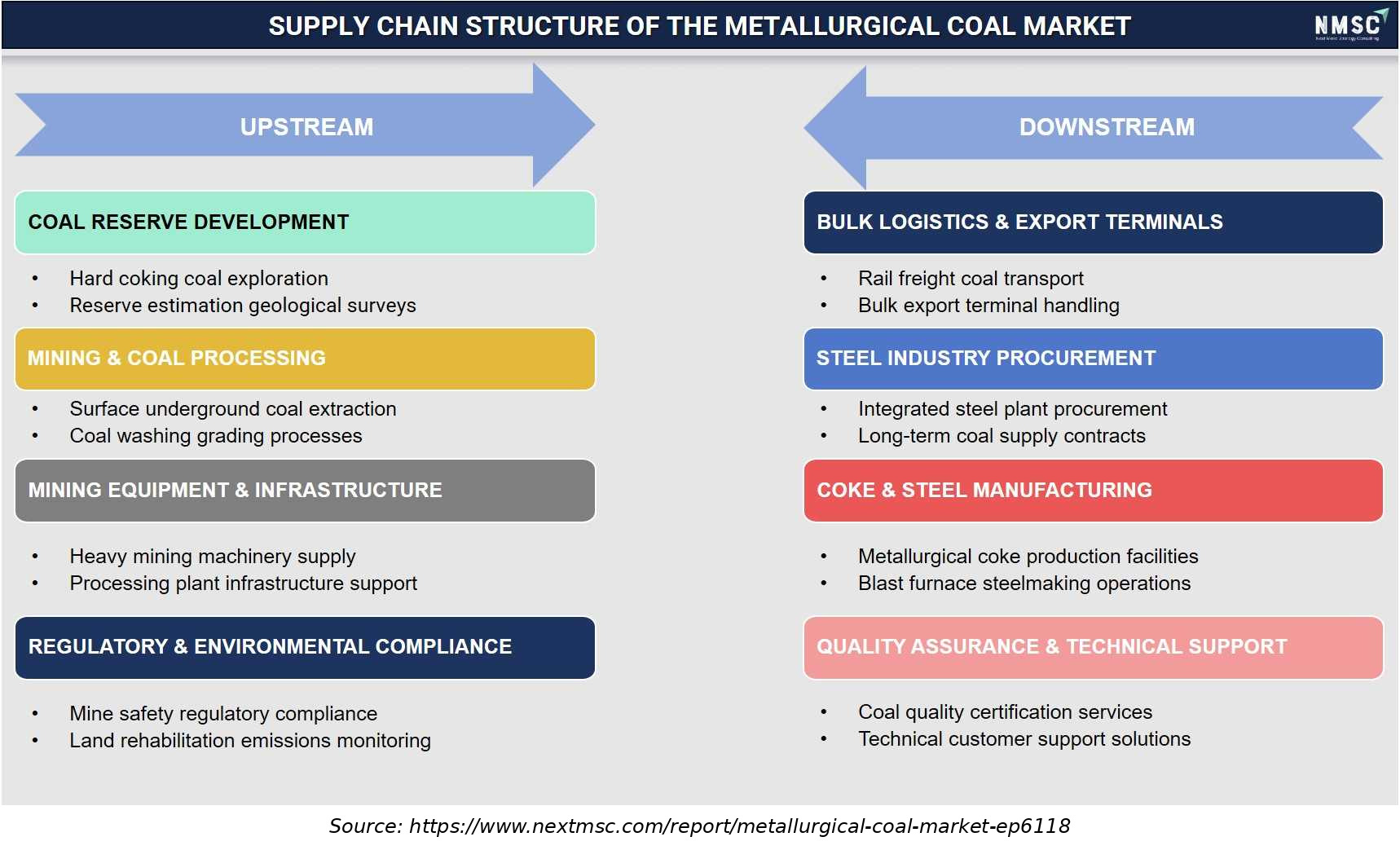
The above infographic presents the supply chain structure of the metallurgical coal market, segmented into upstream and downstream activities. Upstream begins with hard coking coal exploration and reserve estimation, moving into surface and underground extraction, followed by washing and grading processes. Heavy mining machinery and processing infrastructure support operations, while regulatory compliance ensures mine safety and environmental monitoring. Moving downstream, rail freight and export terminals enable global distribution to steel plants through long-term procurement contracts. Coking coal is then converted into metallurgical coke for blast furnace steelmaking. Looking ahead, we observed that coal quality certification and technical support ensure product consistency and customer satisfaction across the steel industry.

Growth Opportunities

We found that three forward-looking whitespace opportunities stand out for stakeholders positioning within the market over the coming decade.

How Can Producers Capture Demand From Indian Blast Furnace Expansion?

Expanding Indian blast furnace capacity creates a mechanism for seaborne exporters to secure long-term supply agreements with a structurally growing import base. Producers of premium hard coking coal grades stand to benefit most, as India's expanding integrated steel producers prioritize consistent, high-quality supply over price-driven spot purchasing.

What Opportunity Does Spot Market Growth Present for Trading Companies?

Rising seaborne market liquidity creates a mechanism for trading companies to expand intermediary volume beyond traditional long-term contract relationships. Trading companies with strong logistics and blending capability stand to benefit most, capturing incremental volume as buyers increasingly supplement contracted tonnage with opportunistic spot purchases.

How Can Underground Miners Unlock Premium Reserve Value?

Growing scarcity of accessible premium-quality surface reserves creates a mechanism for underground mine operators to capture rising premium hard coking coal demand. Producers investing in automated longwall technology and efficient rail freight logistics stand to benefit most, offsetting higher extraction costs with premium pricing for scarce, high-quality coking coal grades.

Regional Outlook

2025 (USD Billion)
2035 (USD Billion)
North Americ
Europe
Asia-Pacific
Middle East
Latin Americ
Region 2025 (USD Billion) 2035 (USD Billion) CAGR (%)
North America $10.0 USD Billion $40.0 USD Billion 9.0%
Europe $17.1 USD Billion $51.1 USD Billion 27.0%
Asia-Pacific $24.2 USD Billion $62.2 USD Billion 25.0%
Middle East & Africa $31.3 USD Billion $73.3 USD Billion 23.0%
Latin America $38.4 USD Billion $84.4 USD Billion 12.0%

Regional data is locked

Unlock complete regional numbers for this market.

Unlock Full Data

PESTEL Analysis of the Metallurgical Coal Industry

PESTEL Analysis of the Metallurgical Coal Industry
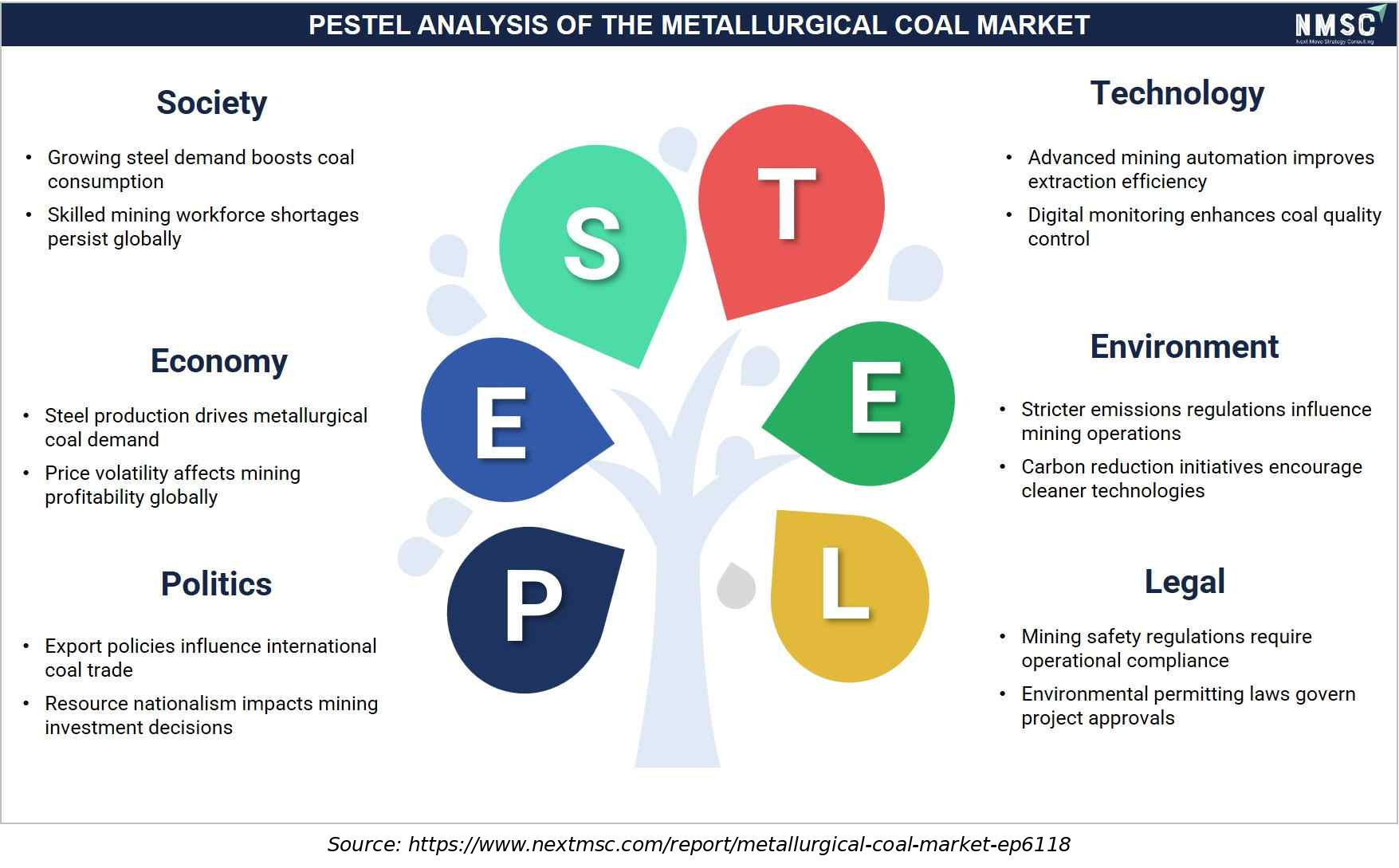
The above infographic presents a PESTEL analysis of the metallurgical coal market, where export policies and resource nationalism are influencing international trade and investment decisions. At the same time, steel demand and price volatility are shaping economic dynamics, while a skilled workforce shortage is creating operational challenges. Technological advancements such as advanced mining automation and digital monitoring are improving extraction efficiency and quality control, while carbon reduction initiatives are encouraging cleaner production technologies. Environmental permitting and mining safety regulations further govern operational compliance and project approvals. Looking ahead, we observed that these interconnected factors collectively shape the market's evolution across the mining and steel production sectors.

Investment Opportunities

What Capital Inflows Are Supporting the Metallurgical Coal Market?

Producers are directing capital toward premium reserve acquisition and automated extraction capability. Glencore's formation of Elk Valley Resources and Whitehaven Coal's Queensland asset acquisitions illustrate sustained capital allocation toward premium metallurgical coal exposure even as broader thermal coal investment faces increasing scrutiny.

How Is Infrastructure Investment Shaping Metallurgical Coal Demand?

Port, rail, and blast furnace infrastructure investment continues to expand the addressable base for seaborne metallurgical coal trade. Our assessment indicates that expanding Indian blast furnace capacity and associated import infrastructure investment are creating multi-year procurement pipelines for exporters with established Asian logistics relationships.

What ESG Considerations Are Influencing Metallurgical Coal Investment Decisions?

Environmental, social, and governance considerations are increasingly influencing capital allocation and financing access for metallurgical coal producers. Industry groups have published metallurgical coal exit lists highlighting companies expanding met coal mining activities for financial institution scrutiny. We observed that investors are increasingly distinguishing metallurgical coal exposure from thermal coal exposure, given its structural role in primary steelmaking, though both face rising sustainability-linked financing scrutiny.

Key Benefits for Stakeholders

How Does This Report Benefit Industry Leaders and Mine Operators?

Industry leaders and mine operators gain granular segmentation data across coal grade, end use, and regional axes, enabling informed capital allocation decisions for new mine development and reserve acquisition. Our analysis, data, and forecasts help operators benchmark portfolio strategy against verified 2025–2035 market trajectories and evolving buyer demand trends.

How Does This Report Benefit Investors and Financial Analysts?

Investors and financial analysts gain a validated 2025 base-year market size, a fundamentals-supported 2026–2035 CAGR, and segment-level growth trajectories that support capital allocation and competitive benchmarking decisions. The report's strategic insights into producer portfolio restructuring and regional demand trends help analysts assess relative positioning across the metallurgical coal value chain.

How Does This Report Benefit Technology Vendors and Product Teams?

Technology vendors and product teams gain visibility into the fastest-growing sub-segments, including PCI coal and Trading companies, informing product roadmap and go-to-market prioritization aligned with documented buyer and end-use demand shifts through 2035.

Key Market Segments Evaluated

By Coal Grade

  • Premium hard coking coal
  • Standard hard coking coal
  • Semi-soft coking coal
  • PCI coal
  • Other grades

By Mining Method

  • Surface mining
  • Underground mining

By End Use

  • Blast furnace steelmaking
  • PCI blending
  • Coke production for foundry and industrial use

By Sales Channel

  • Long-term contracts
  • Spot market

By Buyer Type

  • Integrated steel producers
  • Coke plant operators
  • Trading companies

By Region

  • North America 
    • U.S.
    • Canada
    • Mexico
  • Europe 
    • UK
    • Germany
    • France
    • Italy
    • Spain
    • Sweden
    • Denmark
    • Finland
    • Netherlands
    • Rest of Europe
  • Asia-Pacific 
    • China
    • India
    • Japan
    • South Korea
    • Taiwan
    • Indonesia
    • Vietnam
    • Australia
    • Philippines
    • Malaysia
    • Rest of APAC
  • Middle East & Africa 
    • Saudi Arabia
    • UAE
    • Egypt
    • Israel
    • Turkey
    • Nigeria
    • South Africa
    • Rest of MEA
  • Latin America 
    • Brazil
    • Argentina
    • Chile
    • Colombia
    • Rest of LATAM

Conclusion & Recommendations

The Metallurgical Coal market is positioned for steady growth through 2035, underpinned by expanding Indian blast furnace capacity even as European demand structurally declines. We expect PCI coal and Coke production for foundry and industrial use to gain incremental share as steelmakers optimize fuel rates, while Premium hard coking coal and Blast furnace steelmaking retain their position as the largest revenue contributors across the forecast period.

What Strategic Positioning Should Manufacturers Pursue?

Producers should prioritize premium reserve quality and logistics reliability to align with large integrated steel producer procurement preferences. Our assessment indicates that miners investing in portfolio high-grading, following the pattern established by Glencore and Whitehaven Coal, are best positioned to capture Indian blast furnace expansion and spot market growth opportunities through 2035.

How Attractive Is the Metallurgical Coal Market for Investment?

The market presents a moderately attractive investment case, supported by a validated USD 74 Billion absolute dollar opportunity between 2026 and 2035 and a fundamentals-backed 4.1% CAGR. Sustained Indian demand growth, as demonstrated by expanding blast furnace capacity at Tata Steel and JSW Steel, signals durable underlying demand even as European and Chinese demand growth moderates.

What Market Shifts and Key Risks Should Stakeholders Monitor?

Stakeholders should monitor persistent weak Chinese property-driven steel demand, which restrains near-term seaborne price and volume growth. We found that accelerating electric-arc-furnace and hydrogen-based steelmaking adoption also poses a long-term risk to blast furnace-dependent coking coal demand, particularly in Europe and North America where decarbonization policy pressure is most advanced.

What Are the Key Growth Pathways Through 2035?

Key growth pathways include expanding Indian blast furnace-linked import demand, scaling premium reserve consolidation among diversified miners, and deepening spot market participation among trading companies. Our findings suggest that producers combining premium reserve quality with diversified logistics capability are best positioned to capture disproportionate share of the market's projected USD 246 Billion 2035 revenue base.

FAQs

About the Author

Mayurima Roy

Mayurima Roy

Mayurima Roy is Research Analyst at Next Move Strategy Consulting, where she has spent 4 years working across the firm's full industry coverage rather than a single fixed vertical. Her work centers on structured research, ongoing trend tracking, competitive assessment, and insight-led content development, translating complex market data into clear, decision-ready narratives that support informed client decision-making across diverse global industries, market sectors, and world regions every day.

About the Reviewer

Supradip Baul

Supradip Baul

Supradip Baul is an accomplished business consultant and strategist with over a decade of rich experience in market intelligence, strategy, technology, and business transformation. His work has included rigorous qualitative and quantitative analysis across multiple industries, helping clients shape investment decisions and long-term roadmaps. Earlier in his career, he was associated with Gartner, where he contributed to industry-leading reports and market share analyses. He has worked with leading global companies and holds an MBA with a dual specialization in Marketing and Finance.

Download Free Sample

Pratyush Kumar Das

PRATYUSH KUMAR DAS

Assistant Manager

Polycab India Limited

We would like to express our appreciation for the data and insights provided by nextmsc. We are very pleased with the quality and depth of the information, which has proven to be highly valuable and beneficial for our business decision-making.

Melanie Samko

MELANIE SAMKO

Director of Marketing

TOSOH BIOSCIENCE, INC.

The information provided by NMSC is incredibly valuable, thank you so much for such a excellent work. I really appreciate it. I will make sure to reference all of it, in my summary document.

Mohit Agarwal

MOHIT AGARWAL

Chief Manager

DryChem India Pvt. Ltd.

Next Move Strategy Consulting is an amazing team of consultants. We required a market study report for our investors on top priority and the team went above and beyond our expectations to deliver the same with ample supporting data within a short time span enabling us to secure the investments and keep our project timeline maintained. Their professionalism, attention to detail, and timely delivery of actionable recommendations have left a lasting impression on our organization.

Kishu Kanda

KISHU KANDA

Strategy Analyst

Accenture

We purchased the AI Consumer Market Report from this company. Not only did they customize the report to meet our specific requirements, but they also showed great flexibility in accommodating our budget. The report we received fully met our expectations. Additionally, they provided prompt and thorough responses to both our pre-purchase and follow-up questions. We look forward to working with this company again in the future.

Diana Trejo

DIANA TREJO

Assistant Manager

Sumitomo Corporation de Mexico, S.A. de C.V.

Recently, we purchased a report on the Mexico Data Center Market from Next Move Strategy Consulting. The service has been excellent, with support that is always timely and thoroughly professional. The information provided is interesting, highly useful, and delivered with clarity. I would highly recommend NextMSC for anyone seeking insightful and dependable analysis.

Custom Market Research Services

We will customize the research for you if the listed report does not fully match your requirements.

Get 30% Free Customization

Select License

This website uses cookies to ensure you get the best experience on our website. Learn more

✖