Japan Factory Slowdown Tests Smart Manufacturing Plans
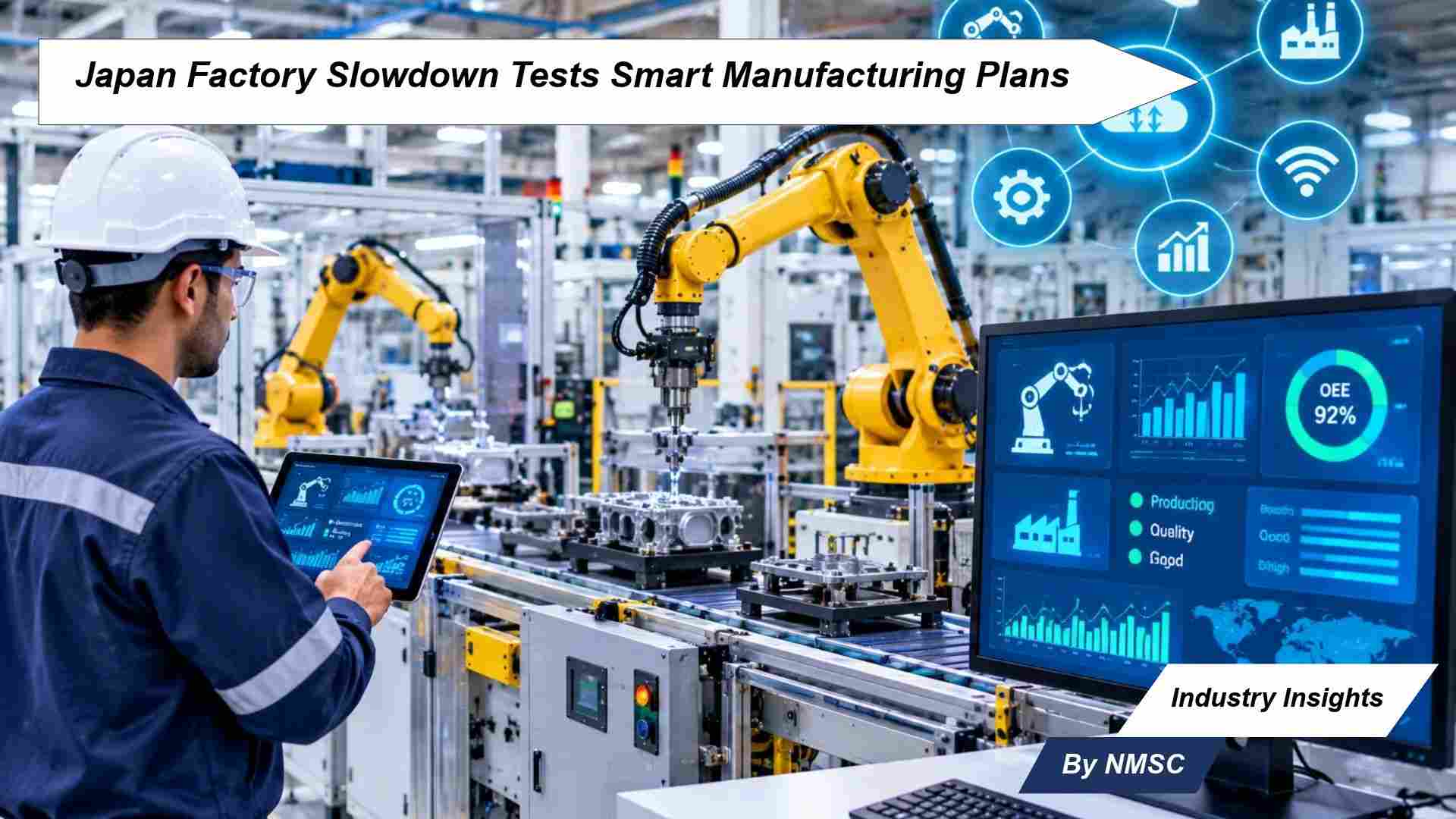
Japan’s Manufacturing PMI Slows to Seven-Month Low, Raising Questions for Automation Investment
TOKYO, Japan — October 23, 2026 — Japan’s manufacturing sector expanded at its slowest pace in seven months in October, as weaker growth in factory output and new orders signalled softer industrial momentum. The slowdown highlights the importance of operational efficiency and demand visibility for companies evaluating Smart Manufacturing Market technologies, including industrial automation, connected factory systems and predictive maintenance.
Main Development
According to a Reuters report published on October 23, the flash S&P Global Japan Manufacturing Purchasing Managers’ Index (PMI) fell to 53.3 in October from 54.1 in September. The reading remained above 50, indicating that manufacturing activity continued to expand, although the pace of growth weakened.
New orders for goods producers increased at their slowest pace since March, while manufacturing output recorded its weakest rise since March. Export-related business across Japan’s private sector also grew at its slowest pace in four months, pointing to more moderate demand momentum.
Manufacturers continued to hire at a moderate pace and increased purchasing activity, resulting in the largest accumulation of purchased-material inventories in almost four years. However, higher raw-material and labour costs contributed to a slight acceleration in input-cost inflation, creating additional considerations for factory operating budgets.
For smart manufacturing providers, the findings offer a relevant indication of the operating environment in which automation and digitalization investment decisions are made. Manufacturers facing slower order growth may place greater emphasis on production flexibility, resource utilization and cost visibility, although the survey does not establish whether spending on smart factory technologies has increased or declined.
Key Highlights
-
Manufacturing momentum: Japan’s flash manufacturing PMI declined to 53.3 in October from 54.1 in September, marking the slowest expansion in seven months.
-
Weaker production growth: Factory output and new orders increased at their weakest rates since March, indicating softer manufacturing momentum.
-
Inventory and cost pressures: Manufacturers recorded their largest accumulation of purchased-material inventories in almost four years, while input-cost inflation accelerated slightly.
-
Automation investment considerations: Industrial automation, industrial IoT, predictive maintenance and digital twins offer potential tools for managing resource efficiency and production visibility, although the PMI data does not measure adoption directly.
Analyst Insight
According to analysts at Next Move Strategy Consulting, slower manufacturing growth can increase the importance of investments that improve production efficiency, operational visibility and resource utilization. Smart manufacturing systems can help companies monitor equipment performance, identify maintenance requirements and adjust production processes to changing demand conditions.
NMSC analysts note that manufacturers evaluating digital factory initiatives must balance expected efficiency gains against implementation costs, integration requirements and near-term business conditions. Predictive maintenance and industrial IoT applications may support better equipment utilization, while digital twins can help manufacturers simulate production processes before making operational changes.
However, a weaker PMI reading alone does not establish a reduction in smart manufacturing adoption or capital expenditure. Assessing the direction of investment requires additional evidence on technology spending, equipment orders and company-level deployment plans.
Industry Outlook
Japan’s October manufacturing survey points to continued expansion at a slower pace, with weaker output and new-order growth potentially influencing how manufacturers prioritize operational improvements. Companies may continue to evaluate digital production systems according to their ability to address productivity, inventory management and cost-control requirements.
The outlook for smart manufacturing will depend on manufacturers’ investment capacity, the measurable benefits of automation and the ability to integrate connected technologies with existing production infrastructure. Industrial IoT, predictive maintenance and digital twins remain relevant areas for efficiency initiatives, but the pace of adoption will need to be assessed through direct investment and deployment evidence rather than manufacturing sentiment alone.
Source: Reuters
For More Information – Download FREE Sample on Smart Manufacturing Market Report
Prepared By: Sanyukta Deb
About the Author
 Sanyukta Deb
— Sanyukta Deb is Digital Marketing Team Lead at Next Move Strategy Consulting, where she has led content strategy and technical SEO for the firm's B2B market research publications for over 2 years. Her editorial process translates NextMSC's primary and secondary research — spanning technology, industrial, and consumer sectors — into commercial narratives, backed by search-intent, keyword, and competitive analysis. She brings 5 years of overall experience in digital marketing and content strategy.
About the Reviewer
 Debashree Dey
— Debashree Dey is Assistant Manager at Next Move Strategy Consulting, where she supports cross-vertical market content and communications across diverse industries for 6 years. Her professional background includes senior content writing, communications, and published manuscript authorship, with experience developing audience-focused business narratives and maintaining clear, consistent messaging. Her role supports research-led content development and editorial quality across NextMSC publications.

















Add Comment