JCI's Nantum AI Acquisition Signals a New Era in Building Energy | NextMSC

Johnson Controls' Nantum AI Acquisition Marks a Structural Shift in Autonomous Building Energy Optimization — as a USD 51.54 Billion Market Takes Shape
On April 27, 2026, Johnson Controls International plc (NYSE: JCI) announced the acquisition of Nantum AI, a New York-based company specializing in proprietary AI algorithms for real-time HVAC airflow optimization based on occupancy data, integrating the technology directly into its OpenBlue digital building ecosystem. The deal — which extends OpenBlue's existing water-side chiller plant optimization to encompass autonomous, AI-driven control across both air-side and water-side HVAC applications — is not merely a product line extension. It is a signal that the era of rule-based building management systems is giving way to closed-loop, autonomous AI control as the commercial standard across complex facilities including healthcare campuses and advanced manufacturing environments.
According to Next Move Strategy Consulting's AI Building Energy Market report, the global AI Building Energy Market was valued at USD 6.45 billion in 2025 and is projected to reach USD 51.54 billion by 2035, growing at a CAGR of 23.1% from 2026 to 2035. The market encompasses AI-powered software platforms, hardware systems, and professional services that monitor, optimize, and autonomously manage energy consumption across commercial, industrial, institutional, and residential building portfolios — a scope that the Johnson Controls–Nantum AI combination directly addresses at the enterprise scale.
For More Information: Download FREE Sample on AI Building Energy Market Report
The Acquisition in Context: Why Autonomous HVAC AI Is Now a Board-Level Imperative
The strategic logic behind Johnson Controls' move is grounded in a convergence of financial and regulatory pressures that have made passive building management systems economically untenable for large commercial operators.
"Artificial intelligence has enormous potential to improve how buildings operate and, with energy demand and costs continuing to climb, leveraging it to increase energy efficiency is a business imperative," said Michael Rudin, Board Member of Prescriptive Holdings LLC, the parent company of Nantum AI, in the April 27, 2026 acquisition announcement. "Nantum AI is already delivering more than 10% energy savings for customers and we are pleased to see how our algorithms complement Johnson Controls' existing deep building expertise."
"We're entering the next phase of the industrial revolution, where digital intelligence is as critical as the physical systems themselves, and the companies that leverage the power of AI to streamline processes, cut costs and unlock new customer value will win," said Vijay Sankaran, Chief Digital and Information Officer at Johnson Controls, in the same announcement.
The 10%-plus energy savings figure Nantum AI has documented for its existing customer base is significant in the context of HVAC systems, which the International Energy Agency's Energy and AI special report (2025) identifies as among the highest-value targets for AI-led building optimization — given that HVAC accounts for a disproportionate share of commercial building electricity consumption globally. According to NextMSC primary research and analysis, HVAC systems contribute 40% to 60% of total commercial building energy consumption, making HVAC Optimization the fastest-growing use case in the AI Building Energy Market at a CAGR of 23.2% from 2026 to 2035, advancing from USD 1.00 billion in 2025 to USD 8.02 billion by 2035.
Schneider Electric's own research, published in 2026, found that AI-enabled building management systems can cut whole-building energy use by up to 22% compared with traditional controls, with corresponding reductions in annual utility costs and carbon emissions. BrainBox AI, whose autonomous HVAC optimization platform operates across commercial building portfolios globally, has documented up to 25% savings in HVAC energy consumption and up to 40% reduction in carbon footprint through its AI-driven closed-loop control architecture.
Regulatory Architecture: The Compliance Engine Driving Mandatory AI Adoption
The Johnson Controls–Nantum AI deal does not exist in a policy vacuum. It reflects growing regulatory and financial pressure on large commercial building owners to improve energy efficiency, reduce emissions, and comply with increasingly stringent building-performance requirements. — not merely strategically desirable.
In the United States, New York City's Local Law 97 — which entered its first active compliance year in calendar year 2024 — imposes carbon intensity caps on buildings over 25,000 square feet, with financial penalties of USD 268 per metric ton of CO₂ equivalent above the annual cap. The first compliance year under LL97 demonstrated strong initial compliance rates, but the caps tighten progressively through 2029 and beyond, creating a sustained multi-year demand cycle for AI energy optimization platforms capable of continuously managing carbon intensity against legally enforceable benchmarks. Equivalent municipal building performance standards in Boston (BERDO) and Washington D.C. (Clean Energy DC) extend this compliance-driven demand across major U.S. metropolitan commercial real estate markets.
In Europe, the recast Energy Performance of Buildings Directive (EPBD) — transposed into national law across EU member states by May 29, 2026 — mandates near-zero energy building standards and requires member states to phase out the worst-performing building stock by 2033. The directive's building automation and control system requirements create a direct specification pathway for AI energy management platform deployment across Europe's commercial retrofit market. Frost & Sullivan's June 2026 analysis of the global homes and buildings industry confirmed that the revised EPBD is expected to stimulate demand for building automation, energy services, and AI-driven management solutions throughout Europe's retrofit market.
The Data Center Demand Surge: AI Infrastructure Creating Its Own Energy Management Market
One of the most structurally significant demand drivers within the AI Building Energy Market is the energy intensity of the AI compute infrastructure that is simultaneously driving the market's own growth — a self-reinforcing dynamic that is reshaping the competitive landscape.
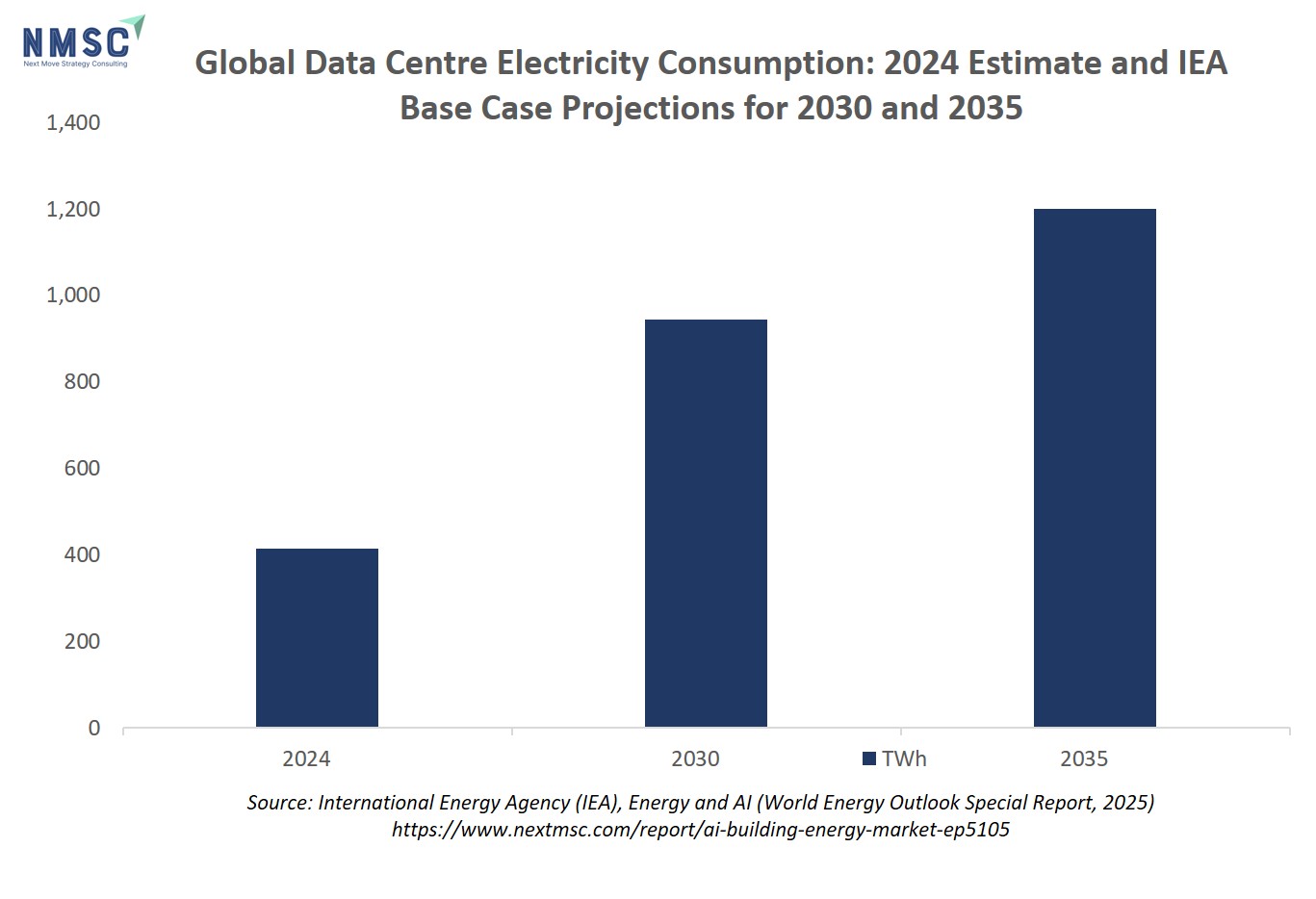
The International Energy Agency's Energy and AI report (2025) documented that data centres accounted for approximately 1.5% of global electricity consumption in 2024, or 415 terawatt-hours (TWh), and projects that data centre electricity consumption will more than double to approximately 945 TWh by 2030. By 2035, the IEA's Base Case projects global data centre electricity consumption rising to approximately 1,200 TWh — a figure that makes autonomous AI-driven power usage effectiveness (PUE) optimization not a discretionary investment but an operational necessity for hyperscale and colocation facility operators.
According to NextMSC primary research and analysis, Data Centers is the fastest-growing building type in the AI Building Energy Market at a CAGR of 23.3% from 2026 to 2035, advancing from USD 0.70 billion in 2025 to USD 5.70 billion by 2035. The IEA further notes that a typical AI-focused data centre consumes as much electricity as 100,000 households, with the largest facilities under construction today consuming 20 times that amount — creating a buyer segment for which AI energy management is not a cost-reduction tool but a core operational infrastructure requirement.
The IEA also identified that if scaled up, existing AI-led interventions in buildings could lead to global electricity savings of approximately 300 TWh — equivalent to the combined annual electricity generation of Australia and New Zealand — underscoring the systemic scale of the opportunity that AI building energy platforms are positioned to capture.
NMSC Market Segmentation Analysis
Software leads the market at USD 3.20 billion in 2025, spanning Building Energy Management Platforms, AI Control modules, Analytics and Fault Detection, Digital Twin engines, Demand Response Software, and Carbon and ESG Software — the intelligence layer that enterprise building owners deploy above physical infrastructure to generate measurable energy cost reduction and regulatory compliance value. Services, at USD 1.35 billion in 2025, is the fastest-growing offering at a CAGR of 23.4%, driven by the growing demand for Managed Operations as building owners outsource AI platform monitoring to specialist operators amid increasing energy compliance complexity and a structural shortage of in-house facilities engineering expertise.
Regional Dynamics: North America Leads, Asia-Pacific Accelerates
North America holds the largest regional share at USD 2.60 billion in 2025, forecast to reach USD 20.80 billion by 2035 at a CAGR of 23.1%, according to NextMSC primary research and analysis. The United States alone contributes approximately USD 2.10 billion in 2025, anchored by the Department of Energy's Building Technology Office programs, the Inflation Reduction Act's Section 179D energy efficiency deduction expansion, and the progressive tightening of municipal building performance standards across New York, Boston, and Washington D.C. that create financially penalized compliance deadlines compelling immediate AI energy platform investment.
Asia-Pacific is the fastest-growing major region at a CAGR of 23.3%, advancing from USD 1.50 billion in 2025 to USD 12.22 billion by 2035, per NextMSC primary research and analysis. India is the fastest-growing national market at a CAGR of 23.4%, driven by the Bureau of Energy Efficiency's Energy Conservation Building Code mandates, a massive commercial construction pipeline across IT parks, hospitals, and retail developments in Bangalore, Hyderabad, Chennai, Mumbai, and Delhi, and corporate sustainability commitments from technology companies including Infosys, TCS, and Wipro — each managing large owned campus portfolios with documented net-zero targets requiring verifiable building energy performance data.
NMSC Strategic Perspective: What the Johnson Controls–Nantum AI Deal Reveals About the Market's Next Phase
The Johnson Controls–Nantum AI acquisition is the most consequential competitive event in the AI Building Energy Market in 2026 because it resolves a long-standing structural gap in the OpenBlue platform: the absence of autonomous, closed-loop air-side HVAC control. Prior to this acquisition, OpenBlue's AI optimization was concentrated on water-side chiller plant efficiency — a high-value but incomplete coverage of the HVAC system. By adding Nantum AI's occupancy-driven airflow algorithms, Johnson Controls has assembled a full-stack autonomous HVAC optimization capability that directly competes with the performance differentiation that AI-native vendors BrainBox AI and 75F have used to win enterprise procurement decisions against established building management system incumbents.
This acquisition pattern — building automation incumbents acquiring AI software depth to close the performance gap with AI-native entrants — is precisely the M&A dynamic that NextMSC primary research and analysis identifies as the defining competitive force shaping the market through 2035. The first combined Johnson Controls–Nantum AI offering is currently in pilot, meaning the competitive impact on enterprise procurement decisions will become measurable within the next two to three quarters.
The broader implication for market participants is that the competitive threshold for AI building energy platform credibility has permanently shifted. Enterprise procurement teams evaluating AI energy management platforms are now benchmarking against documented autonomous energy savings of 10% to 25% above baseline rule-based BMS performance — a standard that Nantum AI's track record and BrainBox AI's published case studies have established as the minimum credible performance claim. Vendors unable to demonstrate autonomous closed-loop control with measurable, contractually committed energy savings will face increasing displacement risk as the market matures from early adoption into mainstream enterprise procurement cycles.
The regulatory convergence across the U.S., EU, and Asia-Pacific further compresses the timeline for enterprise decision-making. With the EU EPBD recast now transposed into national law across member states as of May 2026, and NYC Local Law 97 penalties actively accruing for non-compliant buildings, the investment case for AI building energy platforms has shifted from a multi-year strategic consideration to an immediate compliance obligation with quantifiable financial consequences for delay.
Competitive Landscape: Consolidation Accelerates as AI-Native Entrants Raise the Performance Bar
The AI Building Energy Market is moderately fragmented, with Schneider Electric SE, Siemens AG, and Johnson Controls International plc holding dominant positions in integrated AI building management platform delivery, while specialized AI vendors BrainBox AI, 75F, and GridPoint compete on AI autonomy and energy optimization algorithm performance within targeted building type and use case segments, according to NextMSC primary research and analysis.
Schneider Electric has pursued a parallel strategy, launching its AI-driven EcoCare continuous BMS monitoring service — which the company states can reduce facility energy use by up to 25% — and announcing a multi-year initiative to build an AI-native ecosystem for sustainability and energy management. Siemens' Building X platform integrates digital twin engines updating continuously from live sensor and BACnet data, enabling simultaneous optimization of HVAC, lighting, and distributed energy resource setpoints across multi-site enterprise portfolios.
The convergence of demand response aggregation with AI building energy optimization is creating additional M&A opportunities as utilities and retail energy providers seek to acquire AI platforms enabling automated, portfolio-wide demand flexibility programs across commercial building customer bases — a dynamic that NextMSC primary research and analysis identifies as a high-priority investment theme through 2030.
Bottom Line
The Johnson Controls–Nantum AI acquisition of April 2026 crystallizes a market inflection point that NextMSC primary research and analysis had identified as structurally inevitable: the consolidation of autonomous AI HVAC control into the product architectures of the global building management incumbents. The AI Building Energy Market, valued at USD 6.45 billion in 2025 and projected to reach USD 51.54 billion by 2035 at a CAGR of 23.1%, is now being shaped by three simultaneous forces — regulatory mandates with financial penalties that make AI investment economically mandatory, data centre energy intensity that creates a high-value buyer segment demanding continuous autonomous optimization, and competitive M&A activity that is rapidly closing the performance gap between AI-native entrants and established building automation platforms. North America leads at USD 2.60 billion in 2025, but Asia-Pacific's 23.3% CAGR — anchored by India's 23.4% growth rate and China's dual-carbon policy framework — represents the most significant international expansion runway for vendors delivering localized regulatory compliance support alongside global energy optimization performance. Enterprise procurement teams, institutional real estate investors, and technology vendors that align their strategies with autonomous closed-loop AI control, carbon and ESG reporting integration, and data center vertical-specific architectures will be best positioned to capture the market's highest-value growth segments through 2035.
About Next Move Strategy Consulting
Next Move Strategy Consulting is a premier market research and management consulting firm that has been committed to provide strategically analysed well documented latest research reports to its clients. The research industry is flooded with many firms to choose from, what makes NMSC different from the rest is its top-quality research and the obsession of turning data into knowledge by dissecting every bit of it and providing fact-based research recommendation that is supported by information collected from over 500 million websites, paid databases, industry journals and one on one consultations with industry experts across a diverse range of industry sectors. The high-quality customized research reports with actionable insights and excellent end-to-end customer service help our clients to take critical business decisions that enables them to move beyond time and have competitive edge in the industry.
We have been servicing over 1000 customers globally that includes 90% of the Fortune 500 companies over a decade. Our analysts are constantly tracking various high growth markets and identifying hidden opportunities in each sector or the industry. We provide one of the industry's best quality syndicate as well as custom research reports across 10 different industry verticals. We are committed to deliver high quality research solutions in accordance to your business needs. Our industry standard delivery solutions that ranges from the pre consultation to after-sales services, provide an excellent client experience and ensure right strategic decision making for businesses.
For more information, please contact:
Next Move Strategy Consulting
5th Floor 867 Boylston St, STE 500,
Boston, MA 02116, U.S.
E-Mail: [email protected]
Direct: +1-217-650-7991
Website: www.nextmsc.com
About the Author
 Sanyukta Deb
— Sanyukta Deb is Digital Marketing Team Lead at Next Move Strategy Consulting, where she has led content strategy and technical SEO for the firm's B2B market research publications for over 2 years. Her editorial process translates NextMSC's primary and secondary research — spanning technology, industrial, and consumer sectors — into commercial narratives, backed by search-intent, keyword, and competitive analysis. She brings 5 years of overall experience in digital marketing and content strategy.
Sanyukta Deb
— Sanyukta Deb is Digital Marketing Team Lead at Next Move Strategy Consulting, where she has led content strategy and technical SEO for the firm's B2B market research publications for over 2 years. Her editorial process translates NextMSC's primary and secondary research — spanning technology, industrial, and consumer sectors — into commercial narratives, backed by search-intent, keyword, and competitive analysis. She brings 5 years of overall experience in digital marketing and content strategy.
About the Reviewer
 Debashree Dey
— Debashree Dey is Assistant Manager at Next Move Strategy Consulting, where she supports cross-vertical market content and communications across diverse industries for 6 years. Her professional background includes senior content writing, communications, and published manuscript authorship, with experience developing audience-focused business narratives and maintaining clear, consistent messaging. Her role supports research-led content development and editorial quality across NextMSC publications.
Debashree Dey
— Debashree Dey is Assistant Manager at Next Move Strategy Consulting, where she supports cross-vertical market content and communications across diverse industries for 6 years. Her professional background includes senior content writing, communications, and published manuscript authorship, with experience developing audience-focused business narratives and maintaining clear, consistent messaging. Her role supports research-led content development and editorial quality across NextMSC publications.














Add Comment