AI Building Energy Market Size, Share, Growth & Forecast by Offering (Software: Building Energy Management Platform, AI Control, Analytics and Fault Detection, Digital Twin, Other Software; Hardware: Controllers, Sensors and Meters, Edge Gateways, Other Hardware; Services: Advisory and Audit, Implementation and Integration, Managed Operations, Other Services), Deployment (Cloud, Edge, On-Premises, Hybrid, Other), Building Type, Distribution Channel, and Use Case — Global Analysis 2025–2035
Industry: Energy & Power | Publishing Date: July 13, 2026 | Last Updated: September 30, 2026 | No of Pages: N/A | No. of Tables: N/A | No. of Figures: N/A | Format: PDF | Report Code: EP5105
What Is the AI Building Energy Market Size?
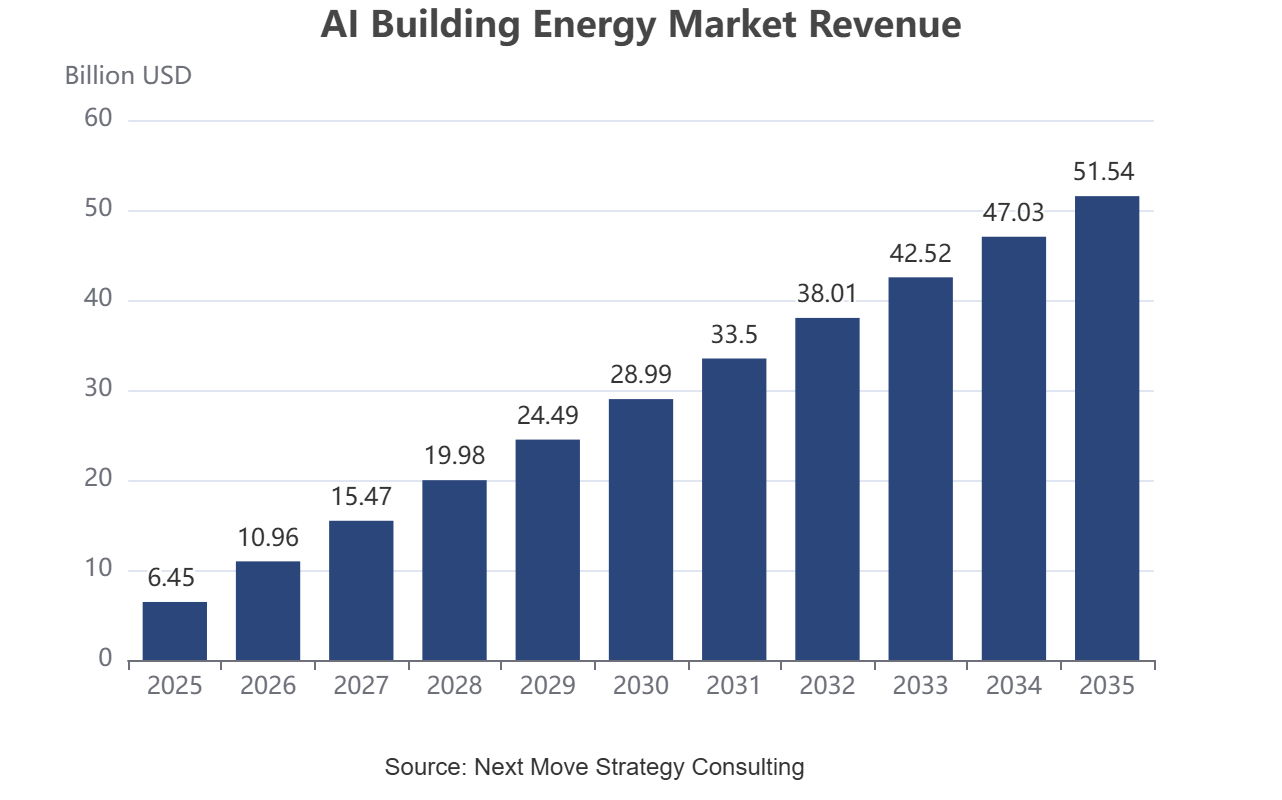
The global AI Building Energy Market encompasses artificial-intelligence-powered software platforms, hardware systems, and professional services that monitor, optimize, and autonomously manage energy consumption across commercial, industrial, institutional, and residential building portfolios. The market was valued at USD 6.45 Billion in 2025 and is expected to reach USD 7.94 Billion in 2026. Rising building carbon regulations, surging enterprise energy costs, and rapid AI-driven HVAC optimization and digital twin platform deployment are forecast to propel the market to USD 51.54 Billion by 2035, at a CAGR of 23.1% from 2026 to 2035.
|
Parameters |
Details |
|
Market Size in 2025 |
USD 6.45 Billion |
|
Market Size in 2026 |
USD 7.94 Billion |
|
Revenue Forecast in 2035 |
USD 51.54 Billion |
|
Growth Rate |
CAGR of 23.1% from 2026 to 2035 |
|
Analysis Period |
2025–2035 |
|
Base Year Considered |
2025 |
|
Forecast Period |
2026–2035 |
|
Market Size Estimation |
Revenue (USD Billion) |
|
Companies Profiled |
20 |
|
Countries Covered |
38 |
|
Market Share |
Available for Top 10 Companies |
AI Building Energy Market Overview
The AI Building Energy Market spans AI-enabled software including building energy management platforms, predictive HVAC control, fault detection, digital twin simulation, demand response, and carbon reporting modules, integrated with smart hardware comprising controllers, sensors, edge gateways, and smart devices, and delivered through advisory, implementation, managed operations, and maintenance services across cloud, edge, on-premises, hybrid, and other deployment architectures. Structural evolution has accelerated from standalone building management systems toward platform-as-a-service architectures aggregating multi-site energy data and applying machine learning models in real time for continuous autonomous optimization. Regulatory mandates, including the European Union's Energy Performance of Buildings Directive recast, the U.S. Department of Energy's building performance programs, and national net zero commitments, are compelling building owners to adopt AI energy management platforms to meet legally binding performance standards. Enterprise cloud adoption, edge AI computing advances, and improved digital twin fidelity are driving rapid technology adoption across office, healthcare, industrial, data center, multifamily, and government building segments globally.
Ecosystem Analysis of the AI Building Energy Industry
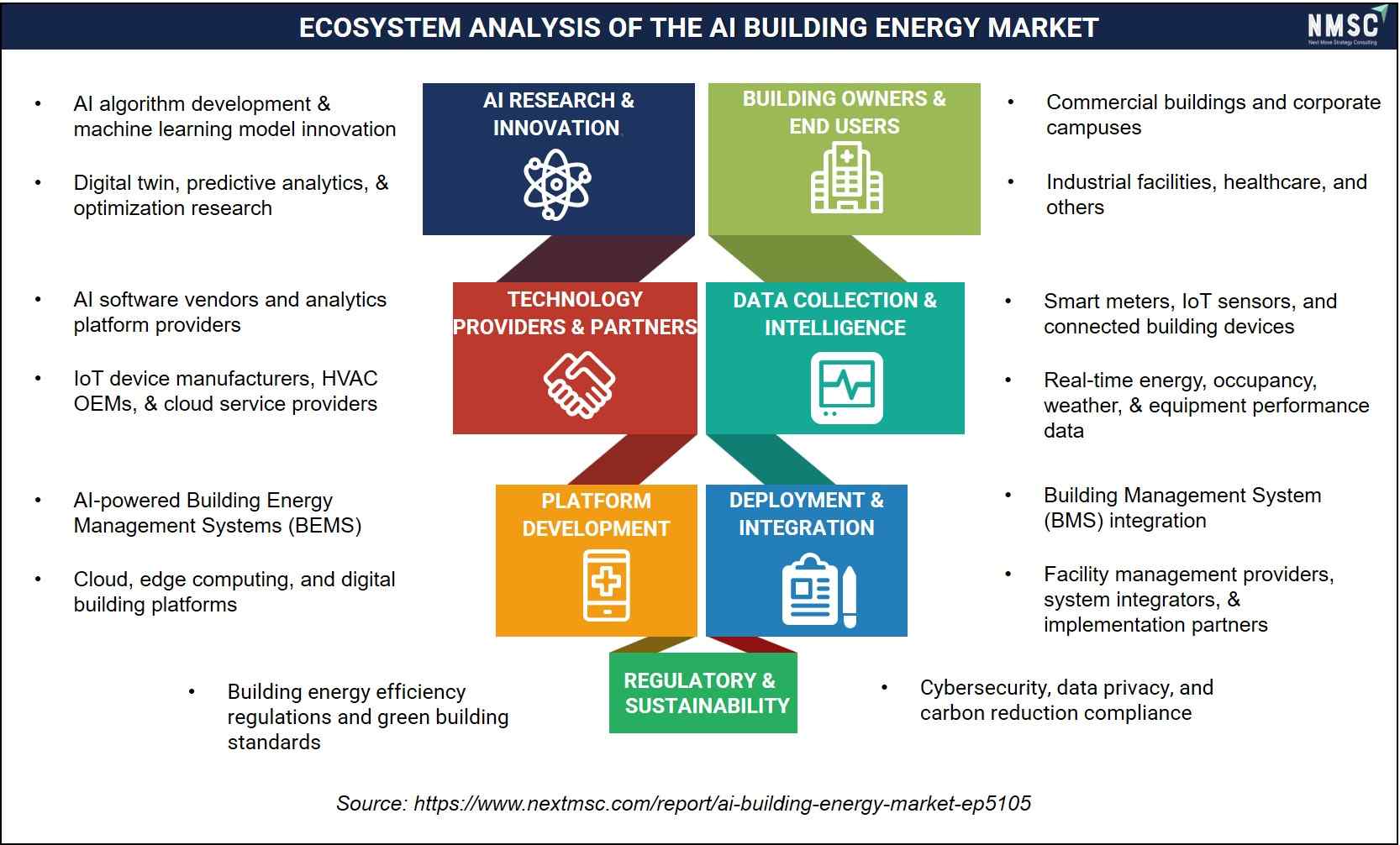
Our analysis indicates that the AI Building Energy Market is supported by a collaborative ecosystem comprising AI developers, IoT manufacturers, cloud providers, building automation companies, and system integrators. Together, these stakeholders enable the development of intelligent energy management solutions by combining advanced AI capabilities with connected building infrastructure and real-time operational data. This integrated approach improves energy optimization, predictive decision-making, and system performance across commercial and industrial facilities. Furthermore, supportive regulations focused on energy efficiency, sustainability, and data security continue to accelerate adoption, strengthening the market's long-term growth and innovation potential.
|
Key Takeaways |
|
Software dominates at USD 3.20 Billion in 2025, projected to reach USD 25.60 Billion by 2035. Services is the fastest-growing offering at a CAGR of 23.4% from 2026 to 2035, driven by Managed Operations demand as building owners outsource AI platform monitoring to specialist operators amid growing energy compliance complexity and skill shortages. |
|
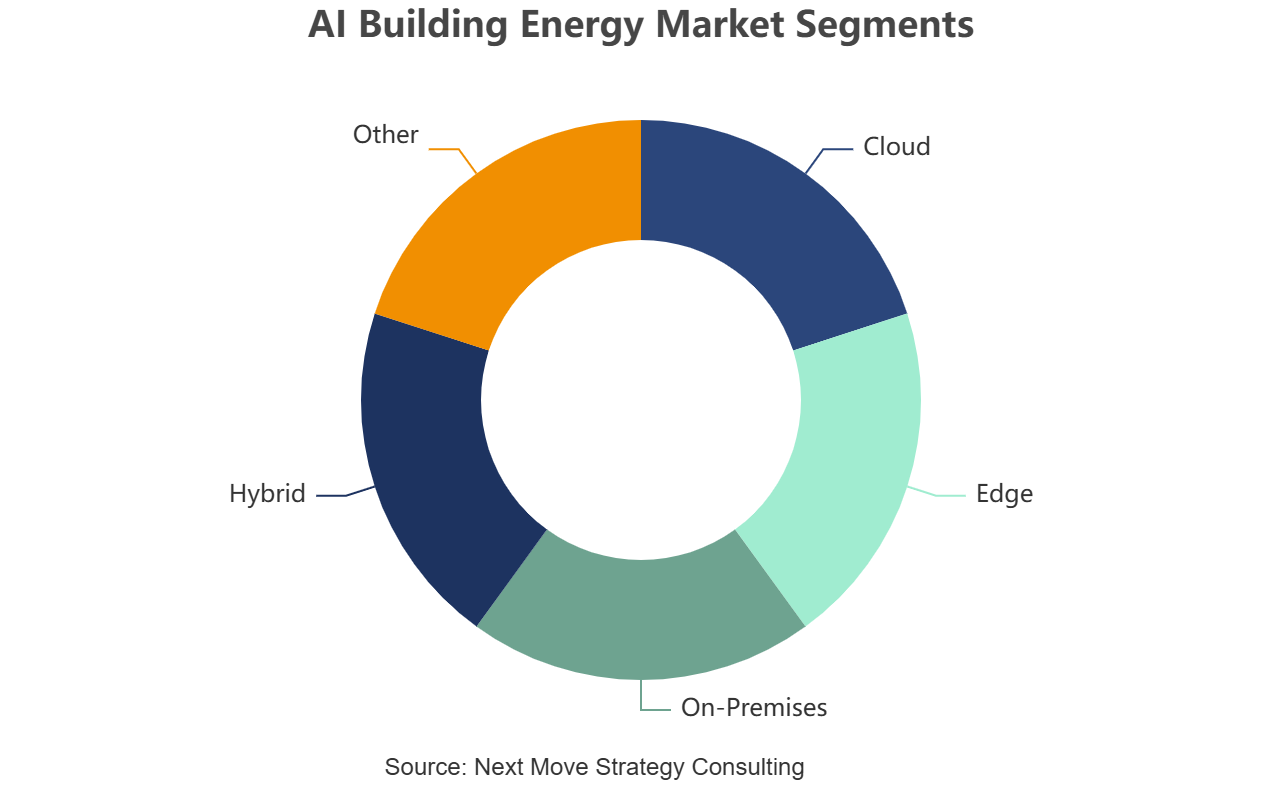
Cloud leads at USD 3.50 Billion in 2025 and USD 28.20 Billion by 2035, and is the fastest-growing deployment at a CAGR of 23.3% from 2026 to 2035, driven by scalable multi-site energy data aggregation requirements and vendor-managed AI model updates that reduce total cost of ownership across large commercial real estate portfolios. |
|
Office is the dominant building type at USD 1.50 Billion in 2025. Data Centers is the fastest-growing building type at a CAGR of 23.3%, advancing from USD 0.70 Billion in 2025 to USD 5.70 Billion by 2035, driven by extreme energy density and the imperative for AI-driven power usage effectiveness optimization within hyperscale and colocation facilities. |
|
Owner Occupier leads at USD 2.00 Billion in 2025 and USD 16.00 Billion by 2035 at a CAGR of 23.1%. System Integrators are the fastest-growing buyer type at a CAGR of 23.2%, as building technology complexity increases demand for specialist firms designing and managing multi-vendor AI energy platform architectures across enterprise building portfolios. |
|
Direct Enterprise leads at USD 2.50 Billion in 2025 and USD 20.04 Billion by 2035 at a CAGR of 23.1%, reflecting enterprise contract complexity requiring dedicated technical sales teams. OEM Embedded is the fastest-growing channel at a CAGR of 23.2%, driven by HVAC and controls manufacturers embedding AI energy optimization software into factory-installed equipment. |
|
Energy Optimization leads at USD 1.20 Billion in 2025. HVAC Optimization is the fastest-growing use case at a CAGR of 23.2%, advancing from USD 1.00 Billion in 2025 to USD 8.02 Billion by 2035, driven by HVAC systems' contribution of 40%–60% of total commercial building energy consumption and the maturity of AI optimization algorithms for chiller plant and air handling unit control. |
|
North America held the largest regional share at USD 2.60 Billion in 2025, forecast to reach USD 20.80 Billion by 2035 at a CAGR of 23.1%, anchored by federal and state building performance standards, IRA clean energy incentives, and the global headquarters of leading AI energy management vendors. |
|
Asia-Pacific is the fastest-growing region at a CAGR of 23.3%, advancing from USD 1.50 Billion in 2025 to USD 12.22 Billion by 2035, driven by rapid urbanization, Indian and Chinese building energy efficiency mandates, expanding data center investment, and growing enterprise smart building procurement across the region. |
|
The United States is the largest national AI Building Energy Market, contributing approximately USD 2.10 Billion in 2025, supported by federal IRA clean energy incentives, Local Law 97 and equivalent municipal building performance standards, and the concentration of enterprise real estate technology buyers. |
|
India is the fastest-growing national market at a CAGR of 23.4% from 2026 to 2035, driven by the Bureau of Energy Efficiency's Energy Conservation Building Code mandates, a massive commercial construction pipeline, and corporate sustainability commitments from technology companies, including Infosys, TCS, and Wipro, managing large owned campus portfolios. |
Key Emerging Trends in the AI Building Energy Market
How Is Generative AI Transforming Building Energy Optimization Across the AI Building Energy Market?
Generative AI is enabling a fundamental capability leap within the market by allowing facility managers to query complex multi-system energy datasets through natural language interfaces, generate counterfactual energy scenarios, and receive autonomous optimization recommendations without deep energy engineering expertise. Vendors including Schneider Electric, Siemens, and BrainBox AI have integrated large language model capabilities within building energy management platforms, enabling conversational energy auditing, automated fault report generation, and AI-drafted demand response proposals for utility programs. Our findings suggest that organizations deploying generative AI-assisted energy management report measurably faster anomaly identification and significantly reduced mean time to energy waste remediation compared to traditional dashboard-based monitoring approaches.
How Is the Convergence of Digital Twin Technology and AI Redefining Predictive Energy Management in the AI Building Energy Market?
The convergence of physics-based digital twin models with AI machine learning is creating a new category of predictive building energy management within the market, enabling real-time simulation of energy scenarios under variable occupancy, weather, and equipment performance conditions before implementing operational changes. From our research, we found that vendors, including Siemens with its Building X platform and Johnson Controls with OpenBlue, have integrated digital twin engines updating continuously from live sensor and BACnet data, enabling simultaneous optimization of HVAC, lighting, and distributed energy resource setpoints. The U.S. Department of Energy's Building America program has documented digital twin adoption in high-performance building demonstrations, reflecting its growing commercial deployment role.
How Is Carbon and ESG Regulatory Pressure Reshaping Demand for AI Building Energy Solutions?
Mandatory carbon disclosure and building performance reporting requirements under the European Union's Corporate Sustainability Reporting Directive, the U.S. Securities and Exchange Commission's climate disclosure rules, and the UK Streamlined Energy and Carbon Reporting framework are creating legally binding demand for AI-powered carbon and ESG software within the AI Building Energy Market. Our assessment indicates that commercial building owners managing publicly listed companies face dual regulatory pressure from securities regulators requiring scope 1 and scope 2 emissions disclosure and building energy authorities mandating operational carbon intensity compliance, compelling simultaneous investment in AI energy optimization platforms and integrated ESG reporting software connecting meter-level energy data to regulatory reporting frameworks.
What Are the Key Market Drivers, Breakthroughs, and Investment Opportunities that will Shape the AI Building Energy Industry in the Next Decade?
|
Driver / Trend / Restraint |
(+/−) % Impact on CAGR Forecast |
Geographic Relevance |
Impact Timeline |
|
Net Zero Regulatory Mandates and Building Performance Standards |
+3.2% |
Global (EU, U.S., APAC) |
2025–2030 |
|
Rising Energy Prices and Grid Decarbonization Pressure |
+2.8% |
Global |
2025–2033 |
|
AI and Edge Computing Cost Reduction Enabling Broader Deployment |
+2.1% |
North America, Europe, APAC |
2025–2035 |
|
High Upfront Integration and Legacy System Replacement Costs |
−1.8% |
Emerging Markets, SME Segment |
2025–2028 |
|
Operational Technology Cybersecurity and Data Privacy Compliance |
−1.2% |
EU, North America |
Ongoing |
What Are the Growth Drivers of the AI Building Energy Market?
How Are Global Net Zero Mandates and Building Energy Codes Driving Demand in the AI Building Energy Market?
National and sub-national building performance standards requiring measurable energy intensity reduction are the most powerful structural demand driver within the market. The European Union's Energy Performance of Buildings Directive recast requires member states to phase out the worst-performing building stock by 2033 and achieve a zero-emission building standard by 2050, directly compelling property owners to invest in AI-powered energy management platforms that continuously optimize operational performance against regulatory benchmarks. In the United States, the Department of Energy's Better Buildings Challenge and municipal building performance standards enacted under New York Local Law 97, Washington D.C.'s Clean Energy DC, and other city frameworks create legally enforceable energy intensity limits with financial penalties that make AI optimization investment economically mandatory for non-compliant buildings.
How Are Rising Energy Prices and Grid Volatility Accelerating AI Building Energy Market Growth?
Structural increases in commercial electricity prices across North America, Europe, and Asia-Pacific, combined with growing grid price volatility as renewable penetration increases real-time imbalance exposure, are creating compelling return-on-investment cases for AI building energy optimization that would not have existed under historically stable energy pricing. The U.S. Energy Information Administration documents sustained electricity price increases in commercial sectors, while European wholesale market volatility has permanently elevated energy cost awareness among CFOs and sustainability officers. Based on NMSC's research, we found that AI demand response and load flexibility platforms deliver measurable cost savings by shifting non-critical consumption to off-peak, low-cost grid windows, creating direct financial justification for AI building energy platform investment independent of regulatory compliance mandates.
What Is the Key Growth Restraint of the AI Building Energy Market?
How Do High Integration Costs and Legacy Infrastructure Constrain the AI Building Energy Market?
The AI Building Energy Industry faces a structural adoption constraint from high upfront system integration costs required to connect AI platforms with heterogeneous installed building automation systems, HVAC controllers, meters, and energy sub-systems operating across incompatible protocols including BACnet, Modbus, LonWorks, and proprietary manufacturer standards. The American Council for an Energy-Efficient Economy has documented that retrofit complexity and upfront capital requirements represent the primary barriers to AI building energy platform adoption among small and mid-sized commercial property owners lacking dedicated facilities engineering staff and capital budgets for multi-year technology deployment programs, creating a significant addressable market gap that limits total realized demand below theoretical potential.
What Is the Key Growth Opportunity in the AI Building Energy Market?
What Growth Opportunities Does the Expansion of Data Centers and Smart City Programs Create in the AI Building Energy Market?
The unprecedented global expansion of hyperscale and colocation data center capacity, driven by AI compute infrastructure investment, is creating a high-value buyer segment within the market requiring continuous power usage effectiveness monitoring, autonomous cooling optimization, on-site renewable energy dispatch, and real-time carbon intensity matching capabilities. The U.S. Department of Energy's National Renewable Energy Laboratory has published roadmaps for AI-driven data center energy optimization, positioning AI building energy platforms as essential infrastructure for federal data center sustainability requirements. Municipal and national smart city programs across Asia, the Middle East, and Europe are additionally driving public sector investment in AI-integrated district energy management systems, extending optimization beyond individual buildings to campus and neighborhood scale.
How Is the AI Building Energy Industry Segmented and What Are the Key Insights from the Segmentation Analysis?
How Does the Offering Dimension Define the Structure of the AI Building Energy Market?
|
Segment |
2025 (USD Bn) |
2035 (USD Bn) |
CAGR% (2026–2035) |
|
Software |
3.20 |
25.60 |
23.2% |
|
Hardware |
1.90 |
15.19 |
23.0% |
|
Services |
1.35 |
10.75 |
23.4% |
The AI Building Energy Market is structured across three distinct offering tiers. Software leads at USD 3.20 Billion in 2025, spanning Building Energy Management Platform, AI Control, Analytics and Fault Detection, Digital Twin, Demand Response Software, Carbon and ESG Software, and Other Software modules that enterprise buyers deploy as the intelligence layer above physical building infrastructure. Hardware at USD 1.90 Billion encompasses Controllers, Sensors and Meters, Edge Gateways, Smart Devices, and Other Hardware, generating the data streams feeding AI analytics engines. Services at USD 1.35 Billion, encompassing Advisory and Audit, Implementation and Integration, Managed Operations, Maintenance and Support, and Other Services, is the fastest-growing offering at a CAGR of 23.4% from 2026 to 2035, driven by increasing demand for specialized managed operations as enterprise building operators outsource AI platform monitoring to dedicated energy services teams managing growing compliance complexity.
How Does Building Type Shape AI Energy Management Adoption Patterns Across the Market?
|
Segment |
2025 (USD Bn) |
2035 (USD Bn) |
CAGR% (2026–2035) |
|
Office |
1.50 |
12.00 |
23.1% |
|
Retail and Hospitality |
0.90 |
7.20 |
23.1% |
|
Healthcare |
0.80 |
6.40 |
23.1% |
|
Education |
0.60 |
4.80 |
23.1% |
|
Industrial and Logistics |
0.85 |
6.84 |
23.2% |
|
Multifamily |
0.55 |
4.40 |
23.1% |
|
Data Centers |
0.70 |
5.70 |
23.3% |
|
Government and Public |
0.35 |
2.80 |
23.1% |
|
Other |
0.20 |
1.40 |
21.4% |
Office buildings lead the AI Building Energy Market at USD 1.50 Billion in 2025, driven by large floor plates, variable occupancy patterns, complex HVAC requirements, and increasingly stringent building performance standards targeting commercial office stock. Retail and Hospitality at USD 0.90 Billion reflects extended operating hours and high energy intensity from refrigeration, lighting, and customer comfort systems amenable to AI optimization. Data Centers is the fastest-growing building type at a CAGR of 23.3%, advancing from USD 0.70 Billion in 2025 to USD 5.70 Billion by 2035, propelled by hyperscale AI compute infrastructure expansion and the energy management intensity requirements of maintaining optimal power usage effectiveness ratios. Healthcare at USD 0.80 Billion reflects 24/7 operations and critical system uptime requirements, making predictive maintenance and fault detection particularly valuable deployments.
Which Use Cases Are Generating the Most Value Within the AI Building Energy Market?
|
Segment |
2025 (USD Bn) |
2035 (USD Bn) |
CAGR% (2026–2035) |
|
Energy Forecasting |
0.50 |
4.00 |
23.1% |
|
Energy Optimization |
1.20 |
9.60 |
23.1% |
|
HVAC Optimization |
1.00 |
8.02 |
23.2% |
|
Lighting Optimization |
0.45 |
3.60 |
23.1% |
|
Fault Detection and Diagnostics |
0.70 |
5.60 |
23.1% |
|
Predictive Maintenance |
0.60 |
4.80 |
23.1% |
|
Occupancy Optimization |
0.50 |
4.00 |
23.1% |
|
Demand Response and Load Flexibility |
0.65 |
5.22 |
23.1% |
|
Carbon and ESG Reporting |
0.45 |
3.60 |
23.1% |
|
Microgrid and DER Orchestration |
0.35 |
2.80 |
23.1% |
|
Other |
0.05 |
0.30 |
19.6% |
The market serves eleven distinct use case categories. Energy Optimization leads at USD 1.20 Billion in 2025, representing the primary AI platform procurement rationale for reducing energy costs through continuous AI-driven setpoint and schedule optimization across building portfolios. HVAC Optimization at USD 1.00 Billion is the fastest-growing use case at a CAGR of 23.2%, expanding to USD 8.02 Billion by 2035, driven by HVAC systems' contribution of 40% to 60% of commercial building energy consumption and the maturity of AI optimization algorithms for chiller plant and air handling unit control. Fault Detection and Diagnostics at USD 0.70 Billion reflects growing AI-powered anomaly detection adoption, identifying equipment inefficiency before it becomes visible in utility bills or equipment failures, and Carbon and ESG Reporting at USD 0.45 Billion is accelerating rapidly under expanding mandatory disclosure frameworks.
Regional Outlook
Geographic Performance Snapshot
|
Region |
2025 (USD Bn) |
2035 (USD Bn) |
CAGR% (2026–2035) |
Key Driver |
|
North America |
2.60 |
20.80 |
23.1% |
Federal and state building performance standards, IRA clean energy incentives, leading vendor HQ |
|
Europe |
1.70 |
13.62 |
23.1% |
EPBD recast, CSRD ESG reporting mandates, national building renovation waves |
|
Asia-Pacific |
1.50 |
12.22 |
23.3% |
Rapid urbanization, ECBC mandates, smart city investment, data center expansion |
|
Middle East & Africa |
0.35 |
2.80 |
23.1% |
Vision 2030 smart building programs, GCC green building codes |
|
Latin America |
0.30 |
2.10 |
21.6% |
Corporate sustainability commitments, energy tariff reform, green building financing
|
North America AI Building Energy Market
North America dominates the global AI Building Energy Market, contributing USD 2.60 Billion in 2025 and is forecast to reach USD 20.80 Billion by 2035 at a CAGR of 23.1%. The region benefits from U.S. federal policy support through the Inflation Reduction Act commercial building energy tax credits, a dense ecosystem of leading vendors including Schneider Electric, Johnson Controls, Honeywell, BrainBox AI, GridPoint, and 75F, and the highest concentration of enterprise real estate technology buyers globally. Building performance standard adoption across major cities and the SEC climate disclosure rule are creating sustained multi-year demand cycles for AI energy management platform procurement across commercial, healthcare, and industrial building stock throughout the forecast period.
U.S. AI Building Energy Market
Based on our engagements, the United States is the dominant market globally, valued at approximately USD 2.10 Billion in 2025 and forecast to reach USD 16.80 Billion by 2035 at a CAGR of 23.1%. Federal programs under the Department of Energy's Building Technology Office, including the Better Buildings Challenge and Advanced Building Construction initiative, are driving technology deployment among large commercial and industrial building owners. New York Local Law 97, BERDO in Boston, and equivalent municipal building performance standards with financial penalty regimes for non-compliance are compelling immediate AI energy platform investment across major metropolitan commercial building portfolios. The IRA's Section 179D energy efficiency deduction expansion further strengthens the financial justification for AI retrofit investment across the commercial building market.
Canada AI Building Energy Market
Through our analysis, Canada contributes approximately USD 0.35 Billion in 2025, projected to reach USD 2.80 Billion by 2035 at a CAGR of 23.1%. Canada's National Energy Code for Buildings and provincial clean building programs in Ontario and British Columbia are shaping enterprise AI energy platform adoption. Natural Resources Canada's Energy Efficiency and Technology branch supports commercial building AI retrofit programs. Toronto, Vancouver, and Montreal represent the highest-density commercial real estate technology adoption centers. Canadian pension funds managing large commercial property portfolios, including Oxford Properties and Brookfield Asset Management, are significant AI building energy platform buyers driving institutional real estate technology investment across their domestic and international building portfolios.
Europe AI Building Energy Market
Europe is the second-largest region in the AI Building Energy Market, contributing USD 1.70 Billion in 2025 and forecast to reach USD 13.62 Billion by 2035 at a CAGR of 23.1%. The recast Energy Performance of Buildings Directive mandating near-zero energy building standards, the Corporate Sustainability Reporting Directive requiring scope 1 and scope 2 emissions transparency, and national building renovation waves across Germany, France, and the Netherlands are creating the most comprehensive regulatory demand environment for AI building energy platforms globally. European corporate real estate buyers are among the earliest adopters of AI carbon and ESG reporting software, driven by simultaneous CSRD compliance obligations and investor ESG due diligence requirements from institutional capital markets.
UK AI Building Energy Market
According to our evaluation, the United Kingdom is Europe's largest individual market, valued at approximately USD 0.35 Billion in 2025 and projected to reach USD 2.80 Billion by 2035 at a CAGR of 23.1%. The UK's Streamlined Energy and Carbon Reporting framework, the Energy Savings Opportunity Scheme for large enterprises, and the Future Homes Standard for new construction are compelling investments in AI energy monitoring and optimization. The UK Climate Change Act's statutory net zero by 2050 target and BREEAM certification requirements for commercial property transactions are increasingly influencing AI energy system specification in premium office and logistics developments, reinforcing long-term structured enterprise demand.
Germany AI Building Energy Market
Based on our engagements, Germany is Europe's second-largest market, contributing approximately USD 0.32 Billion in 2025, projected to reach USD 2.56 Billion by 2035 at a CAGR of 23.1%. The German Gebäudeenergiegesetz Building Energy Act and the national Energieeffizienzstrategie Gebäude drive regulatory demand. Germany's industrial and manufacturing building stock represents a large addressable market, with energy-intensive operations in Bavaria, Baden-Württemberg, and North Rhine-Westphalia creating high-value AI energy deployment opportunities. Siemens AG and Schneider Electric's German operations are active vendors, and the country's strong BACnet and KNX smart building standards ecosystem facilitates interoperability for AI platform deployments across the commercial and industrial real estate stock.
France AI Building Energy Market
Through our analysis, France contributes approximately USD 0.25 Billion in 2025, projected to reach USD 2.00 Billion by 2035 at a CAGR of 23.1%. France's Tertiary Sector Decree mandating 40% energy reduction by 2030, 50% by 2040, and 60% by 2050 for commercial buildings over 1,000 square meters is one of Europe's most specific building performance mandate frameworks, creating direct compliance-driven AI energy platform demand. The ADEME administers building renovation investment support. Legrand SA, headquartered in France, is a significant domestic vendor. French commercial office, retail, and public sector building operators face OPERAT performance monitoring obligations requiring continuous AI-assisted energy reporting aligned with regulatory reduction trajectory requirements.
Asia-Pacific AI Building Energy Market
Asia-Pacific is the fastest-growing major region in the market, advancing from USD 1.50 Billion in 2025 to USD 12.22 Billion by 2035 at a CAGR of 23.3%. Rapid urbanization across China, India, and Southeast Asia is creating vast new commercial and industrial building stock requiring modern AI energy management systems. National building energy efficiency codes across China, India, South Korea, and Japan are mandating energy performance standards, driving retrofit AI platform investment. The region's expanding data center capacity from hyperscaler investment in Singapore, Japan, Australia, and India is creating a high-value, energy-intensive buyer segment demanding sophisticated power and cooling optimization capabilities.
China AI Building Energy Market
Through our analysis, China is the largest individual market in Asia-Pacific, valued at approximately USD 0.42 Billion in 2025 and projected to reach USD 3.42 Billion by 2035 at a CAGR of 23.2%. China's Three-Year Action Plan for Peaking Carbon Emissions, Green Building Action Plan, and Ministry of Housing and Urban-Rural Development green building standards are compelling AI energy platform adoption across China's massive new commercial construction pipeline. The government's dual carbon goals, carbon peaking by 2030 and carbon neutrality by 2060, drive sustained policy support for building energy management technology investment. Domestic vendors, including Alibaba Cloud and Huawei, are deploying AI building energy platforms alongside global vendors Schneider Electric and Siemens.
India AI Building Energy Market
From our assessment, India is the fastest-growing market in Asia-Pacific at a CAGR of 23.4%, advancing from approximately USD 0.25 Billion in 2025 to USD 2.04 Billion by 2035. The Bureau of Energy Efficiency's Energy Conservation Building Code and the Star Rating program for commercial buildings provide the regulatory framework. India's massive commercial construction pipeline spanning IT parks, hospitals, retail malls, and government buildings in Bangalore, Hyderabad, Chennai, Mumbai, and Delhi represents a vast greenfield AI building energy deployment opportunity. Corporate sustainability commitments from technology companies, including Infosys, TCS, and Wipro, which have documented net-zero targets and large owned campus portfolios, are driving significant enterprise AI energy platform procurement.
Japan AI Building Energy Market
According to our evaluation, Japan contributes approximately USD 0.25 Billion in 2025, projected to reach USD 2.00 Billion by 2035 at a CAGR of 23.1%. Japan's Act on the Rational Use of Energy requires large commercial building owners to report energy consumption and implement energy management measures. The Ministry of Land, Infrastructure, Transport and Tourism's ZEB policy targeting 50% new zero-energy building construction by 2030 drives AI energy control adoption. Japanese conglomerates, including Hitachi, Panasonic, and Daikin, are both significant AI building energy technology vendors and large building portfolio owners. Japan's district energy integration ambitions and advanced building automation market create favorable AI energy overlay platform deployment conditions.
South Korea AI Building Energy Market
Based on our engagements, South Korea contributes approximately USD 0.16 Billion in 2025, projected to reach USD 1.28 Billion by 2035 at a CAGR of 23.1%. South Korea's Green Building Certification System, the Energy Use Rationalization Act, and the national 2050 Carbon Neutrality Framework drive AI building energy adoption. Korea's high-density urban commercial building stock in Seoul, Busan, and Incheon creates significant retrofit market potential. LG Electronics and Samsung Engineering are active building energy management solution providers, while Korea's advanced semiconductor and electronics manufacturing facilities represent high-energy-intensity industrial buildings requiring sophisticated AI energy optimization capabilities. The Korea Energy Agency administers building energy auditing programs, creating a structured compliance demand.
Middle East and Africa AI Building Energy Market
The Middle East and Africa region contributes USD 0.35 Billion in 2025 and is forecast to reach USD 2.80 Billion by 2035 at a CAGR of 23.1%. Vision 2030 programs in Saudi Arabia and the UAE, which include mandatory green building requirements for new government-funded construction, are the primary growth engines. South Africa's large commercial and industrial energy-intensive building stock and severe grid reliability constraints are driving AI energy optimization platform adoption as facility managers seek to reduce exposure to load shedding through demand response and behind-the-meter storage optimization. Regional smart city development programs across NEOM, KAFD, and Masdar City represent flagship AI-integrated district energy management deployments.
UAE AI Building Energy Market
Based on our engagements, the UAE is the most advanced AI Building Energy Market in the MEA region, valued at approximately USD 0.09 Billion in 2025 and projected to reach USD 0.72 Billion by 2035 at a CAGR of 23.1%. The UAE's Estidama Pearl Building Rating System in Abu Dhabi, Dubai's Green Building Regulations and Specifications, and the UAE Net Zero by 2050 strategic initiative are compelling corporate building owners in DIFC and ADGM financial districts to adopt AI energy management platforms demonstrating measurable carbon intensity reduction. Expo 2020 sustainability legacy programs and Masdar City's smart energy infrastructure represent advanced AI building energy deployment references, driving broader UAE market adoption.
Saudi Arabia AI Building Energy Market
Through our analysis, Saudi Arabia is the second-largest MEA market, valued at approximately USD 0.08 Billion in 2025 and projected to reach USD 0.64 Billion by 2035 at a CAGR of 23.1%. Saudi Vision 2030's smart city programs, including NEOM and KAFD, require AI-integrated energy management systems within all major development frameworks. The Saudi Authority for Data and Artificial Intelligence is driving AI deployment across government-managed facilities. ARAMCO's corporate sustainability program and SABIC's industrial energy efficiency mandates create high-value enterprise AI energy platform demand within Saudi Arabia's dominant hydrocarbon sector facilities undergoing operational carbon reduction programs aligned with the kingdom's national net zero target.
South Africa AI Building Energy Market
From our assessment, South Africa is the most advanced Sub-Saharan market, valued at approximately USD 0.03 Billion in 2025 and projected to reach USD 0.24 Billion by 2035 at a CAGR of 23.1%. South Africa's National Energy Act and SANS 10400-XA energy efficiency requirements, combined with the Eskom load shedding crisis creating severe grid reliability pressure, are strong dual drivers for AI building energy platform adoption. South African property companies, including Growthpoint Properties and Redefine Properties, are among Africa's most advanced corporate building sustainability reporters, driving demand for AI energy management platforms that simultaneously optimize grid-connected consumption, on-site solar generation, and battery storage dispatch during load shedding events.
Latin America AI Building Energy Market
Latin America contributes USD 0.30 Billion in 2025 and is forecast to reach USD 2.10 Billion by 2035 at a CAGR of 21.6%, growing more moderately than other regions due to longer building energy regulation enforcement timelines and more fragmented enterprise technology adoption patterns. Brazil and Argentina represent the primary markets, with growing corporate sustainability commitments from Latin American multinationals and the commercial real estate sectors in São Paulo, Buenos Aires, and Santiago driving initial enterprise AI energy platform deployments. Regional financial institution green lending programs and IFC-aligned green building certification requirements are creating structured financing incentives for AI building energy upgrades within certified commercial real estate assets.
Brazil AI Building Energy Market
Based on our engagements, Brazil is the largest AI Building Energy Market in Latin America, valued at approximately USD 0.14 Billion in 2025 and projected to reach USD 0.98 Billion by 2035 at a CAGR of 21.4%. Brazil's PROCEL label program and ABNT NBR 16401 commercial building energy performance standards provide regulatory demand foundations. São Paulo and Rio de Janeiro's large corporate commercial real estate markets, including Itau Unibanco, Bradesco, and Vale's large owned facility portfolios, are primary enterprise buyers with documented corporate carbon neutrality commitments. Brazil's high electricity tariffs due to hydroelectric dependency volatility create strong financial ROI cases for AI platforms reducing peak demand charges and time-of-use energy costs.
Argentina AI Building Energy Market
Through our analysis, Argentina contributes approximately USD 0.06 Billion in 2025, projected to reach USD 0.42 Billion by 2035 at a CAGR of 21.4% in the market. Argentina's Law 27191 on renewable energy and energy efficiency provisions creates an evolving framework for commercial building AI energy adoption. Buenos Aires' commercial real estate market, including multinational company regional headquarters, banking sector facilities, and growing technology sector campuses, is the primary adoption segment. Argentina's recurring macroeconomic volatility can compress capital expenditure available for AI energy upgrades, though operating expenditure-model SaaS AI energy platforms with subscription pricing reduce upfront investment barriers for corporate building owners.
Supply Chain Analysis of the AI Building Energy Industry
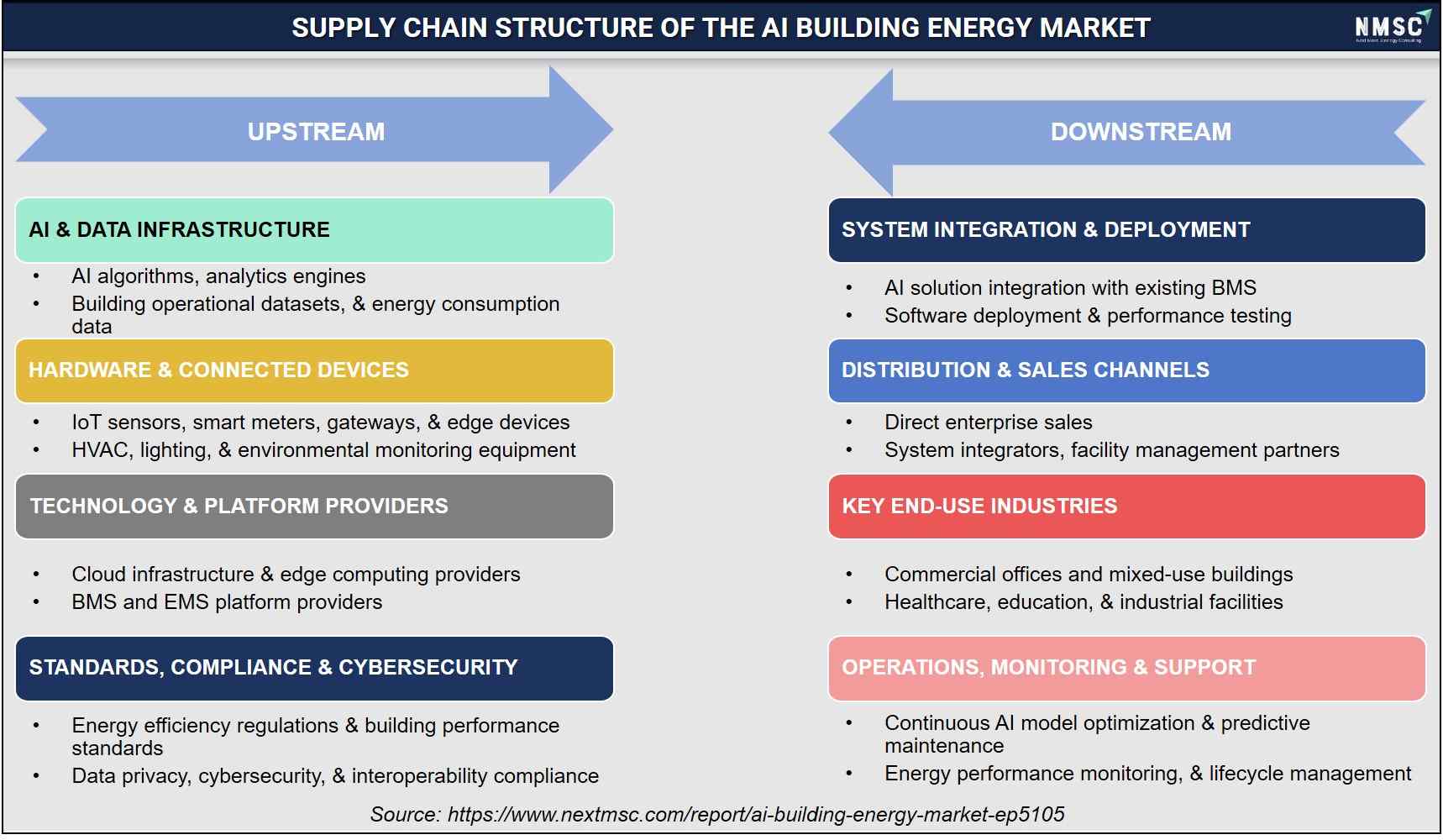
Our analysis indicates that the AI Building Energy Market depends on an integrated supply chain that combines AI software, connected hardware, cloud infrastructure, and system integration expertise to deliver intelligent energy optimization solutions. Upstream participants provide the technologies and digital infrastructure that enable deployment, while downstream stakeholders focus on implementation, monitoring, and long-term performance optimization. As demand for energy efficiency, decarbonization, and smarter building operations grows, seamless collaboration across the supply chain continues to accelerate innovation, improve solution scalability, and support sustainable market growth.
Competitive Landscape
|
Key Takeaways |
Details |
|
Market Structure |
The AI Building Energy Market is moderately fragmented, with Schneider Electric, Siemens, and Johnson Controls holding dominant positions in integrated AI building management platform delivery, while specialized AI vendors BrainBox AI, 75F, and GridPoint compete on AI autonomy and energy optimization algorithm performance within targeted building type and use case segments. |
|
Innovation Focus |
Vendors are prioritizing generative AI integration for natural language energy management, autonomous closed-loop HVAC and demand response optimization, digital twin real-time fidelity improvements, and carbon and ESG reporting automation connecting meter-level energy data to regulatory compliance reporting frameworks without manual data preparation overhead. |
|
M&A Activity |
The market has seen strategic consolidation as building automation giants acquire AI software startups to defend market share, cloud platform vendors integrate building energy modules into IoT and sustainability suites, and energy services companies acquire AI software capabilities to embed optimization within performance contracting models offering guaranteed energy cost savings. |
How Do Companies Compete in the AI Building Energy Industry?
Competition in the AI Building Energy Market occurs across four primary dimensions: AI algorithm performance and autonomy depth, platform integration breadth covering multiple building system protocols, vertical-specific pre-trained AI models adapted to building types including healthcare, data centers, and industrial facilities, and ecosystem partnership scale with HVAC manufacturers, utility demand response programs, and cloud platform providers. In our observation, Schneider Electric and Siemens compete on integrated end-to-end platform comprehensiveness spanning hardware, software, and services delivery. Specialized AI vendors BrainBox AI, 75F, and GridPoint compete on autonomous AI optimization performance, offering measured energy savings guarantees that established BMS vendors historically could not commit to contractually due to manual system architectures.
How Are AI Innovation and Platform Differentiation Driving Competitive Success in the AI Building Energy Market?
AI innovation competitive success centers on three distinct technology differentiation themes: autonomous closed-loop control that acts on AI recommendations without human approval, physics-informed machine learning combining engineering building models with operational data, and multi-objective optimization that simultaneously minimizes energy cost, carbon intensity, and occupant comfort trade-offs. Our analysis shows that vendors embedding autonomous AI control, including BrainBox AI's ARIA autonomous HVAC optimization and Siemens Building X's self-learning control modules, are demonstrating documented energy savings of 15% to 25% above baseline rule-based BMS performance, creating performance-differentiated competitive positioning that resonates with enterprise procurement teams evaluating measurable energy cost reduction return on investment.
How Will M&A Activity Shape the AI Building Energy Market Through 2035?
Our findings suggest that M&A activity will intensify within the market as building automation incumbents seek to acquire AI software depth to defend market share against AI-native entrants, and as cloud technology platforms including Microsoft, IBM, and Oracle seek to integrate building energy intelligence within broader enterprise sustainability and IoT platform suites. Energy services companies and ESCOs are acquiring AI software capabilities to embed optimization within performance contracting models, guaranteeing energy cost savings. The convergence of demand response aggregation with AI building energy optimization is creating M&A opportunities as utilities and retail energy providers acquire AI platforms enabling automated, portfolio-wide demand flexibility programs across commercial building customer bases.
Key Market Players in the AI Building Energy Market
-
Schneider Electric SE
-
Siemens AG
-
Carrier Global Corporation
-
Trane Technologies plc
-
Eaton Corporation plc
-
Emerson Electric Co.
-
Legrand SA
-
Cisco Systems, Inc.
-
Hitachi, Ltd.
-
C3.ai, Inc.
-
BrainBox AI Inc.
-
Uplight, Inc.
-
75F, Inc.
-
GridPoint, Inc.
-
International Business Machines Corporation
-
Microsoft Corporation
-
Oracle Corporation
What Are the Latest Developments in the AI Building Energy Industry?
|
Date |
Event |
|
April 2026 |
Johnson Controls announced the acquisition of Nantum AI to expand AI-driven optimization within the OpenBlue digital building ecosystem. The technology enables real-time airflow and HVAC optimization based on occupancy data across complex facilities. |
Expert Insights

“Artificial intelligence has enormous potential to improve how buildings operate and, with energy demand and costs continuing to climb, leveraging it to increase energy efficiency is a business imperative.”
— Michael Rudin, Board Member of Prescriptive Holdings LLC
Statement made following Johnson Controls' acquisition of Nantum AI.
Market Interpretation
The statement underscores the increasing importance of AI in transforming building energy management through intelligent HVAC optimization, predictive controls, and real-time operational decision-making. As energy costs rise and sustainability goals become more stringent, demand for AI-driven building energy solutions is expected to accelerate, encouraging wider adoption of autonomous energy optimization platforms across commercial and institutional buildings.
Investment Opportunities in the AI Building Energy Market
The AI Building Energy Market is attracting substantial venture capital and private equity investment concentrated on autonomous AI building control software startups, carbon and ESG reporting platform vendors, and AI-integrated demand response aggregation companies, reflecting institutional investor confidence in the market's USD 51.54 Billion forecast by 2035 at a CAGR of 23.1%. Infrastructure investment is concentrated in cloud AI platform development, edge computing hardware for on-premises AI control, and digital twin engine capabilities requiring sustained R&D capital to achieve competitive technical performance across building-type verticals. ESG considerations provide an additional structural demand catalyst, as institutional real estate investors, including pension funds and sovereign wealth funds managing assets under UN Principles for Responsible Investment commitments, require AI energy management platform deployment as a condition of new property acquisitions and portfolio-wide lease renewals, creating durable recurring revenue streams for platform vendors with established institutional real estate customer relationships.
Key Benefits for Stakeholders
This AI Building Energy Market report delivers targeted value across three primary stakeholder groups: enterprise technology leaders and CIOs can leverage the report's segmentation analysis across six dimensions, deployment architecture guidance, and vendor competitive landscape to inform multi-year AI energy platform procurement, integration sequencing, and make-versus-buy decisions aligned with corporate net zero commitments; investors and financial analysts gain reliable USD 6.45 Billion to USD 51.54 Billion market sizing, 23.1% CAGR growth projections, high-growth segment identification including data centers and cloud deployment, and competitive M&A trend analysis to evaluate AI building energy vendor investment theses and portfolio company growth trajectories through 2035; technology vendors and product teams benefit from use case revenue segmentation, buyer type adoption pattern intelligence, regional regulatory demand analysis across 38 countries, and competitive differentiation benchmarking to align product roadmaps with the highest-revenue market opportunities across the global market.
Key Market Segments
By Offering
-
Software
-
Building Energy Management Platform
-
AI Control
-
Analytics and Fault Detection
-
Digital Twin
-
Demand Response Software
-
Carbon and ESG Software
-
Other Software
-
-
Hardware
-
Controllers
-
Sensors and Meters
-
Edge Gateways
-
Smart Devices
-
Other Hardware
-
-
Services
-
Advisory and Audit
-
Implementation and Integration
-
Managed Operations
-
Maintenance and Support
-
Other Services
-
By Deployment
-
Cloud
-
Edge
-
On-Premises
-
Hybrid
-
Other
By Building Type
-
Office
-
Retail and Hospitality
-
Healthcare
-
Education
-
Industrial and Logistics
-
Multifamily
-
Data Centers
-
Government and Public
-
Other
By Buyer Type
-
Owner Occupier
-
Landlord and REIT
-
ESCO
-
System Integrator
-
General Contractor
-
Utility and Aggregator
-
Public Agency
-
Other
By Distribution Channel
-
Direct Enterprise
-
Partner Reseller
-
OEM Embedded
-
Marketplace
-
Distributor
-
Other
By Use Case
-
Energy Forecasting
-
Energy Optimization
-
HVAC Optimization
-
Lighting Optimization
-
Fault Detection and Diagnostics
-
Predictive Maintenance
-
Occupancy Optimization
-
Demand Response and Load Flexibility
-
Carbon and ESG Reporting
-
Microgrid and DER Orchestration
-
Other
By Region
-
North America: U.S., Canada, and Mexico
-
Europe: UK, Germany, France, Italy, Spain, Sweden, Denmark, Finland, Netherlands, and Rest of Europe
-
Asia-Pacific: China, India, Japan, South Korea, Taiwan, Indonesia, Vietnam, Australia, Philippines, Malaysia, and Rest of APAC
-
Middle East & Africa: Saudi Arabia, UAE, Egypt, Israel, Turkey, Nigeria, South Africa, and Rest of MEA
-
Latin America: Brazil, Argentina, Chile, Colombia, and Rest of LATAM
Conclusion & Recommendations
The AI Building Energy Market is positioned for sustained high-growth expansion through 2035, advancing from USD 7.94 Billion in 2026 to USD 51.54 Billion at a CAGR of 23.1%, driven by an irreversible combination of net-zero regulatory mandates, surging commercial energy costs creating compelling AI optimization ROI, and rapidly maturing autonomous AI control and digital twin technologies enabling building performance management at scale without manual intervention. Vendors should prioritize autonomous closed-loop AI control capability, carbon and ESG reporting module integration, and data center vertical-specific product architectures as the highest-priority near-term competitive investment themes, while geographic expansion into Asia-Pacific's high-growth markets, particularly India, China, Indonesia, and Southeast Asia, offers the most attractive international growth runway for platforms delivering localized regulatory compliance support and regional AI model training alongside global energy optimization performance.
About the Author
 Mayurima Roy
— Mayurima Roy is Research Analyst at Next Move Strategy Consulting, where she has spent 4 years working across the firm's full industry coverage rather than a single fixed vertical. Her work centers on structured research, ongoing trend tracking, competitive assessment, and insight-led content development, translating complex market data into clear, decision-ready narratives that support informed client decision-making across diverse global industries, market sectors, and world regions every day.
Mayurima Roy
— Mayurima Roy is Research Analyst at Next Move Strategy Consulting, where she has spent 4 years working across the firm's full industry coverage rather than a single fixed vertical. Her work centers on structured research, ongoing trend tracking, competitive assessment, and insight-led content development, translating complex market data into clear, decision-ready narratives that support informed client decision-making across diverse global industries, market sectors, and world regions every day.
About the Reviewer
 Supradip Baul
— Supradip Baul is an accomplished business consultant and strategist with over a decade of rich experience in market intelligence, strategy, technology, and business transformation. His work has included rigorous qualitative and quantitative analysis across multiple industries, helping clients shape investment decisions and long-term roadmaps. Earlier in his career, he was associated with Gartner, where he contributed to industry-leading reports and market share analyses. He has worked with leading global companies and holds an MBA with a dual specialization in Marketing and Finance.
Supradip Baul
— Supradip Baul is an accomplished business consultant and strategist with over a decade of rich experience in market intelligence, strategy, technology, and business transformation. His work has included rigorous qualitative and quantitative analysis across multiple industries, helping clients shape investment decisions and long-term roadmaps. Earlier in his career, he was associated with Gartner, where he contributed to industry-leading reports and market share analyses. He has worked with leading global companies and holds an MBA with a dual specialization in Marketing and Finance.
At Next Move Strategy Consulting, we understand that insightful market research is the cornerstone of successful business decisions. That's why we employ a robust and multifaceted approach, combining various methodologies to deliver the most accurate and actionable data for our clients.

Research Landscape
We navigate the world of research with two primary approaches:
Qualitative Approach
Our qualitative research methodologies involve immersive techniques such as in-depth interviews, focus groups, and observational studies. By engaging directly with individuals and stakeholders, we uncover valuable insights that quantitative data alone may overlook.

Quantitative Research
In tandem with qualitative methodologies, NMSC leverages the power of Quantitative Research to provide a robust foundation of numerical insights. Through systematic data collection and analysis, we quantify patterns, preferences, and market trends, offering a comprehensive view of the business landscape.
Our quantitative research approach employs diverse tools, including surveys, experiments, and statistical modelling. These methodologies enable us to gather data from a large and representative sample, ensuring the statistical significance of our findings. By employing structured questionnaires and standardized data collection methods, we guarantee the reliability and validity of the information we present to our clients.
Quantitative research is particularly effective in measuring the prevalence of trends, assessing market size, and gauging the impact of various factors on consumer behavior. The numerical precision attained through this approach equips our clients with actionable insights, facilitating data-driven decision-making and strategy formulation.


Our Specialized Toolbox for Industry-Specific Market Research
We deploy a specialized arsenal of techniques tailored to meet your unique requirements. Here's a glimpse into our comprehensive toolbox:

Information Procurement
The stage entails acquiring market data or relevant information through various sources and methodologies.


Market Research Approach
We utilize both top-down and bottom-up approaches in market research analysis to achieve a comprehensive understanding of the market dynamics, leveraging the broad perspective of industry trends and macroeconomic factors alongside detailed insights from specific segments and individual companies.

Porters Five Forces Analysis
We conduct Porter's Five Forces analysis to evaluate the competitive landscape of an industry, providing us with insights into factors that affect profitability and strategic positioning.

SWOT Analysis

Forecasting
We utilize a forecasting model to predict future consumption by considering parameters like population, economics, regulations, market competition, drivers, constraints, technology, and pricing. We also employ statistical techniques such as multilinear regression, exponential smoothing, moving average, ARIMA, and Monte Carlo simulations for accurate predictions. In econometric forecasting, we analyzed short-term and long-term event impacts, attributing values based on regulatory frameworks, economic factors, and market events.





 Speak to Our Analyst