Kardex Orders Outrun Sales, Putting Vertical Lift Module Demand to the Test
Kardex's Automated Products Unit Booked 7.0% More Orders but Recorded 11.1% Less Revenue in the First Half, Leaving Vertical Lift Module Makers to Prove They Can Convert Backlog Into Sales
On 30 July 2026, Kardex Holding AG reported first-half results that exposed a gap at the centre of automated storage demand: bookings at its Automated Products division, which operates as Kardex Remstar, rose 7.0% to EUR 314.6 million, while net revenues fell 11.1% to EUR 251.5 million. Across the Group, Kardex booked EUR 571.5 million of orders, up 25.8% from EUR 454.3 million a year earlier, and closed the period with an order backlog of EUR 727.2 million that the company described as record-high. The split matters for the vertical lift module industry because it shows demand building faster than manufacturers, installers and customers can convert it into delivered and invoiced systems.
According to Next Move Strategy Consulting's Vertical Lift Module (VLM) Market report, the global vertical lift module (VLM) market was valued at USD 1.91 billion in 2025 and is projected to reach USD 2.93 billion by 2030, growing at a CAGR of 8.9% from 2025 to 2030. NextMSC primary research and analysis attributes that trajectory to three forces: rising commercial real estate costs that make floor space expensive, warehouse management system integration that improves inventory accuracy, and ergonomic access that reduces physical strain on workers. The same research identifies the high initial cost of installation as the main restraint for smaller businesses.
For More Information: Download FREE Sample on Vertical Lift Module (VLM) Market Report
The Financial Logic: Orders Up, Revenue Down, Backlog at a Record
Kardex's own figures show where the pressure sits. In Automated Products, order backlog at 30 June 2026 stood at EUR 314.7 million, up 11.7% from EUR 281.8 million a year earlier, yet gross margin slipped to 38.2% from 39.5% and EBIT margin fell to 10.5% from 16.0%. Group EBIT dropped 38.4% to EUR 30.1 million, a 6.8% margin against 11.8% in the first half of 2025. The faster-growing Standardized Systems segment, which covers Kardex Mlog, AS Solutions and Rocket Solution, lifted bookings 60.8% to EUR 257.9 million but earns thinner margins, with EBIT of EUR 5.2 million, or 2.7% of its net revenues.
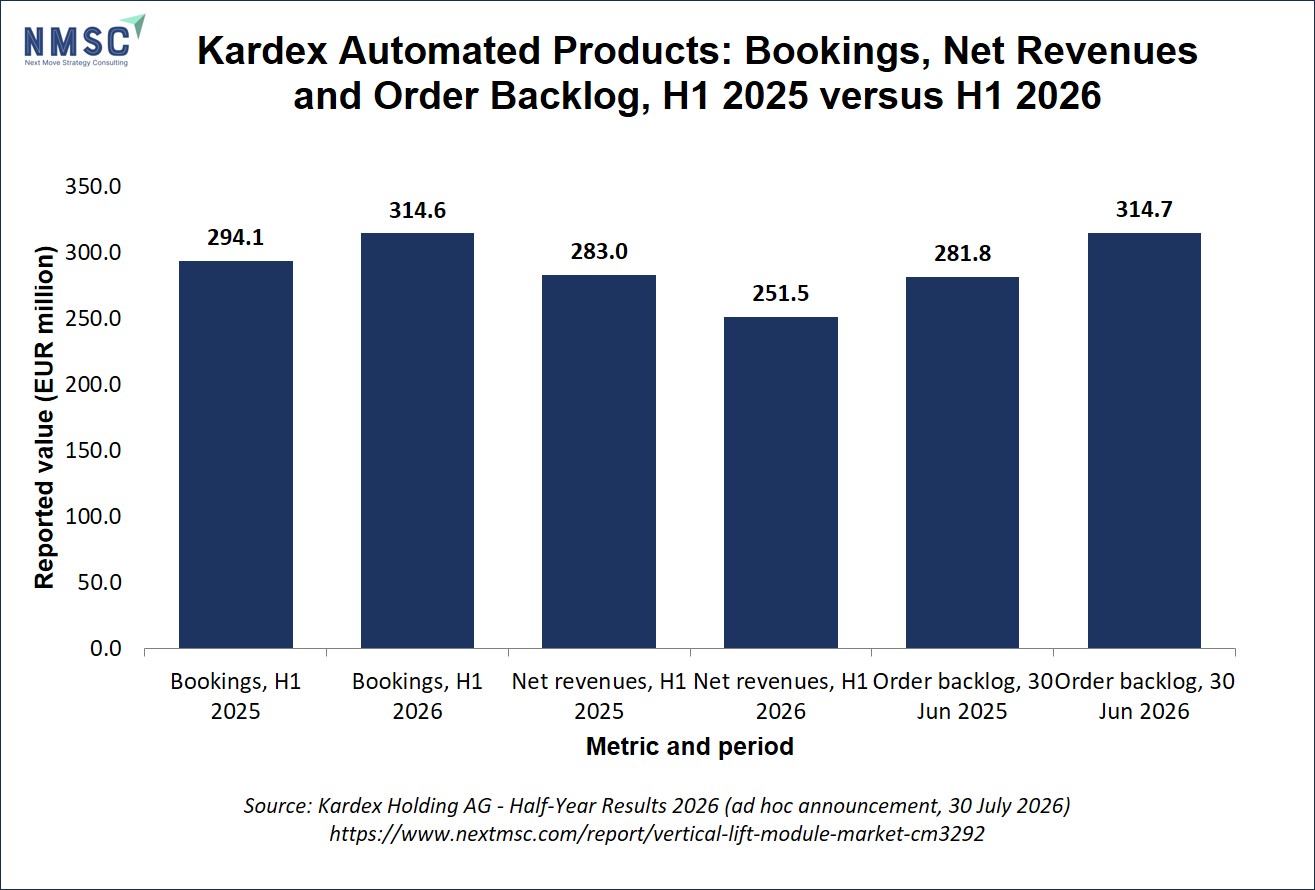
The chart isolates the Automated Products segment. Bookings and order backlog were higher in the first half of 2026 than a year earlier, while net revenues were lower, the gap that Kardex management expects a materially stronger second half to narrow.
Kardex is also spending ahead of revenue. Operating expenses rose 9.0% to EUR 101.4 million, or 23.0% of revenues against 22.4% a year earlier, headcount grew 6.6% to 3,037 full-time equivalents, and net working capital increased 30.4% to EUR 130.5 million. Free cash flow fell to EUR 1.9 million from EUR 8.4 million. Chief Executive Officer Jens Hardenacke said in the 30 July 2026 announcement that the growth initiative launched in late 2024 entails significant investment in sales headcount, marketing, IT and research and development, and that Kardex targets revenues of EUR 1.5 billion between 2029 and 2031 at an EBIT margin of 10-14%.
Kardex Holding AG: First-Half Results, H1 2026 versus H1 2025 (EUR million unless stated)
|
Metric |
H1 2026 |
H1 2025 |
Change |
|
Group bookings |
571.5 |
454.3 |
+25.8% |
|
Group order backlog (30 June) |
727.2 |
512.7 |
+41.8% |
|
Group net revenues |
440.5 |
415.7 |
+6.0% |
|
Automated Products bookings |
314.6 |
294.1 |
+7.0% |
|
Automated Products net revenues |
251.5 |
283.0 |
-11.1% |
|
Automated Products EBIT margin |
10.5% |
16.0% |
-5.5 pp |
|
Standardized Systems bookings |
257.9 |
160.4 |
+60.8% |
|
Standardized Systems net revenues |
189.7 |
133.0 |
+42.6% |
Key Industry Developments
Kardex management acknowledged the unevenness directly. Jens Hardenacke said in the half-year announcement of 30 July 2026 that the higher-margin Automated Products segment had been less dynamic since the second half of 2025, with both bookings and net revenues trailing expectations, but that bookings in the segment had risen steadily since March 2026. The company guided to full-year 2026 order and revenue growth of 15-20% with an EBIT margin of 8-10%, and stated that the record-high backlog should return the Group to its targeted EBIT margin range of 10-14% in the second half. It named reshoring, labor shortages and automation as key growth drivers of the intralogistics industry.
“We expect a materially stronger and more profitable H2 2026 within the financial target range.”
- Jens Hardenackeb, Chief Executive Officer, Kardex Holding AG, Kardex Holding AG: Half-Year Results 2026 (ad hoc announcement), 30 July 2026.
Capacity additions elsewhere in the supply base point in the same direction. In a release dated 3 June 2025, Modula said construction began on 17 February 2025 on a 170,000-square-foot addition to its 242,000-square-foot plant in Franklin, Ohio, with completion projected for early 2026 and annual output of up to 1,600 vertical lift modules at the site. Modula put the project cost above USD 36 million and said it has averaged 25% year-over-year growth over the past five years. Orfeo Finocchi, Chief Executive Officer of Modula, said in that release that growing demand in North America made it essential to scale production accordingly.
Buyer sentiment supports the capacity build. The 2026 MHI Annual Industry Report, published by MHI with Deloitte on 15 April 2026 under the title Rewiring the Future: A Supply Chain Playbook for Innovation, found that 39% of surveyed supply chain leaders rate the impact of robotics and automation as significant or greater, up 16 percentage points from 2025. In the same survey, 56% expect to increase spending on supply chain innovation and 17% plan to spend more than USD 10 million.
Demand Drivers: E-Commerce Volume and Warehouse Labor Economics
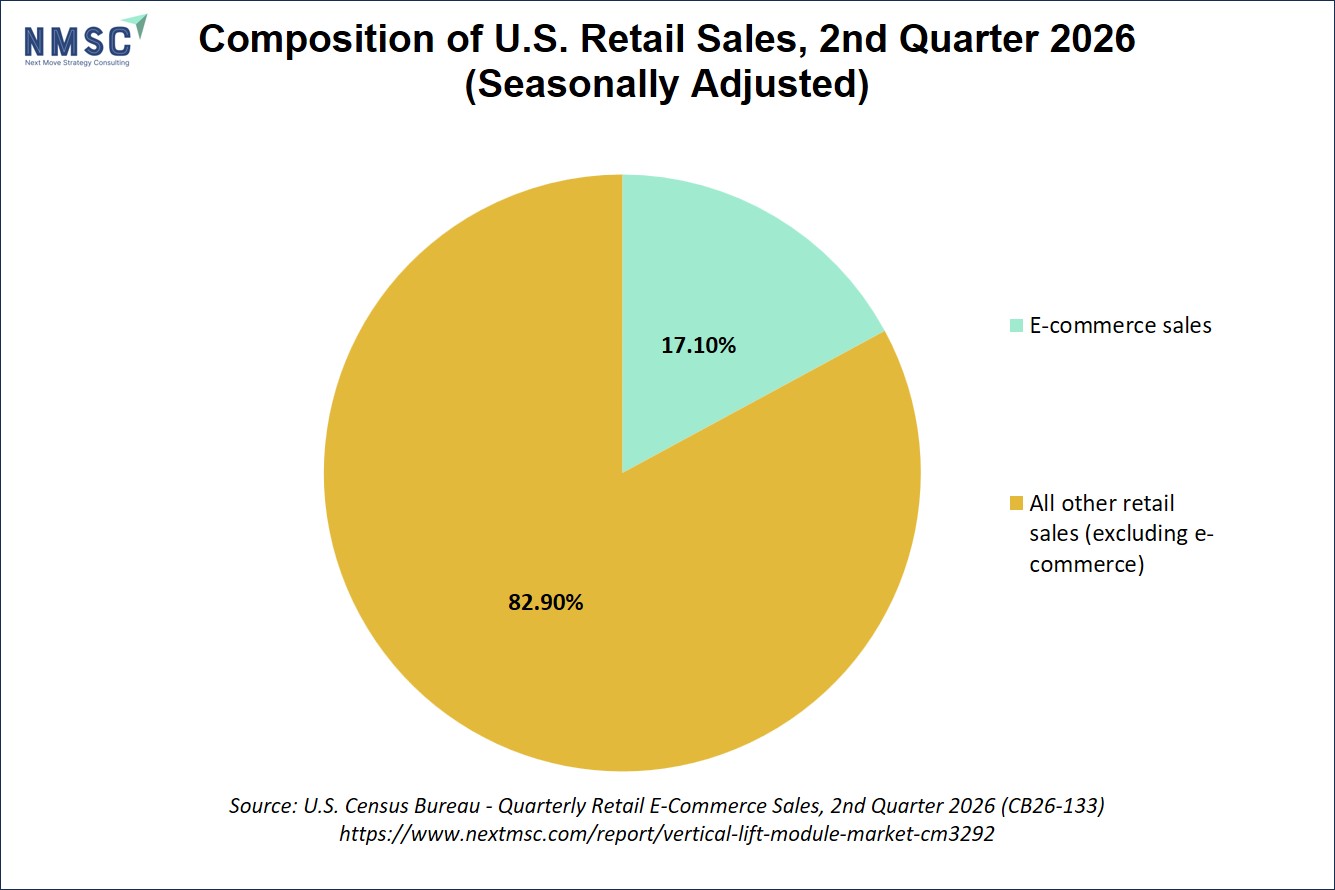
The U.S. Census Bureau reported on 18 August 2026 that seasonally adjusted U.S. retail e-commerce sales reached USD 340.2 billion in the second quarter of 2026 on a preliminary basis, or 17.1% of total retail sales, up 3.8% from the first quarter and 12.2% from the second quarter of 2025. A year earlier the same series grew 5.0% year over year, so online order volume is now expanding at more than twice that pace. NextMSC primary research and analysis links this kind of volume growth to vertical lift module adoption, because order-fulfilment operations adopt the machines to streamline picking and reduce labor costs.
U.S. Retail E-Commerce Sales, Seasonally Adjusted, 2Q 2025 to 2Q 2026
|
Quarter |
Total retail sales (USD million) |
E-commerce sales (USD million) |
E-commerce share of retail (%) |
Change versus year earlier (%) |
|
2Q 2025 (revised) |
1,861,603 |
303,284 |
16.3 |
5.0 |
|
3Q 2025 |
1,893,125 |
310,817 |
16.4 |
5.3 |
|
4Q 2025 |
1,900,653 |
317,999 |
16.7 |
5.9 |
|
1Q 2026 (revised) |
1,929,759 |
327,861 |
17.0 |
10.1 |
|
2Q 2026 (preliminary) |
1,986,488 |
340,244 |
17.1 |
12.2 |
Labor economics tilt the same way. Data from the U.S. Bureau of Labor Statistics for warehousing and storage (NAICS 493) show 2025 median hourly wages of USD 21.49 for stock clerks and order fillers, the most numerous of the five occupations it lists at 457,740 workers, USD 22.06 for hand laborers and material movers, and USD 23.16 for industrial truck and tractor operators. The same publication records a total recordable injury and illness rate of 4.8 per 100 full-time workers in the industry in 2024, and average hourly earnings of USD 26.87 for all employees in September 2026 on a preliminary basis. Industry employment stood at 1,839.2 thousand in October 2026 on a preliminary seasonally adjusted basis, almost unchanged from 1,838.5 thousand in July 2026.
Selected Warehousing and Storage Occupations, United States, 2025
|
Occupation |
Employment |
Median hourly wage (USD) |
Mean hourly wage (USD) |
|
Stock clerks and order fillers |
457,740 |
21.49 |
22.09 |
|
Laborers and freight, stock, and material movers, hand |
433,060 |
22.06 |
21.82 |
|
Industrial truck and tractor operators |
286,750 |
23.16 |
24.23 |
|
Shipping, receiving, and traffic clerks |
89,090 |
22.42 |
22.99 |
|
Transportation, storage, and distribution managers |
21,430 |
47.75 |
53.79 |
Segment Dynamics: How the Report Divides the Equipment
NextMSC primary research and analysis segments the vertical lift module market by storage type (temperature-controlled refrigerator and non-refrigerator), load capacity (below 20 tons, 20-40 tons and above 40 tons), per-tray load capacity (up to 300 kg, 300-500 kg and above 500 kg), height (less than 10 meters, 10-15 meters and above 15 meters), configuration (internal and external bay) and delivery type (single and dual level). Application segments cover wave picking, batch picking, consolidation, sorting and replenishment, and the industry-vertical view spans metals and machinery, e-commerce, consumer electronics, food and beverage, electronics, healthcare and chemicals.
The Kardex pattern bears most directly on the application and industry-vertical lenses. E-commerce fulfilment and replenishment are the workloads that scale with order volume, which is why the Census Bureau series above matters to a machine sold by tray capacity and height. NextMSC research flags pharmaceuticals and aerospace as sectors where inventory precision is non-negotiable, and NextMSC's view is that in such accounts the integration of the machines with warehouse management systems is likely to govern project timing as much as equipment availability.
Regional Outlook
NextMSC primary research and analysis identifies North America as the leading region for vertical lift modules, supported by adoption across manufacturing, logistics and healthcare and by demand for space-efficient storage. Europe is described as growing on energy-efficiency and sustainability priorities, with Germany and the United Kingdom adopting the machines in manufacturing and warehousing. Asia-Pacific is characterized as one of the fastest-growing regions, with China, Japan and India at the forefront of adoption as manufacturing capacity and e-commerce volumes expand.
Company evidence points the same way. The Kardex Holding AG Media and Analysts Conference presentation of 30 July 2026 cites strong Automated Products demand in Asia-Pacific and the United States and strong momentum in the United States for Standardized Systems, although it does not publish regional bookings as percentages. Modula's decision to add Franklin, Ohio capacity in response to North American demand, as set out in its 3 June 2025 release, reinforces the North American weighting in NextMSC's regional view.
Growth Drivers and Restraints
-
Driver, order volume: The U.S. Census Bureau recorded seasonally adjusted e-commerce sales growth of 12.2% year over year in the second quarter of 2026, against 5.0% in the second quarter of 2025.
-
Driver, labor cost and supply: The U.S. Bureau of Labor Statistics reports a median hourly wage of USD 21.49 for stock clerks and order fillers in warehousing and storage, and Kardex Holding AG names labor shortages and reshoring among the growth drivers of intralogistics.
-
Driver, buyer intent: MHI reports that 39% of surveyed supply chain leaders rate robotics and automation as having significant or greater impact, up 16 percentage points from 2025.
-
Restraint, conversion lag and margin pressure: Kardex Automated Products net revenues fell 11.1% in the first half of 2026 and its EBIT margin dropped to 10.5% from 16.0%, even as segment bookings rose 7.0%.
-
Restraint, upfront capital: NextMSC primary research and analysis finds that hardware, systems integration and training costs deter smaller businesses, and that in narrow-margin industries payback can take several years.
NMSC Strategic Perspective: Backlog Conversion Sets the Pace
NextMSC primary research and analysis reads the Kardex half-year as a timing signal rather than a demand warning. The NextMSC forecast implies roughly USD 1.02 billion of added annual market value between 2025 and 2030, which at a CAGR of 8.9% requires steady conversion of orders into installed systems. Kardex Automated Products shows the opposite of weak demand: backlog grew 11.7% to EUR 314.7 million and management reports bookings rising since March 2026. If that backlog converts as guided in the second half, the revenue shortfall of the first half becomes a delay rather than a loss.
Two cautions apply. First, a single company's half-year is not a measure of the global market, and the NextMSC report profiles 15 companies whose order books need not move in step. Second, Kardex's fastest growth is coming from Standardized Systems, which earned a 2.7% EBIT margin in the first half, against 10.5% in Automated Products. If growth mix keeps tilting toward lower-margin systems integration, vertical lift module makers may report rising bookings alongside thinner profitability. NextMSC research also points to retrofitting existing facilities as the route by which smaller operators can adopt vertical storage without new construction, which would widen the buyer base beyond large greenfield projects.
Competitive Landscape
Kardex and Modula are the two players with recent, traceable disclosures. Kardex reported record-high Group backlog on 30 July 2026 and confirmed its mid-term revenue target of EUR 1.5 billion; Modula announced on 3 June 2025 an expansion of its Franklin, Ohio plant to produce up to 1,600 vertical lift modules a year. NextMSC primary research and analysis profiles 15 companies in total, including Modula Inc., Kardex, White Systems, Toyota Industries Corporation, Ferretto Group, Lista AG, Addverb and Vidir Vertical Solutions, and publishes market shares for 10 of them in the full report. NextMSC primary research and analysis finds that competition centers on energy-efficient designs and warehouse management system integration.
Bottom Line
Kardex's first-half results of 30 July 2026 show a vertical lift module industry with plenty of demand and a conversion problem. Automated Products bookings rose 7.0% to EUR 314.6 million and its backlog reached EUR 314.7 million, yet net revenues fell 11.1% and EBIT margin dropped to 10.5% from 16.0%. Group backlog of EUR 727.2 million, which Kardex describes as record-high, sits alongside guidance for 15-20% order and revenue growth in 2026. Outside the company, U.S. e-commerce sales grew 12.2% year over year in the second quarter of 2026, the median hourly wage for stock clerks and order fillers is USD 21.49, and 39% of MHI survey respondents rate robotics and automation as significantly disruptive. NextMSC primary research and analysis projects the market at USD 2.93 billion by 2030 at a CAGR of 8.9%, with second-half delivery from Kardex and new capacity from Modula the next evidence to watch.
About Next Move Strategy Consulting
Next Move Strategy Consulting is a premier market research and management consulting firm that has been committed to provide strategically analysed well documented latest research reports to its clients. The research industry is flooded with many firms to choose from, what makes NMSC different from the rest is its top-quality research and the obsession of turning data into knowledge by dissecting every bit of it and providing fact-based research recommendation that is supported by information collected from over 500 million websites, paid databases, industry journals and one on one consultations with industry experts across a diverse range of industry sectors. The high-quality customized research reports with actionable insights and excellent end-to-end customer service help our clients to take critical business decisions that enables them to move beyond time and have competitive edge in the industry.
We have been servicing over 1000 customers globally that includes 90% of the Fortune 500 companies over a decade. Our analysts are constantly tracking various high growth markets and identifying hidden opportunities in each sector or the industry. We provide one of the industry’s best quality syndicate as well as custom research reports across 10 different industry verticals. We are committed to deliver high quality research solutions in accordance to your business needs. Our industry standard delivery solutions that ranges from the pre consultation to after-sales services, provide an excellent client experience and ensure right strategic decision making for businesses.
For more information, please contact:
Next Move Strategy Consulting
5th Floor 867 Boylston St, STE 500,
Boston, MA 02116, U.S.
E-Mail: [email protected]
Direct: +1-217-650-7991
Website: www.nextmsc.com
About the Author
 Priyanshu Das
— Priyanshu Das is SEO Executive at Next Move Strategy Consulting, where he has led on-page and off-page SEO, keyword research, and SEO audits for the firm's B2B market research publications for 2 years. His audit process combines technical crawl analysis, backlink profile review, and competitor keyword gap mapping — using tools including Screaming Frog and Google Search Console — to prioritize fixes by organic search-visibility impact, informed by his own prior in-house and agency SEO experience.
About the Reviewer
 Debashree Dey
— Debashree Dey is Assistant Manager at Next Move Strategy Consulting, where she supports cross-vertical market content and communications across diverse industries for 6 years. Her professional background includes senior content writing, communications, and published manuscript authorship, with experience developing audience-focused business narratives and maintaining clear, consistent messaging. Her role supports research-led content development and editorial quality across NextMSC publications.














Add Comment