New Forecast Reveals the Current Size of the Global Shredder Blades Market
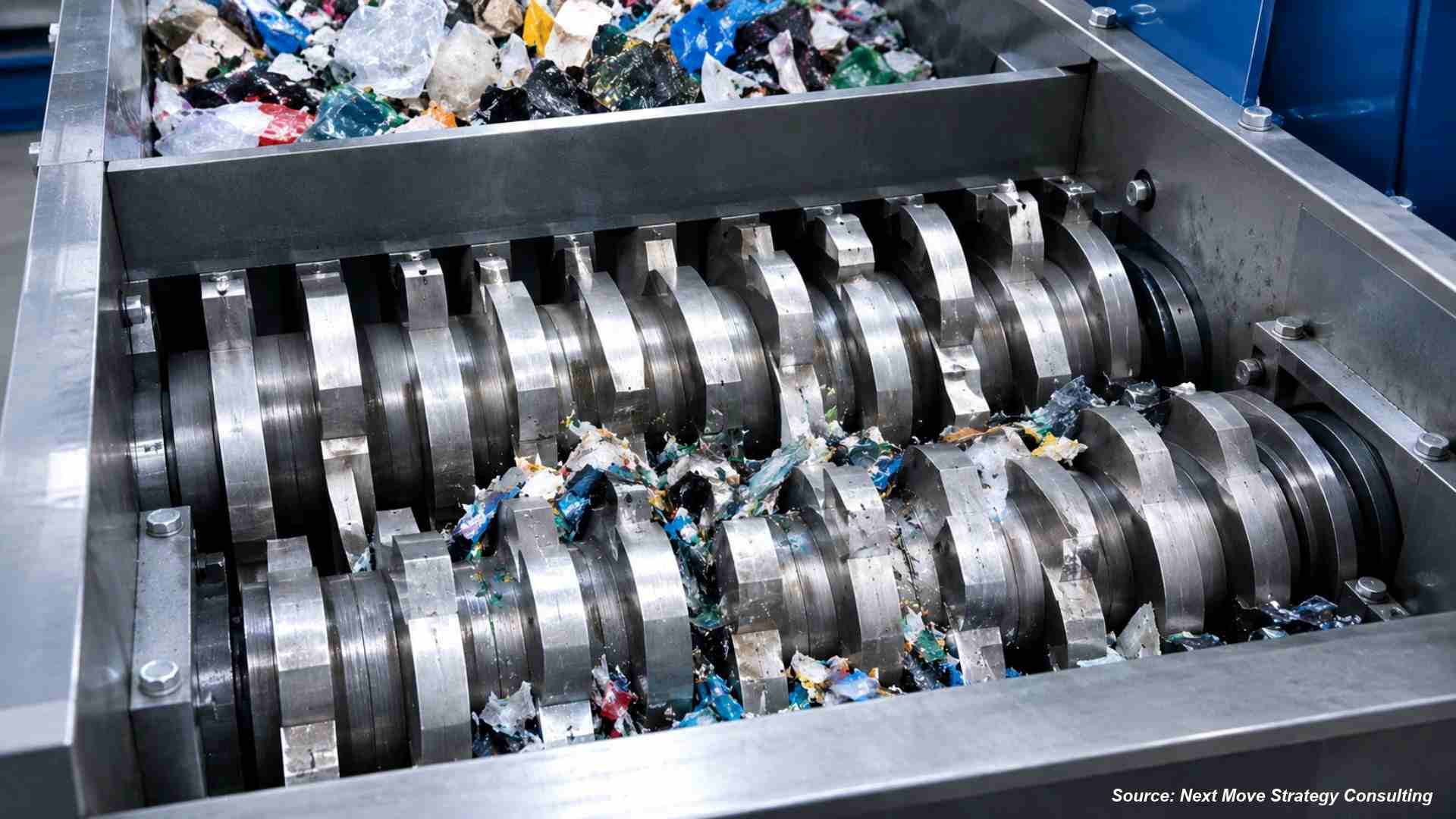
As the EU Packaging Regulation Takes Effect and Machine Builders Launch New Shredders, the Blade Market Stands at USD 473.2 Million With USD 614.5 Million Projected by the End of the Decade
On 12 August 2026, the European Union's Packaging and Packaging Waste Regulation, formally Regulation (EU) 2025/40, began to apply in all EU member states, replacing the former Packaging and Packaging Waste Directive 94/62/EC, according to the law firm Faegre Drinker (29 July 2026). The European Commission's European Circular Economy Stakeholder Platform (6 April 2026) states that the regulation covers all packaging placed on the EU market regardless of material or origin, that all packaging must be designed for material recycling, that recyclability performance grades apply from 2030, that packaging must be recyclable at scale from 2035, and that stricter recyclability obligations follow from 2038. For the manufacturers of the cutting blades inside the shredders that reduce plastic, paper, wood and mixed waste to recyclable feedstock, the application date marks the point at which a multi-year regulatory timetable moves from adoption to application.
According to Next Move Strategy Consulting's Shredder Blades Market report, the global shredder blades market was valued at USD 449.2 million in 2024 and is projected to reach USD 614.5 million by 2030, growing at a CAGR of 5.4% from 2025 to 2030. NextMSC primary research and analysis places the 2025 market size at USD 473.2 million, the latest full-year figure published in the report, and identifies a surge in industrial and municipal waste generation, a regulatory push for recycling efficiency and capital investment in waste management infrastructure as the three factors sustaining that trajectory.
For More Information: Download FREE Sample on Shredder Blades Market Report
The Financial Logic: Waste Volumes Are Outrunning Treatment Capacity
The scale of the feedstock problem was reset in March 2026, when the World Bank Group published What a Waste 3.0, drawing on data from 217 countries and economies and 262 cities. The report finds that the world generated 2.56 billion tonnes of municipal solid waste in 2022, a level that the 2018 edition had not expected to be reached until 2030, and that generation under a business-as-usual scenario grows to 3.86 billion tonnes by 2050, an increase of 50%. Food waste is the largest component at 38% of municipal solid waste globally, while plastics account for about 12.5%, of which 65% are single-use, according to the World Bank Group. Imperial College London's account of the report (25 March 2026) adds that around 30% of the world's municipal waste is still dumped or left uncollected, a gap that caps the volume reaching any shredding line.
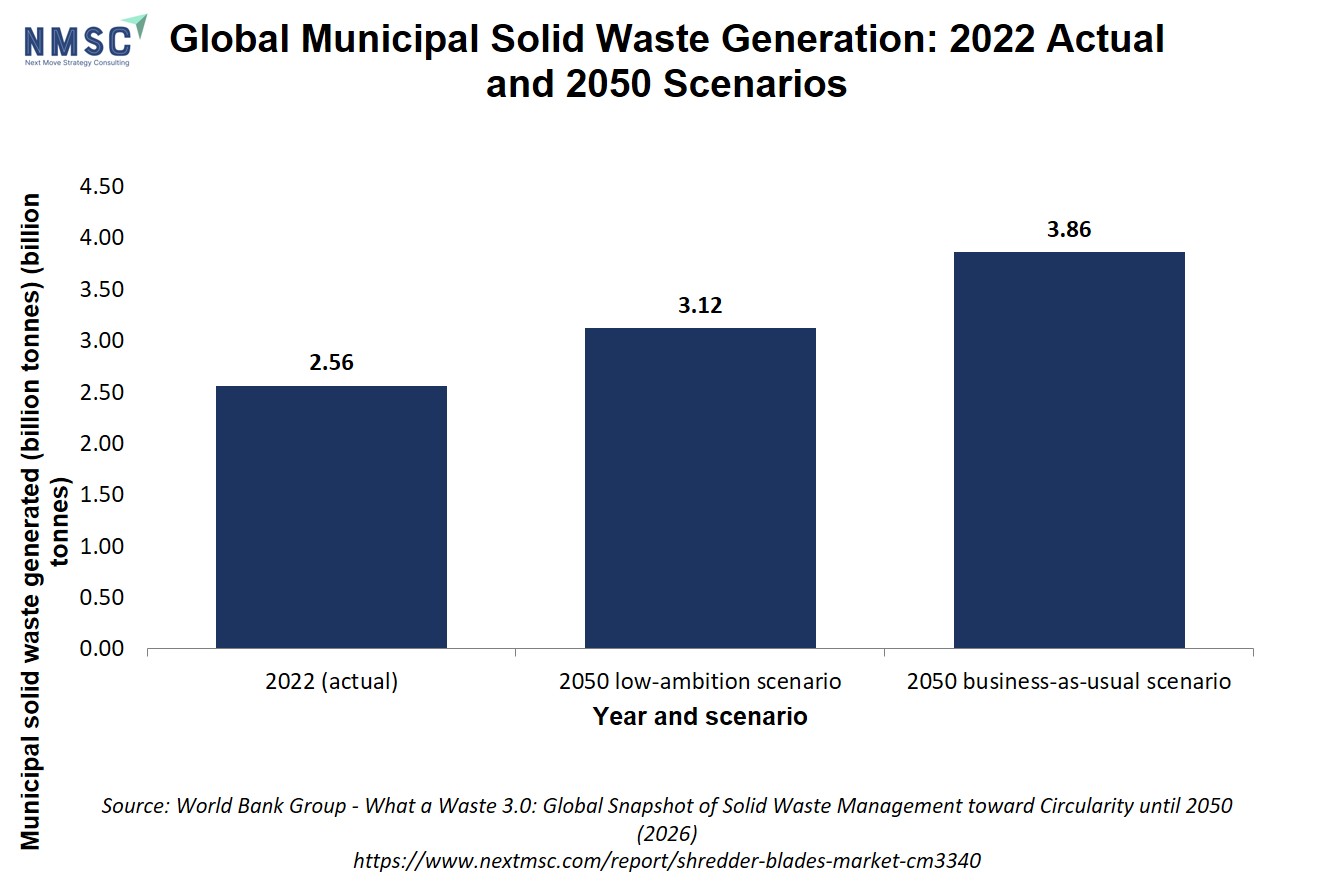
The World Bank Group's What a Waste 3.0 reports 2.56 billion tonnes of municipal solid waste generated in 2022, 3.86 billion tonnes by 2050 under a business-as-usual scenario and 3.12 billion tonnes by 2050 under its low-ambition scenario.
The report also frames waste as a spending line. The World Bank Group states that global municipal waste management already costs more than US$250 billion a year and is projected to rise to US$426 billion by 2050, and that low- and lower-middle-income countries need an estimated US$556 billion of investment between 2022 and 2050. Each additional tonne that is collected and diverted into recovery rather than dumped passes through size-reduction equipment whose cutting blades are consumed by wear, which is the demand channel that NextMSC primary research and analysis tracks in this market.
“waste generation is rising faster than municipal systems can cope with.”
- Dr Ed Cook, Research Associate in Waste Management and lead author of What a Waste 3.0, Imperial College London, Imperial College London news, 25 March 2026.
What a Waste 3.0: Collection, Composition and Cost Indicators
|
Indicator |
World Bank Group finding |
|
Municipal solid waste generated, 2022 |
2.56 billion tonnes |
|
Business-as-usual projection, 2050 |
3.86 billion tonnes, a 50% increase |
|
Low-ambition scenario, 2050 |
3.12 billion tonnes |
|
Share of global municipal waste that is food waste |
38% |
|
Share of global municipal waste that is plastics |
About 12.5%, of which 65% are single-use |
|
Waste collection rate, Sub-Saharan Africa and South Asia |
As low as 31% and 67% respectively |
|
Global cost of municipal waste management |
More than US$250 billion a year, rising to US$426 billion by 2050 |
Key Industry Developments: Machine Builders Prepare for Tougher Feedstocks
Shredder manufacturers spent the first half of 2026 repositioning their ranges. In a press release dated 4 March 2026, Vecoplan AG announced that its VEZ 3300 e-mobil would make its debut at IFAT Munich, held from 4 to 7 May 2026, with live demonstrations in the exhibition's outdoor area, and Interempresas (10 March 2026) described the machine as the company's first mobile shredder. In NextMSC's analysis, mobile and semi-mobile formats let operators move size reduction to the point where material accumulates, rather than hauling bulky waste to a fixed plant.
Recycling Product News reported on 21 April 2026 that UNTHA, an Austrian manufacturer of industrial shredding technology, would introduce the MR1800C, a single-shaft universal shredder for tough or difficult-to-shred materials including wood and all types of plastics, and the SR3000XC, a secondary shredder for refuse-derived fuel, alongside an upgraded XR mobil-e semi-mobile platform and the four-shaft RS40. Earlier in the year, Rock Products (20 January 2026) reported that EDGE Innovate would use ConExpo-Con/Agg 2026 as the global launch platform for the VS750s, a 53-tonne slow-speed, high-torque waste shredder available in direct-drive and electric-hybrid configurations, with the show running from 3 to 7 March, according to Recycling Product News.
Regulatory and Equipment Milestones Shaping Blade Demand in 2026
|
Milestone |
Date |
Detail |
|
EU Packaging and Packaging Waste Regulation applies |
12 August 2026 |
Regulation (EU) 2025/40 generally applies; recyclability grades from 2030; recycling at scale from 2035 |
|
Vecoplan VEZ 3300 e-mobil |
Announced 4 March 2026; IFAT Munich 4-7 May 2026 |
Mobile shredder debuting with live demonstrations; described as the company's first mobile shredder |
|
UNTHA MR1800C, SR3000XC and upgraded XR mobil-e |
Reported 21 April 2026; IFAT Munich 2026 |
Single-shaft universal shredder, RDF secondary shredder and upgraded semi-mobile platform |
|
EDGE Innovate VS750s |
ConExpo-Con/Agg, 3-7 March 2026 |
53-tonne slow-speed, high-torque shredder; direct-drive and electric-hybrid options |
Demand for shredding capacity is also being pulled by materials that are difficult to process. Textile World (17 August 2026), citing the German Institutes of Textile and Fiber Research Denkendorf, reported that Europe's wind energy industry has committed, starting in 2026, to keep end-of-life turbine blades out of landfills, and that the EU-funded REWIND project, which brings together 13 partners from seven countries, is developing dismantling, recycling and reuse processes for blade composites. In NextMSC's analysis, composite blades are a demanding input for any shredder, which raises the importance of blade material and wear life.
Segment Dynamics: Machine Configurations Map onto Blade Specifications
NextMSC primary research and analysis segments the shredder blades market by blade material (carburizing steel, tool steel, case hardened and chromium low alloy steel), blade design (hook and square), shaft count (single shaft, double shaft and other shafts), application (plastic, rubber, metals, wood, e-waste, paper and cardboard, and other applications) and end user (waste management and recycling, food, pharmaceuticals and others). The 2026 launches fall across these axes: UNTHA's MR1800C is a single-shaft machine, iVT International (February/March 2026) describes EDGE Innovate's VS750s as using a heavy-duty twin-shaft shredding chamber, and UNTHA's RS40 is a four-shaft design that falls under other shaft counts in NMSC's taxonomy. In NMSC's analysis, because each configuration carries its own cutter geometry and wear profile, every new machine platform widens the range of blades that suppliers must stock.
Shredder Blades Market: NextMSC Reference Figures
|
Metric |
Value |
|
Market size, 2024 (base year) |
USD 449.2 million |
|
Market size, 2025 |
USD 473.2 million |
|
Projected market size, 2030 |
USD 614.5 million |
|
CAGR, 2025 to 2030 |
5.4% |
|
Increase in annual market value, 2025 to 2030 |
USD 141.3 million (calculated from NextMSC figures) |
Regional Outlook
NextMSC primary research and analysis finds that North America remains a dominant region in the shredder blades market, supported by recycling capability in the United States and Canada, a growing need to process electronic waste, metals and decommissioned wind turbine blades, and regulatory support for green initiatives. Europe is positioned for steady growth, with Germany, France and the United Kingdom leading in waste management and material recycling, and with the PPWR application date adding a binding recyclability timetable to the region's existing waste rules.
Asia-Pacific is described in NMSC's research as a region of significant growth, led by China, India and Japan, where metal recycling, waste-to-energy and plastic waste processing are expanding. In the rest of the world, which covers Latin America, the Middle East and Africa, NMSC's analysis points to rising demand as Brazil and South Africa improve their recycling infrastructure, although capital investment and technology adoption remain constraints. The World Bank Group's finding that collection rates are as low as 31% in Sub-Saharan Africa and 67% in South Asia indicates where that infrastructure gap is widest.
Growth Drivers and Restraints
Shredder Blades Market: Growth Catalyst and Risk Assessment Matrix
|
Factor |
Type |
Basis |
|
Surge in industrial and municipal waste generation requiring higher-capacity shredding |
Driver |
World Bank Group: 2.56 billion tonnes in 2022, 3.86 billion tonnes by 2050 under business-as-usual |
|
Regulatory push for recycling efficiency, including the EU Waste Framework Directive and similar rules in the U.S. and Asia |
Driver |
EU PPWR applies from 12 August 2026; recyclability timetable runs to 2038 |
|
Capital investment in waste management infrastructure and new shredder platforms |
Driver |
Vecoplan, UNTHA and EDGE Innovate launches announced in 2026 |
|
High maintenance and replacement costs, particularly for small and medium-sized enterprises |
Restraint |
NextMSC primary research and analysis |
|
Development of eco-efficient blade materials such as recycled steel alloys, tungsten carbide composites and ceramic-infused metals |
Opportunity |
NextMSC primary research and analysis |
NMSC Strategic Perspective: Regulation Sets the Timetable, Wear Life Sets the Margin
NextMSC primary research and analysis reads the current period as one in which regulation and feedstock volume are converging while blade economics remain the binding constraint. A shredder blade is a consumable: it wears with every tonne processed, so demand follows throughput rather than machine sales. The World Bank Group's finding that waste generation is rising faster than systems can manage points to throughput growth, while the EU timetable of 2030, 2035 and 2038 milestones phases the requirement for recovery capacity over several years. In NMSC's analysis, that phasing spreads blade demand across the forecast period instead of concentrating it in a single procurement wave, which is consistent with a steady 5.4% CAGR rather than a step change.
Cost sensitivity is the second variable. NMSC's report identifies high maintenance and replacement costs as the main restraint, particularly for small and medium-sized enterprises, and the 2026 launches widen the gap between large facilities that can absorb frequent blade changes and smaller operators that cannot. NextMSC's analysis indicates that blade makers able to extend wear life, through the recycled steel alloys, tungsten carbide composites and ceramic-infused metals named in the report, will compete on cost per tonne shredded rather than on unit price, because frequent downtime, specialised technician requirements and material fatigue add to the lifecycle cost of a blade, according to NMSC's report.
For vendors, NMSC's recommendation is to pair material development with regrinding, re-tipping and replacement services, because the machines launched in 2026 span single-shaft, twin-shaft and four-shaft configurations and no single blade geometry serves all of them. For investors, NextMSC's figures imply an addition of USD 141.3 million in annual market value between 2025 and 2030, which positions shredder blades as a steady consumables market rather than a high-growth equipment category. NextMSC also cautions that regulatory dates are not procurement dates: PPWR obligations phase in through 2038, and recovery capacity depends on collection systems that the World Bank Group describes as weakest in the regions where waste is growing fastest.
Competitive Landscape
NextMSC primary research and analysis profiles 15 companies in the shredder blades market, including Jiangsu Chongcheng Guide Rail Machinery Co., Ltd, MULTECH Machinery Corp., MIHEU, Apex Shears Private Limited, Saturn Machine Knives Ltd., Granutech-Saturn Systems, Nanjing Huaxin Machinery Tool Manufacturing Co., Ltd., Wanrooe Machinery Co. Ltd., Polystruder, Fernite of Sheffield Ltd., Povelato srl, IDEA HOLDING LIMITED, Aker Tools & Components, Sangeeta Engineering Enterprise and Arun Auto Spring Mfg. Company, and provides market share data for 10 of them in the full report.
These blade and knife specialists operate downstream of the machine builders whose 2026 launches are described above. Each new machine platform defines the blade profiles, shaft configurations and wear parts that its installed base will require, and in NMSC's analysis that relationship between machine launch and consumable demand is the main competitive channel in the market. The company developments reported in this article are those of machine builders, whose announcements are traceable to named trade publications and company releases; they are not announcements by the blade makers profiled in NMSC's report.
Bottom Line
The EU Packaging and Packaging Waste Regulation began to apply on 12 August 2026, the World Bank Group has reset the global waste baseline at 2.56 billion tonnes a year, and machine builders including Vecoplan, UNTHA and EDGE Innovate have introduced new shredders in 2026. Against that backdrop, NextMSC primary research and analysis values the shredder blades market at USD 473.2 million in 2025 and projects USD 614.5 million by 2030, a CAGR of 5.4%. The growth is steady rather than rapid, because blade demand tracks tonnes shredded and is tempered by replacement costs that weigh on smaller operators. Blade makers that extend wear life and offer regrinding and replacement services are best placed to capture the additional USD 141.3 million in annual market value between 2025 and 2030, while buyers should expect the strongest regulatory pull in Europe and the largest volume growth where collection systems are weakest.
About Next Move Strategy Consulting
Next Move Strategy Consulting is a premier market research and management consulting firm that has been committed to provide strategically analysed well documented latest research reports to its clients. The research industry is flooded with many firms to choose from, what makes NMSC different from the rest is its top-quality research and the obsession of turning data into knowledge by dissecting every bit of it and providing fact-based research recommendation that is supported by information collected from over 500 million websites, paid databases, industry journals and one on one consultations with industry experts across a diverse range of industry sectors. The high-quality customized research reports with actionable insights and excellent end-to-end customer service help our clients to take critical business decisions that enables them to move beyond time and have competitive edge in the industry.
We have been servicing over 1000 customers globally that includes 90% of the Fortune 500 companies over a decade. Our analysts are constantly tracking various high growth markets and identifying hidden opportunities in each sector or the industry. We provide one of the industry’s best quality syndicate as well as custom research reports across 10 different industry verticals. We are committed to deliver high quality research solutions in accordance to your business needs. Our industry standard delivery solutions that ranges from the pre consultation to after-sales services, provide an excellent client experience and ensure right strategic decision making for businesses.
For more information, please contact:
Next Move Strategy Consulting
5th Floor 867 Boylston St, STE 500,
Boston, MA 02116, U.S.
E-Mail: [email protected]
Direct: +1-217-650-7991
Website: www.nextmsc.com
About the Author
 Sanyukta Deb
— Sanyukta Deb is Digital Marketing Team Lead at Next Move Strategy Consulting, where she has led content strategy and technical SEO for the firm's B2B market research publications for over 2 years. Her editorial process translates NextMSC's primary and secondary research — spanning technology, industrial, and consumer sectors — into commercial narratives, backed by search-intent, keyword, and competitive analysis. She brings 5 years of overall experience in digital marketing and content strategy.
About the Reviewer
 Debashree Dey
— Debashree Dey is Assistant Manager at Next Move Strategy Consulting, where she supports cross-vertical market content and communications across diverse industries for 6 years. Her professional background includes senior content writing, communications, and published manuscript authorship, with experience developing audience-focused business narratives and maintaining clear, consistent messaging. Her role supports research-led content development and editorial quality across NextMSC publications.















Add Comment