Luxury Travel Market Enters a New Era of Ultra-Premium Scale

Four Seasons Yachts Debut and Record Global Tourism Receipts Signal a Structural Inflection Point for the Global Luxury Travel Industry
On March 20, 2026 — coinciding symbolically with the 65th anniversary of the Four Seasons brand — Four Seasons Hotels Limited launched its first ultra-luxury yacht, Four Seasons I, inaugurating a new category of premium hospitality at sea. The vessel, spanning 14 decks and featuring 95 suites, began its inaugural 2026 season with sailings across the Caribbean, Bahamas, Greece, Croatia, and the French Riviera, with suite pricing commencing at USD 29,200 per voyage. In June 2026, the group revealed Four Seasons II — the second vessel in its luxury yacht fleet — set to debut in 2028, introducing 79 expansive suites including multi-room Yacht Residential Suites with open-concept living spaces and private splash pools.
The Four Seasons Yachts launch is not merely a product announcement. It is a strategic declaration that the world's most established luxury hospitality operators are committing capital to an entirely new service category — one that fuses private aviation-grade exclusivity with the immersive, destination-led experience model that is now the defining characteristic of premium travel demand globally.
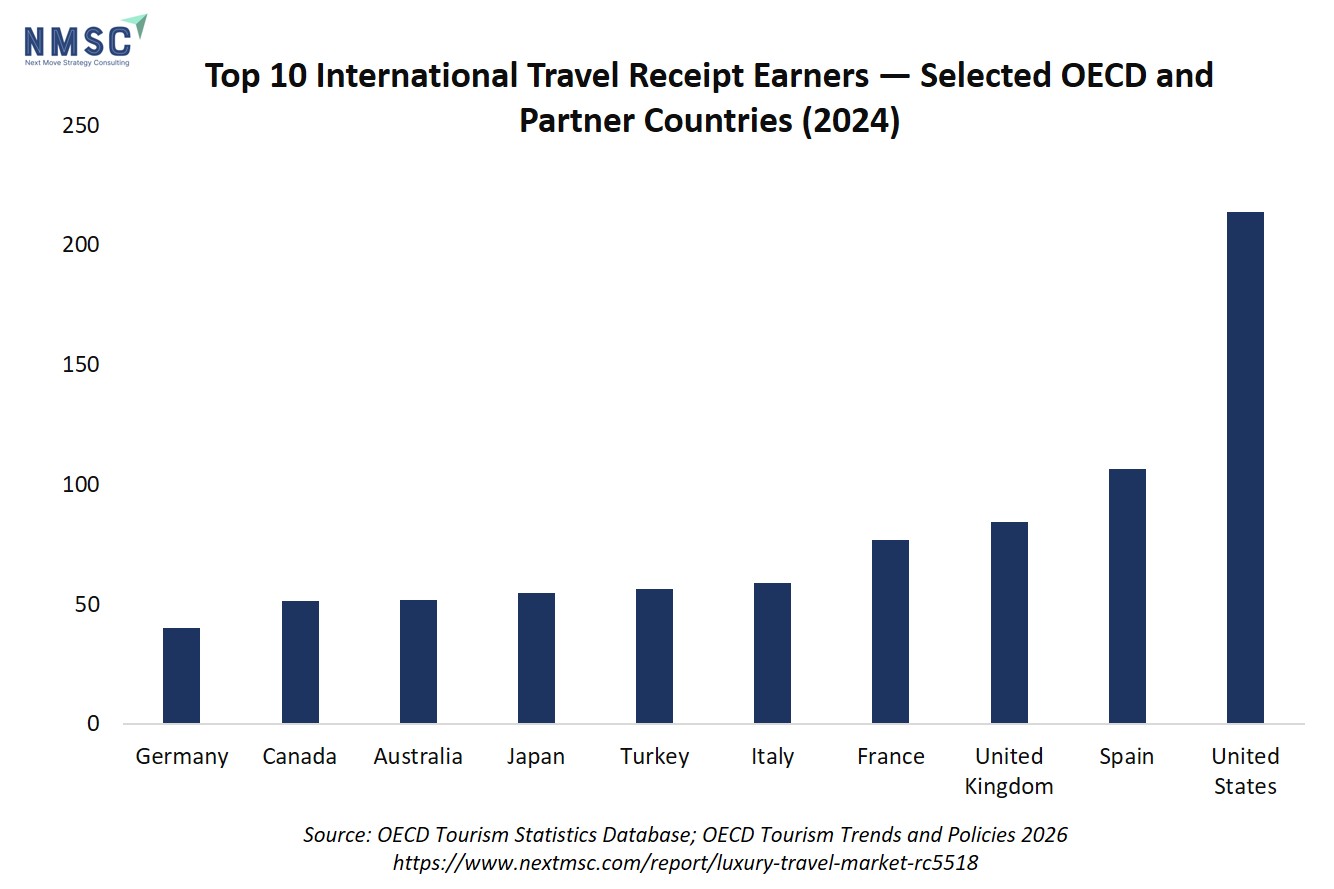
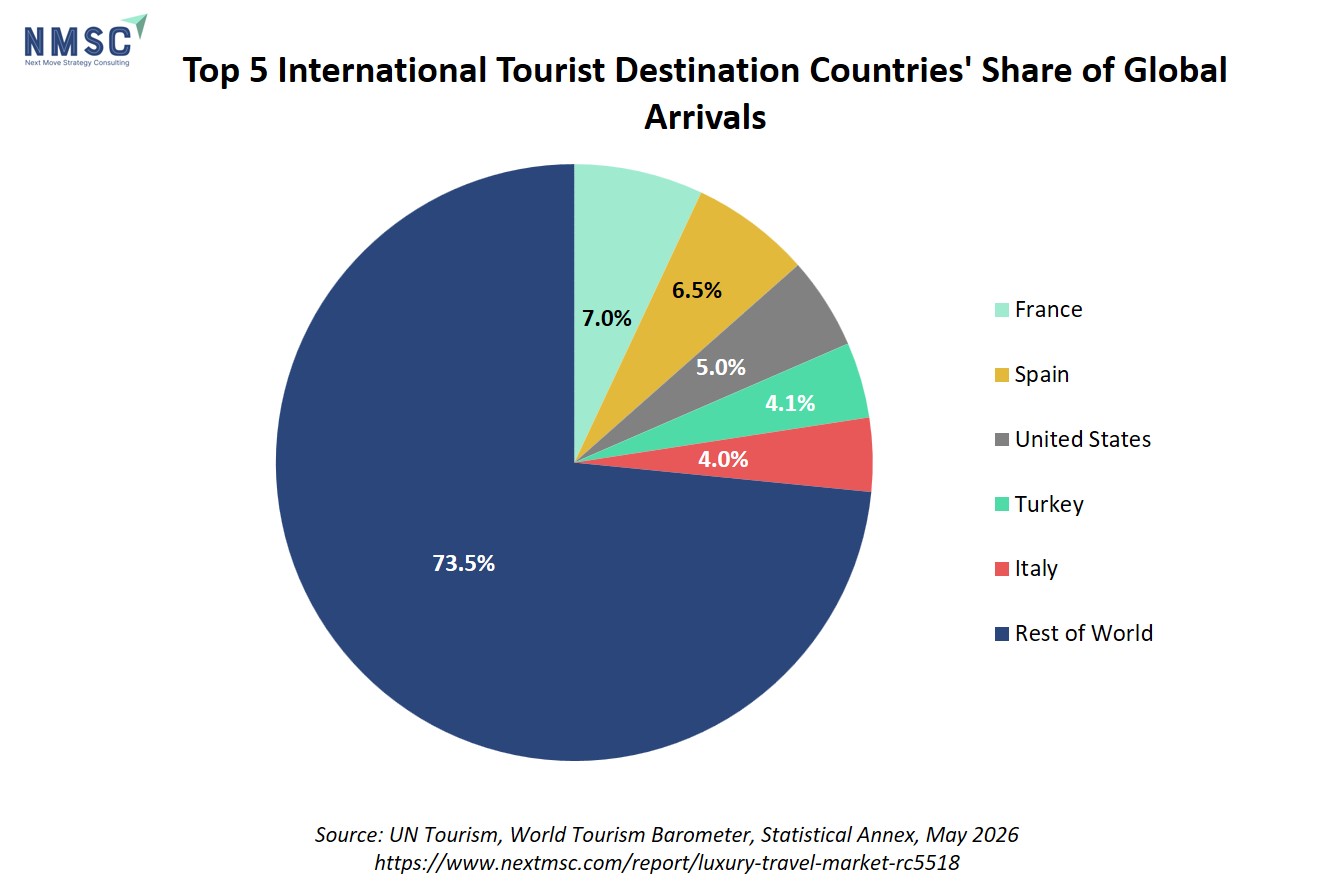
This development arrives at a moment of structural significance for the broader tourism economy. Preliminary estimates by UN Tourism show that globally, international tourism receipts reached USD 1.9 trillion in 2025, a 4 percent increase from 2024. International tourist arrivals in OECD countries reached a record 847 million in 2025, up 3.4 percent year-on-year, while global arrivals reached 1.534 billion — surpassing pre-pandemic levels. The World Travel & Tourism Council (WTTC) confirmed that Travel & Tourism's contribution to global GDP reached a record USD 11.6 trillion in 2025, accounting for 9.8 percent of the global economy and growing at 4.1 percent year-on-year — outpacing the broader global economy.
Within this expanding global tourism economy, the premium segment is growing at a materially faster rate than the mass market — driven by rising high-net-worth individual populations, the structural shift from material consumption to experiential spending, and the accelerating integration of wellness, private aviation, and bespoke itinerary design into the luxury travel value proposition.
Market Intelligence: Scale, Trajectory, and Structural Drivers
According to Next Move Strategy Consulting, the global Luxury Travel Market was valued at USD 2.06 trillion in 2025 and is estimated at USD 2.22 trillion in 2026, with a forecast to reach USD 4.98 trillion by 2035, expanding at a compound annual growth rate (CAGR) of 9.40 percent over the 2026–2035 forecast period. The market is projected to generate an absolute dollar opportunity of USD 2.76 trillion between 2026 and 2035 — one of the largest incremental revenue pools in the global consumer economy.
For More Information: Download FREE Sample on Luxury Travel Market Report
The market's growth is broad-based across every segmentation axis. By service type, Luxury Hotels & Resorts hold the dominant position with approximately 38 percent revenue share (USD 782.8 billion in 2025), while Private Jet & Luxury Air Travel is the fastest-growing sub-segment at an 11.6 percent CAGR through 2035. By traveler age group, Millennials lead with approximately 36 percent share (USD 741.6 billion in 2025), while Gen Z is the fastest-growing cohort at 11.3 percent CAGR. By trip purpose, Bleisure Travel — the convergence of business and leisure — is the fastest-growing sub-segment at 13.8 percent CAGR, reflecting the structural transformation of work patterns among affluent professionals.
Geographically, Europe leads with approximately 34 percent revenue share (USD 700.4 billion in 2025), supported by heritage hospitality brands, premium rail networks, and Mediterranean and Alpine resort destinations. Asia-Pacific is the fastest-growing region at 11.8 percent CAGR, propelled by an expanding affluent middle class and rising outbound travel from China and India. The Middle East & Africa region is expanding at 13.1 percent CAGR, driven by large-scale destination mega-projects and sustained luxury hospitality investment across the Gulf states.
The Structural Shift: From Destination Tourism to Experience Architecture
The Four Seasons Yachts launch crystallizes a broader structural transformation that has been reshaping the luxury travel industry over the past three years. Affluent travelers are no longer selecting destinations — they are commissioning experiences. This shift from destination-led to experience-led luxury travel is the single most consequential demand-side development in the market.
George Morgan-Grenville, Founder and CEO of Red Savannah, articulated this transformation precisely: "Luxury travel has become highly customized. We are certainly seeing a gradual metamorphosis from exclusivity to inclusivity where experience is placed ahead of materialism. Today's luxury traveler doesn't just want to see, they want to participate."
This behavioral shift is supported by macroeconomic data. The OECD's July 2026 Tourism Trends and Policies report confirmed that by 2030, Millennials and Generation Z are projected to account for more than half of global travelers, with spending patterns increasingly oriented toward experiences rather than goods. Sports tourism alone — a subset of experiential travel — generated USD 609 billion globally in 2023 and is expected to grow at 16 percent annually from 2024 to 2030.
The global middle class is projected to reach approximately 5 billion people by 2030, up from approximately 4 billion in the early 2020s — an expanding consumer base that is expected to significantly boost tourism demand across all segments, with the premium tier benefiting disproportionately as wealth accumulation accelerates in Asia-Pacific and the Middle East.
Competitive Landscape: Capital Deployment at Scale
The luxury travel market's competitive dynamics are being shaped by a combination of fleet expansion, branded-residence development, wellness integration, and AI-enabled personalization. The Four Seasons Yachts program exemplifies the capital intensity of this competitive environment — the development of a purpose-built ultra-luxury yacht fleet represents a multi-hundred-million-dollar commitment to a single new service category.
Marriott International unveiled its 2026 global luxury growth strategy in December 2025, announcing nearly 35 high-end hotel and resort openings scheduled throughout 2026 across flagship brands including St. Regis, The Ritz-Carlton, W Hotels, and JW Marriott, targeting high-demand cultural, wellness, and emerging luxury corridors across Japan, India, and the United Arab Emirates. Aman Group opened Aman Nai Lert Bangkok in April 2025, featuring 52 ultra-spacious suites starting at 92 square meters within the historic Nai Lert Park, reinforcing the brand's strategy of urban sanctuary positioning in Asia-Pacific gateway cities.
VistaJet's expanded membership program, broadened in 2025, increasingly specifies guaranteed availability across intercontinental routes — a direct response to rising demand among high-net-worth travelers seeking to eliminate commercial airport congestion from multi-leg itineraries. Abercrombie & Kent's expanded private-guide network, scaled through 2025, pairs travelers with destination specialists rather than fixed group schedules, elevating demand for flexible, on-demand itinerary platforms. Rosewood Hotel Group's expanded wellness-residence concept, scaled through 2025, embeds longevity-focused programming directly into flagship properties — a model that is rapidly becoming a competitive baseline rather than a differentiator.
Accor's continued expansion of its luxury and lifestyle brand collection through recent portfolio additions reflects the broader M&A pattern of selective acquisitions of boutique hospitality and experiential-tour brands by larger conglomerates seeking to expand experiential and wellness-travel portfolios.
The Geopolitical and Macroeconomic Context: Resilience Under Pressure
The luxury travel market's structural growth trajectory is not without material headwinds. The OECD's July 2026 report identified geopolitical instability — cited by 80 percent of surveyed tourism authorities — as the primary risk for 2026, followed by persistent price pressures (75 percent of respondents), connectivity disruptions (45 percent), and economic slowdown in source markets (40 percent).
The evolving conflict in the Middle East has disrupted global travel flows, severely restricting air services through strategic Gulf aviation hubs, raising energy prices, and increasing airfares and transport costs. UN Tourism expects international arrivals growth to fall 1 to 2 percentage points below its initial forecast of 3 to 4 percent for 2026 as a result. Approximately 307 million tourists traveled internationally in Q1 2026, representing a 2 percent increase over the same period in 2025 — a figure that reflects both the sector's underlying resilience and the moderating effect of geopolitical disruption.
Critically, however, the luxury segment has demonstrated a historically superior capacity to absorb macroeconomic shocks relative to mass-market tourism. High-net-worth travelers exhibit lower price elasticity, shorter booking-window flexibility, and greater willingness to substitute destinations rather than cancel travel entirely. The OECD confirmed that evidence suggests travelers have changed routes and destinations rather than cancelling trips outright in response to the current disruption — a behavioral pattern that disproportionately benefits operators with diversified, multi-destination portfolio structures.
Tourism directly accounts for 4.0 percent of GDP, 6.3 percent of employment, and 19.3 percent of service-related exports on average across OECD countries — figures that, while slightly below pre-pandemic levels, underscore the sector's structural economic weight and its demonstrated capacity to recover from external shocks.
Technology, AI, and the Personalization Imperative
Digitalization is a cross-cutting transformation reshaping the luxury travel system — from business models and service delivery to visitor management and destination planning. The OECD's 2026 report confirmed that the increasing use of digital tools and data-driven approaches, including Artificial Intelligence, is enabling more personalized services, optimizing operations, and supporting real-time management of visitor flows.
For luxury travel operators, AI-enabled personalization is not a future capability — it is an active competitive differentiator. The American Express 2026 Global Travel Trends Report found that 40 percent of global respondents plan to spend more on travel in 2026 than in the prior year, with 74 percent of Millennials and Gen Z surveyed expressing intent to increase travel spending. This demand intensity is driving operators to invest in proprietary booking technology, AI-personalized itinerary platforms, and biometric airport processing to strengthen direct-channel relationships with repeat premium customers.
The OECD's 2026 survey of SME AI adoption highlighted that while uptake of off-the-shelf AI applications is increasing rapidly, strategic and secure integration within business operations remains uneven — a gap that larger luxury hospitality conglomerates with dedicated technology investment budgets are positioned to exploit as a competitive advantage over smaller boutique operators.
Blockchain-based loyalty programs, AI-enabled concierge platforms, and mobile-first booking integration are emerging as the technology infrastructure layer underpinning the next generation of luxury travel service delivery — particularly in Asia-Pacific, where mobile-first consumer behavior is most advanced.
Regional Dynamics: Asia-Pacific and the Middle East as Growth Epicenters
Japan recorded the highest growth rate in international travel receipts among OECD countries between 2023 and 2024 — up 37.6 percent in constant prices — driven by strong inbound arrivals growth of 47.1 percent, supported by yen depreciation and recovery in the Chinese market. In 2025, Japan welcomed 42.68 million international visitors — a 15.8 percent increase year-on-year and a 34 percent increase over pre-pandemic 2019 levels — positioning it as one of the world's fastest-recovering and highest-growth luxury travel destinations.
Saudi Arabia's international travel receipts grew from USD 16.4 billion in 2019 to USD 41.0 billion in 2024 — a 149 percent increase — reflecting the transformative impact of the Kingdom's Vision 2030 tourism diversification program and its large-scale giga-project resort developments. According to Next Move Strategy Consulting, the Saudi Arabia luxury travel market is projected to grow at a CAGR of approximately 13.8 percent through 2035 — the fastest among all covered countries — while the UAE luxury travel market is projected to expand at 12.9 percent CAGR over the same period.
India represents the most compelling long-term growth narrative in the global luxury travel market. According to Next Move Strategy Consulting, the India luxury travel market was valued at approximately USD 58 billion in 2025 and is projected to reach approximately USD 205 billion by 2035 at a CAGR of approximately 13.5 percent — the fastest among all covered countries in the Asia-Pacific region. This trajectory is supported by India's rapidly expanding affluent class, rising technology penetration, and the aggressive strategic capacity additions being pursued by domestic groups such as the Indian Hotels Company.
Key Luxury Travel Market Players — Recent Strategic Developments (2025–2026)
|
Company |
Headquarters |
Development |
Period |
|
Four Seasons Hotels Limited |
Canada |
Launched Four Seasons I, first ultra-luxury yacht, on March 20, 2026; inaugural season covers Caribbean, Bahamas, Greece, Croatia, and French Riviera; suite pricing from USD 29,200 per voyage |
March 2026 |
|
Four Seasons Hotels Limited |
Canada |
Revealed Four Seasons II, second vessel in luxury yacht fleet, set to debut in 2028; features 79 suites including multi-room Yacht Residential Suites with private splash pools |
June 2026 |
|
Marriott International, Inc. |
USA |
Unveiled 2026 global luxury growth strategy; announced nearly 35 high-end hotel and resort openings across St. Regis, The Ritz-Carlton, W Hotels, and JW Marriott; targeting Japan, India, and UAE |
December 2025 |
|
Aman Group |
Singapore |
Opened Aman Nai Lert Bangkok; 52 ultra-spacious suites from 92 sq m; integrated holistic wellness spaces and private gardens in historic Nai Lert Park |
April 2025 |
|
VistaJet Group Holding S.A. |
Malta |
Expanded membership program with guaranteed intercontinental route availability; targeting high-net-worth travelers seeking to eliminate commercial airport congestion |
2025 |
|
Abercrombie & Kent |
UK |
Expanded private-guide network; pairing travelers with destination specialists rather than fixed group schedules; scaling flexible, on-demand itinerary platforms |
2025 |
|
Rosewood Hotel Group |
Hong Kong |
Expanded wellness-residence concept across flagship properties; embedding longevity-focused programming directly into hotel operations |
2025 |
|
Accor SA |
France |
Continued expansion of luxury and lifestyle brand collection through selective boutique portfolio acquisitions; targeting experiential and wellness-travel segments |
2025–2026 |
|
Six Senses Hotels Resorts Spas |
Thailand |
Expanded longevity retreat concept across Asia-Pacific portfolio; pairing medical-grade diagnostics with resort hospitality under single booking |
2025 |
|
Belmond Ltd. |
UK |
Completed expanded sustainability certification across rail and hotel portfolio; verified environmental reporting across guest-facing itineraries |
2025 |
Sustainability, ESG, and the Regulatory Dimension
Environmental, Social, and Governance considerations are increasingly shaping investment decisions in the luxury travel market, with institutional investors favoring operators demonstrating verified sustainability certification and community-linked tourism programs. Belmond's expanded sustainability certification across its rail and hotel portfolio, completed in 2025, exemplifies the direction of travel — with verified environmental reporting across guest-facing itineraries becoming a competitive expectation rather than a voluntary differentiator.
The OECD's 2026 report highlighted that tourism prices for restaurants and hotels rose by 46.1 percent between 2020 and 2024, compared with 34.9 percent across the broader economy — a differential that, while reflecting the sector's pricing power, also introduces a structural risk of demand compression among aspirational luxury travelers if inflationary pressures persist.
Regulatory frameworks including the European Union's Package Travel Directive and the U.S. Department of Transportation's charter aviation rules continue to shape consumer-protection and safety requirements for tour operators and private aviation providers. National tourism boards across Asia-Pacific and the Middle East are increasingly influencing sustainable luxury certification standards, creating a regulatory environment that rewards operators with credible ESG credentials and penalizes those without verifiable sustainability reporting.
The OECD confirmed that more than three quarters of surveyed countries expect tourism performance to exceed 2025 levels by the end of 2026 — a broadly positive institutional sentiment that, combined with the structural demand drivers identified above, supports a constructive medium-term outlook for the luxury travel sector despite near-term geopolitical headwinds.
Bottom Line
The global luxury travel market is entering a phase of accelerating structural expansion, underpinned by the convergence of rising high-net-worth individual populations, the irreversible shift from material to experiential consumption, and the deployment of institutional capital into entirely new premium service categories — as exemplified by the Four Seasons Yachts launch in March 2026. According to Next Move Strategy Consulting, the market is projected to grow from USD 2.22 trillion in 2026 to USD 4.98 trillion by 2035 at a CAGR of 9.40 percent, generating an absolute dollar opportunity of USD 2.76 trillion over the forecast period. Global tourism receipts reached USD 1.9 trillion in 2025, and the WTTC confirmed Travel & Tourism's record USD 11.6 trillion contribution to global GDP — providing the macroeconomic foundation for sustained premium segment growth. The primary investment opportunities lie in Asia-Pacific and the Middle East & Africa, where double-digit regional CAGRs reflect the fastest wealth accumulation and infrastructure development globally. Private aviation membership expansion, wellness-integrated resort development, and AI-enabled personalization platforms represent the three highest-conviction growth pathways through 2035. Key risks include geopolitical instability across Gulf aviation corridors, persistent inflationary pressure on premium accommodation pricing, and currency volatility in emerging travel-origin markets. For investors, operators, and policymakers, the strategic imperative is unambiguous: the luxury travel market's structural growth is durable, its demand drivers are secular, and the window for early-mover advantage in the fastest-growing sub-segments is narrowing as capital deployment accelerates.
About Next Move Strategy Consulting
Next Move Strategy Consulting is a premier market research and management consulting firm that has been committed to provide strategically analysed well documented latest research reports to its clients. The research industry is flooded with many firms to choose from, what makes NMSC different from the rest is its top-quality research and the obsession of turning data into knowledge by dissecting every bit of it and providing fact-based research recommendation that is supported by information collected from over 500 million websites, paid databases, industry journals and one on one consultations with industry experts across a diverse range of industry sectors. The high-quality customized research reports with actionable insights and excellent end-to-end customer service help our clients to take critical business decisions that enables them to move beyond time and have competitive edge in the industry.
We have been servicing over 1000 customers globally that includes 90% of the Fortune 500 companies over a decade. Our analysts are constantly tracking various high growth markets and identifying hidden opportunities in each sector or the industry. We provide one of the industry's best quality syndicate as well as custom research reports across 10 different industry verticals. We are committed to deliver high quality research solutions in accordance to your business needs. Our industry standard delivery solutions that ranges from the pre consultation to after-sales services, provide an excellent client experience and ensure right strategic decision making for businesses.
For more information, please contact:
Next Move Strategy Consulting
5th Floor 867 Boylston St, STE 500,
Boston, MA 02116, U.S.
E-Mail: [email protected]
Direct: +1-217-650-7991
Website: www.nextmsc.com
About the Author
 Sanyukta Deb
— Sanyukta Deb is Digital Marketing Team Lead at Next Move Strategy Consulting, where she has led content strategy and technical SEO for the firm's B2B market research publications for over 2 years. Her editorial process translates NextMSC's primary and secondary research — spanning technology, industrial, and consumer sectors — into commercial narratives, backed by search-intent, keyword, and competitive analysis. She brings 5 years of overall experience in digital marketing and content strategy.
Sanyukta Deb
— Sanyukta Deb is Digital Marketing Team Lead at Next Move Strategy Consulting, where she has led content strategy and technical SEO for the firm's B2B market research publications for over 2 years. Her editorial process translates NextMSC's primary and secondary research — spanning technology, industrial, and consumer sectors — into commercial narratives, backed by search-intent, keyword, and competitive analysis. She brings 5 years of overall experience in digital marketing and content strategy.
About the Reviewer
 Debashree Dey
— Debashree Dey is Assistant Manager at Next Move Strategy Consulting, where she supports cross-vertical market content and communications across diverse industries for 6 years. Her professional background includes senior content writing, communications, and published manuscript authorship, with experience developing audience-focused business narratives and maintaining clear, consistent messaging. Her role supports research-led content development and editorial quality across NextMSC publications.
Debashree Dey
— Debashree Dey is Assistant Manager at Next Move Strategy Consulting, where she supports cross-vertical market content and communications across diverse industries for 6 years. Her professional background includes senior content writing, communications, and published manuscript authorship, with experience developing audience-focused business narratives and maintaining clear, consistent messaging. Her role supports research-led content development and editorial quality across NextMSC publications.
















Add Comment