Luxury Travel Market Size, Share, Trends and Growth Analysis, By Service Type (Luxury Hotels & Resorts, Luxury Cruises, Private Jet & Luxury Air Travel, Luxury Tour Packages & Experiential Travel, and Luxury Transportation Services), By Traveler Age Group, By Booking Channel (Direct Booking, Online Travel Agencies,and Others), By Trip Purpose (Leisure Travel, Business Travel, Bleisure Travel, and Honeymoon and Special Occasion Travel), and Region — Global Industry Report and Forecast, 2026–2035
Industry: Retail and Consumer | Publishing Date: August 1, 2026 | Last Updated: August 1, 2026 | No of Pages: N/A | No. of Tables: N/A | No. of Figures: N/A | Format: PDF | Report Code: RC5518
What Is the Luxury Travel Market Size?
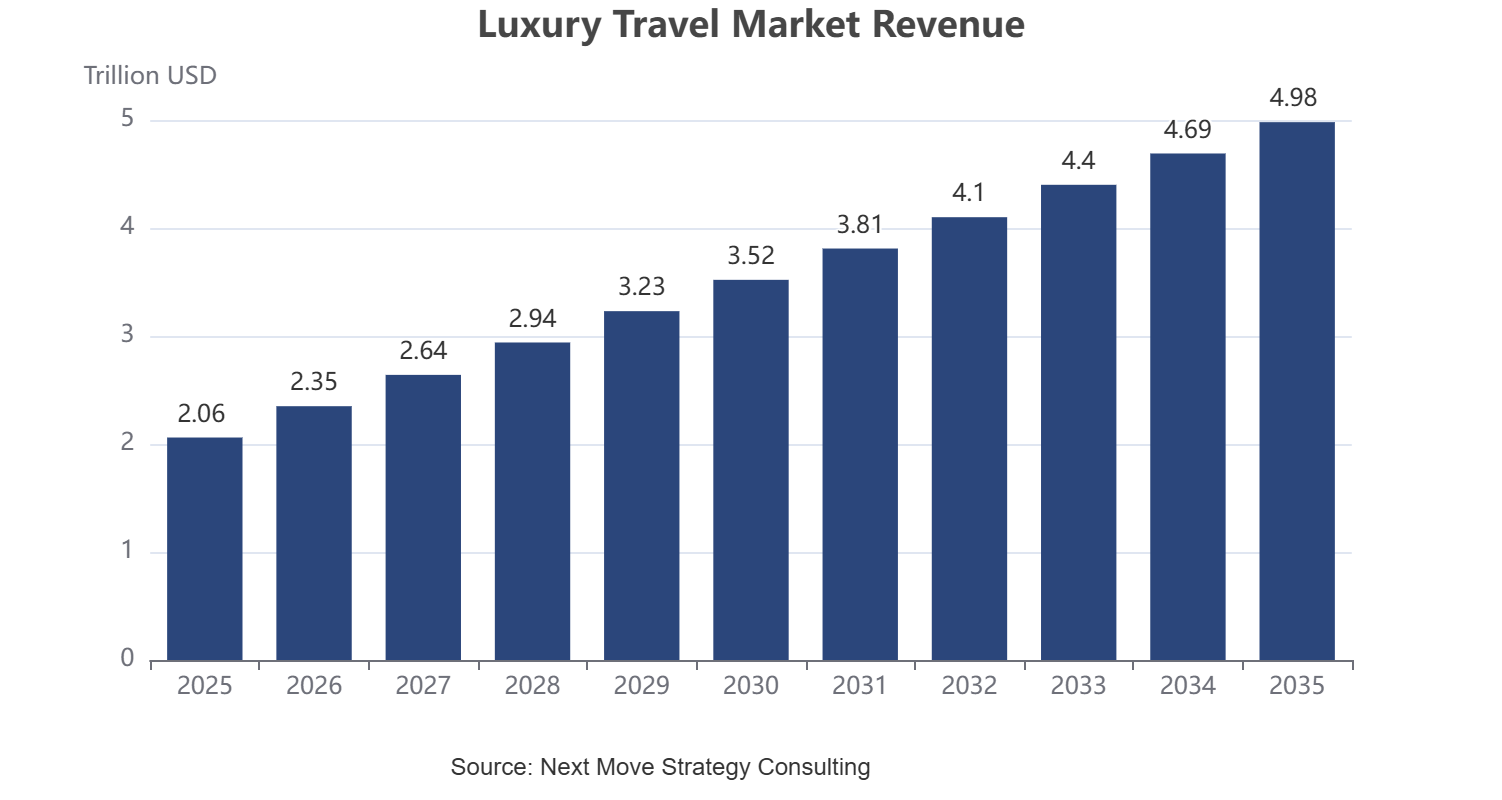
The global luxury travel market size was valued at USD 2.06 trillion in 2025 and is estimated at USD 2.22 trillion in 2026, forecast to reach USD 4.98 trillion by 2035, expanding at a 9.40% CAGR between 2026 and 2035. Europe leads with approximately 34% share, while luxury hotels and resorts dominate all other service types with approximately 38% share.
We observed that the growth is broad-based across every segmentation axis, with experiential itineraries and private aviation demand driving the dominant structural shifts through 2035.
|
Key Takeaways |
|
By Service Type: Luxury Hotels & Resorts held the largest share of approximately 38% (USD 782.8 Billion) in 2025; Private Jet & Luxury Air Travel is the fastest-growing sub-segment at 11.6% CAGR from 2026–2035. |
|
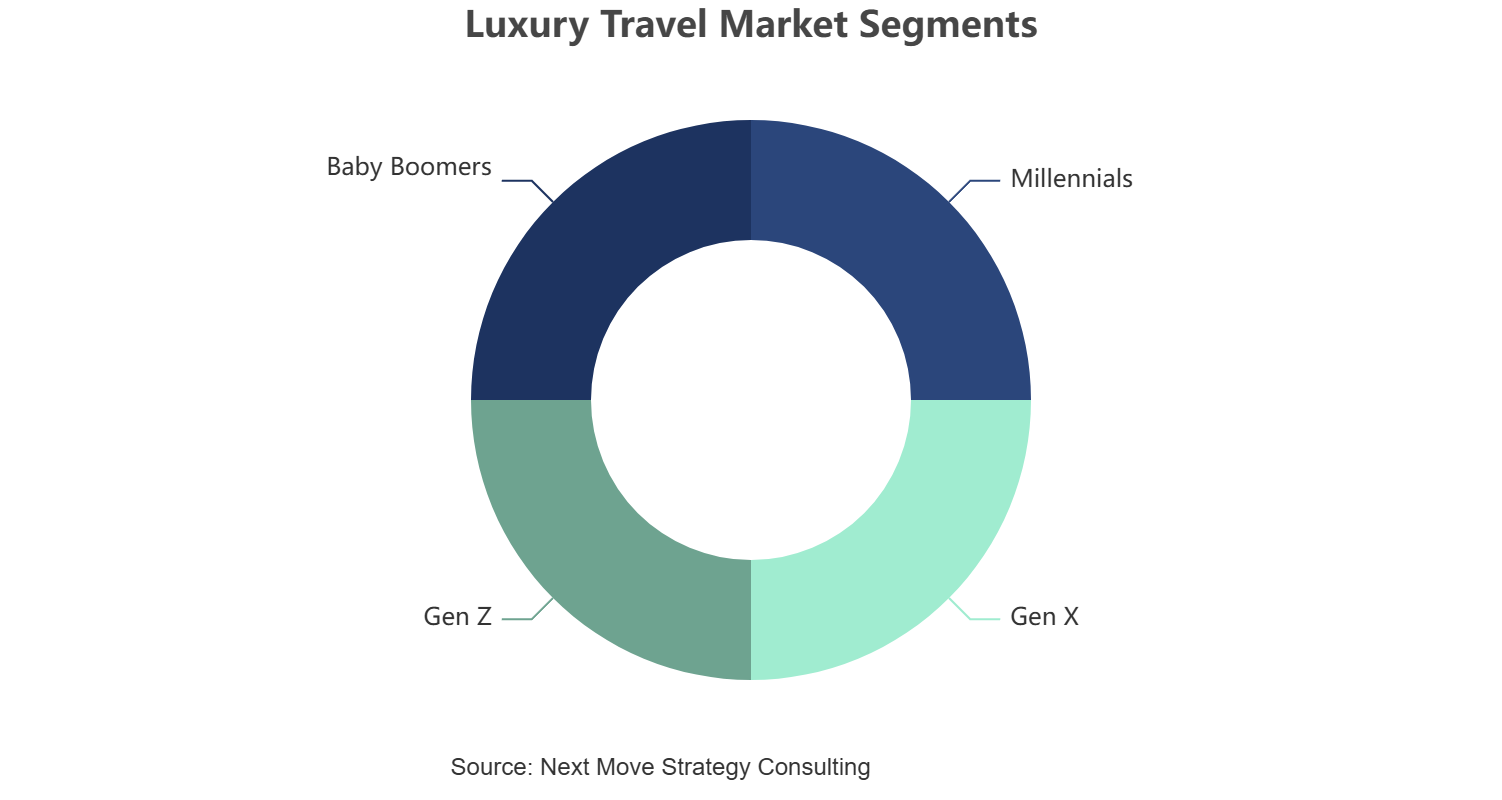
By Traveler Age Group: Millennials held the largest share of approximately 36% (USD 741.6 Billion) in 2025; Gen Z is the fastest-growing sub-segment at 11.3% CAGR from 2026–2035. |
|
By Booking Channel: Direct Booking held the largest share of approximately 46% (USD 947.6 Billion) in 2025; Online Travel Agencies (OTAs) is the fastest-growing sub-segment at 11.1% CAGR from 2026–2035. |
|
By Trip Purpose: Leisure Travel held the largest share of approximately 58% (USD 1,194.8 Billion) in 2025; Bleisure Travel is the fastest-growing sub-segment at 13.8% CAGR from 2026–2035. |
|
Dominant Region: Europe dominated with approximately 34% revenue share (USD 700.4 Billion) in 2025. |
|
Fastest-Growing Region: Asia-Pacific is expected to register the highest CAGR of 11.8% during 2026–2035. |
|
Dominant Country: U.S. led with approximately USD 480 Billion in 2025. |
|
Fastest-Growing Country: India is the fastest-growing country at approximately 13.5% CAGR from 2026–2035. |
Market Opportunity: The luxury travel market is expected to create an absolute dollar opportunity of USD 2.76 trillion between 2026 and 2035, presenting significant investment potential across the hospitality, private aviation, cruise, and experiential-tourism value chain.
According to Next Move Strategy Consulting analysis, high-net-worth travelers are increasingly prioritizing wellness-integrated and multi-generational itineraries over singular destination stays, a shift that favors diversified operators with global property and experience portfolios over single-destination specialists as personalization expectations intensify through 2035.
Luxury Travel Market Overview
The luxury travel market encompasses premium accommodation, private aviation, cruise, and curated experiential services purchased by high-net-worth and affluent travelers seeking exclusivity, personalization, and superior service standards. Our assessment indicates that the scope spans five-star hotels and resorts, private jet charters, ultra-luxury cruise lines, bespoke tour operators, and chauffeured transportation providers serving leisure, business, and honeymoon travel occasions. The category has evolved from destination-led package tourism into an experience-driven model, with concierge-level personalization, wellness integration, and multi-generational trip planning reshaping how operators design and price premium itineraries worldwide.
Regulatory frameworks such as the European Union's Package Travel Directive and the U.S. Department of Transportation's charter aviation rules shape consumer-protection and safety requirements for tour operators and private aviation providers, while national tourism boards increasingly influence sustainable luxury certification standards. We observed that technology adoption is shifting toward AI-enabled itinerary personalization, biometric airport processing, and blockchain-based loyalty programs. Next Move Strategy Consulting's analysis indicates that this structural shift, combined with rising demand for wellness tourism integration, is redefining service design criteria across the luxury travel market.
|
Parameter |
Details |
|
Market Size in 2025 |
USD 2.06 Trillion |
|
Market Size in 2026 |
USD 2.22 Trillion |
|
Revenue Forecast in 2035 |
USD 4.98 Trillion |
|
Growth Rate |
CAGR of 9.40% from 2026 to 2035 |
|
Analysis Period |
2025–2035 |
|
Base Year Considered |
2025 |
|
Forecast Period |
2026–2035 |
|
Market Size Estimation |
Revenue (USD Trillion) |
|
Companies Profiled |
20 |
|
Countries Covered |
38 |
|
Market Share |
Available for Top 10 Companies |
Key Emerging Trends
Based on research conducted by Next Move Strategy Consulting, we found that four structural trends are reshaping product development, sourcing, and stakeholder engagement across the industry.
How Is Wellness Integration Transforming Luxury Travel Itineraries?
Wellness-integrated stays combining spa therapy, sleep programs, and longevity diagnostics are replacing conventional leisure itineraries among affluent travelers. We observed that Six Senses' longevity retreat concept, expanded across its Asia-Pacific portfolio in 2025, pairs medical-grade diagnostics with resort hospitality under a single booking. Hotel groups are retooling property design to accommodate dedicated wellness wings, while tour operators are bundling wellness modules into multi-city itineraries across leisure and honeymoon travel occasions.
Why Is Private Aviation Gaining Adoption Among Affluent Travelers?
Private jet charter and fractional ownership programs are gaining share as high-net-worth travelers seek to avoid commercial airport congestion and shorten multi-leg itineraries. Our findings suggest that VistaJet's expanded membership program, broadened in 2025, increasingly specifies guaranteed availability across intercontinental routes to reduce scheduling friction. Providers such as NetJets and VistaJet are expanding fleet capacity, positioning private aviation as a premium, higher-margin category within the broader market segmentation structure.
How Is Experiential Tourism Reshaping Bespoke Itinerary Design?
Curated, single-purpose experiential trips centered on culinary immersion, wildlife conservation, and cultural access are pushing operators toward hyper-personalized itinerary architecture. We observed that Abercrombie & Kent's expanded private-guide network, scaled through 2025, increasingly pairs travelers with destination specialists rather than fixed group schedules. This trend is elevating demand for flexible, on-demand itinerary platforms among tour operators, while agencies redesign booking systems to accommodate real-time customization requests.
What Role Does Sustainable Luxury Play in Travel Innovation?
Sustainability-certified luxury properties and low-impact cruise itineraries are emerging as a differentiator amid rising traveler scrutiny of environmental footprint. Our analysis shows that operators in premium hospitality and cruise tourism are piloting carbon-tracked itineraries paired with regenerative-tourism partnerships to reduce destination impact. Belmond's expanded sustainability certification across its rail and hotel portfolio, completed in 2025, exemplifies this direction with verified environmental reporting across guest-facing itineraries.
Strategic Framework of the Luxury Travel Market
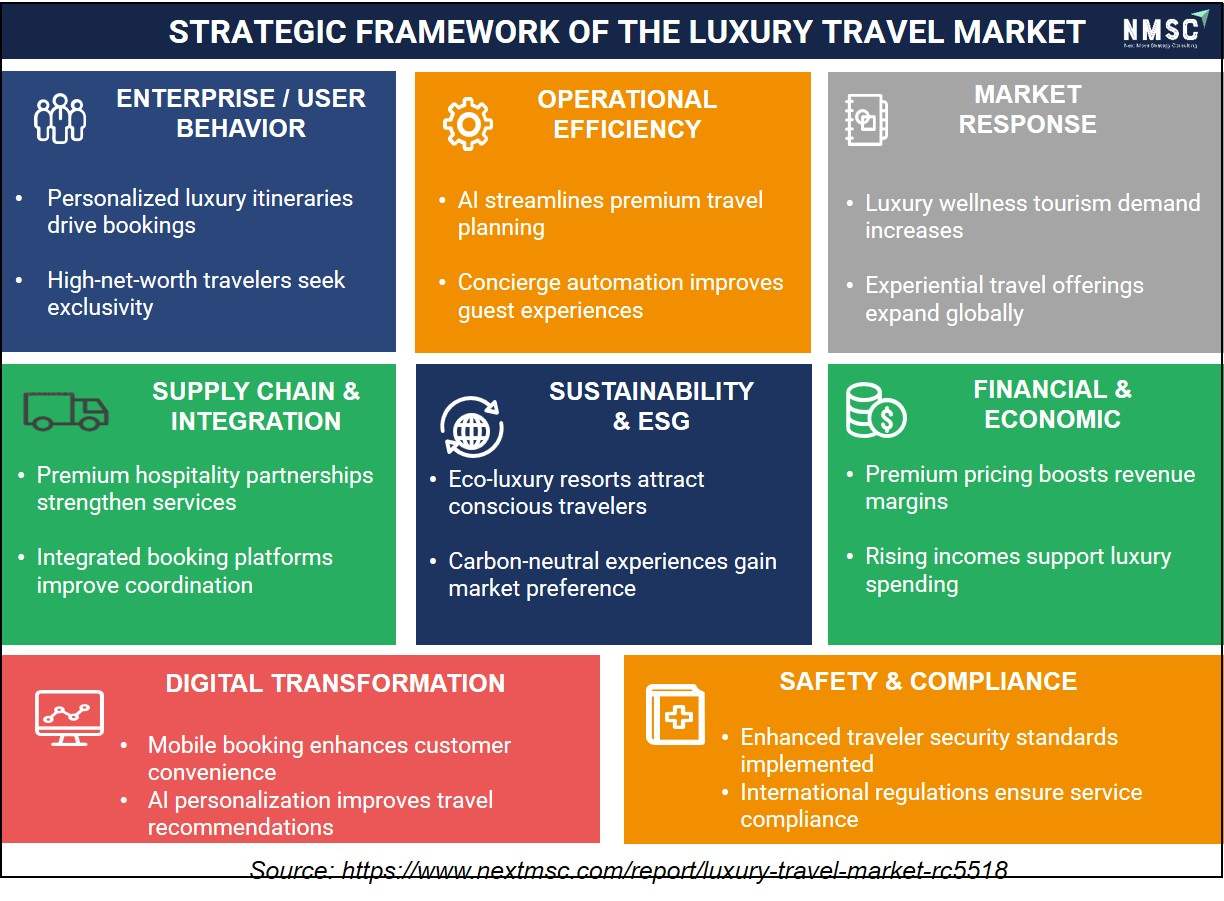
Based on our strategic framework assessment, we identified that the luxury travel market is driven by personalized traveler preferences, operational excellence, premium hospitality partnerships, sustainability initiatives, digital transformation, financial strength, market responsiveness, and regulatory compliance. Furthermore, our analysis indicates that AI-powered itinerary planning, integrated booking platforms, eco-luxury experiences, mobile-first engagement, premium pricing strategies, and adherence to international travel and safety standards strengthen competitive differentiation, enhance customer satisfaction, and support long-term market growth.
Growth Drivers & Restraints
Growth Catalyst & Risk Assessment Matrix
|
Factors |
Type |
(+/−) % Impact on CAGR |
Geographic Relevance |
Impact Timeline |
|
Rising high-net-worth individual population |
Driver |
+2.1% |
Global |
2026–2035 |
|
Growth in experiential and bespoke itinerary demand |
Driver |
+1.8% |
Global |
2026–2032 |
|
Expansion of private aviation fleet capacity |
Driver |
+1.4% |
North America, Europe |
2026–2035 |
|
Rising wellness tourism integration |
Driver |
+1.2% |
Asia-Pacific, Europe |
2027–2035 |
|
Growth of multi-generational family travel |
Driver |
+0.9% |
Global |
2026–2033 |
|
Currency volatility affecting cross-border spending |
Restraint |
−0.8% |
Latin America, MEA |
2026–2029 |
|
Geopolitical instability in key travel corridors |
Restraint |
−0.7% |
Middle East & Africa |
2026–2030 |
|
Rising airfare and premium accommodation costs |
Restraint |
−0.6% |
Global |
2026–2035 |
What Is the Primary Growth Driver of the Luxury Travel Market?
Rising high-net-worth individual populations represent the primary growth driver, expanding the addressable base of travelers able to afford premium hospitality, private aviation, and curated itineraries. Data from national statistical agencies indicates sustained wealth accumulation across Asia-Pacific and North American economies through 2025. This expanding affluent base is prompting operators to scale loyalty programs and dedicated concierge services to capture repeat premium spending across leisure and business travel occasions.
How Is Experiential Demand Driving Market Growth?
Growing preference for single-purpose experiential trips over standardized packages is driving market growth, as travelers increasingly value access, immersion, and personalization over destination volume. Tourism ministry data from several G20 economies shows rising visitor spending per trip within premium travel categories through 2025. Tour operators are responding by expanding private-guide networks and limited-capacity itineraries to preserve exclusivity while meeting rising demand.
What Is Restraining the Luxury Travel Market Growth?
Currency volatility and geopolitical instability across key travel corridors restrain market growth by disrupting cross-border spending confidence and itinerary planning. Central bank data has documented material currency fluctuations across several emerging travel-origin markets in recent reporting periods. These conditions are prompting operators to diversify destination portfolios and offer flexible rebooking terms to preserve traveler confidence during periods of macroeconomic uncertainty.
Segmentation Analysis
Segment Sizing: By Service Type
|
Segment |
2025 (USD Billion) |
2035 (USD Billion) |
CAGR% (2026–2035) |
|
Luxury Hotels & Resorts |
782.8 |
1,830.0 |
9.1% |
|
Luxury Cruises |
432.6 |
1,064.7 |
10.2% |
|
Private Jet & Luxury Air Travel |
350.2 |
921.3 |
11.6% |
|
Luxury Tour Packages & Experiential Travel |
308.0 |
736.7 |
9.7% |
|
Luxury Transportation Services |
186.4 |
427.3 |
8.9% |
|
Total |
2,060.0 |
4,980.0 |
9.40% |
Which Service Type Dominates the Luxury Travel Market?
Service type segmentation divides the market into luxury hotels and resorts, cruises, private aviation, experiential tour packages, and dedicated transportation services. Luxury hotels and resorts hold the dominant position, supported by established global property networks and repeat corporate and leisure demand. Private jet and luxury air travel is the fastest-growing sub-segment, driven by expanding fractional-ownership programs and rising demand for point-to-point intercontinental itineraries among affluent travelers.
Segment Sizing: By Traveler Age Group
|
Segment |
2025 (USD Billion) |
2035 (USD Billion) |
CAGR% (2026–2035) |
|
Millennials |
741.6 |
1,794.7 |
10.3% |
|
Gen X |
597.4 |
1,349.6 |
9.5% |
|
Gen Z |
411.9 |
1,080.7 |
11.3% |
|
Baby Boomers |
309.1 |
755.0 |
9.3% |
|
Total |
2,060.0 |
4,980.0 |
9.40% |
Which Traveler Age Group Leads Luxury Travel Spending?
Traveler age group segmentation covers Millennials, Gen X, Gen Z, and Baby Boomers as distinct spending cohorts. Millennials dominate the segment, reflecting peak-earning professionals prioritizing experiential and wellness-oriented trips over material purchases. Gen Z is the fastest-growing cohort, supported by early wealth accumulation among younger entrepreneurs and rising social-driven demand for exclusive, shareable travel experiences across curated destinations worldwide.
Segment Sizing: By Booking Channel
|
Segment |
2025 (USD Billion) |
2035 (USD Billion) |
CAGR% (2026–2035) |
|
Direct Booking |
947.6 |
2,136.9 |
9.5% |
|
Online Travel Agencies (OTAs) |
597.4 |
1,544.0 |
11.1% |
|
Offline Travel Agents & Tour Operators |
515.0 |
1,299.1 |
10.9% |
|
Total |
2,060.0 |
4,980.0 |
9.40% |
Which Booking Channel Is Preferred for Luxury Travel?
Booking channel segmentation spans direct booking, online travel agencies, and offline travel agents and tour operators. Direct booking dominates the channel mix, reflecting affluent travelers' preference for dedicated concierge relationships and loyalty-program benefits offered directly by hotel and cruise brands. Online travel agencies represent the fastest-growing channel, supported by expanding premium listing categories and AI-enabled personalization tools that streamline high-value itinerary comparison and booking.
Growth Opportunities
Beyond current demand drivers, three forward-looking whitespace opportunities are positioned to reshape competitive positioning through 2035.
Multi-Generational Itinerary Bundling
Operators can capture rising multi-generational family travel demand by bundling wellness, adventure, and leisure modules within a single itinerary. Luxury tour operators stand to benefit most, as bundled offerings increase average booking value while reducing the coordination burden extended families face when planning shared trips across differing age-group preferences.
Private Aviation Membership Expansion
Expanding fractional-ownership and membership-based private aviation programs into emerging affluent markets presents a scalable growth mechanism. Private jet operators benefit directly, as membership models convert episodic charter demand into recurring, higher-margin revenue streams while reducing aircraft positioning inefficiencies across new regional markets.
Branded Residences and Extended-Stay Luxury
Branded residence developments paired with hotel-grade services create a durable opportunity linking real estate and hospitality revenue streams. Luxury hotel and resort groups benefit most, capturing recurring service fees from residence owners while extending brand presence into destinations beyond traditional transient-stay properties.
Regional Outlook
Geographic Performance Snapshot
|
Region |
2025 (USD Billion) |
2035 (USD Billion) |
CAGR% (2026–2035) |
Key Driver |
|
Europe |
700.4 |
1,533.8 |
9.1% |
Heritage hospitality brands and premium rail/cruise networks |
|
North America |
576.8 |
1,284.8 |
9.3% |
High-net-worth population growth and private aviation demand |
|
Asia-Pacific |
453.2 |
1,229.6 |
11.8% |
Rising affluent middle class and outbound luxury travel |
|
Middle East & Africa |
185.4 |
560.0 |
13.1% |
Destination mega-projects and luxury hospitality investment |
|
Latin America |
144.2 |
371.8 |
11.1% |
Expanding premium eco-tourism and resort development |
|
Total |
2,060.0 |
4,980.0 |
9.40% |
— |
Europe Luxury Travel Market
Europe leads the global luxury travel market, supported by an established base of heritage hospitality brands, premium rail networks, and Mediterranean and Alpine resort destinations. Regulatory frameworks under the EU Package Travel Directive shape consumer-protection standards across cross-border itineraries. Technology adoption is advancing through digital concierge platforms, and operators are pursuing a strategic focus on multi-country rail and cruise itinerary bundling to sustain premium positioning through 2035.
North America Luxury Travel Market
North America maintains a strong luxury travel position, driven by rising high-net-worth population growth and expanding private aviation fleet capacity. Federal aviation and consumer-protection regulations shape charter and resort operating standards across the region. Technology adoption centers on AI-personalized itinerary platforms, with operators strategically expanding branded-residence and wellness-resort portfolios to capture recurring premium demand.
Asia-Pacific Luxury Travel Market
Asia-Pacific is the fastest-growing luxury travel region, propelled by an expanding affluent middle class and rising outbound travel from China and India. National tourism authorities across the region are easing visa processes to attract premium inbound visitors. Technology adoption is advancing through mobile-first booking platforms, and operators are strategically prioritizing wellness-integrated resort development to capture rising regional demand through 2035.
Middle East & Africa Luxury Travel Market
The Middle East and Africa region is expanding rapidly, supported by large-scale destination mega-projects and sustained luxury hospitality investment across the Gulf states. Regulatory efforts by national tourism authorities are streamlining premium visitor entry programs. Technology adoption includes biometric processing at flagship airports, with operators strategically positioning integrated resort and entertainment destinations to capture growing regional and international premium demand.
Latin America Luxury Travel Market
Latin America is growing steadily, driven by expanding premium eco-tourism offerings and new resort development along coastal and rainforest destinations. National environmental and tourism agencies are shaping sustainable-development standards for premium properties. Technology adoption is advancing through digital payment and booking integration, with operators strategically expanding boutique and eco-luxury property networks to capture rising regional demand through 2035.
U.S. Luxury Travel Market
Based on our engagements, the U.S. luxury travel market was valued at approximately USD 480 Billion in 2025 and is projected to reach approximately USD 1,030 Billion by 2035 at a CAGR of approximately 8.9%. Demand structure centers on domestic resort stays and international private aviation, supported by high technology penetration in booking platforms, established regulatory oversight of charter aviation, and intense competitive activity among branded hospitality groups pursuing loyalty-driven strategic expansion.
Canada Luxury Travel Market
Through our analysis, the Canada luxury travel market was valued at approximately USD 96.8 Billion in 2025 and is projected to grow at a CAGR of approximately 9.0% through 2035. Demand structure reflects strong outbound premium travel and expanding wilderness-lodge tourism, supported by moderate technology penetration, stable regulatory oversight, and a competitive landscape led by international hospitality brands pursuing selective strategic property additions.
UK Luxury Travel Market
From our assessment, the UK luxury travel market was valued at approximately USD 210 Billion in 2025 and is projected to grow at a CAGR of approximately 9.0% through 2035. Demand structure is anchored in heritage hospitality and premium rail travel, supported by high technology adoption in digital concierge services, EU-aligned consumer-protection regulation, and a competitive landscape shaped by long-established luxury hotel groups pursuing international strategic expansion.
Germany Luxury Travel Market
According to evaluation, the Germany luxury travel market was valued at approximately USD 175 Billion in 2025 and is projected to grow at a CAGR of approximately 8.8% through 2035. Demand structure reflects strong outbound premium leisure travel and Alpine resort demand, supported by high technology penetration, EU regulatory alignment, and a competitive landscape featuring both domestic and international hospitality operators pursuing steady strategic growth.
France Luxury Travel Market
Based on our engagements, the France luxury travel market was valued at approximately USD 168 Billion in 2025 and is projected to grow at a CAGR of approximately 9.2% through 2035. Demand structure centers on flagship urban hospitality and premium wine-region tourism, supported by high technology adoption, EU consumer-protection regulation, and intense competitive activity among heritage luxury hotel groups pursuing global strategic brand extension.
China Luxury Travel Market
Through our analysis, the China luxury travel market was valued at approximately USD 140 Billion in 2025 and is projected to reach approximately USD 430 Billion by 2035 at a CAGR of approximately 13.4%. Demand structure reflects rapidly rising outbound premium travel, supported by expanding mobile-first technology penetration, evolving tourism regulation, and a competitive landscape where international hospitality brands are pursuing aggressive strategic property expansion to capture rising domestic affluence.
India Luxury Travel Market
From our assessment, the India luxury travel market was valued at approximately USD 58 Billion in 2025 and is projected to reach approximately USD 205 Billion by 2035 at a CAGR of approximately 13.5%, the fastest among covered countries. Demand structure is driven by a rapidly expanding affluent class, supported by rising technology penetration, evolving tourism-promotion regulation, and a competitive landscape where domestic groups such as the Indian Hotels Company are pursuing significant strategic capacity additions.
Japan Luxury Travel Market
According to evaluation, the Japan luxury travel market was valued at approximately USD 96 Billion in 2025 and is projected to grow at a CAGR of approximately 10.1% through 2035. Demand structure centers on premium ryokan stays and curated cultural itineraries, supported by high technology penetration, stable tourism regulation, and a competitive landscape featuring established domestic hospitality groups pursuing selective international strategic partnerships.
South Korea Luxury Travel Market
Based on our engagements, the South Korea luxury travel market was valued at approximately USD 62 Billion in 2025 and is projected to grow at a CAGR of approximately 10.6% through 2035. Demand structure reflects rising outbound premium leisure travel among younger affluent cohorts, supported by high technology adoption, evolving tourism regulation, and a competitive landscape where international hospitality brands are pursuing targeted strategic urban property expansion.
Australia Luxury Travel Market
Through our analysis, the Australia luxury travel market was valued at approximately USD 88 Billion in 2025 and is projected to grow at a CAGR of approximately 9.6% through 2035. Demand structure centers on premium coastal resort stays and eco-luxury lodges, supported by moderate technology penetration, stable tourism regulation, and a competitive landscape featuring domestic and international operators pursuing steady strategic expansion.
UAE Luxury Travel Market
From our assessment, the UAE luxury travel market was valued at approximately USD 78 Billion in 2025 and is projected to grow at a CAGR of approximately 12.9% through 2035. Demand structure is shaped by flagship integrated resort destinations and premium retail-linked hospitality, supported by high technology penetration, streamlined visitor regulation, and a competitive landscape where global hospitality brands are pursuing aggressive strategic property development.
Saudi Arabia Luxury Travel Market
According to evaluation, the Saudi Arabia luxury travel market was valued at approximately USD 52 Billion in 2025 and is projected to grow at a CAGR of approximately 13.8% through 2035. Demand structure is driven by large-scale giga-project resort development under national tourism diversification programs, supported by rapidly rising technology penetration, evolving visitor regulation, and a competitive landscape where international hospitality groups are pursuing significant strategic capacity commitments.
South Africa Luxury Travel Market
Based on our engagements, the South Africa luxury travel market was valued at approximately USD 28 Billion in 2025 and is projected to grow at a CAGR of approximately 10.9% through 2035. Demand structure centers on premium safari lodges and wildlife-conservation tourism, supported by moderate technology penetration, stable conservation-linked regulation, and a competitive landscape featuring specialized boutique operators pursuing selective strategic lodge expansion.
Brazil Luxury Travel Market
Through our analysis, the Brazil luxury travel market was valued at approximately USD 68 Billion in 2025 and is projected to grow at a CAGR of approximately 11.4% through 2035. Demand structure reflects rising premium coastal and rainforest tourism, supported by expanding technology penetration, evolving tourism regulation, and a competitive landscape where domestic and regional operators are pursuing steady strategic property development.
Argentina Luxury Travel Market
From our assessment, the Argentina luxury travel market was valued at approximately USD 26 Billion in 2025 and is projected to grow at a CAGR of approximately 10.7% through 2035. Demand structure is centered on premium wine-region and Patagonian eco-lodge tourism, supported by moderate technology penetration, stable tourism regulation, and a competitive landscape featuring boutique operators pursuing targeted strategic expansion.
Consumer Behavior Analysis of the Luxury Travel Market
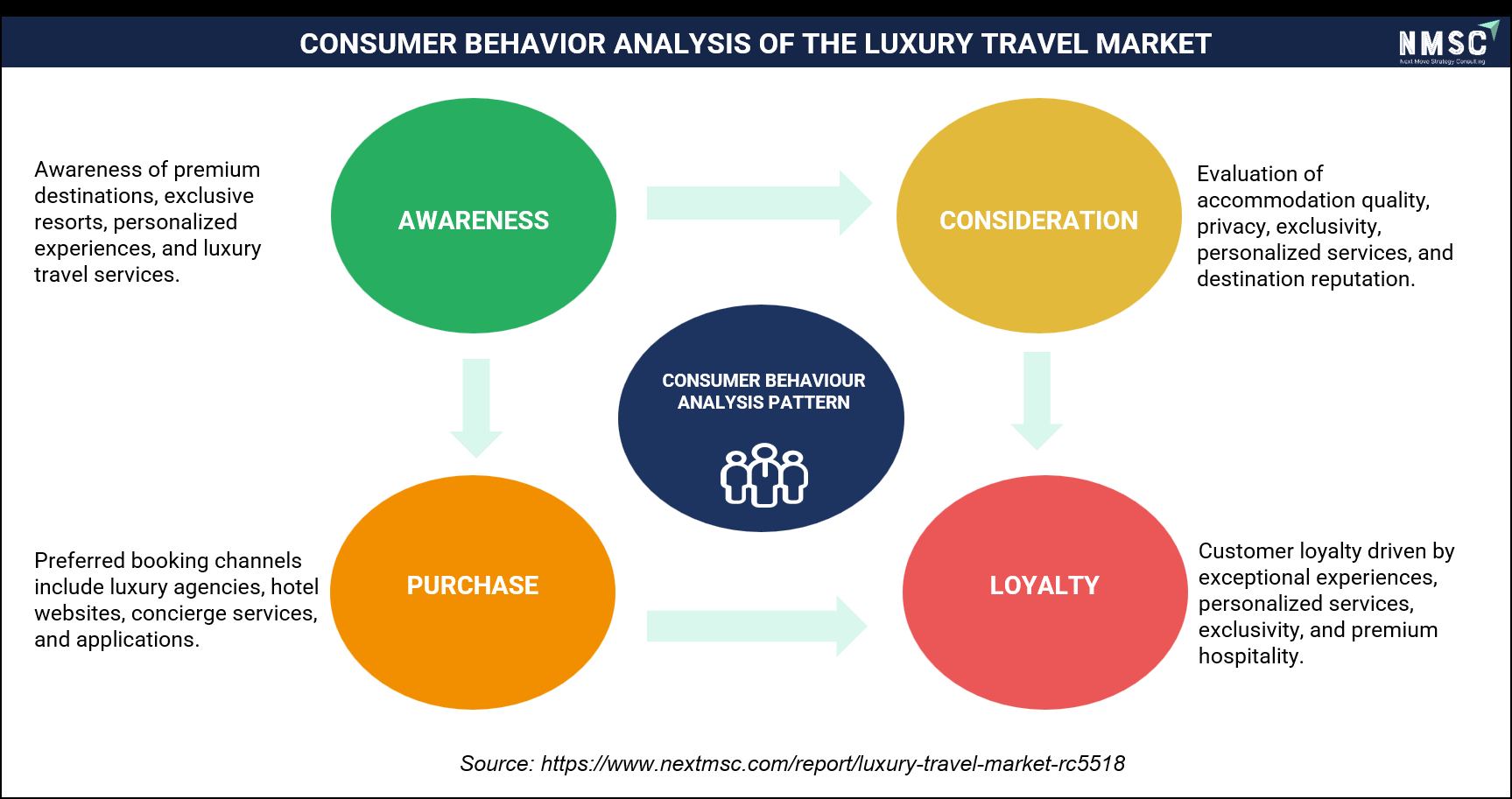
Based on our consumer behavior assessment, we identified that purchasing decisions in the luxury travel market are primarily influenced by accommodation quality, privacy, exclusivity, personalized services, destination reputation, and premium guest experiences. Furthermore, our analysis indicates that affluent travelers increasingly prefer booking through luxury travel agencies, hotel websites, concierge services, and dedicated applications while demonstrating stronger loyalty toward brands that consistently deliver exceptional hospitality, bespoke experiences, seamless service, and exclusive travel offerings.
Competitive Landscape
We observed that the competitive landscape is moderately consolidated, with established global hospitality, cruise, and private aviation groups accounting for a substantial share of branded premium capacity.
|
Dimension |
Assessment |
|
Market Structure |
Moderately consolidated, led by global hospitality groups and specialized private aviation and cruise operators. |
|
Innovation Focus |
AI-enabled personalization, wellness integration, and sustainable luxury certification programs. |
|
M&A Activity |
Selective acquisitions of boutique brands to expand experiential and wellness-travel portfolios. |
How Do Companies Compete in the Luxury Travel Market?
Companies compete primarily on brand prestige, property and fleet exclusivity, and depth of personalized service delivery rather than on price. Loyalty-program integration and multi-property global reach are key differentiators for large hospitality groups, while boutique tour operators compete on destination access and guide expertise. Industry participants are increasingly investing in proprietary booking technology to strengthen direct-channel relationships with repeat premium customers.
Which Competitive Archetypes Dominate the Luxury Travel Market?
Two archetypes dominate the industry: diversified global hospitality conglomerates with multi-brand property portfolios, and specialized single-category operators focused on private aviation, cruise, or bespoke tour design. The diversified archetype benefits from cross-selling loyalty ecosystems, while specialists differentiate through deep category expertise. This dual structure explains why market share remains distributed across both large conglomerates and focused independent operators.
What Innovation and Differentiation Strategies Are Companies Pursuing?
Companies are pursuing wellness-integrated property redesign, AI-personalized itinerary platforms, and sustainability certification as core differentiation strategies. Rosewood Hotel Group's expanded wellness-residence concept, scaled through 2025, illustrates a strategy of embedding longevity-focused programming directly into flagship properties. Operators across the industry are prioritizing proprietary data platforms to deepen guest personalization while protecting direct-booking relationships.
What M&A Activity Is Shaping the Competitive Landscape?
M&A activity centers on selective acquisitions of boutique hospitality and experiential-tour brands by larger conglomerates seeking to expand experiential and wellness-travel portfolios. Accor's continued expansion of its luxury and lifestyle brand collection through recent portfolio additions reflects this consolidation pattern. Geographic expansion and pricing strategy remain secondary to brand-portfolio broadening as the primary competitive lever across the current M&A cycle.
Key Market Players
We found that the competitive set below reflects the validated group of companies most active in shaping global luxury travel supply as of 2026.
-
Marriott International, Inc.
-
Hilton Worldwide Holdings Inc.
-
InterContinental Hotels Group PLC
-
Accor SA
-
LVMH Moët Hennessy Louis Vuitton SE
-
Mandarin Oriental Hotel Group International Limited
-
Rosewood Hotel Group
-
EIH Limited
-
Aman Group
-
Shangri-La Asia Limited
-
The Indian Hotels Company Limited
-
Jumeirah Group LLC
-
Kempinski Hotels S.A.
-
Royal Caribbean Group
-
Carnival Corporation & plc
-
Norwegian Cruise Line Holdings Ltd.
-
VistaJet Group Holding S.A.
-
Abercrombie & Kent Group of Companies
Latest Developments
Our analysis shows that recent company activity reflects continued portfolio expansion and product innovation across hospitality, aviation, and cruise segments.
|
Date |
Event |
|
June 2026 |
Four Seasons Hotels Limited revealed Four Seasons II, the second vessel in its luxury yacht fleet, set to debut in 2028. Following the March 2026 launch of Four Seasons I, the new superyacht introduces 79 expansive suites, including brand-new multi-room Yacht Residential Suites with open-concept living spaces and private splash pools, to further expand its ultra-luxury hospitality experience at sea. |
|
December 2025 |
Marriott International, Inc. unveiled its robust 2026 global luxury growth strategy, announcing nearly 35 high-end hotel and resort openings scheduled throughout the year across iconic brands such as St. Regis, The Ritz-Carlton, W Hotels, and JW Marriott. The strategic expansion targets high-demand cultural, wellness, and emerging luxury corridors across Japan, India, and the United Arab Emirates to cater to evolving experiential travel demands |
|
April 2025 |
Aman Group opened Aman Nai Lert Bangkok, marking the brand's newest flagship urban sanctuary. Situated within the historic Nai Lert Park in Thailand, the exclusive property features 52 ultra-spacious suites starting at 92 square meters, integrated holistic wellness spaces, and private gardens designed to offer high-end travelers a secluded retreat in the heart of the capital city |
Expert Insights
 “Luxury travel has become highly customized. We are certainly seeing a gradual metamorphosis from exclusivity to inclusivity where experience is placed ahead of materialism. Today's luxury traveler doesn't just want to see, they want to participate.”
— George Morgan-Grenville, Founder & CEO, Red Savannah
Statement made during an interview with Travel Weekly discussing the evolving preferences of luxury travelers and the growing importance of personalized, experience-driven journeys in shaping the future of the luxury travel industry.
Market Interpretation
The statement highlights the ongoing transformation of the luxury travel market, where affluent travelers increasingly prioritize personalized, immersive, and authentic experiences over traditional notions of exclusivity and material luxury. This shift is driving travel companies, luxury hospitality providers, and destination operators to invest in bespoke itineraries, experiential tourism, wellness retreats, and culturally enriching travel offerings. Consequently, the rising demand for hyper-personalized and experience-led travel is expected to support the sustained growth of the global Luxury Travel Market.
Investment Opportunities
What Capital Inflows Are Shaping the Luxury Travel Market?
Capital inflows are concentrating on branded-residence developments and flagship resort expansions across high-growth destinations. Sovereign wealth funds and private equity investors are directing sustained capital toward integrated resort projects across the Middle East and Asia-Pacific. This inflow pattern is enabling operators to accelerate property pipelines while diversifying revenue between transient-stay and residence-linked income streams through 2035.
How Is Infrastructure Investment Supporting Market Expansion?
Infrastructure investment in premium airport terminals, private aviation facilities, and destination connectivity is directly supporting luxury travel expansion. Government-backed airport modernization programs across Gulf and Asia-Pacific economies are expanding capacity for premium and private-charter traffic. This infrastructure buildout is reducing transit friction for affluent travelers, reinforcing demand for multi-destination luxury itineraries across newly connected regional markets.
What ESG Considerations Are Influencing Investment Decisions?
Environmental, Social, and Governance considerations are increasingly shaping investment decisions, with investors favoring operators demonstrating verified sustainability certification and community-linked tourism programs. Regenerative-tourism partnerships and carbon-tracked property operations are gaining preference among institutional investors evaluating long-term hospitality assets. This ESG-linked capital allocation is reinforcing demand for luxury jewelry and adjacent premium-lifestyle retail partnerships that align with sustainability-conscious affluent consumer segments.
Key Benefits for Stakeholders
How Does This Report Benefit Industry Leaders?
Industry leaders gain a validated view of segment-level revenue distribution, competitive positioning, and regional growth trajectories that inform property, fleet, and itinerary investment decisions. The report's segmentation and regional analysis clarify where premium demand is concentrating, enabling hospitality, aviation, and tour-operator executives to prioritize capital allocation toward the highest-growth service categories and destinations through 2035.
How Does This Report Benefit Investors and Financial Analysts?
Investors and financial analysts gain access to consistent market-sizing figures, CAGR forecasts, and competitive-landscape assessment that support valuation and portfolio-allocation decisions across hospitality, aviation, and cruise assets. The report's regional and segmental breakdowns provide a defensible basis for evaluating growth-adjusted investment opportunities across the luxury travel value chain through the 2026–2035 forecast period.
How Does This Report Benefit Technology and Service Vendors?
Technology and service vendors supplying booking platforms, personalization engines, and concierge software gain insight into which booking channels and traveler segments are expanding fastest. This analysis helps vendors prioritize product roadmaps toward the highest-growth integration points, including direct-booking loyalty platforms and AI-enabled itinerary personalization tools favored by the dominant traveler cohorts identified in this report.
Key Market Segments
By Service Type
-
Luxury Hotels & Resorts
-
Luxury Cruises
-
Private Jet & Luxury Air Travel
-
Luxury Tour Packages & Experiential Travel
-
Luxury Transportation Services
By Traveler Age Group
-
Millennials
-
Gen X
-
Gen Z
-
Baby Boomers
By Booking Channel
-
Direct Booking
-
Online Travel Agencies (OTAs)
-
Offline Travel Agents & Tour Operators
By Trip Purpose
-
Leisure Travel
-
Business Travel
-
Bleisure Travel
-
Honeymoon & Special Occasion Travel
By Region
-
North America: U.S., Canada, Mexico
-
Europe: UK, Germany, France, Italy, Spain, Sweden, Denmark, Finland, Netherlands, Rest of Europe
-
Asia-Pacific: China, India, Japan, South Korea, Taiwan, Indonesia, Vietnam, Australia, Philippines, Malaysia, Rest of APAC
-
Middle East & Africa: Saudi Arabia, UAE, Egypt, Israel, Turkey, Nigeria, South Africa, Rest of MEA
-
Latin America: Brazil, Argentina, Chile, Colombia, Rest of LATAM
Conclusion & Recommendations
What Is the Long-Term Outlook for the Luxury Travel Market?
The long-term outlook remains strongly positive, with the market expanding from USD 2.22 trillion in 2026 to USD 4.98 trillion by 2035 at a 9.40% CAGR. Sustained high-net-worth population growth, expanding private aviation capacity, and rising experiential-travel demand collectively support continued double-digit growth across the fastest-expanding regions and service categories through the full forecast period.
What Strategic Positioning Should Operators Pursue?
Operators should prioritize wellness integration, multi-generational itinerary bundling, and direct-booking loyalty platforms to strengthen competitive positioning. Diversified hospitality groups are advised to expand branded-residence offerings, while specialized aviation and cruise operators should scale membership-based revenue models to capture recurring premium demand across both established and emerging affluent traveler segments.
How Attractive Is the Luxury Travel Market for Investment?
The market presents strong investment attractiveness, supported by an absolute dollar opportunity of USD 2.76 trillion between 2026 and 2035. Asia-Pacific and Middle East & Africa offer the highest growth-adjusted returns given their double-digit regional CAGRs, while established European and North American markets provide stable, lower-volatility exposure to premium hospitality and aviation assets.
What Market Shifts and Key Risks Should Stakeholders Monitor?
Stakeholders should monitor currency volatility, geopolitical instability across key travel corridors, and rising input costs affecting premium accommodation and aviation pricing. Additionally, shifting traveler preference toward experiential over material luxury requires continuous itinerary innovation, as operators unable to adapt bundled service offerings risk losing share to more agile experiential-travel specialists.
What Are the Key Growth Pathways Through 2035?
Key growth pathways include expanding wellness-integrated resort portfolios, scaling private aviation membership programs, and deepening experiential-tour personalization across emerging affluent markets. Operators pursuing coordinated expansion across these three pathways, supported by direct-booking technology investment, are best positioned to capture disproportionate share of the USD 2.76 trillion incremental opportunity through 2035.
About the Author
 Saista Faiyaz
— Saista Faiyaz is Research Associate at Next Move Strategy Consulting, where she has covered consumer markets and healthcare technologies for 3 years. Her work includes primary interview review, secondary-source validation, market sizing, and structured analysis of company and industry data. She supports research by comparing evidence across sources, organizing findings into market narratives, and documenting assumptions used in analysis. Her scope includes cross-market benchmarking, and reports.
Saista Faiyaz
— Saista Faiyaz is Research Associate at Next Move Strategy Consulting, where she has covered consumer markets and healthcare technologies for 3 years. Her work includes primary interview review, secondary-source validation, market sizing, and structured analysis of company and industry data. She supports research by comparing evidence across sources, organizing findings into market narratives, and documenting assumptions used in analysis. Her scope includes cross-market benchmarking, and reports.
About the Reviewer
 Supradip Baul
— Supradip Baul is an accomplished business consultant and strategist with over a decade of rich experience in market intelligence, strategy, technology, and business transformation. His work has included rigorous qualitative and quantitative analysis across multiple industries, helping clients shape investment decisions and long-term roadmaps. Earlier in his career, he was associated with Gartner, where he contributed to industry-leading reports and market share analyses. He has worked with leading global companies and holds an MBA with a dual specialization in Marketing and Finance.
Supradip Baul
— Supradip Baul is an accomplished business consultant and strategist with over a decade of rich experience in market intelligence, strategy, technology, and business transformation. His work has included rigorous qualitative and quantitative analysis across multiple industries, helping clients shape investment decisions and long-term roadmaps. Earlier in his career, he was associated with Gartner, where he contributed to industry-leading reports and market share analyses. He has worked with leading global companies and holds an MBA with a dual specialization in Marketing and Finance.
At Next Move Strategy Consulting, we understand that insightful market research is the cornerstone of successful business decisions. That's why we employ a robust and multifaceted approach, combining various methodologies to deliver the most accurate and actionable data for our clients.

Research Landscape
We navigate the world of research with two primary approaches:
Qualitative Approach
Our qualitative research methodologies involve immersive techniques such as in-depth interviews, focus groups, and observational studies. By engaging directly with individuals and stakeholders, we uncover valuable insights that quantitative data alone may overlook.

Quantitative Research
In tandem with qualitative methodologies, NMSC leverages the power of Quantitative Research to provide a robust foundation of numerical insights. Through systematic data collection and analysis, we quantify patterns, preferences, and market trends, offering a comprehensive view of the business landscape.
Our quantitative research approach employs diverse tools, including surveys, experiments, and statistical modelling. These methodologies enable us to gather data from a large and representative sample, ensuring the statistical significance of our findings. By employing structured questionnaires and standardized data collection methods, we guarantee the reliability and validity of the information we present to our clients.
Quantitative research is particularly effective in measuring the prevalence of trends, assessing market size, and gauging the impact of various factors on consumer behavior. The numerical precision attained through this approach equips our clients with actionable insights, facilitating data-driven decision-making and strategy formulation.


Our Specialized Toolbox for Industry-Specific Market Research
We deploy a specialized arsenal of techniques tailored to meet your unique requirements. Here's a glimpse into our comprehensive toolbox:

Information Procurement
The stage entails acquiring market data or relevant information through various sources and methodologies.


Market Research Approach
We utilize both top-down and bottom-up approaches in market research analysis to achieve a comprehensive understanding of the market dynamics, leveraging the broad perspective of industry trends and macroeconomic factors alongside detailed insights from specific segments and individual companies.

Porters Five Forces Analysis
We conduct Porter's Five Forces analysis to evaluate the competitive landscape of an industry, providing us with insights into factors that affect profitability and strategic positioning.

SWOT Analysis

Forecasting
We utilize a forecasting model to predict future consumption by considering parameters like population, economics, regulations, market competition, drivers, constraints, technology, and pricing. We also employ statistical techniques such as multilinear regression, exponential smoothing, moving average, ARIMA, and Monte Carlo simulations for accurate predictions. In econometric forecasting, we analyzed short-term and long-term event impacts, attributing values based on regulatory frameworks, economic factors, and market events.





 Speak to Our Analyst