Mammography Market: AI, 3D Imaging & Mobile Screening Boost Accuracy
Lede
Three recent developments—the integration of AI in digital breast tomosynthesis (DBT) to improve detection rates, the adoption of 3D mammography systems at hospitals, and the launch of mobile mammography units targeting rural populations—together illustrate a Mammography Market moving from conventional screening toward more precise, accessible, and technology-driven solutions. Collectively, these trends highlight technical progress (AI enhanced imaging and advanced 3D systems), practical challenges (workflow integration, training, and rural accessibility), and a growing commercial premium for technologies that improve detection and reach underserved populations.
1. AI Assisted Digital Breast Tomosynthesis Improves Detection
A large-scale study recently evaluated the role of AI in assisting DBT for breast cancer screening. The results were striking: AI-assisted screening identified 7.57 cancers per 1,000 exams versus 6.23 without AI, representing a 22% increase in detection rate. The study also reported 26% higher detection of invasive cancers and more than double the detection of lobular cancers.
Beyond detection, AI reduced radiologist workload by 44%, allowing faster interpretation of large screening volumes. The technology is particularly beneficial for women with dense breast tissue, a historically challenging cohort. This demonstrates that AI is not only enhancing accuracy but also enabling scalability in mammography workflows—critical as demand for screening grows worldwide.
2. 3D Mammography Adoption Expands Diagnostic Precision
Healthcare providers are upgrading imaging infrastructure to improve early detection. Harrison Community Hospital recently introduced a 3D mammography system, which captures multiple layers of breast tissue to detect abnormalities that traditional 2D imaging might miss.
3D mammography has been shown to reduce false positives while improving diagnostic confidence, allowing radiologists to identify subtle lesions earlier. Adoption of 3D systems is increasingly seen as standard for hospitals and imaging centers committed to high-quality screening, particularly as patient demand for precision and safety grows.
3. Mobile Mammography Extends Access to Underserved Regions
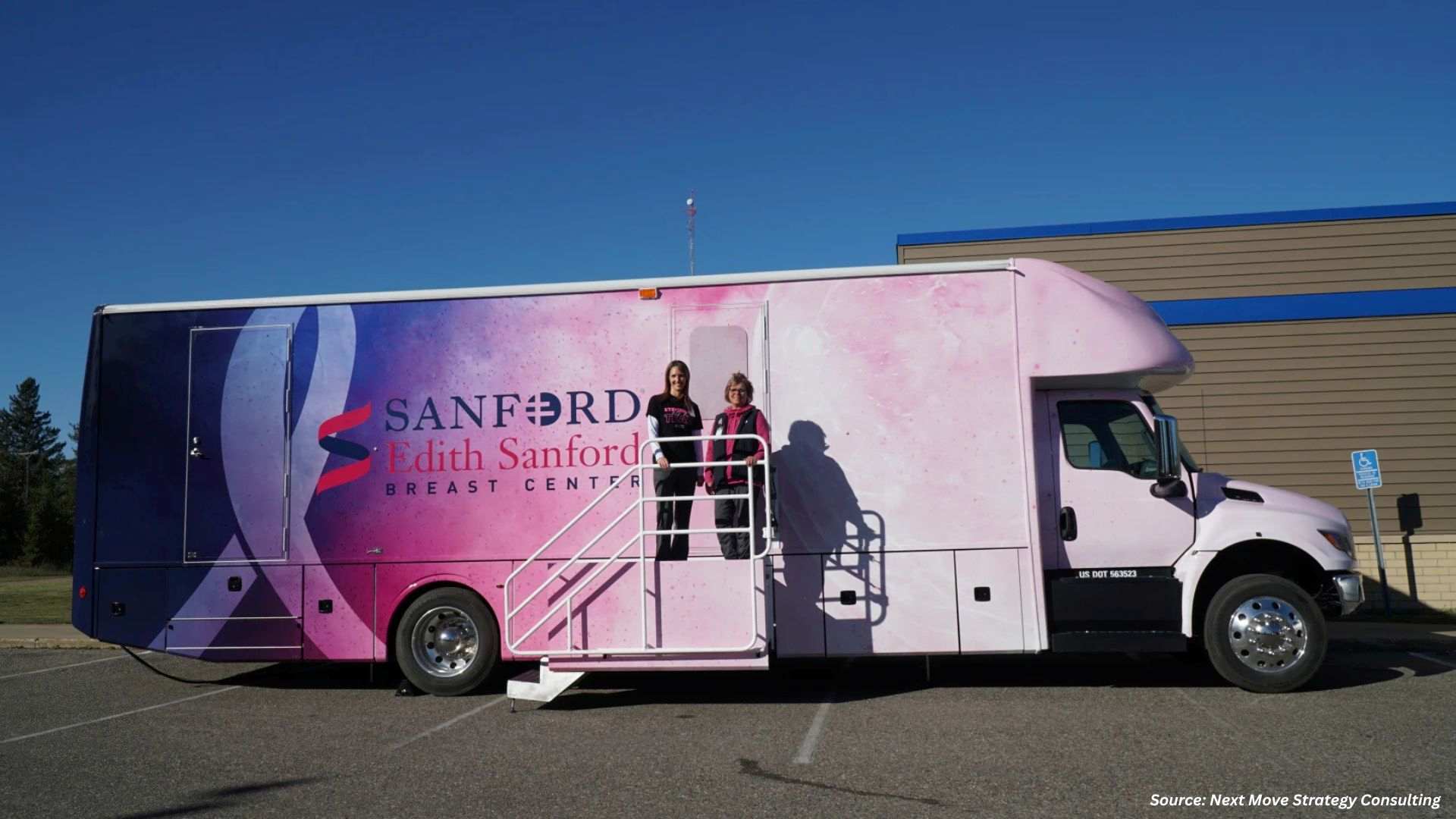
Sanford Health’s deployment of a mobile mammography truck is a direct response to geographic and socioeconomic barriers in healthcare. By bringing screening services to rural and underserved populations, mobile units help detect cancers earlier in areas where hospitals or clinics may be sparse.
These mobile platforms represent a strategic shift in how mammography services are delivered, combining technological capability with outreach to maximize screening coverage. Such initiatives can improve population health outcomes and reduce disparities in breast cancer detection.
4. Next Move Strategy Consulting – Opinion, Impact, and Near-Term Prospects
Next Move Strategy Consulting interprets these developments as evidence of a maturing Mammography Market, where innovation is measured not just by new technology but by accessibility, workflow efficiency, and clinical impact.
-
AI integration as a growth driver: Tools that improve detection accuracy and reduce workload are set to become standard, driving both software and service opportunities in clinical settings.
-
3D imaging as the new baseline: Hospitals adopting DBT systems are likely to set new diagnostic standards, accelerating legacy system replacement and shaping procurement cycles.
-
Mobile screening as a market differentiator: Outreach-focused units expand access and patient volumes, particularly in rural areas, creating opportunities for service providers and mobile imaging technology developers.
-
Regulatory and training implications: Integrating AI and 3D imaging requires careful attention to clinician training, data security, and compliance, which could become high-margin consulting and service areas.
-
Investment signals: Companies offering scalable AI solutions, advanced imaging systems, or mobile mammography platforms are well-positioned for partnerships, acquisitions, or expansion into new geographies.

5. Practical Suggestions for Stakeholders
-
Healthcare providers should prioritize AI-assisted and 3D mammography integration while planning outreach programs for underserved populations.
-
Technology vendors must support scalable AI deployment, training, and regulatory compliance to facilitate adoption.
-
Investors should focus on firms offering solutions that combine detection accuracy, workflow efficiency, and accessibility.
-
Policymakers can encourage mobile screening adoption and fund AI and 3D imaging pilot programs to improve early detection rates nationwide.
Conclusion
The integration of AI-assisted DBT, 3D imaging systems, and mobile mammography units signals a shift in the Mammography Market from conventional, facility-based screening toward a model emphasizing precision, scalability, and access. Stakeholders aligning technological innovation with operational feasibility and population health impact are likely to capture the most value as mammography becomes increasingly accurate, efficient, and inclusive.
About Next Move Strategy Consulting:
Next Move Strategy Consulting is a premier market research and management consulting firm that has been committed to providing strategically analysed well documented latest research reports to its clients. The research industry is flooded with many firms to choose from, what makes Next Move different from the rest is its top-quality research and the obsession of turning data into knowledge by dissecting every bit of it and providing fact-based research recommendation that is supported by information collected from over 500 million websites, paid databases, industry journals and one on one consultations with industry experts across a diverse range of industry sectors. The high-quality customized research reports with actionable insights and excellent end-to-end customer service help our clients to take critical business decisions that enables them to move beyond time and have competitive edge in the industry.
We have been servicing over 1000 customers globally that includes 90% of the Fortune 500 companies over a decade. Our analysts are constantly tracking various high growth markets and identifying hidden opportunities in each sector or the industry. We provide one of the industry’s best quality syndicate as well as custom research reports across 10 different industry verticals. We are committed to deliver high quality research solutions in accordance to your business needs. Our industry standard delivery solutions that ranges from the pre consultation to after-sales services, provide an excellent client experience and ensure right strategic decision making for businesses.
For more information please contact:
Next Move Strategy Consulting
5th Floor 867
Boylston St, STE 500,
Boston, MA 02116, U.S.
E-Mail: [email protected]
Direct: +1-857-758-5017
Website: www.nextmsc.com
About the Author
 Sanyukta Deb
— Sanyukta Deb is Digital Marketing Team Lead at Next Move Strategy Consulting, where she has led content strategy and technical SEO for the firm's B2B market research publications for over 2 years. Her editorial process translates NextMSC's primary and secondary research — spanning technology, industrial, and consumer sectors — into commercial narratives, backed by search-intent, keyword, and competitive analysis. She brings 5 years of overall experience in digital marketing and content strategy.
Sanyukta Deb
— Sanyukta Deb is Digital Marketing Team Lead at Next Move Strategy Consulting, where she has led content strategy and technical SEO for the firm's B2B market research publications for over 2 years. Her editorial process translates NextMSC's primary and secondary research — spanning technology, industrial, and consumer sectors — into commercial narratives, backed by search-intent, keyword, and competitive analysis. She brings 5 years of overall experience in digital marketing and content strategy.
About the Reviewer
 Debashree Dey
— Debashree Dey is Assistant Manager at Next Move Strategy Consulting, where she supports cross-vertical market content and communications across diverse industries for 6 years. Her professional background includes senior content writing, communications, and published manuscript authorship, with experience developing audience-focused business narratives and maintaining clear, consistent messaging. Her role supports research-led content development and editorial quality across NextMSC publications.
Debashree Dey
— Debashree Dey is Assistant Manager at Next Move Strategy Consulting, where she supports cross-vertical market content and communications across diverse industries for 6 years. Her professional background includes senior content writing, communications, and published manuscript authorship, with experience developing audience-focused business narratives and maintaining clear, consistent messaging. Her role supports research-led content development and editorial quality across NextMSC publications.
















Add Comment