McDonald’s Pilots Humanoid Robots in China’s Service Sector
Industry Insights from Next Move Strategy Consulting
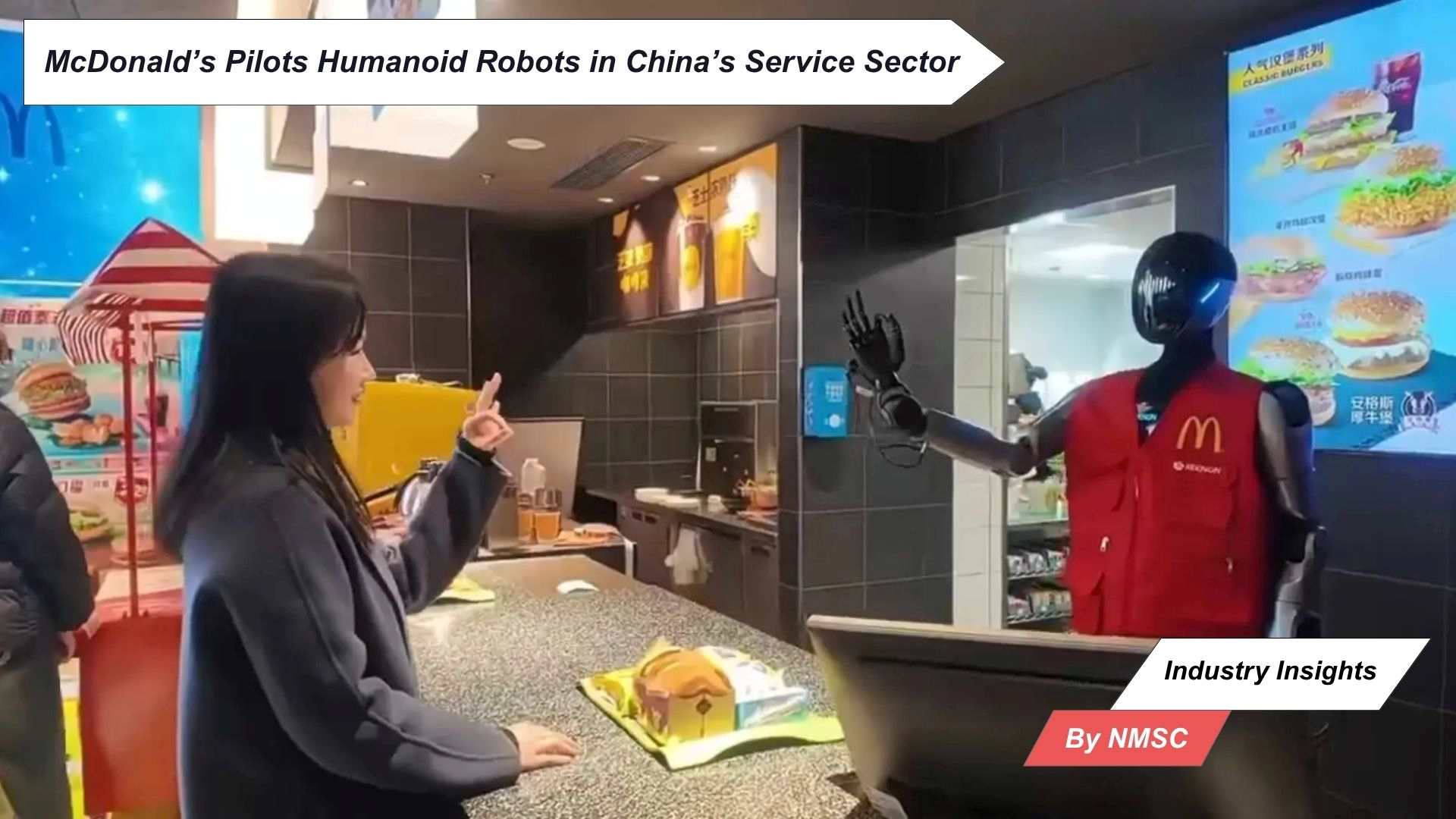
As automation continues to reshape the global service industry, McDonald's has introduced a pilot program featuring humanoid robots at a restaurant in a Chinese city. This development signals a notable advancement within the Modular Robotics Market, highlighting the increasing integration of robotics into everyday customer service environments.
A New Step Toward Automated Customer Experience
In an effort to enhance operational efficiency and customer engagement, McDonald’s has begun testing humanoid robots capable of greeting customers and serving meals. These robots are designed to interact directly with visitors, offering a glimpse into how automation can complement human-led service models in high-traffic food service settings.
The pilot reflects a broader shift toward adopting intelligent robotic systems in commercial environments, where speed, consistency, and novelty play a crucial role in customer satisfaction. By embedding robotics into front-end operations, the company is exploring new ways to streamline workflows while creating a differentiated in-store experience.
Key Functional Highlights of the Robotic System:
-
Greeting customers upon entry, enhancing first-point interaction
-
Assisting in meal delivery within the restaurant space
-
Supporting staff by handling repetitive service tasks
-
Providing an interactive and tech-driven dining environment
Modular Robotics Driving Flexibility and Scalability
The deployment of humanoid robots in this pilot underscores the growing relevance of modular robotics—systems designed with adaptable components that can be configured for multiple functions. Such flexibility enables businesses to scale robotic applications based on operational needs, from customer interaction to logistics support.
In fast-paced service sectors like quick-service restaurants, modular robots offer the advantage of easy upgrades and customization. This allows companies to continuously refine capabilities without overhauling entire systems, making automation more practical and cost-effective over time.
Industry Response and Strategic Implications
The introduction of humanoid robots in a real-world retail setting has drawn attention from both technology developers and service industry stakeholders. It reflects a broader trend toward blending artificial intelligence and robotics with consumer-facing roles, traditionally dominated by human workers.
As companies seek to optimize labor efficiency and enhance customer engagement, such pilot programs are expected to play a critical role in shaping future investment decisions across the robotics and automation landscape.
According to Next Move Strategy Consulting
This development is expected to accelerate demand within the modular robots market, particularly in the service and hospitality sectors. The successful integration of humanoid robots in customer-facing roles could drive increased adoption of flexible robotic systems, encouraging innovation in design, functionality, and scalability. As businesses continue to prioritize automation for efficiency and differentiation, modular robotics is likely to emerge as a key enabler of next-generation service models.
Advancing the Future of Service Automation
McDonald’s pilot initiative represents more than a technological experiment—it reflects a strategic move toward redefining customer interaction through automation. As robotics technology continues to evolve, such real-world applications are set to influence how businesses balance human and machine collaboration in delivering seamless service experiences.
Source: New York Post
Prepared By: Next Move Strategy Consulting
About the Author
 Sanyukta Deb
— Sanyukta Deb is Digital Marketing Team Lead at Next Move Strategy Consulting, where she has led content strategy and technical SEO for the firm's B2B market research publications for over 2 years. Her editorial process translates NextMSC's primary and secondary research — spanning technology, industrial, and consumer sectors — into commercial narratives, backed by search-intent, keyword, and competitive analysis. She brings 5 years of overall experience in digital marketing and content strategy.
Sanyukta Deb
— Sanyukta Deb is Digital Marketing Team Lead at Next Move Strategy Consulting, where she has led content strategy and technical SEO for the firm's B2B market research publications for over 2 years. Her editorial process translates NextMSC's primary and secondary research — spanning technology, industrial, and consumer sectors — into commercial narratives, backed by search-intent, keyword, and competitive analysis. She brings 5 years of overall experience in digital marketing and content strategy.
About the Reviewer
 Debashree Dey
— Debashree Dey is Assistant Manager at Next Move Strategy Consulting, where she supports cross-vertical market content and communications across diverse industries for 6 years. Her professional background includes senior content writing, communications, and published manuscript authorship, with experience developing audience-focused business narratives and maintaining clear, consistent messaging. Her role supports research-led content development and editorial quality across NextMSC publications.
Debashree Dey
— Debashree Dey is Assistant Manager at Next Move Strategy Consulting, where she supports cross-vertical market content and communications across diverse industries for 6 years. Her professional background includes senior content writing, communications, and published manuscript authorship, with experience developing audience-focused business narratives and maintaining clear, consistent messaging. Her role supports research-led content development and editorial quality across NextMSC publications.

















Add Comment