Meta's JEM Pushes Self-Supervised Vision Training to 7 billion Parameters

Meta FAIR's JEM Result Shows Self-Supervised Models Can Beat DINOv3 on Panoptic Segmentation With 12× Less Data, Reframing the Training-Cost Case for Enterprise Vision AI
On 7 October 2026, Meta FAIR researchers Maximilian Seitzer, Gabriele Trivigno, Piotr Bojanowski and colleagues posted "Scalable Patch-Level Self-Supervised Learning" (arXiv:2610.10013), introducing JEM, a training method that learns visual representations from unlabelled images and, according to the authors, is the first latent-space patch-level method demonstrated at 7 billion parameters. Meta FAIR reported that at that scale JEM exceeds the DINOv3 model on panoptic segmentation despite being trained on 12 times less data and without refinement stages.
According to Next Move Strategy Consulting's Self-Supervised Learning Market report, the global market is projected to reach USD 95.14 billion by 2030, growing at a CAGR of 34.0% from 2025 to 2030. NextMSC primary research and analysis identifies the high cost of training self-supervised systems, which demand extensive data and processing capacity, as the main restraint on adoption among start-ups and smaller firms, which is the constraint that the JEM result addresses most directly.
For More Information: Download FREE Sample on Self-Supervised Learning Market Report
What Meta FAIR Disclosed on 7 October
JEM is a student-teacher method: a student network sees one altered view of an image, a teacher network (an exponential moving average of the student) sees another, and the student learns to match the teacher's patch-level targets across the overlapping regions. Meta FAIR states that the method rests on a single information-theoretic objective, with an alignment loss plus two regularisers that prevent the model from collapsing to a trivial solution, rather than the stacked objectives used by earlier large-scale vision models. The team trained ViT-L, ViT-g and ViT-7B encoders; the ViT-g model ran for 500,000 iterations at a global batch size of 3,072, on public ImageNet data and on A140M, an open reproduction of the curated 142-million-image LVD-142M dataset.
The paper's ablation results show which component carries the training signal. In ViT-L models trained on ImageNet-22k for 250,000 steps, removing the global collapse regulariser reduced ImageNet-1k attention-probe accuracy from 82.8 to 10.3 and ADE20k segmentation mIoU from 48.1 to 0.5, meaning the model failed outright. Removing the alignment loss cut accuracy to 63.1 and mIoU to 22.4. Removing the structural regulariser changed the two scores by only 0.5 and 0.1, to 82.3 and 48.0, in that test configuration.
Training compute is the scarce input behind those runs, and it is geographically concentrated. The International Energy Agency reported in its Energy and AI report, published in April 2025, that the United States accounted for 45% of global data centre electricity consumption in 2024, China for 25% and Europe for 15%. NextMSC primary research and analysis reads that concentration as a cost signal for the market: a training recipe that needs 12 times less data, as Meta FAIR reports for JEM, lowers the compute bill most for organisations that sit outside those three power-rich regions.
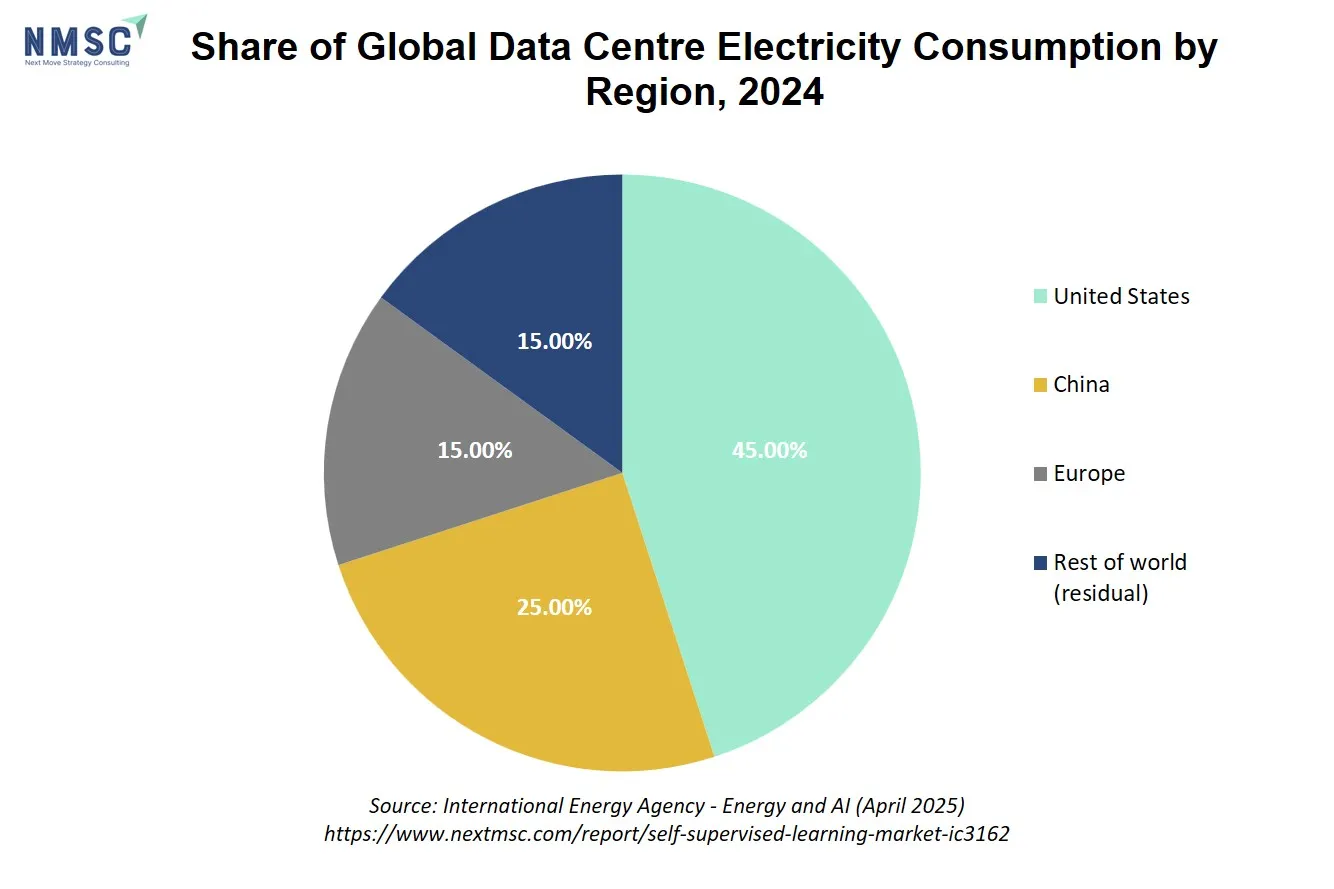
The International Energy Agency's three named regions together account for 85% of global data centre electricity consumption; the remaining 15% is shown as the residual of that total.
JEM Objective Ablation (ViT-L, ImageNet-22k, 250,000 Steps)
|
Configuration |
ImageNet-1k accuracy |
ADE20k mIoU |
|
Full JEM model |
82.8 |
48.1 |
|
Without alignment loss |
63.1 |
22.4 |
|
Without global collapse regulariser |
10.3 |
0.5 |
|
Without structural collapse regulariser |
82.3 |
48.0 |
Key Industry Developments: Three Milestones That Frame the Shift
The JEM paper is the latest of three dated disclosures that show self-supervised methods moving from benchmark research toward physical-world applications. On 9 March 2026, TechCrunch reported that AMI Labs, the venture co-founded by Turing Award winner Yann LeCun after he left Meta, raised USD 1.03 billion at a USD 3.5 billion pre-money valuation to build world models based on the Joint Embedding Predictive Architecture. TechCrunch reported that the company has no plans to generate revenue for the time being and that it could take years for world models to move from theory to commercial applications.
“My prediction is that 'world models' will be the next buzzword.”
- Alexandre LeBrun, Chief Executive Officer, AMI Labs, TechCrunch, March 9, 2026.
A week later, FAIR at Meta released V-JEPA 2.1, a family of self-supervised video models that includes ViT-g and ViT-G encoders of 1 billion and 2 billion parameters and two distilled variants of 80 million and 300 million parameters. The authors report that its dense features produced a 20% higher grasp success rate than V-JEPA 2-AC on real Franka robot arms, deployed zero-shot in a new environment. The commercial implication is that representations learned without labels are now being tested on robot manipulation, where annotating every frame of motion data would be prohibitively slow.
Selected 2026 Self-Supervised Learning Milestones
|
Date |
Organisation |
Milestone |
Disclosed detail |
|
9 March 2026 |
AMI Labs |
Seed financing for JEPA-based world models |
USD 1.03 billion at USD 3.5 billion pre-money valuation |
|
16 March 2026 |
FAIR at Meta |
V-JEPA 2.1 released |
Models of 80 million to 2 billion parameters; 20% higher grasp success rate than V-JEPA 2-AC on Franka arms, zero-shot |
|
7 October 2026 |
Meta FAIR |
JEM introduced |
Trains stably from 300 million to 7 billion parameters; exceeds DINOv3 on panoptic segmentation with 12 times less data |
Demand Signal: Enterprise AI Adoption in Europe
Lower training cost matters only if enterprises have the appetite to deploy. Eurostat reported on 11 December 2025 that 20.0% of EU enterprises with 10 or more employees used artificial intelligence technologies in 2025, up 6.5 percentage points from 13.5% in 2024. Adoption was highest in Denmark at 42.0%, Finland at 37.8% and Sweden at 35.0%, and lowest in Romania at 5.2%, Poland at 8.4% and Bulgaria at 8.5%. These figures measure AI use in general, not self-supervised learning specifically, but the 36.8 percentage-point gap between Denmark and Romania shows how much of the European enterprise base has not yet adopted any AI technology.
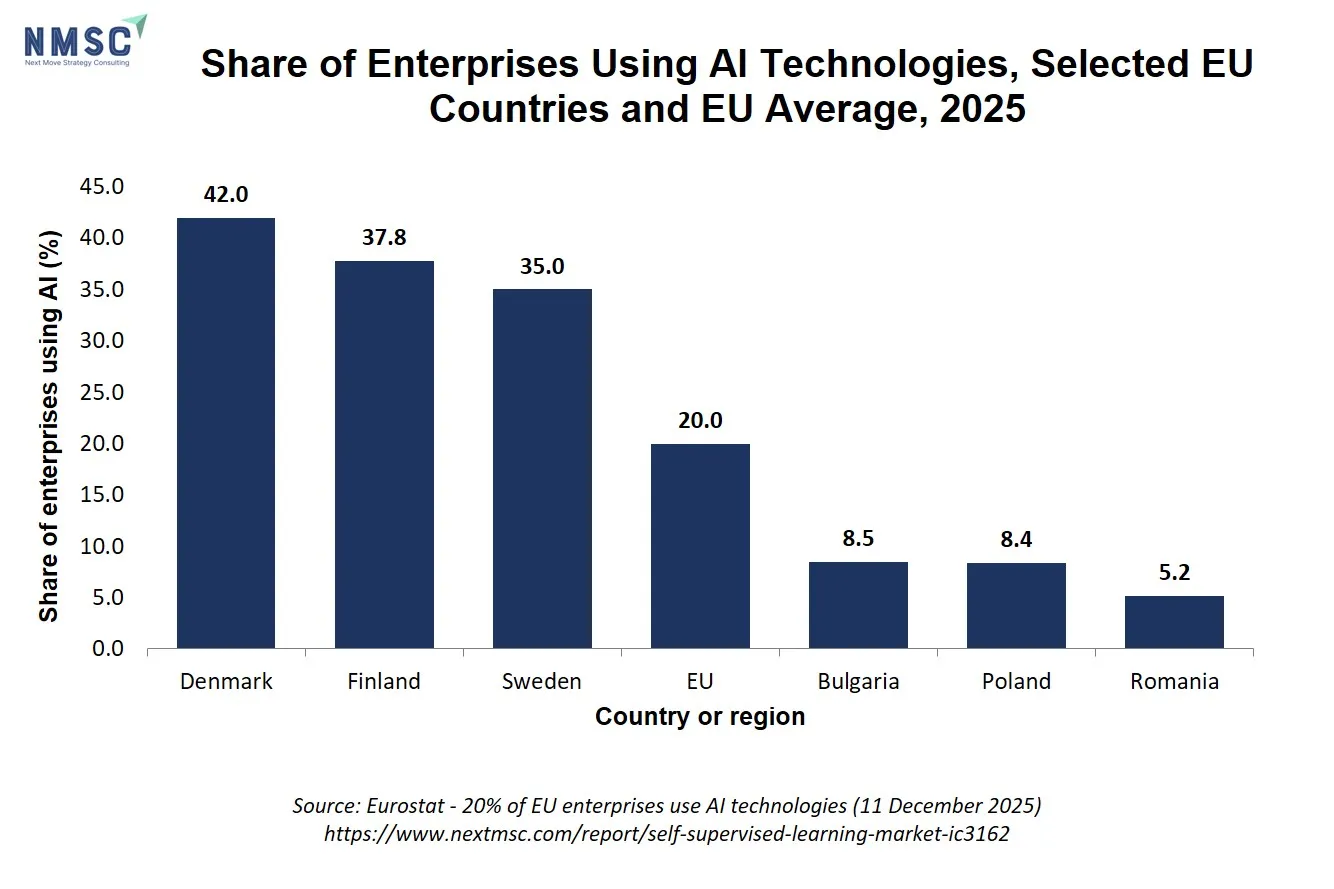
Eurostat (Statistics Explained), in its article on the use of artificial intelligence in enterprises extracted in December 2025, added that 55.03% of large EU enterprises used AI technologies in 2025 and that the information and communication sector used them most, which shows that adoption among large firms is far above the 19.95% recorded across all EU enterprises.
NextMSC primary research and analysis defines self-supervised learning as a method in which systems learn from unlabelled data, which reduces dependency on labelled datasets. That feature is the mechanism through which a cheaper training recipe such as JEM could widen the addressable base: firms without large annotation budgets can still build vision systems, provided they can fund the compute. The Stanford Institute for Human-Centered Artificial Intelligence published the ninth edition of its AI Index Report on 13 April 2026, with separate chapters on research and development, technical performance and the economy.
Segment Dynamics and Regional Outlook
NextMSC primary research and analysis segments the market by technology into natural language processing, computer vision and speech processing, and by end user into BFSI, automotive and transportation, healthcare, media and entertainment, IT, manufacturing and other industries. The JEM and V-JEPA 2.1 results sit squarely in the computer vision segment, whose sub-segments in the NextMSC report include quality assurance and inspection, measurement, identification and predictive maintenance.
NextMSC primary research and analysis holds that North America has the dominant regional share and expects it to remain so during the forecast period, citing healthcare investment in the United States and Canada and the presence of players such as AWS, IBM Corporation and Alphabet Inc. Asia-Pacific is expected to grow steadily, in the report's assessment, on the strength of its automotive industry and the use of unsupervised algorithms in advanced driver assistance systems.
NMSC Strategic Perspective: Efficiency Becomes the Competitive Variable
NextMSC primary research and analysis reads the 2026 disclosures as evidence that the competitive variable in self-supervised learning is shifting from model scale alone to training efficiency. NextMSC's forecast implies USD 78.75 billion of absolute market expansion between 2024 and 2030, and the report's own list of growth factors, which spans the BFSI sector, the automotive industry and advances in artificial intelligence, depends on organisations being able to afford training at that scale. A method that reaches comparable dense-prediction quality on a smaller dataset and a shorter schedule, as Meta FAIR reports for JEM against DINOv3, converts directly into a lower entry cost for the smaller firms that NextMSC identifies as the most constrained buyers.
NextMSC primary research and analysis also notes that the opportunity the report attributes to graph neural networks and generative adversarial networks will be easier to capture if foundation-model training recipes become simpler and more reproducible. Meta FAIR's choice to derive JEM from a single objective, rather than combine several tuned losses, is a design direction that favours reproducibility. The limits are equally clear: the DINOv3 comparison involves models trained on different datasets and schedules, since the authors note that JEM ran for a shorter time on a smaller dataset, and the result is a research disclosure, not a commercial product, so revenue effects will lag the technical signal.
Competitive Landscape
The NextMSC report profiles 15 companies, including IBM Corporation, Alphabet Inc, Microsoft Corporation, Amazon Web Services, Meta, SAS Institute Inc, DataRobot Inc, Apple Inc, Baidu Inc and DeepMind Technologies. Within that group, Meta has used 2026 to publish two documented advances: V-JEPA 2.1 in March, released with code and pretrained models, and JEM in October. Outside the profiled set, TechCrunch reported that AMI Labs will publish papers as it goes, which keeps a second JEPA-based research pipeline in public view.
The pattern favours organisations that can combine research output with distribution. Cloud providers and enterprise software vendors in the NextMSC list control the channels through which new training recipes reach BFSI, automotive and healthcare customers, while research-led entrants set the technical frontier that those channels later adopt.
Bottom Line
Meta FAIR's 7 October 2026 JEM paper adds to a year of disclosures in which self-supervised learning moved closer to production use. JEM trains stably up to 7 billion parameters and, on panoptic segmentation, exceeds DINOv3 using 12 times less data, while AMI Labs' USD 1.03 billion financing and V-JEPA 2.1's gains in robot grasping show capital and research converging on the same method. NextMSC primary research and analysis values the global self-supervised learning market at USD 16.39 billion in 2024 and projects USD 95.14 billion by 2030 at a 34.0% CAGR, with training cost as the principal restraint. Eurostat data showing 20.0% of EU enterprises using AI in 2025 leaves a wide base of non-adopters. The decisive questions for 2027 are whether efficiency gains such as JEM's reach commercial platforms, and whether smaller firms can convert cheaper training into deployed systems.
About Next Move Strategy Consulting
Next Move Strategy Consulting is a premier market research and management consulting firm that has been committed to provide strategically analysed well documented latest research reports to its clients. The research industry is flooded with many firms to choose from, what makes NMSC different from the rest is its top-quality research and the obsession of turning data into knowledge by dissecting every bit of it and providing fact-based research recommendation that is supported by information collected from over 500 million websites, paid databases, industry journals and one on one consultations with industry experts across a diverse range of industry sectors. The high-quality customized research reports with actionable insights and excellent end-to-end customer service help our clients to take critical business decisions that enables them to move beyond time and have competitive edge in the industry.
We have been servicing over 1000 customers globally that includes 90% of the Fortune 500 companies over a decade. Our analysts are constantly tracking various high growth markets and identifying hidden opportunities in each sector or the industry. We provide one of the industry’s best quality syndicate as well as custom research reports across 10 different industry verticals. We are committed to deliver high quality research solutions in accordance to your business needs. Our industry standard delivery solutions that ranges from the pre consultation to after-sales services, provide an excellent client experience and ensure right strategic decision making for businesses.
For more information, please contact:
Next Move Strategy Consulting
5th Floor 867 Boylston St, STE 500,
Boston, MA 02116, U.S.
E-Mail: [email protected]
Direct: +1-217-650-7991
Website: www.nextmsc.com
About the Author
 Priyanshu Das
— Priyanshu Das is SEO Executive at Next Move Strategy Consulting, where he has led on-page and off-page SEO, keyword research, and SEO audits for the firm's B2B market research publications for 2 years. His audit process combines technical crawl analysis, backlink profile review, and competitor keyword gap mapping — using tools including Screaming Frog and Google Search Console — to prioritize fixes by organic search-visibility impact, informed by his own prior in-house and agency SEO experience.
About the Reviewer
 Debashree Dey
— Debashree Dey is Assistant Manager at Next Move Strategy Consulting, where she supports cross-vertical market content and communications across diverse industries for 6 years. Her professional background includes senior content writing, communications, and published manuscript authorship, with experience developing audience-focused business narratives and maintaining clear, consistent messaging. Her role supports research-led content development and editorial quality across NextMSC publications.

















Add Comment