Microsoft, Amazon, Google Cloud Backlogs Each Top Half a Trillion Dollars

Contracted AI demand now runs to hundreds of billions of dollars at the three largest cloud providers, as Google Cloud revenue doubled and AWS posted its fastest growth in nearly five years
Microsoft Corp., Alphabet Inc. and Amazon.com, Inc. each reported third-quarter results on October 28 and 29, 2026 showing that enterprise demand for hosted artificial intelligence is turning into contracted, multi-year revenue. Microsoft disclosed commercial remaining performance obligation of $677 billion, up 73%. Amazon's AWS segment posted net sales of $46.0 billion, up 39%, its fastest growth in nearly five years. Google Cloud revenue rose 103% to $30.7 billion, and The Next Web, citing Reuters, reported on October 29, 2026 that the Google Cloud backlog reached $561 billion. Published within two days of one another, the three disclosures put each company's contracted pipeline above half a trillion dollars.
According to Next Move Strategy Consulting's report on the global AI as a Service Market, the market was valued at USD 24.73 billion in 2024 and is projected to reach USD 190.63 billion by 2030, growing at a CAGR of 40.2% from 2026 to 2030. NextMSC primary research and analysis places the 2025 value at USD 35.32 billion. The report, titled Artificial Intelligence as a Service Market, covers software, platform and infrastructure offerings delivered through the cloud.
For More Information: Download FREE Sample on AI as a Service Market Report
What Microsoft, Amazon and Alphabet Reported
Microsoft announced first quarter fiscal 2027 results on October 28, 2026, for the quarter ended September 30, 2026. Revenue was $92.3 billion, up 19%, and Microsoft Cloud revenue was $63.9 billion, up 30% (31% in constant currency). Azure revenue increased 48%, and revenue in the Agents and Infra segment was $76.8 billion, up 25%. Commercial remaining performance obligation, which is contracted revenue not yet recognised across Microsoft's commercial business, increased 73% to $677 billion. Because that measure spans all commercial contracts rather than Azure alone, it is not a pure AI backlog; it is the forward-demand measure that Microsoft reports.
“By helping organizations build and own their own intelligence, and earning trust through agent safety and security, we are translating our innovation into growing adoption and real-world impact across every industry.”
- Satya Nadella, Chairman and Chief Executive Officer, Microsoft Corp., Microsoft Announces First Quarter Results, October 28, 2026.
Amazon.com, Inc. published third quarter results on October 29, 2026. AWS segment net sales increased 39% to $46.0 billion from $33.0 billion in the third quarter of 2025, and AWS operating income rose to $17.8 billion from $11.4 billion. Amazon put the AWS annualised revenue run rate at $184 billion. According to Amazon, Fortune 500 companies spent nearly 7 times more on Amazon Bedrock, its inference service, than a year earlier, and total Bedrock token volume grew nearly 17 times. Amazon also said it continues to expect 2026 cash capital expenditures of approximately $220 billion. CIO Dive reported on October 30, 2026 that the AWS backlog grew at a triple-digit rate year over year to $578 billion, and that Amazon CEO Andy Jassy told investors on the earnings call that the company is installing one AI accelerator about every 14 seconds.
“Our AWS investment in functionality and infrastructure is working, with over 39% year-over-year revenue growth in Q3 ($184 billion revenue run rate) and projected revenue growth rates of over 40% both in 2027 and in 2028.”
- Andy Jassy, President and Chief Executive Officer, Amazon.com, Inc., Amazon.com Announces Third Quarter Results, October 29, 2026.
The segment mix in Amazon's own results shows how quickly AI-driven cloud revenue is changing the group. AWS represented 23% of Amazon net sales in the third quarter of 2026, up from 18% in the third quarter of 2025, while North America fell to 56% from 59% and International to 21% from 23%. Amazon.com, Inc. reported total net sales of $201.9 billion for the quarter, up 12%.
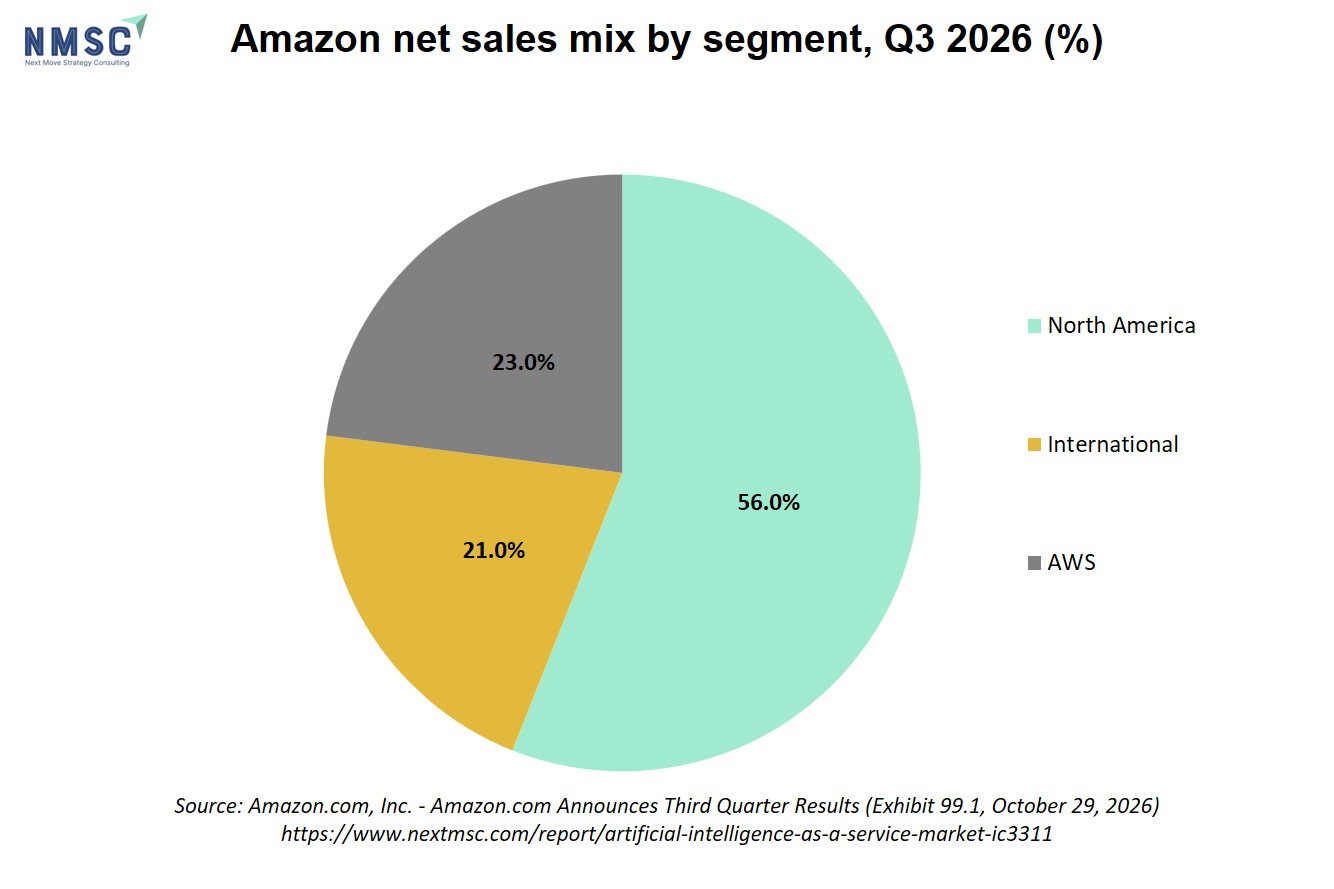
Amazon.com, Inc. reports net sales mix of 56% for North America, 21% for International and 23% for AWS in the third quarter of 2026.
Alphabet Inc. announced third quarter 2026 results on October 28, 2026. Alphabet said Google Cloud revenues increased 103% to $30.7 billion, from $15.2 billion in the third quarter of 2025, led by Google Cloud Platform across enterprise AI infrastructure and enterprise AI solutions, with TPU systems sales described as a meaningful contributor. Google Cloud operating income was $11.1 billion, compared with $3.6 billion a year earlier, and consolidated Alphabet revenues rose 25% to $127.6 billion. The Next Web, citing Reuters, reported on October 29, 2026 that the Google Cloud backlog of contracted revenue reached $561 billion, that Alphabet expects to recognise more than 55% of it within two years, and that the company kept its 2026 capital spending forecast at $195 billion to $205 billion, with spending set to rise significantly again in 2027.
“Google Cloud revenues grew 103%, powered by huge demand for our AI infrastructure and AI solutions.”
- Sundar Pichai, Chief Executive Officer of Google and Alphabet, Alphabet Inc., Alphabet Announces Third Quarter 2026 Results, October 28, 2026.
The table below sets the three disclosures side by side. Backlog definitions differ by company, so the final column should be read as each company's own measure of contracted, not-yet-recognised demand rather than as a like-for-like total.
Third-quarter 2026 cloud results and contracted backlog at the three largest providers
|
Company |
Cloud revenue measure |
Q3 2026 revenue |
Year-over-year growth |
Contracted backlog |
|
Microsoft Corp. |
Microsoft Cloud revenue |
$63.9 billion |
30% (Azure revenue: 48%) |
$677 billion commercial remaining performance obligation, up 73% |
|
Amazon.com, Inc. |
AWS segment net sales |
$46.0 billion |
39% |
$578 billion |
|
Alphabet Inc. |
Google Cloud revenue |
$30.7 billion |
103% |
$561 billion |
How the Cloud Profit Pool Moved Year over Year
Two of the three companies report a stand-alone operating income line for their cloud segment. AWS operating income rose to $17,773 million in the third quarter of 2026 from $11,434 million a year earlier, on net sales that grew from $33,006 million to $45,984 million. Google Cloud operating income increased to $11,121 million from $3,594 million as revenue moved from $15,157 million to $30,709 million. Both segments therefore added profit as well as revenue while the companies continued to raise capital spending on AI capacity.
AWS and Google Cloud segment results, third quarter 2025 versus third quarter 2026 (USD million)
|
Segment |
Revenue Q3 2025 |
Revenue Q3 2026 |
Operating income Q3 2025 |
Operating income Q3 2026 |
|
AWS (Amazon.com, Inc.) |
33,006 |
45,984 |
11,434 |
17,773 |
|
Google Cloud (Alphabet Inc.) |
15,157 |
30,709 |
3,594 |
11,121 |
Where Enterprise Adoption Stands Outside the Hyperscalers
Eurostat reported on December 11, 2025, in its news article 20% of EU enterprises use AI technologies, that 20.0% of EU enterprises with 10 or more employees used AI technologies in 2025, up 6.5 percentage points from 13.5% in 2024. The share was 7.7% in 2021 and 8.1% in 2023. Denmark (42.0%), Finland (37.8%) and Sweden (35.0%) recorded the highest shares in 2025, while Romania (5.2%), Poland (8.4%) and Bulgaria (8.5%) recorded the lowest. The most common application was analysing written language (11.8% of enterprises), followed by generating pictures, video or audio (9.5%), generating written or spoken language (8.8%) and converting speech into machine-readable format (7.2%).
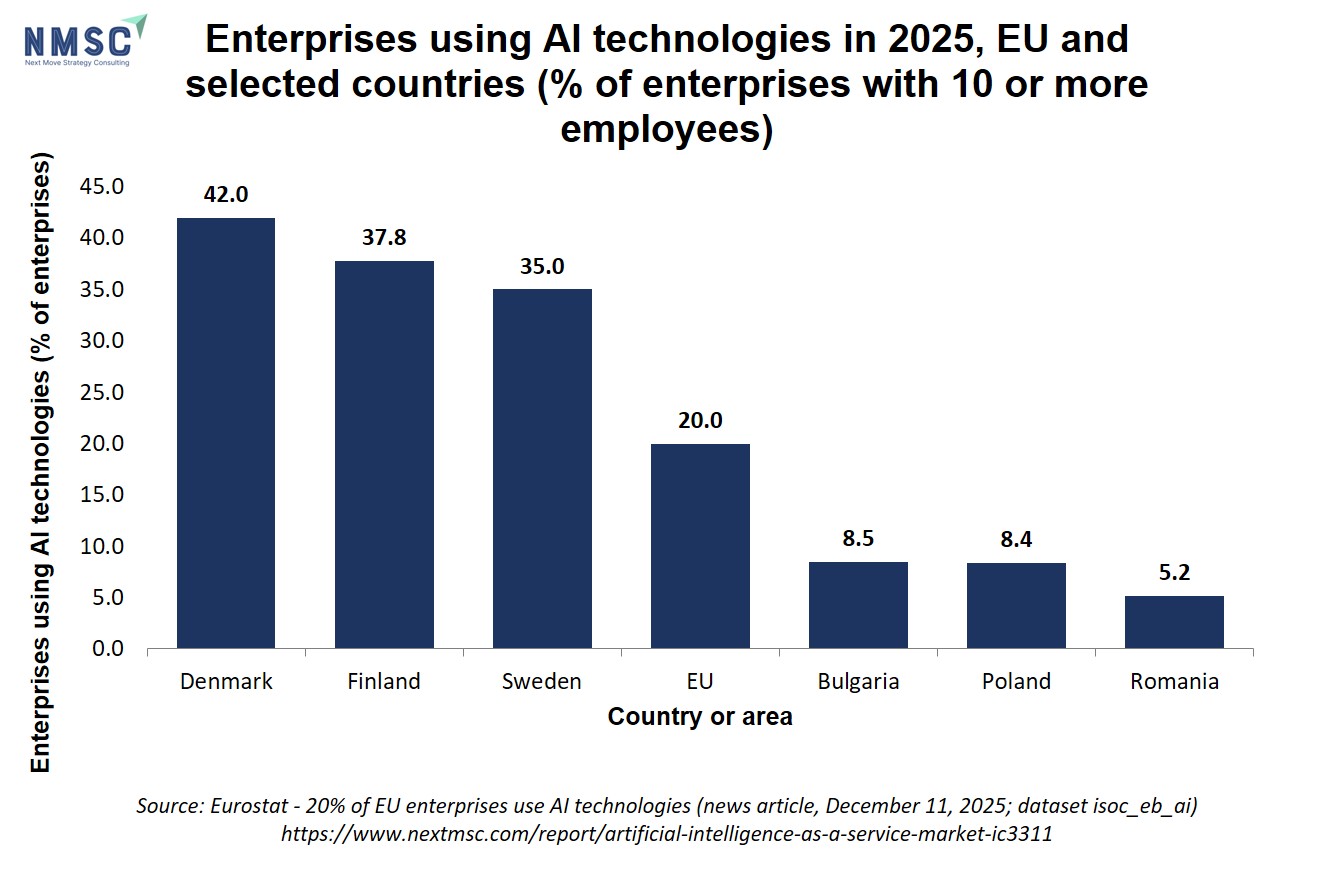
Eurostat reports the highest 2025 shares in Denmark, Finland and Sweden and the lowest in Romania, Poland and Bulgaria.
Share of EU enterprises with 10 or more employees using AI technologies
|
Year |
Enterprises using AI technologies (% of enterprises) |
|
2021 |
7.7 |
|
2023 |
8.1 |
|
2024 |
13.5 |
|
2025 |
20.0 |
In the United States, the U.S. Census Bureau analysed its Business Trends and Outlook Survey in a May 2026 article titled Large Firms With at Least 20 Employees Biggest AI Users. It found that overall business AI use hovered between 17% and 20% from December 14, 2025 to May 3, 2026, and that between 20% and 23% of businesses expected to use AI within six months. As of May 3, 2026, the national rate was 19.8%, compared with 39.7% in the Information sector and 33.9% in Finance and Insurance. Larger firms reported higher use: 37% of firms with at least 250 employees, and 32% of firms with 100 to 249 employees in the period ending May 3, 2026. The Census Bureau also noted that it revised its core question in November 2025 to cover AI use in any business function, which affects comparisons with earlier survey readings.
AI use by U.S. businesses, Business Trends and Outlook Survey, period ending May 3, 2026
|
Business group |
Share reporting AI use (%) |
|
All U.S. businesses (national rate, as of May 3, 2026) |
19.8 |
|
Information sector (as of May 3, 2026) |
39.7 |
|
Finance and Insurance sector (as of May 3, 2026) |
33.9 |
|
Firms with at least 250 employees |
37 |
|
Firms with 100 to 249 employees |
32 |
NMSC Strategic Perspective: Backlogs Meet the AIaaS Forecast
NextMSC primary research and analysis defines the Artificial Intelligence as a Service (AIaaS) market across three offering types: software as a service, platform as a service and infrastructure as a service. The infrastructure layer includes cloud GPU and compute, AI storage and data lakes, and AI networking and accelerators, which is the layer that the capital expenditure and backlog disclosures from Amazon, Alphabet and Microsoft touch most directly. The NextMSC report also segments the market by technology capability (machine learning, natural language processing, computer vision, generative AI and decision support systems), deployment mode, organisation size, industry vertical and region.
The NextMSC forecast of USD 190.63 billion by 2030, from USD 35.32 billion in 2025, rests on drivers that the October disclosures illustrate with company-reported figures: rising adoption of AI across industries, demand for cost-efficient and scalable AI solutions, and advances in cloud computing infrastructure that support AI deployment. Amazon's reported near-17-fold growth in Bedrock token volume, and Alphabet's report that its first-party model APIs process nearly 32 billion tokens per minute, more than four times a year earlier, are examples of usage growth that sits within the platform and infrastructure layers of the AIaaS definition.
The comparison has limits. The cloud lines reported by the three companies include workloads that are not AI services, and Microsoft's remaining performance obligation covers all commercial contracts, so those figures cannot be added to, or netted against, the NextMSC market value. NextMSC primary research and analysis treats the earnings disclosures as directional evidence of demand rather than as a measurement of the AIaaS market itself.
The NextMSC report also identifies constraints: high infrastructure costs from scaling AI and cloud capacity that weigh most on smaller firms, regulatory pressure in Europe and North America that requires stricter data privacy and sustainability practices, and skill shortages in developing regions that hinder innovation. The Eurostat and Census Bureau data above are consistent with an uneven adoption curve: 42.0% of Danish enterprises used AI in 2025 against 5.2% in Romania, and 39.7% of U.S. Information-sector businesses against 19.8% nationally.
Bottom Line
The October 28 and 29, 2026 disclosures show that contracted demand for cloud-delivered AI at Microsoft, Amazon and Alphabet has passed half a trillion dollars at each company on the measures each one reports, with Google Cloud revenue up 103%, AWS up 39% and Azure up 48%. Eurostat and U.S. Census Bureau data show that enterprise use remains well below saturation, at 20.0% of EU enterprises in 2025 and 19.8% of U.S. businesses in May 2026, which leaves room for the usage growth that the providers' backlogs assume. NextMSC primary research and analysis projects the AIaaS market at USD 190.63 billion by 2030, a CAGR of 40.2% from 2026 to 2030. The evidence to watch is whether backlog converts into recognised revenue at the pace of capital spending, including Alphabet's expectation of recognising more than 55% of its backlog within two years and Amazon's approximately $220 billion of 2026 capital expenditure.
About Next Move Strategy Consulting
Next Move Strategy Consulting is a premier market research and management consulting firm that has been committed to provide strategically analysed well documented latest research reports to its clients. The research industry is flooded with many firms to choose from, what makes NMSC different from the rest is its top-quality research and the obsession of turning data into knowledge by dissecting every bit of it and providing fact-based research recommendation that is supported by information collected from over 500 million websites, paid databases, industry journals and one on one consultations with industry experts across a diverse range of industry sectors. The high-quality customized research reports with actionable insights and excellent end-to-end customer service help our clients to take critical business decisions that enables them to move beyond time and have competitive edge in the industry.
We have been servicing over 1000 customers globally that includes 90% of the Fortune 500 companies over a decade. Our analysts are constantly tracking various high growth markets and identifying hidden opportunities in each sector or the industry. We provide one of the industry’s best quality syndicate as well as custom research reports across 10 different industry verticals. We are committed to deliver high quality research solutions in accordance to your business needs. Our industry standard delivery solutions that ranges from the pre consultation to after-sales services, provide an excellent client experience and ensure right strategic decision making for businesses.
For more information, please contact:
Next Move Strategy Consulting
5th Floor 867 Boylston St, STE 500,
Boston, MA 02116, U.S.
E-Mail: [email protected]
Direct: +1-217-650-7991
Website: www.nextmsc.com
About the Author
 Sanyukta Deb
— Sanyukta Deb is Digital Marketing Team Lead at Next Move Strategy Consulting, where she has led content strategy and technical SEO for the firm's B2B market research publications for over 2 years. Her editorial process translates NextMSC's primary and secondary research — spanning technology, industrial, and consumer sectors — into commercial narratives, backed by search-intent, keyword, and competitive analysis. She brings 5 years of overall experience in digital marketing and content strategy.
About the Reviewer
 Debashree Dey
— Debashree Dey is Assistant Manager at Next Move Strategy Consulting, where she supports cross-vertical market content and communications across diverse industries for 6 years. Her professional background includes senior content writing, communications, and published manuscript authorship, with experience developing audience-focused business narratives and maintaining clear, consistent messaging. Her role supports research-led content development and editorial quality across NextMSC publications.















Add Comment