Shopify’s Canvas Puts AI Agents at the Center of Website Builder Software

Shopify’s October 1 Canvas Launch, Wix’s Base 1 Model and GoDaddy’s Fivefold Airo Run Rate Show Website Builders Competing on AI Agents and Checkout, Not Templates
On October 1, 2026, Shopify introduced Canvas, a design surface in which merchants see every page of an online store laid out side by side and build it through conversation with Sidekick, the company’s AI agent. Shopify’s announcement, Introducing Canvas: Opening the aperture on online store design, states that Canvas renders the real code behind the store rather than a static preview, and that Sidekick made more than twenty-five million edits to themes in the first half of 2026, before Canvas existed. Ben Sehl, Director of Product at Shopify and co-founder of Kotn, said that building a rough store took him two weeks a dozen years ago despite his coding skills, and that a merchant can now build a fully custom store in twenty minutes. Sehl added that Canvas does not yet replace Shopify’s existing editor and that gaps remain to be closed.
According to Next Move Strategy Consulting’s Website Builder Software Market report, the global website builder software market was valued at USD 11.57 billion in 2025 and is projected to reach USD 79.58 billion by 2035, growing at a CAGR of 17.7% from 2026 to 2035. NextMSC primary research and analysis places the 2026 value at USD 18.37 billion and attributes the expansion to small business digitalization tied to online selling and to the spread of AI-assisted site creation, with North America leading today and Asia-Pacific advancing fastest.
For More Information: Download FREE Sample on Website Builder Software Market Report
The Financial Logic: Online Sales Create the Storefront Demand
The demand that Canvas targets is visible in official retail data. The U.S. Census Bureau’s Quarterly Retail E-Commerce Sales, 2nd Quarter 2026 release (CB26-133, published August 18, 2026) reported seasonally adjusted retail e-commerce sales of USD 340.2 billion, up 12.2% from a year earlier, while total retail sales rose 6.7% over the same period. E-commerce accounted for 17.1% of total retail sales in the preliminary figures. NextMSC primary research and analysis treats that shift as the primary structural driver of website builder software, because each additional online seller needs a storefront, which converts retail migration directly into platform subscriptions.
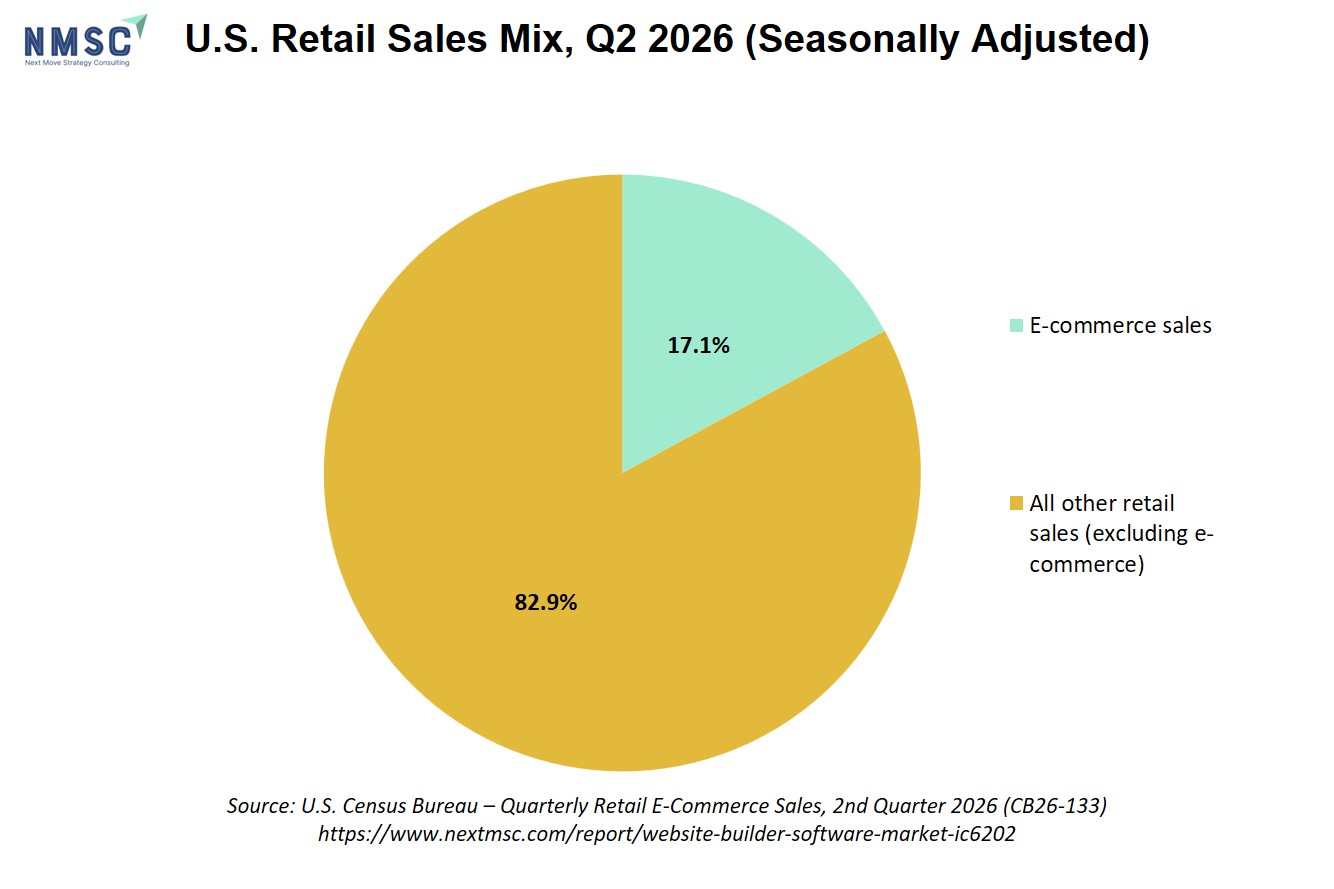
The chart shows the Census Bureau’s preliminary, seasonally adjusted split of U.S. retail sales in the second quarter of 2026: 17.1% e-commerce and 82.9% all other retail sales, the latter being 100% minus the published e-commerce share.
Across the five quarters from the second quarter of 2025 to the second quarter of 2026, the Census Bureau series for seasonally adjusted e-commerce sales rose from USD 303.3 billion to USD 340.2 billion, and the share of total retail sales moved from 16.3% to 17.1%. The second-quarter 2026 figure is preliminary, and the first-quarter 2026 and second-quarter 2025 figures are revised, so the series remains open to change when the Census Bureau publishes its third-quarter 2026 release on November 19, 2026.
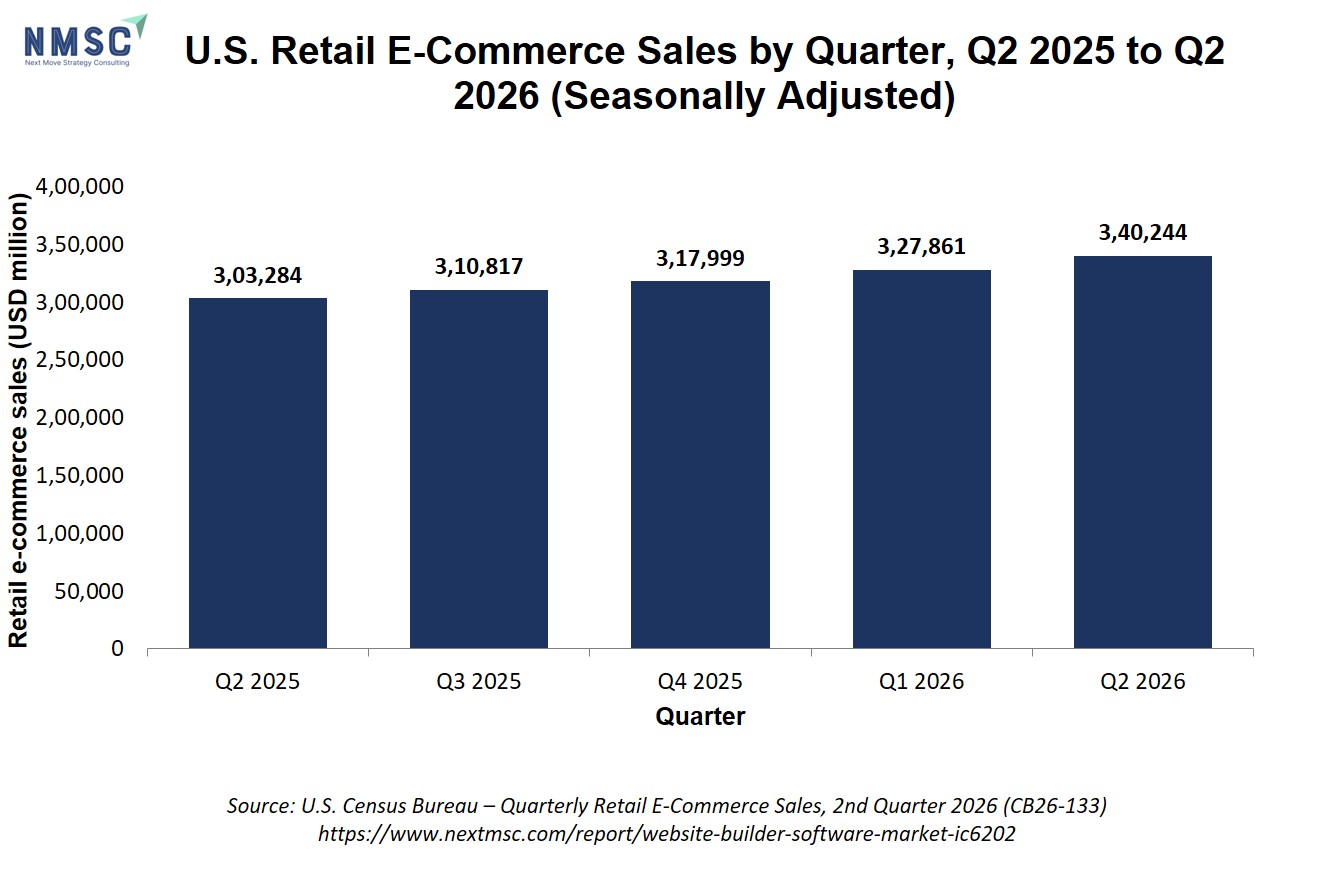
The bars show seasonally adjusted quarterly retail e-commerce sales in USD million as published by the Census Bureau, from 303,284 in the second quarter of 2025 to 340,244 in the second quarter of 2026; the second-quarter 2026 value is preliminary.
Merchant-side revenue at Shopify shows where that demand lands. In its second-quarter 2026 results, published on August 5, 2026 under the title Shopify Delivers Big: 30%+ Growth Across GMV, Revenue, Gross Profit, and Free Cash Flow, Shopify reported gross merchandise volume of USD 115.6 billion against USD 87.8 billion a year earlier, monthly recurring revenue of USD 221 million against USD 185 million, and total revenue of USD 3.58 billion, up 34%. Subscription solutions revenue, the line closest to the storefront seat, grew 22% to USD 802 million, while merchant solutions revenue, which carries payments and other transaction services, grew 37% to USD 2.78 billion. Transaction-linked revenue therefore grew faster than the seat and now represents 78% of Shopify’s revenue, which shows why builders increasingly compete on checkout and payments rather than on editor features.
Second-Quarter and First-Half 2026 Disclosures From Four Website Platform Vendors
|
Vendor |
Reporting date |
Disclosed metric |
Reported figure |
|
Shopify |
August 5, 2026 |
Subscription solutions revenue |
USD 802 million, up 22% from USD 656 million |
|
Wix.com Ltd. |
August 4, 2026 |
Partners revenue |
USD 213.8 million, up 17% year over year |
|
GoDaddy Inc. |
July 30, 2026 |
Applications and Commerce revenue |
USD 514.8 million, up 11% year over year |
|
IONOS Group SE |
August 6, 2026 |
Customer base, first half |
6.91 million after a net gain of 280,000 |
Key Industry Developments: Agents, Margins and Installed Bases
Canvas works on theme files directly. Shopify said it simplified its theme architecture so that Sidekick can understand a store’s structure, logic and design, and that Sidekick validates its own code and reviews screenshots of its changes before handing the result back to the merchant.
“an entrepreneur on Shopify can build a fully custom store in twenty minutes”
- Ben Sehl, Director of Product, Shopify, Introducing Canvas: Opening the aperture on online store design, October 1, 2026.
The Shopify Help Center requirements page for Canvas lists the constraints that currently bound that promise. Canvas is in early access and available only to certain stores, runs on desktop devices only, and works with themes developed by Shopify and with custom themes but not with third-party themes. A theme edited in Canvas opens only in Canvas, stops receiving theme updates, cannot be downloaded as theme files, and cannot take app blocks, app embeds or per-market customization. These limits set the near-term boundary of Canvas’s reach: merchants that depend on third-party themes, app blocks or market-specific storefronts are not yet addressed by the product.
On August 4, 2026, Wix.com Ltd. reported second-quarter revenue of USD 563.1 million, up 15%, and announced that Base44, its no-code application platform, had launched a proprietary language model called Base 1. Wix described compute and inference spend as the largest cost driver in AI-native businesses and said it now expects Base44’s non-GAAP gross margin to reach approximately 60% in the second half of 2026, up from near zero entering the year. The pressure that Base 1 targets appears in the reported figures: Creative Subscriptions cost of revenues rose to USD 81.1 million from USD 54.1 million as segment revenue grew 15%, and that segment’s non-GAAP gross margin fell to 80% from 85% a year earlier, while total non-GAAP gross margin fell to 67% from 70%.
On July 30, 2026, GoDaddy Inc. reported that Airo, its AI-powered small-business experience, reached an annualized bookings run rate of USD 50 million, five times the USD 10 million disclosed one quarter earlier. In the same release GoDaddy reported total revenue of USD 1.298 billion, up 7%, Applications and Commerce revenue of USD 514.8 million, up 11%, and 20.5 million customers. Chief Executive Officer Aman Bhutani described Airo as an agentic operating system at the center of a company-wide AI transformation, and GoDaddy guided to low double-digit Applications and Commerce revenue growth for the third quarter and for full-year 2026.
On August 6, 2026, IONOS Group SE reported that its customer base grew by about 280,000 in the first half of 2026 to 6.91 million, against a gain of 150,000 in the first half of 2025, and that revenue rose 6.9% to EUR 701.1 million, or 8.2% excluding currency effects. IONOS raised its currency-adjusted revenue growth forecast for 2026 to about 8% from 7%. NextMSC primary research and analysis identifies bundled hosting and domain ownership as the lowest-cost route to new builder customers, because vendors with large installed bases cross-sell builders, commerce tools and AI add-ons at a lower acquisition cost than pure-play entrants.
Segment Dynamics: Services and Ecommerce Grow Faster Than the Core Seat
NextMSC primary research and analysis shows that software platforms hold the largest share of the market, rising from USD 9.14 billion in 2025 to USD 57.30 billion by 2035 at a 16.6% CAGR from 2026 to 2035. Services is the fastest-growing offering at a 20.9% CAGR, expanding from USD 2.43 billion in 2025 to USD 22.28 billion by 2035. NextMSC primary research and analysis attributes the faster services growth to customer demand for finished outcomes, meaning managed design, migration and optimization work, rather than tools alone.
By application, business and corporate websites hold the largest share, growing from USD 4.17 billion in 2025 to USD 23.08 billion by 2035, while ecommerce and online stores is the fastest-growing application at a 20.1% CAGR, projected to rise from USD 5.51 billion in 2026 to USD 28.65 billion by 2035. By end user, small and medium enterprises hold the largest share, rising from USD 6.24 billion in 2025 to USD 37.40 billion by 2035, while large enterprises is the fastest-growing end-user segment at a 21.5% CAGR.
Website Builder Software Market: NMSC Segment Outlook
|
Segment |
2025 value (USD billion) |
2035 value (USD billion) |
Growth indicator |
|
Software platform (offering) |
9.14 |
57.30 |
Largest offering; 16.6% CAGR, 2026–2035 |
|
Services (offering) |
2.43 |
22.28 |
Fastest-growing offering; 20.9% CAGR, 2026–2035 |
|
Business and corporate websites (application) |
4.17 |
23.08 |
Largest application |
|
Small and medium enterprises (end user) |
6.24 |
37.40 |
Largest end user |
Regional Outlook: North America Leads, Asia-Pacific Closes the Gap
North America leads today with USD 6.62 billion of revenue in 2026, about 36% of the global total. NextMSC primary research and analysis projects the region to rise from USD 4.29 billion in 2025 to USD 23.87 billion by 2035 at a 15.3% CAGR, with the U.S. growing from USD 3.47 billion to USD 18.38 billion at 14.8%. Established platforms sell into a large base of small businesses and agencies, AI features reach users first in this region, and growth is expected to moderate as penetration rises, shifting the mix toward services and enterprise seats.
Asia-Pacific is the fastest-growing region at a 21.6% CAGR, rising from USD 2.66 billion in 2025 to USD 26.67 billion by 2035, and NextMSC primary research and analysis projects that it will overtake North America by the end of the period. India is the fastest-growing covered country at a 27.8% CAGR, expanding from USD 0.21 billion in 2025 to USD 3.73 billion by 2035. Europe is projected to rise from USD 3.24 billion to USD 18.70 billion at a 15.9% CAGR, while the Middle East & Africa and Latin America each advance from USD 0.69 billion to USD 5.17 billion at an 18.8% CAGR.
Website Builder Software Market: NMSC Regional Outlook
|
Region |
2025 value (USD billion) |
2035 value (USD billion) |
CAGR, 2026–2035 |
|
North America |
4.29 |
23.87 |
15.3% |
|
Europe |
3.24 |
18.70 |
15.9% |
|
Asia-Pacific |
2.66 |
26.67 |
21.6% |
|
Middle East & Africa |
0.69 |
5.17 |
18.8% |
|
Latin America |
0.69 |
5.17 |
18.8% |
Growth Drivers and Restraints
NextMSC primary research and analysis quantifies seven forces in percentage points of CAGR. AI-assisted and prompt-based site generation carries the largest positive impact, at +4.1 percentage points through 2030, and price competition and free entry tiers carry the largest negative impact, at −1.9 percentage points through 2030.
Website Builder Software Market: Growth Catalyst and Risk Assessment Matrix
|
Factor |
Type |
Impact on CAGR |
Geography |
Timeline |
|
Small business digitalization and ecommerce migration |
Driver |
+3.4% |
Global, strongest in Asia-Pacific |
2026–2035 |
|
AI-assisted and prompt-based site generation |
Driver |
+4.1% |
North America, Europe |
2026–2030 |
|
Agency and professional partner channels |
Driver |
+1.8% |
North America, Europe |
2026–2032 |
|
Composable website platforms in large enterprises |
Driver |
+2.2% |
North America, Europe, Asia-Pacific |
2027–2035 |
|
Price competition and free entry tiers |
Restraint |
−1.9% |
Global |
2026–2030 |
|
Accessibility and data protection compliance costs |
Restraint |
−1.1% |
Europe, North America |
2026–2035 |
|
Vendor lock-in and migration friction |
Restraint |
−1.3% |
Global |
2026–2032 |
NMSC Strategic Perspective: Value Migrates From the Editor to Commerce, Hosting and Managed Outcomes
NextMSC primary research and analysis reads the Canvas launch as evidence that the editor itself is becoming a commodity input. When an agent can produce a custom store from a conversation, the scarce assets shift to what the agent does not generate: checkout and payments, hosting and domain relationships, and managed outcomes. Shopify’s second-quarter mix supports that reading, with merchant solutions at 78% of revenue and growing 37% against 22% for subscription solutions, and the NMSC segment outlook points the same way, with services growing at a 20.9% CAGR against 16.6% for software platforms.
Cost structure is the second axis. Wix.com Ltd. identified inference spend as the largest cost driver in AI-native businesses, and its own results show the pressure, with Creative Subscriptions non-GAAP gross margin at 80% against 85% a year earlier. NextMSC primary research and analysis sizes the price-competition and free-tier restraint at −1.9 percentage points of CAGR through 2030, so vendors that control model costs, as Wix is attempting with Base 1, are positioned to defend margin against free entry tiers more effectively than vendors that do not.
Asia-Pacific is the regional test of this thesis. NextMSC primary research and analysis projects Asia-Pacific at a 21.6% CAGR and expects the region to overtake North America by 2035. In India, the fastest-growing covered country at a 27.8% CAGR, the NMSC report ties demand to micro businesses going online through mobile-first tools and digital payments, an outlook that favors affordable, AI-assisted builders over seat-priced design software.
For investors, NextMSC primary research and analysis identifies an absolute opportunity of USD 61.21 billion between 2026 and 2035, and rates the most attractive pockets as ecommerce and online stores at a 20.1% CAGR, services at a 20.9% CAGR and large enterprises at a 21.5% CAGR. The main risk is already concrete in Shopify’s documentation: a theme edited in Canvas stops receiving updates and cannot be downloaded, which raises migration friction, a restraint that NextMSC primary research and analysis sizes at −1.3 percentage points of CAGR through 2032.
Competitive Landscape: Four Vendors, Four Routes to Retention
NextMSC primary research and analysis describes the market as moderately concentrated at the top, with a long tail of private and regional vendors, and finds that competition runs on three fronts: speed to a publishable site, depth of commerce and marketing tools, and total cost including hosting and domains. The NMSC report profiles Wix.com Ltd., Shopify, GoDaddy Inc., IONOS Group SE and Hostinger. Each disclosure in this article maps to a different route to retention: Shopify through commerce and payments attached to an agent-built storefront, Wix through ownership of its model costs, GoDaddy through an installed base of 20.5 million customers and the Airo run rate, and IONOS through hosting-led customer additions.
NextMSC primary research and analysis expects consolidation to target capability gaps rather than scale, in AI generation, animation and developer tooling, localization and commerce add-ons.
Bottom Line
The website builder software market is moving from a contest over editors to a contest over cost, commerce and retention. Shopify’s October 1, 2026 launch of Canvas lets merchants build a custom store by conversation, yet its Help Center lists early-access limits that leave third-party themes, app blocks and market-specific storefronts outside the product for now. The second-quarter 2026 disclosures show where revenue is concentrating: transaction-linked revenue at Shopify, a fivefold Airo run-rate increase at GoDaddy, hosting-led customer additions at IONOS and a model-cost reset at Wix. NextMSC primary research and analysis projects the market at USD 18.37 billion in 2026 and USD 79.58 billion by 2035, with services at a 20.9% CAGR, ecommerce applications at 20.1% and Asia-Pacific at 21.6%. Vendors that bundle checkout, hosting and managed delivery, and that control inference cost, are best positioned to convert agent-built sites into durable revenue.
About Next Move Strategy Consulting
Next Move Strategy Consulting is a premier market research and management consulting firm that has been committed to provide strategically analysed well documented latest research reports to its clients. The research industry is flooded with many firms to choose from, what makes NMSC different from the rest is its top-quality research and the obsession of turning data into knowledge by dissecting every bit of it and providing fact-based research recommendation that is supported by information collected from over 500 million websites, paid databases, industry journals and one on one consultations with industry experts across a diverse range of industry sectors. The high-quality customized research reports with actionable insights and excellent end-to-end customer service help our clients to take critical business decisions that enables them to move beyond time and have competitive edge in the industry.
We have been servicing over 1000 customers globally that includes 90% of the Fortune 500 companies over a decade. Our analysts are constantly tracking various high growth markets and identifying hidden opportunities in each sector or the industry. We provide one of the industry’s best quality syndicate as well as custom research reports across 10 different industry verticals. We are committed to deliver high quality research solutions in accordance to your business needs. Our industry standard delivery solutions that ranges from the pre consultation to after-sales services, provide an excellent client experience and ensure right strategic decision making for businesses.
For more information, please contact:
Next Move Strategy Consulting
5th Floor 867 Boylston St, STE 500,
Boston, MA 02116, U.S.
E-Mail: [email protected]
Direct: +1-217-650-7991
Website: www.nextmsc.com
About the Author
 Sanyukta Deb
— Sanyukta Deb is Digital Marketing Team Lead at Next Move Strategy Consulting, where she has led content strategy and technical SEO for the firm's B2B market research publications for over 2 years. Her editorial process translates NextMSC's primary and secondary research — spanning technology, industrial, and consumer sectors — into commercial narratives, backed by search-intent, keyword, and competitive analysis. She brings 5 years of overall experience in digital marketing and content strategy.
About the Reviewer
 Debashree Dey
— Debashree Dey is Assistant Manager at Next Move Strategy Consulting, where she supports cross-vertical market content and communications across diverse industries for 6 years. Her professional background includes senior content writing, communications, and published manuscript authorship, with experience developing audience-focused business narratives and maintaining clear, consistent messaging. Her role supports research-led content development and editorial quality across NextMSC publications.
















Add Comment