Modine's Commercial HVAC Sales Jump 23% as Heating Products Gain Ground
Commercial HVAC sales and order books are climbing at Modine, Lennox and Trane, but margin pressure, data center concentration and a DOE rulemaking proposal complicate the read-through for heating equipment
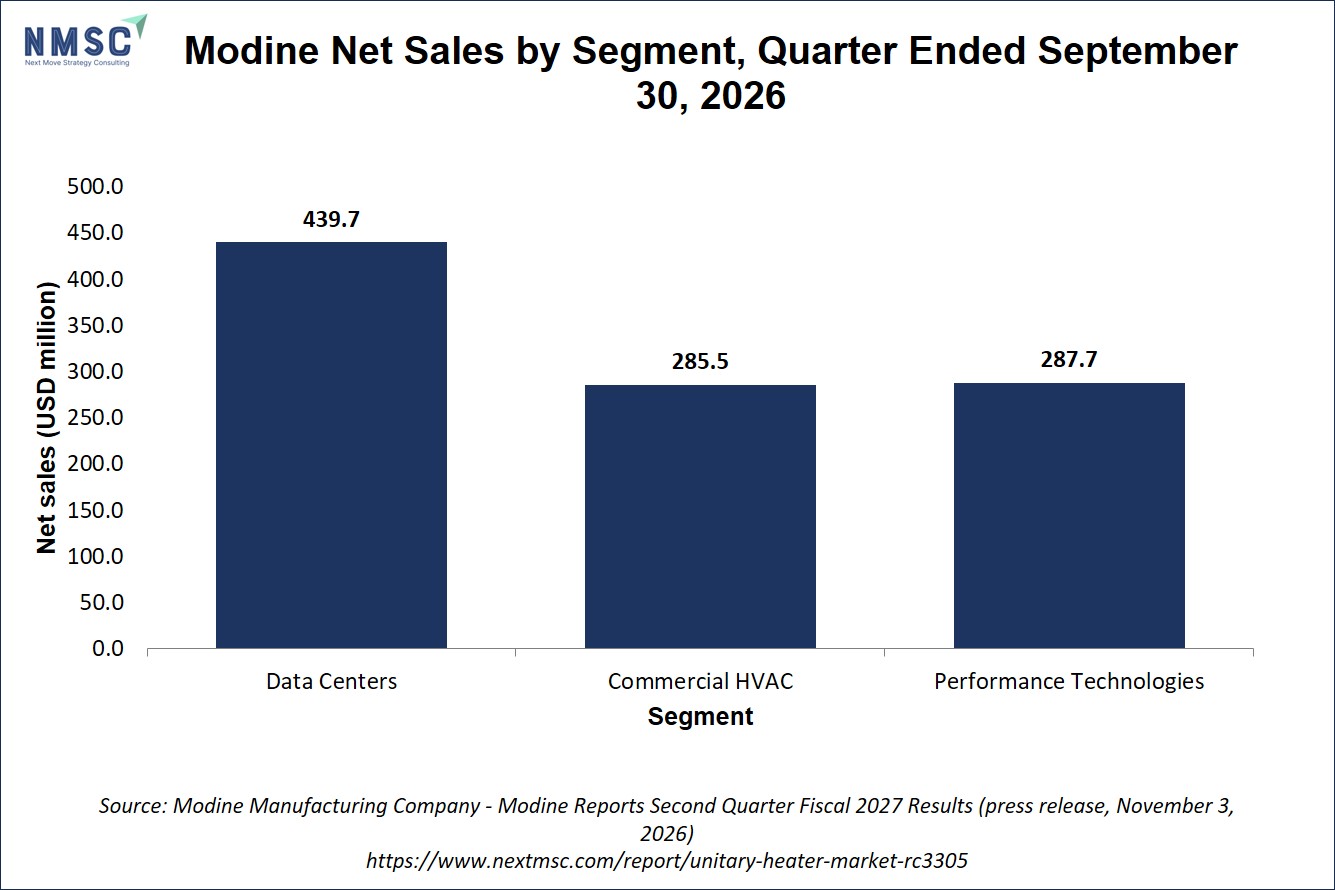
On November 3, 2026, Modine Manufacturing Company reported second-quarter fiscal 2027 results for the quarter ended September 30, 2026, with consolidated net sales of USD 994.4 million, up 35% from USD 738.9 million a year earlier. Its Commercial HVAC segment posted sales of USD 285.5 million, a 23% increase from USD 232.9 million, which the company attributed to higher sales of coils, coatings, and heating and ventilation products. The report arrived within a week of third-quarter results from Lennox International on October 28, 2026 and Trane Technologies on October 29, 2026, both of which also showed commercial building equipment running well ahead of the prior year, and it followed the U.S. Department of Energy's July 2026 proposal to revise how it sets efficiency standards for appliances and certain commercial and industrial equipment.
According to Next Move Strategy Consulting's Unitary Heater Market report, the global unitary heater market was valued at USD 5.06 billion in 2024 and is projected to reach USD 6.78 billion by 2030, growing at a CAGR of 5.0% from 2025 to 2030. NextMSC primary research and analysis places the 2025 value at USD 5.31 billion and links the trajectory to rising demand for energy-efficient HVAC systems, the need for localized heating in large spaces such as warehouses and factories, and regulatory support for decarbonization, while noting that high upfront costs for advanced models restrain adoption among smaller businesses.
For More Information: Download FREE Sample on Unitary Heater Market Report
The Financial Logic: Commercial Backlogs, Margins and Tariff Costs
Trane Technologies reported on October 29, 2026 that third-quarter revenue reached USD 6,759.7 million, up 18% (16% organic), with Americas revenue of USD 5,647.9 million, up 21%. Bookings totalled USD 7,248 million, up 21%, and backlog stood at USD 12.5 billion, up 73%. On the same day's earnings call, Chief Financial Officer Christopher Kuehn said more than USD 8 billion of that backlog relates to 2027 and beyond, and Chair and CEO Dave Regnery said the backlog is equipment only, with no services included.
The composition of that backlog matters for any heating read-through. Regnery told investors that Trane is tracking 1,700 mega projects, up from 1,400 in the second quarter, with more than 90% of them data centers. The largest order build at the biggest HVAC manufacturers is therefore tied to data center cooling and applied systems, and in the results material reviewed for this article none of the three companies reported unit heater sales as a separate line.
Lennox International reported on October 28, 2026 net sales of USD 1,572.5 million, up 10%. Its Building Climate Solutions segment grew revenue 24% to USD 635.3 million (15% organic) and segment profit 19% to USD 166.5 million, while segment margin slipped 110 basis points to 26.2%. Home Comfort Solutions revenue rose 3% to USD 937.2 million, but its segment profit fell 18% and margin dropped 490 basis points to 18.7%. Lennox lowered its 2026 adjusted earnings per share guidance to USD 21.00 to USD 21.50 from USD 23.00 to USD 24.00, and Chief Executive Officer Alok Maskara acknowledged in the release that margins and results fell short of the company's expectations.
Table 1 places the three reports side by side.
Table 1: Commercial HVAC Results Reported Between October 28 and November 3, 2026
|
Company |
Reporting period |
Metric |
Reported value |
Change vs prior year |
|
Modine Manufacturing Company |
Quarter ended September 30, 2026 |
Commercial HVAC sales |
USD 285.5 million |
+23% |
|
Lennox International |
Third quarter 2026 |
Building Climate Solutions revenue |
USD 635.3 million |
+24% (15% organic) |
|
Trane Technologies |
Third quarter 2026 |
Americas revenue |
USD 5,647.9 million |
+21% (19% organic) |
|
Trane Technologies |
Third quarter 2026 |
Total backlog (equipment only) |
USD 12.5 billion |
+73% |
Cost recovery, rather than demand, is where the pressure shows. Modine reported that Commercial HVAC gross margin fell 140 basis points to 23.1%, mainly on unfavorable sales mix and higher material and tariff costs, even as segment operating income rose 30% to USD 34.3 million and adjusted EBITDA rose 22% to USD 43.0 million.
Key Industry Developments
Modine's November 3, 2026 release shows how unevenly commercial growth is distributed. Its Data Centers segment generated USD 439.7 million in sales, up 95% from USD 225.0 million, while Commercial HVAC grew 23%. Performance Technologies, the business Modine spun off on October 1, 2026, edged up to USD 287.7 million from USD 286.3 million. For its continuing business, Modine guided to fiscal 2027 net sales of USD 3.1 billion to USD 3.2 billion and adjusted EBITDA of USD 470 million to USD 500 million. In the release, Chief Executive Officer Neil D. Brinker said both the Data Centers and Commercial HVAC segments:
“delivered strong quarters, with revenue growth of 95% and 23%, respectively.”
- Neil D. Brinker, President and Chief Executive Officer, Modine Manufacturing Company, Modine second-quarter fiscal 2027 results release, November 3, 2026.
The U.S. Department of Energy added a regulatory development on July 2, 2026, when it announced a notice of proposed rulemaking to revise its Process Rule, the framework that governs how it sets energy conservation standards and test procedures for consumer products and certain commercial and industrial equipment. The notice, scheduled for Federal Register publication on July 7, 2026 with comments due 30 days later, would make the rule binding on DOE for actions that could raise efficiency requirements, define significant energy savings with numerical thresholds, and restore a comparative analysis across trial standard levels. The portion of the notice reviewed for this article does not single out unit heaters, and the proposal changes procedure rather than any specific heating equipment standard.
Segment Dynamics: Fuel, Capacity and Efficiency Tiers
NextMSC primary research and analysis segments the unitary heater market by product type (gas-fired, hydronic, electric, oil-fired and propane-fired units), installation type (horizontal, vertical and suspended), mounting type (ceiling, floor, wall and overhead), capacity (up to 50,000 BTU, 50,000 to 100,000 BTU and over 100,000 BTU), efficiency (standard, high efficiency up to 80% AFUE, and ultra-high efficiency above 80% AFUE) and end user (residential, commercial and industrial). NextMSC identifies the shift from fossil-fuel units toward electric unit heaters as the main opportunity for manufacturers, with high initial cost as the restraint.
Installed-base data from the U.S. Energy Information Administration show how far that shift has to run. In its analysis of the 2018 Commercial Buildings Energy Consumption Survey, natural gas supplied 73% of the 2,167 trillion Btu of major-fuel space heating energy in U.S. commercial buildings, district heat 12%, electricity 11% and fuel oil 4%, as Table 2 shows.
Table 2: Energy Sources for Space Heating in U.S. Commercial Buildings (2018 Survey Data)
|
Energy source |
Share of space heating energy |
|
Natural gas |
73% |
|
District heat |
12% |
|
Electricity |
11% |
|
Fuel oil |
4% |
|
Total (2,167 trillion Btu) |
100% |
The same U.S. Energy Information Administration analysis ties equipment choice to climate. Furnaces were the most common heating equipment in the cold or very cold zone (44%) and the cool zone (47%), while packaged heating units were most common in the mixed-mild zone (40%), the warm zone (58%) and the hot or very hot zone (70%). These are 2018 survey figures and are presented as installed-base context, not as 2026 shipments.
Regional Outlook
NextMSC primary research and analysis expects demand in North America to rest on zone heating for commercial and industrial facilities and on the age of existing building stock, in Europe on stringent environmental regulation and the push toward electric heating, and in Asia-Pacific on a rapidly expanding industrial sector and a growing number of commercial buildings. The Rest of the World group is tied more closely to local economic conditions and regulation.
External evidence supports the European electrification point at the company level. On Trane Technologies' October 29, 2026 earnings call, Executive Vice President and Chief Operating Officer Donald Simmons said the electrification of heating in Europe is also growing; no figures accompanied the remark. In the United States, the U.S. Energy Information Administration reported that space heating intensity in 2018 reached 36,100 Btu per square foot in cold or very cold climates against 6,300 Btu per square foot in hot or very hot climates, which explains why heating demand is geographically concentrated even within a single country.
Growth Drivers and Restraints
-
Driver, equipment backlog: Trane Technologies reported a USD 12.5 billion equipment-only backlog on October 29, 2026, up 73%, with more than USD 8 billion scheduled for 2027 and beyond.
-
Driver, commercial volume: Lennox International's Building Climate Solutions revenue rose 24% in the third quarter of 2026, and Modine Manufacturing Company's Commercial HVAC sales rose 23% on higher coil, coating, and heating and ventilation sales.
-
Driver, electrification: Trane Technologies' Donald Simmons said on October 29, 2026 that the electrification of heating in Europe is growing.
-
Restraint, margin compression: Modine's Commercial HVAC gross margin fell 140 basis points to 23.1% on mix, materials and tariffs, and Lennox International's Building Climate Solutions margin fell 110 basis points to 26.2%.
-
Restraint, residential softness: Lennox International's Home Comfort Solutions segment profit fell 18% on revenue growth of 3%, with margin down 490 basis points.
-
Restraint, regulatory uncertainty: The U.S. Department of Energy's July 2026 Process Rule proposal changes how future standards are set, which leaves long-term product-development planning for efficiency tiers less certain.
NMSC Strategic Perspective: Reading Commercial HVAC Strength Through a Heating Lens
NextMSC primary research and analysis reads the October and November 2026 results with caution on one point: the fastest growth is not in standalone heating. Modine's Data Centers sales rose 95% and Trane Technologies is tracking 1,700 mega projects, more than 90% of them data centers, while NextMSC's own unitary heater forecast compounds at 5.0% a year, taking the market from USD 5.31 billion in 2025 to USD 6.78 billion by 2030, an addition of USD 1.47 billion. A unit heater supplier is therefore competing for a different pool of capital than the data center cooling projects that dominate the large OEM backlogs.
The growth case for unit heaters rests on mechanisms that are specific to the product. Standalone units deliver heat to a defined zone of a warehouse, factory or retail floor without a central plant, which lets operators control energy use zone by zone. With natural gas supplying 73% of commercial space heating energy in the U.S. Energy Information Administration's 2018 survey and electricity only 11%, the conversion to electric and higher-efficiency units has a long runway, but the up-front cost of those units, which NextMSC identifies as the leading restraint, determines how quickly smaller operators move.
NextMSC will track three indicators: whether Modine, Lennox International or Trane Technologies begin to disclose heating product revenue separately, how the U.S. Department of Energy's Process Rule proposal progresses, and whether tariff and material costs continue to compress commercial segment margins as they did at Modine in the quarter ended September 30, 2026.
Competitive Landscape
NextMSC primary research and analysis profiles 15 companies in the unitary heater market, including Daikin Industries, Trane Technologies, Reznor HVAC Systems, Lennox International, Modine Manufacturing Company, Turbonics, Johnson Controls International, Armstrong International, Combat Heating Solutions, Mestek, Beacon Morris, Dunham-Bush, King Electric, Thermon and Sterling HVAC, with market share data for 10 of them. Per the NextMSC report, Modine launched a refreshed Hot Dawg Unit Heaters series in November 2024, a gas-fired line that uses dimpled heat exchanger tubes to improve efficiency and reduce noise. The company events dated within the last six months, namely Modine's November 3, 2026 results, Lennox International's October 28, 2026 results and Trane Technologies' October 29, 2026 results, are all taken from the companies' own releases.
Bottom Line
Commercial HVAC manufacturers are reporting sharp gains. Modine's Commercial HVAC sales rose 23% to USD 285.5 million, Lennox International's Building Climate Solutions revenue rose 24% to USD 635.3 million, and Trane Technologies' backlog reached USD 12.5 billion, up 73%. The detail is more cautious for anyone tracking heating specifically. Modine and Lennox International both reported margin compression in their commercial segments, the largest order books are tied to data center projects, and none of the three companies reported unit heater sales separately. NextMSC primary research and analysis values the global unitary heater market at USD 5.06 billion in 2024 and projects USD 6.78 billion by 2030 at a 5.0% CAGR, a path built on efficiency upgrades, localized heating for large spaces and gradual electrification. The U.S. Department of Energy's proposed Process Rule revision adds regulatory uncertainty for manufacturers planning efficient and electric heating products.
About Next Move Strategy Consulting
Next Move Strategy Consulting is a premier market research and management consulting firm that has been committed to provide strategically analysed well documented latest research reports to its clients. The research industry is flooded with many firms to choose from, what makes NMSC different from the rest is its top-quality research and the obsession of turning data into knowledge by dissecting every bit of it and providing fact-based research recommendation that is supported by information collected from over 500 million websites, paid databases, industry journals and one on one consultations with industry experts across a diverse range of industry sectors. The high-quality customized research reports with actionable insights and excellent end-to-end customer service help our clients to take critical business decisions that enables them to move beyond time and have competitive edge in the industry.
We have been servicing over 1000 customers globally that includes 90% of the Fortune 500 companies over a decade. Our analysts are constantly tracking various high growth markets and identifying hidden opportunities in each sector or the industry. We provide one of the industry’s best quality syndicate as well as custom research reports across 10 different industry verticals. We are committed to deliver high quality research solutions in accordance to your business needs. Our industry standard delivery solutions that ranges from the pre consultation to after-sales services, provide an excellent client experience and ensure right strategic decision making for businesses.
For more information, please contact:
Next Move Strategy Consulting
5th Floor 867 Boylston St, STE 500,
Boston, MA 02116, U.S.
E-Mail: [email protected]
Direct: +1-217-650-7991
Website: www.nextmsc.com
About the Author
 Priyanshu Das
— Priyanshu Das is SEO Executive at Next Move Strategy Consulting, where he has led on-page and off-page SEO, keyword research, and SEO audits for the firm's B2B market research publications for 2 years. His audit process combines technical crawl analysis, backlink profile review, and competitor keyword gap mapping — using tools including Screaming Frog and Google Search Console — to prioritize fixes by organic search-visibility impact, informed by his own prior in-house and agency SEO experience.
About the Reviewer
 Debashree Dey
— Debashree Dey is Assistant Manager at Next Move Strategy Consulting, where she supports cross-vertical market content and communications across diverse industries for 6 years. Her professional background includes senior content writing, communications, and published manuscript authorship, with experience developing audience-focused business narratives and maintaining clear, consistent messaging. Her role supports research-led content development and editorial quality across NextMSC publications.
















Add Comment