Sustainable Phone Case Makers Face a Proof Test as EU Packaging Rules Apply
As Brussels' Packaging Rulebook Takes Effect, OtterBox's 75% Recycled-Content Launch and CASETiFY's SGS-Verified Case Raise the Bar for Phone Case Makers
On 12 August 2026, the European Union’s Packaging and Packaging Waste Regulation, Regulation (EU) 2025/40, began to apply generally across all member states, replacing the bloc’s earlier packaging directive with a harmonised framework for packaging and packaging waste. The Regulation covers the packaging used to sell and ship consumer goods, including retail boxes, inner trays, mailers and shipping cartons, rather than the phone case itself. The European Commission’s August 2026 guidance clarifies an important distinction: there is no blanket grace period for packaging first placed on the EU market from the application date, but packaging manufactured before 12 August 2026 and still held in stock does not have to be destroyed, remanufactured or relabelled solely because it has not yet been placed on the market. Required identification and manufacturer information for such stock may be supplied in an accompanying document. Packaging already placed on the EU market before the application date can also remain on the market even if it does not comply with the new requirements. These provisions make documentation, traceability and packaging compliance important considerations for sustainable phone case makers selling into Europe.
According to Next Move Strategy Consulting's Sustainable Phone Cases Market report, the global sustainable phone cases market was valued at USD 10.65 billion in 2025 and is projected to reach USD 16.54 billion by 2035, growing at a CAGR of 4.5% from 2026 to 2035. NextMSC primary research and analysis places the 2026 value at USD 11.13 billion and identifies Asia-Pacific, with a 34% share of 2025 revenue, as the largest region and Latin America, at a 5.2% CAGR, as the fastest-growing one. The report defines the category as protective smartphone enclosures made from biodegradable, compostable, plant fiber, bamboo, cork or recycled plastic materials, and it excludes conventional silicone and polycarbonate cases that carry no verified recycled or bio-based content, so verification of content, rather than marketing language, sets the boundary of the addressable base.
For More Information: Download FREE Sample on Sustainable Phone Cases Market Report
What the Packaging Regulation Changes for Case Makers
The Regulation entered into force on 11 February 2025 and generally applies from 12 August 2026, according to the European Circular Economy Stakeholder Platform's explainer of 6 April 2026, which adds that all packaging must be recyclable, with recyclability performance grades applying from 2030 and stricter recyclability obligations from 2038. The European Commission's notice of 11 August 2026 lists the later milestones that matter most to accessory brands: a harmonised EU-wide labelling system in 2028, and in 2030 mandatory recycled plastic content in new plastic packaging, limits on empty space, restrictions on certain single-use plastic packaging and reuse targets.
Packaging and Packaging Waste Regulation: Milestones for Consumer-Goods Packaging
|
Date |
Milestone |
|
11 February 2025 |
Regulation (EU) 2025/40 enters into force |
|
12 August 2026 |
General application across the EU begins; the Regulation covers all packaging regardless of material or origin |
|
2028 |
Harmonised EU-wide packaging labelling system applies |
|
2030 |
All packaging must be recyclable; recyclability performance grades apply; mandatory recycled plastic content in new plastic packaging; limits on empty space; reuse targets |
|
2035 |
Packaging must be collected, sorted and recycled at scale |
|
2038 |
Stricter recyclability obligations apply |
Two details carry commercial weight. First, the PPWR’s general application date remains 12 August 2026, and there is no blanket grace period for newly placed packaging subject to the applicable requirements. However, the absence of a general grace period does not mean that every physical packaging unit requires a separate Declaration of Conformity or that pre-existing stock must automatically be destroyed or relabelled. Second, the European Commission’s August 2026 guidance clarifies that manufacturers must draw up a written Declaration of Conformity for each relevant packaging type. The declaration should be prepared at the level where the packaging’s characteristics and the packaged product determine compliance. A single declaration may cover different sizes when the packaged product is the same and the size difference does not affect compliance with the applicable requirements. Packaging with materially different characteristics or intended for different products may require separate declarations. The assessment covers the packaging unit as a whole, including its relevant components, rather than requiring a separate declaration for each component. Accordingly, phone case brands should evaluate their packaging formats and product variants individually before determining the scope of their compliance documentation.
“The new Packaging and Packaging Waste Regulation is an investment in Europe's future.”
-Jessika Roswall, Commissioner for Environment, Water Resilience and a Competitive Circular Economy, European Commission, European Commission news release, New EU rules on packaging enter into application, 11 August 2026.
Recycled Content Moves from Brand Story to Verified Claim
Case makers were already moving toward documented claims. On 17 August 2026, OtterBox announced Sole Series featuring Realtree, a MagSafe-compatible line for the iPhone 17, iPhone 17 Pro and iPhone 17 Pro Max priced at USD 59.99 and constructed with a minimum of 75% recycled content, according to the company's press release. The release does not name a third-party verifier for that figure. Earlier, on 28 January 2026, SGS announced that CASETiFY's Compact Cases for the iPhone 17 series had earned SGS Green Marks, following a recycled content assessment under ISO 14021 that was completed in the fourth quarter of 2025. CASETiFY's sustainability page calls the Compact Case its first product to earn the mark and states that it is verified to contain over 50% post-consumer recycled plastics.
The same CASETiFY page reports that its Re/CASETiFY programme has recovered over 3.3 million phone cases and diverted over 166,000 kg of plastics from landfill since 2020, including 59,000 kg in 2025, which gives the brand a documented return flow of material that a recycled-content claim can point to.
Recycled-Content and Recovery Disclosures from Phone Case Makers
|
Company |
Product or programme |
Disclosed metric |
Disclosure date |
|
OtterBox |
Sole Series featuring Realtree (iPhone 17, iPhone 17 Pro, iPhone 17 Pro Max) |
Minimum 75% recycled content; USD 59.99 |
17 August 2026 |
|
CASETiFY |
Compact Case, iPhone 17 series |
Over 50% post-consumer recycled plastics; first product to earn the SGS Green Mark; recycled content assessment under ISO 14021 completed in Q4 2025 |
28 January 2026 (SGS release) |
|
CASETiFY |
Re/CASETiFY recovery programme |
Over 3.3 million cases recovered and over 166,000 kg of plastics diverted since 2020; 59,000 kg in 2025 |
2025 Sustainability Report page (undated) |
Channel Economics: Online Sales Keep Taking Share of Retail
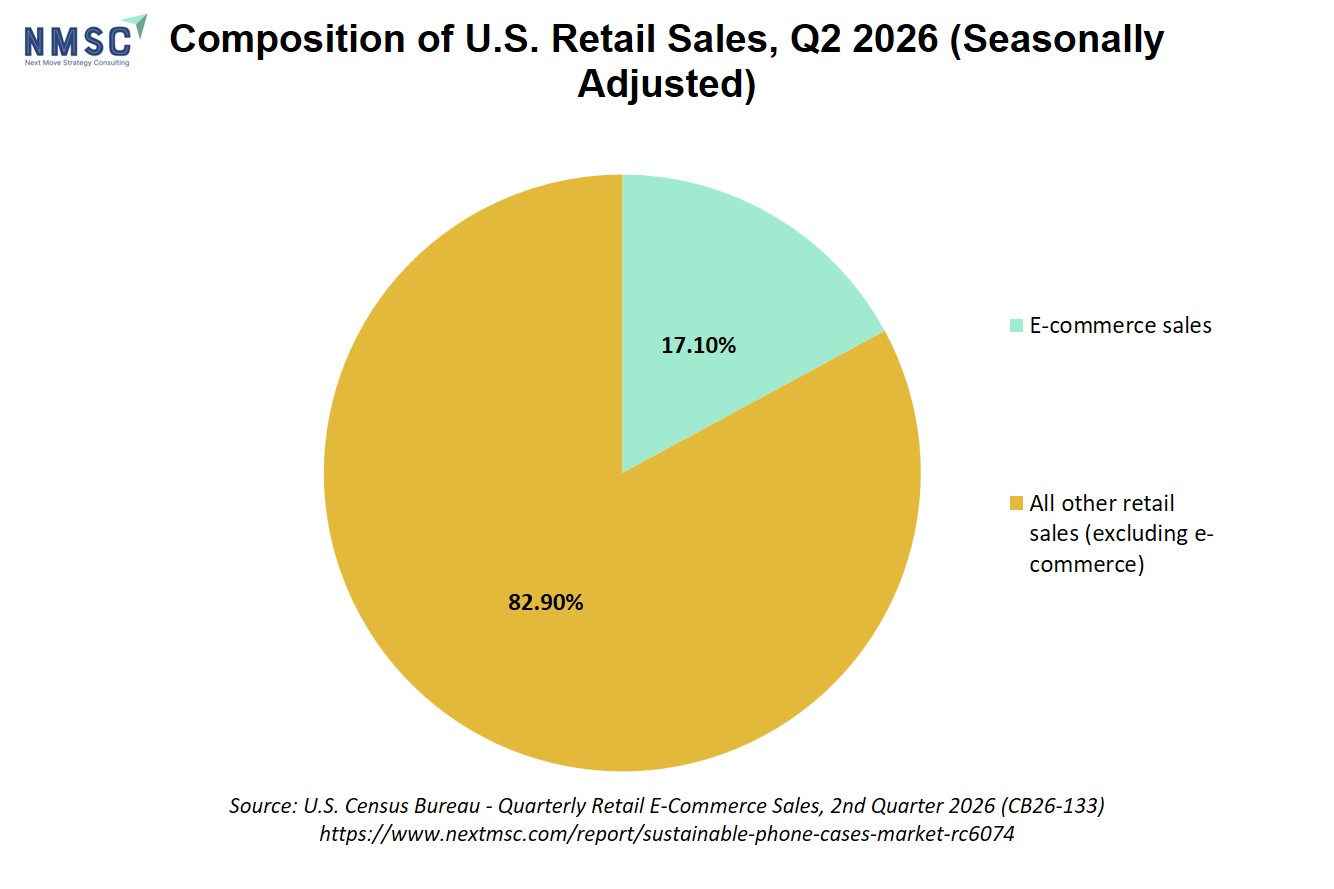
The packaging rules reach case makers most directly through the online channel. The U.S. Census Bureau reported on 18 August 2026 that seasonally adjusted U.S. retail e-commerce sales reached USD 340.2 billion in the second quarter of 2026, up 3.8% from the first quarter and 12.2% from a year earlier, against growth of 6.7% for total retail sales over the same year. E-commerce accounted for 17.1% of total retail sales, compared with 16.3% in the second quarter of 2025.
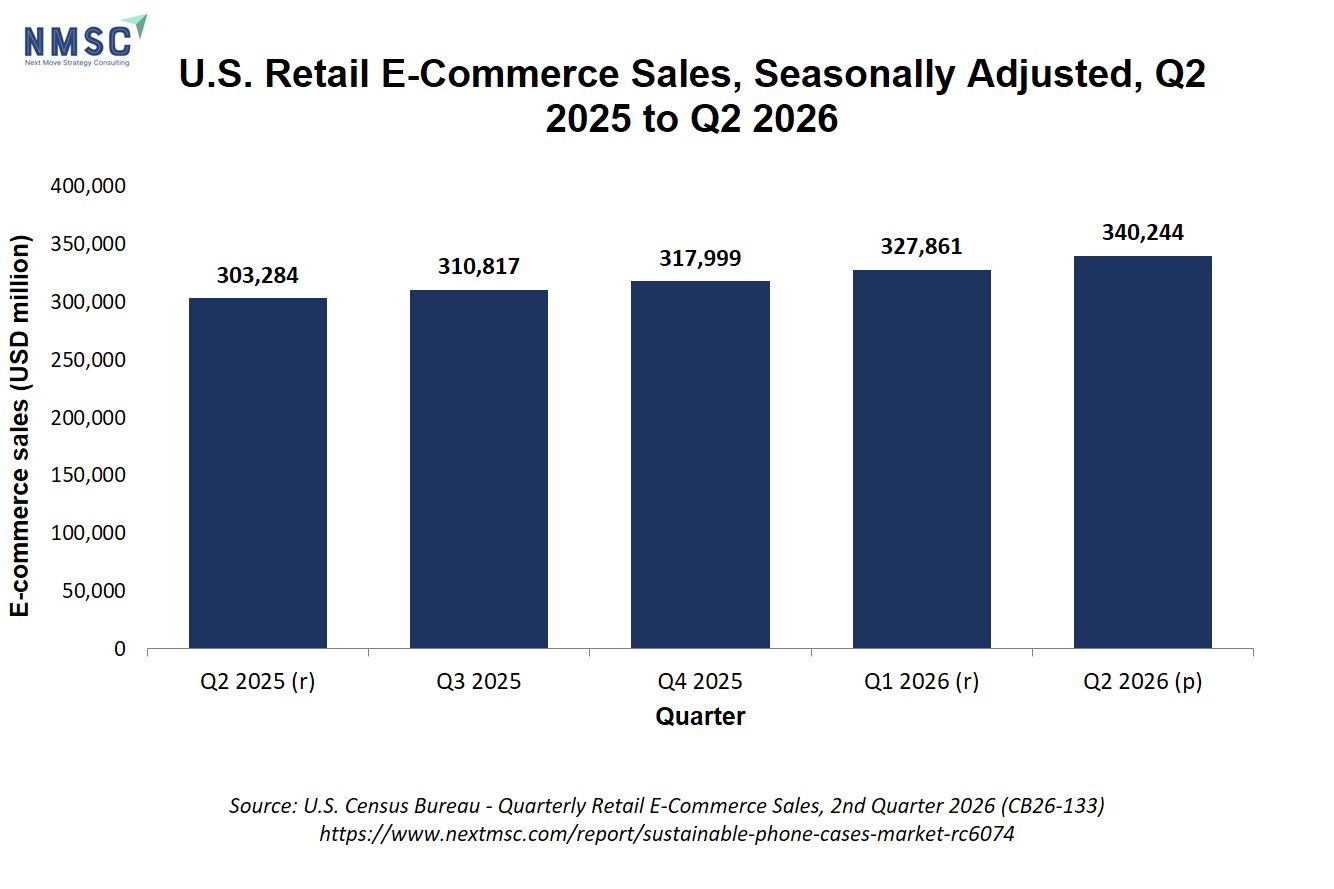
U.S. Retail E-Commerce Share and Growth, Seasonally Adjusted
|
Quarter |
E-commerce share of total retail sales (%) |
E-commerce sales growth vs same quarter a year earlier (%) |
Total retail sales growth vs same quarter a year earlier (%) |
|
Q2 2025 (revised) |
16.3 |
5.0 |
3.7 |
|
Q3 2025 |
16.4 |
5.3 |
4.1 |
|
Q4 2025 |
16.7 |
5.9 |
2.7 |
|
Q1 2026 (revised) |
17.0 |
10.1 |
3.9 |
|
Q2 2026 (preliminary) |
17.1 |
12.2 |
6.7 |
NextMSC primary research and analysis places online retail as the largest distribution channel for sustainable phone cases, at a 58% share of 2025 revenue, or USD 6.18 billion, and also as the fastest-growing channel, at a 4.8% CAGR from 2026 to 2035. Because the largest share of the category's revenue is sold online, the Commission's 2030 limits on empty space in packaging bear on the format through which most of that revenue reaches buyers.
Segment Dynamics: Material and Device Mix
By material type, NextMSC primary research and analysis shows plant fiber based cases leading at USD 3.09 billion in 2025, a 29% share, followed by biodegradable plastics at USD 2.61 billion, bamboo at USD 1.28 billion, recycled ocean plastic at USD 1.17 billion, recycled post-consumer plastic at USD 1.02 billion, cork at USD 0.85 billion, and natural rubber and silicone blends at USD 0.63 billion. Recycled ocean plastic is the fastest-growing material at a 5.5% CAGR from 2026 to 2035, ahead of recycled post-consumer plastic at 4.8% and of plant fiber based and biodegradable plastics at 4.5% each.
By phone compatibility, iPhone-compatible cases led with USD 4.47 billion, a 42% share, in 2025. That concentration on one handset family is visible in OtterBox's 17 August 2026 release, which lists three iPhone 17 models as the launch devices for the new line, and it links case volumes to the timing of device launches as much as to material preference.
Regional Outlook: Europe Holds a Quarter of the Base
NextMSC primary research and analysis puts Asia-Pacific first at USD 3.62 billion in 2025 and a 4.9% CAGR, followed by North America at USD 2.66 billion (4.1% CAGR), Europe at USD 2.56 billion (4.0% CAGR), Latin America at USD 0.96 billion (5.2% CAGR) and Middle East & Africa at USD 0.85 billion (4.6% CAGR). Europe, where the Packaging and Packaging Waste Regulation now applies, therefore holds about 24% of the 2025 base but is projected to grow more slowly than Asia-Pacific, Latin America and Middle East & Africa. In NextMSC's analysis, the Regulation changes which suppliers can compete for that base rather than how large it is.
Growth Drivers and Restraints
-
Driver, regulation: the EU Packaging and Packaging Waste Regulation applies from 12 August 2026, with recyclability and recycled plastic content obligations phased in during 2030 (European Commission, 11 August 2026).
-
Driver, verified recycled content: CASETiFY's Compact Case carries an SGS Green Mark based on an ISO 14021 recycled content assessment, and OtterBox discloses a minimum of 75% recycled content in its newest line (SGS, 28 January 2026; OtterBox, 17 August 2026).
-
Driver, channel shift: U.S. e-commerce reached 17.1% of retail sales in the second quarter of 2026, up from 16.3% a year earlier (U.S. Census Bureau, 18 August 2026).
-
Driver, take-back: the Re/CASETiFY programme has recovered over 3.3 million phone cases since 2020 (CASETiFY, 2025 Sustainability Report page).
-
Restraint, compliance workload: Manufacturers must conduct conformity assessments and prepare Declarations of Conformity for relevant packaging types, with the required scope depending on packaging characteristics and the products being packaged. Although one declaration may cover certain variants, differences affecting compliance may require separate documentation. The general application date of 12 August 2026 does not provide a blanket grace period for newly placed packaging, while the European Commission has clarified that qualifying pre-existing stock does not automatically need to be destroyed, remanufactured or relabelled (European Commission, PPWR Frequently Asked Questions, August 2026).
-
Restraint, composting infrastructure: NextMSC primary research and analysis identifies limited industrial composting infrastructure in North America, Latin America and Middle East & Africa as a constraint on how far compostability claims translate into real-world environmental benefit.
NMSC Strategic Perspective: Verification Becomes the Entry Ticket
NextMSC primary research and analysis reads the 12 August 2026 start of application as a change in the compliance requirements governing packaging used by sustainable phone case brands, rather than a restriction on any particular case material. Under the PPWR, manufacturers must maintain the necessary conformity assessment and Declaration of Conformity for each relevant packaging type. Standardising packaging formats may help reduce administrative complexity, particularly where variations in size do not affect compliance and the packaged product remains the same. However, packaging designed for different products or with characteristics that affect conformity may require separate declarations. The European Commission has also clarified that packaging manufactured before 12 August 2026 and held in stock does not have to be destroyed, remanufactured or relabelled solely because it has not yet been placed on the market. These distinctions mean that brands should review packaging designs, supplier documentation and existing inventories separately when planning for EU compliance.
Third-party verification is the second lever. The NextMSC report finds that third-party certification has become a competitive necessity rather than a differentiator alone, and the SGS assessment of CASETiFY's Compact Case is a concrete example of what a verified claim looks like in this category. OtterBox's 75% figure, by contrast, is a company disclosure in a press release that names no verifier, which is the kind of claim the NextMSC category definition excludes until content is verified.
Material mix is the third lever. Recycled ocean plastic's 5.5% CAGR, the fastest among material types in the NextMSC report, is driven, according to the report, by traceable coastal cleanup supply chains and brand partnerships, which suits brands that can document where their feedstock originates as scrutiny of green claims increases.
Competitive Landscape
NextMSC primary research and analysis describes the category as moderately fragmented, with sustainability-first specialists such as Pela Case and Wave Case competing against diversified accessory makers such as OtterBox and Incipio, and the report profiles 20 companies. The two events documented above show the diversified maker and the premium customisation brand moving on different proofs: OtterBox on recycled content share in a mainstream rugged line, and CASETiFY on a certified recycled content product paired with a take-back programme. Urban Armor Gear, Speck Products and Case-Mate are also among the participants NextMSC lists; this article documents only the OtterBox and CASETiFY developments, which are the two traceable to named public disclosures.
Bottom Line
The start of application of the EU Packaging and Packaging Waste Regulation on 12 August 2026 moves the sustainable phone case category from voluntary claims toward an enforceable packaging rulebook, even though the Regulation governs packaging rather than the case itself. NextMSC primary research and analysis values the global category at USD 10.65 billion in 2025 and projects USD 16.54 billion by 2035 at a 4.5% CAGR, with Europe holding USD 2.56 billion of the base. Three developments define the near term: a Declaration of Conformity requirement that scales with packaging variants, recycled content disclosures such as OtterBox's 75% minimum and CASETiFY's SGS-verified Compact Case, and an online channel that U.S. Census Bureau data show holding 17.1% of retail sales. Brands that consolidate packaging formats, document their feedstock and obtain third-party verification are positioned to carry a lower compliance cost per unit than peers that rely on unverified claims.
About Next Move Strategy Consulting
Next Move Strategy Consulting is a premier market research and management consulting firm that has been committed to provide strategically analysed well documented latest research reports to its clients. The research industry is flooded with many firms to choose from, what makes NMSC different from the rest is its top-quality research and the obsession of turning data into knowledge by dissecting every bit of it and providing fact-based research recommendation that is supported by information collected from over 500 million websites, paid databases, industry journals and one on one consultations with industry experts across a diverse range of industry sectors. The high-quality customized research reports with actionable insights and excellent end-to-end customer service help our clients to take critical business decisions that enables them to move beyond time and have competitive edge in the industry.
We have been servicing over 1000 customers globally that includes 90% of the Fortune 500 companies over a decade. Our analysts are constantly tracking various high growth markets and identifying hidden opportunities in each sector or the industry. We provide one of the industry’s best quality syndicate as well as custom research reports across 10 different industry verticals. We are committed to deliver high quality research solutions in accordance to your business needs. Our industry standard delivery solutions that ranges from the pre consultation to after-sales services, provide an excellent client experience and ensure right strategic decision making for businesses.
For more information, please contact:
Next Move Strategy Consulting
5th Floor 867 Boylston St, STE 500,
Boston, MA 02116, U.S.
E-Mail: [email protected]
Direct: +1-217-650-7991
Website: www.nextmsc.com
About the Author
 Sanyukta Deb
— Sanyukta Deb is Digital Marketing Team Lead at Next Move Strategy Consulting, where she has led content strategy and technical SEO for the firm's B2B market research publications for over 2 years. Her editorial process translates NextMSC's primary and secondary research — spanning technology, industrial, and consumer sectors — into commercial narratives, backed by search-intent, keyword, and competitive analysis. She brings 5 years of overall experience in digital marketing and content strategy.
About the Reviewer
 Debashree Dey
— Debashree Dey is Assistant Manager at Next Move Strategy Consulting, where she supports cross-vertical market content and communications across diverse industries for 6 years. Her professional background includes senior content writing, communications, and published manuscript authorship, with experience developing audience-focused business narratives and maintaining clear, consistent messaging. Her role supports research-led content development and editorial quality across NextMSC publications.














Add Comment