Mouser Expands Autonomous Vehicle Resource Hub
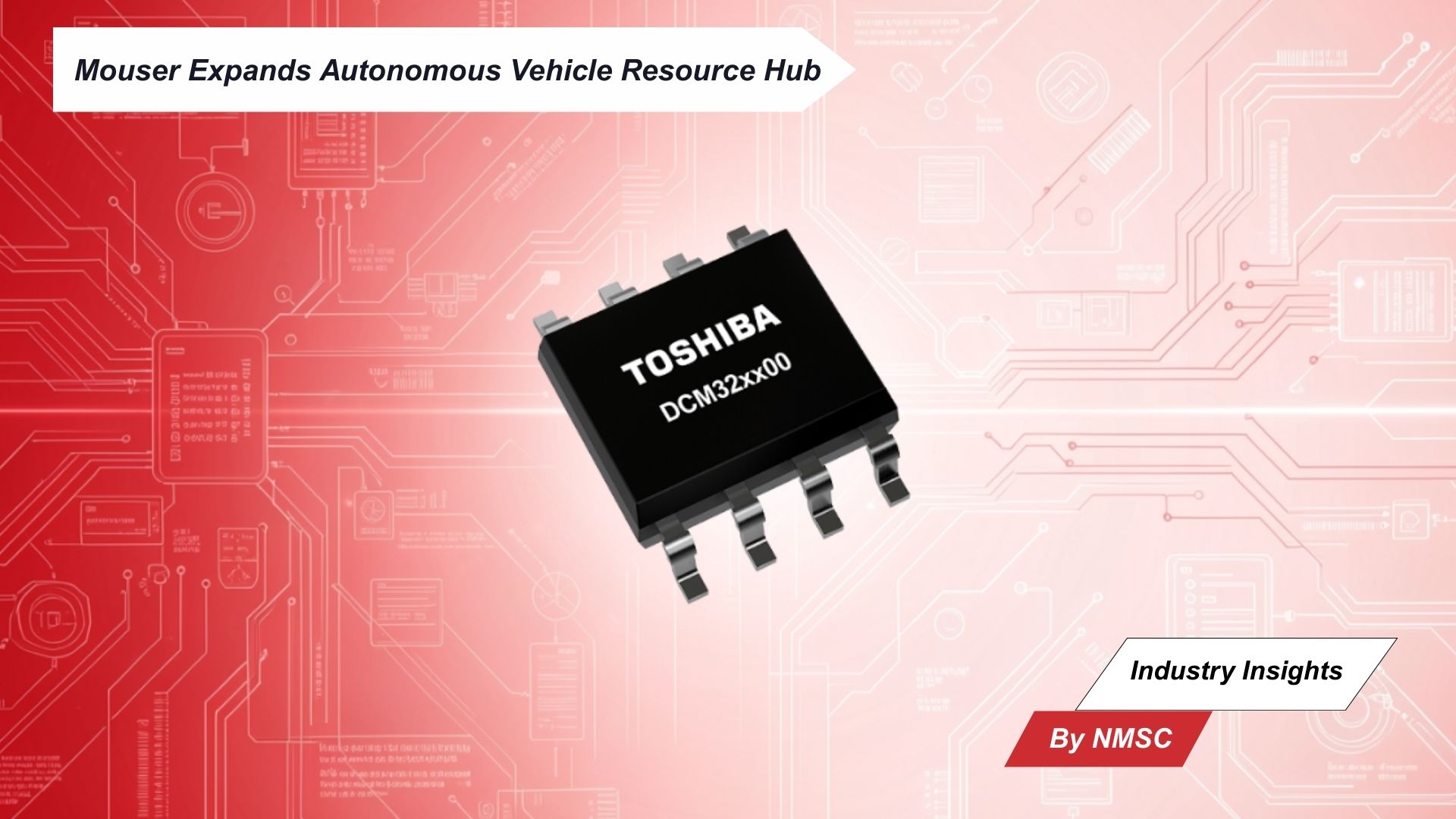
Industry Insights from Next Move Strategy Consulting
As the autonomous vehicle ecosystem continues to evolve from experimental prototypes to real-world mobility solutions, new technological and engineering challenges are emerging across system design and deployment. The expansion of the Autonomous Vehicle resource centre by Mouser Electronics marks an important step in supporting engineers and developers navigating these complexities within the rapidly advancing autonomous vehicle market.
The enhanced platform focuses on the system architectures and design constraints shaping production-ready autonomy. It highlights how sensing technologies, in-vehicle networking, and vehicle-to-everything (V2X) communication work together to power real-time decision-making systems, while also addressing safety, cybersecurity, and ethical considerations that increasingly define the feasibility of autonomous mobility solutions.
Engineering Autonomous Vehicles for Real-World Conditions
Transitioning autonomous vehicles from controlled testing environments to real-world roadways requires engineers to balance multiple technical priorities. Deterministic system performance, functional safety, and cybersecurity must operate together to ensure that vehicles can make safe and responsible decisions in complex traffic scenarios. Robotaxi deployments have already demonstrated that real-world conditions introduce challenges that remain difficult to solve at scale.
To address these challenges, developers are incorporating high-bandwidth sensing systems, advanced in-vehicle networking, and continuous over-the-air (OTA) software updates into vehicle architectures. These design strategies allow systems to be certified, maintained, and upgraded throughout their operational lifecycle. At the same time, the industry is moving toward software-defined vehicles and zonal architectures, where sensing and actuation components are separated from centralized computing platforms. This architecture reduces wiring complexity, improves fault isolation, and supports modular system upgrades after deployment.
A Knowledge Platform for Autonomous Vehicle Innovation
Developed with contributions from Mouser’s technical specialists and manufacturing partners, the Autonomous Vehicle Resource Hub serves as a curated knowledge platform for engineers working on next-generation mobility technologies. The resource centre provides access to articles, blogs, eBooks, and product information aimed at helping developers understand practical integration challenges and deployment trade-offs associated with autonomous systems.
The platform covers key technical areas including perception and sensor fusion, deterministic networking, cybersecurity frameworks, functional safety, ethical decision-making systems, and regulatory considerations. By focusing on real-world integration challenges rather than laboratory-only performance metrics, the hub aims to support practical engineering solutions for autonomous vehicle deployment.
Components Enabling Autonomous Vehicle Architectures
Alongside technical insights, the resource hub also highlights several semiconductor and connectivity solutions designed for autonomous vehicle systems. Examples include the DP83TC817S-Q1 Automotive Ethernet Transceiver from Texas Instruments, which enables single-pair Ethernet communication with integrated security features and flexible interface options.
Another example is the S32E2 real-time automotive processor family developed by NXP Semiconductors. Built on a 16-nm process, the processors support software-defined vehicle architectures and comply with ASIL D functional safety and ISO/SAE 21434 cybersecurity standards while integrating eight Arm Cortex-R52 cores for scalable automotive control applications.
Additional components include the MCP998x automotive temperature sensors from Microchip Technology for safety-critical thermal monitoring, and the NanoMQS 0.50 mm miniaturized connector system from TE Connectivity, designed to reduce PCB footprint while maintaining reliable electrical connections in high-vibration automotive environments.
According to Next Move Strategy Consulting
According to Next Move Strategy Consulting, initiatives such as Mouser’s expanded resource hub highlight the growing emphasis on integrated system architectures and scalable electronic components in the Autonomous Vehicle Market. As the industry transitions toward software-defined vehicles and modular computing frameworks, demand for advanced sensing technologies, networking solutions, and safety-focused semiconductor components is expected to increase.
The continued development of engineering resources and technology ecosystems is likely to accelerate innovation, support industry collaboration, and help bridge the gap between experimental autonomous systems and commercially deployable mobility solutions.
Source: Mouser Electronics
Prepared by: Next Move Strategy Consulting
About the Author
 Sanyukta Deb
— Sanyukta Deb is Digital Marketing Team Lead at Next Move Strategy Consulting, where she has led content strategy and technical SEO for the firm's B2B market research publications for over 2 years. Her editorial process translates NextMSC's primary and secondary research — spanning technology, industrial, and consumer sectors — into commercial narratives, backed by search-intent, keyword, and competitive analysis. She brings 5 years of overall experience in digital marketing and content strategy.
Sanyukta Deb
— Sanyukta Deb is Digital Marketing Team Lead at Next Move Strategy Consulting, where she has led content strategy and technical SEO for the firm's B2B market research publications for over 2 years. Her editorial process translates NextMSC's primary and secondary research — spanning technology, industrial, and consumer sectors — into commercial narratives, backed by search-intent, keyword, and competitive analysis. She brings 5 years of overall experience in digital marketing and content strategy.
About the Reviewer
 Debashree Dey
— Debashree Dey is Assistant Manager at Next Move Strategy Consulting, where she supports cross-vertical market content and communications across diverse industries for 6 years. Her professional background includes senior content writing, communications, and published manuscript authorship, with experience developing audience-focused business narratives and maintaining clear, consistent messaging. Her role supports research-led content development and editorial quality across NextMSC publications.
Debashree Dey
— Debashree Dey is Assistant Manager at Next Move Strategy Consulting, where she supports cross-vertical market content and communications across diverse industries for 6 years. Her professional background includes senior content writing, communications, and published manuscript authorship, with experience developing audience-focused business narratives and maintaining clear, consistent messaging. Her role supports research-led content development and editorial quality across NextMSC publications.
















Add Comment