NYC Office-to-Residential Conversions Face Regulatory Setback
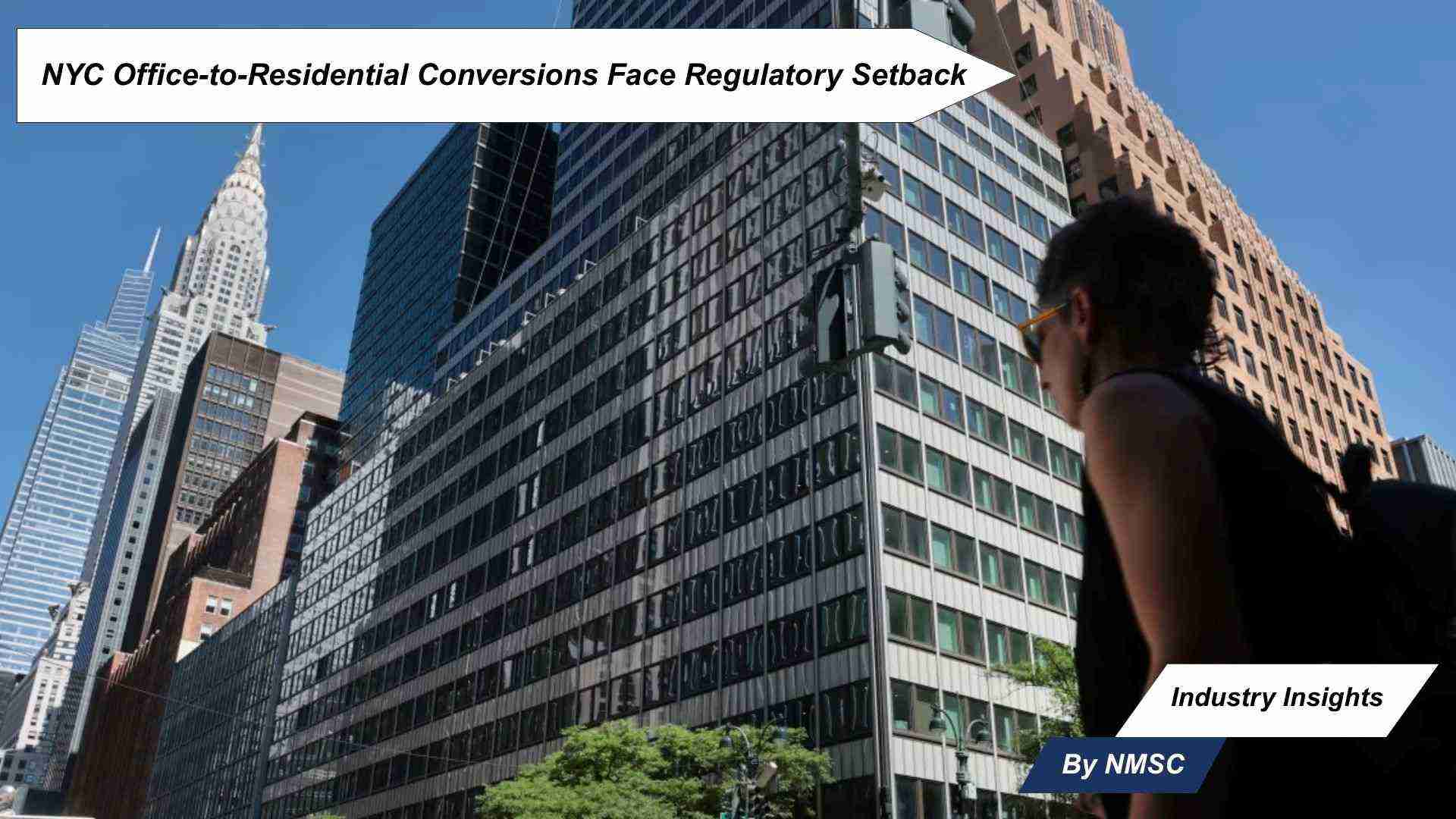
NYC Issues Stop-Work Orders at Two Major Office-to-Residential Conversion Projects
NEW YORK CITY, United States — July 31, 2026 — The New York City Department of Buildings has issued stop-work orders at two prominent Manhattan office-to-residential conversion projects, intensifying regulatory scrutiny over a housing strategy that city officials have positioned as a cornerstone of their affordability agenda. The development carries significant implications for the broader real estate market, which is valued at USD 25.26 trillion in 2025 and projected to reach USD 33.61 trillion by 2030, registering a CAGR of 5.87%, according to Next Move Strategy Consulting.
Inspectors issued a full stop-work order at 222 Broadway in Lower Manhattan after cracked concrete beams on the 32nd floor went unreported to city officials for weeks. Developer GFP Real Estate is converting the 1962-era former Western Electric headquarters into 300 residential apartments. Engineering firm DeSimone submitted requested repair documentation, but the full stop-work order remains active pending departmental review.
A separate partial stop-work order was issued at 750 Third Avenue in Midtown Manhattan, where developer SL Green is converting the 1957 building into 639 apartments. The firm self-identified a discrepancy involving steel welding on upper floors that did not match filed building plans, though city officials reported no structural distress. SL Green stated it is working with the city to lift the order promptly.
The two stoppages follow heightened concern triggered by developer MetroLoft's 1,600-unit conversion of the former Pfizer headquarters, where partial column collapses occurred during stabilization work. The New York City Department of Buildings subsequently announced that a review of the MetroLoft building found "no significant structural issues which would endanger public safety," though a partial stop-work order at that site also remains in place pending further inspections.
NYC Mayor Zohran Mamdani and city housing leaders regard office-to-residential conversions as a strategic mechanism to ease the city's housing shortage more rapidly than ground-up construction. The city has leveraged 2024 tax incentives to accelerate a broader conversion pipeline, positioning New York as a national model for adaptive reuse strategies.
Key Highlights:
-
Full stop-work order issued at 222 Broadway (GFP Real Estate, 300 units) following unreported cracked concrete beams on the 32nd floor; repair documentation submitted but order remains active.
-
Partial stop-work order issued at 750 Third Avenue (SL Green, 639 units) after steel welding discrepancies were identified on upper floors; no structural distress reported.
-
MetroLoft's 1,600-unit Pfizer HQ conversion remains under partial stoppage, serving as the catalyst for heightened citywide scrutiny of conversion projects.
-
NYC's 2024 tax incentive framework has expanded the office-to-residential conversion pipeline, making regulatory compliance and structural due diligence increasingly critical for developers.
Analyst Insight:
According to analysts at Next Move Strategy Consulting, the wave of stop-work orders in New York City underscores a structural risk that has been underpriced in the office-to-residential conversion segment. As adaptive reuse accelerates globally — driven by hybrid work trends and urban housing shortages — the incidents at 222 Broadway and 750 Third Avenue highlight the disproportionate cost of inadequate pre-construction due diligence in aging building stock. NMSC analysts note that developers and institutional investors entering conversion pipelines must integrate rigorous structural feasibility assessments and contingency funding mechanisms from the outset, as late-stage defect discovery can materially impact project timelines, financing costs, and regulatory standing — factors that will increasingly influence asset valuations in the broader real estate market.
Industry Outlook:
The stop-work orders at multiple Manhattan conversion sites are likely to prompt a broader reassessment of due diligence standards across the office-to-residential conversion sector, both in New York and in other major U.S. cities pursuing similar adaptive reuse strategies. Industry specialists, including Andy O'Brien of The Baldwin Group and John Edwards of McClennan+Partners Architects, have emphasized that thorough upfront feasibility analysis and contingency planning are essential for managing the structural unknowns inherent in older commercial buildings.
As cities continue to rely on adaptive reuse to address housing supply deficits — a trend supported by the global real estate market's projected expansion to USD 33.61 trillion by 2030 — regulatory bodies are expected to tighten inspection protocols and documentation requirements for conversion projects. Developers that invest in comprehensive structural assessments, maintain transparent communication with municipal authorities, and build adequate financial contingencies into project budgets will be better positioned to navigate an increasingly scrutinized regulatory environment.
Source: HousingWire
For More Information – Download FREE Sample on Real Estate Market Report
Prepared By: Sanyukta Deb
About the Author
 Sanyukta Deb
— Sanyukta Deb is Digital Marketing Team Lead at Next Move Strategy Consulting, where she has led content strategy and technical SEO for the firm's B2B market research publications for over 2 years. Her editorial process translates NextMSC's primary and secondary research — spanning technology, industrial, and consumer sectors — into commercial narratives, backed by search-intent, keyword, and competitive analysis. She brings 5 years of overall experience in digital marketing and content strategy.
Sanyukta Deb
— Sanyukta Deb is Digital Marketing Team Lead at Next Move Strategy Consulting, where she has led content strategy and technical SEO for the firm's B2B market research publications for over 2 years. Her editorial process translates NextMSC's primary and secondary research — spanning technology, industrial, and consumer sectors — into commercial narratives, backed by search-intent, keyword, and competitive analysis. She brings 5 years of overall experience in digital marketing and content strategy.
About the Reviewer
 Debashree Dey
— Debashree Dey is Assistant Manager at Next Move Strategy Consulting, where she supports cross-vertical market content and communications across diverse industries for 6 years. Her professional background includes senior content writing, communications, and published manuscript authorship, with experience developing audience-focused business narratives and maintaining clear, consistent messaging. Her role supports research-led content development and editorial quality across NextMSC publications.
Debashree Dey
— Debashree Dey is Assistant Manager at Next Move Strategy Consulting, where she supports cross-vertical market content and communications across diverse industries for 6 years. Her professional background includes senior content writing, communications, and published manuscript authorship, with experience developing audience-focused business narratives and maintaining clear, consistent messaging. Her role supports research-led content development and editorial quality across NextMSC publications.

















Add Comment