Optical Centrifuge Breakthrough Advances Superfluid Research
Industry Insights from Next Move Strategy Consulting
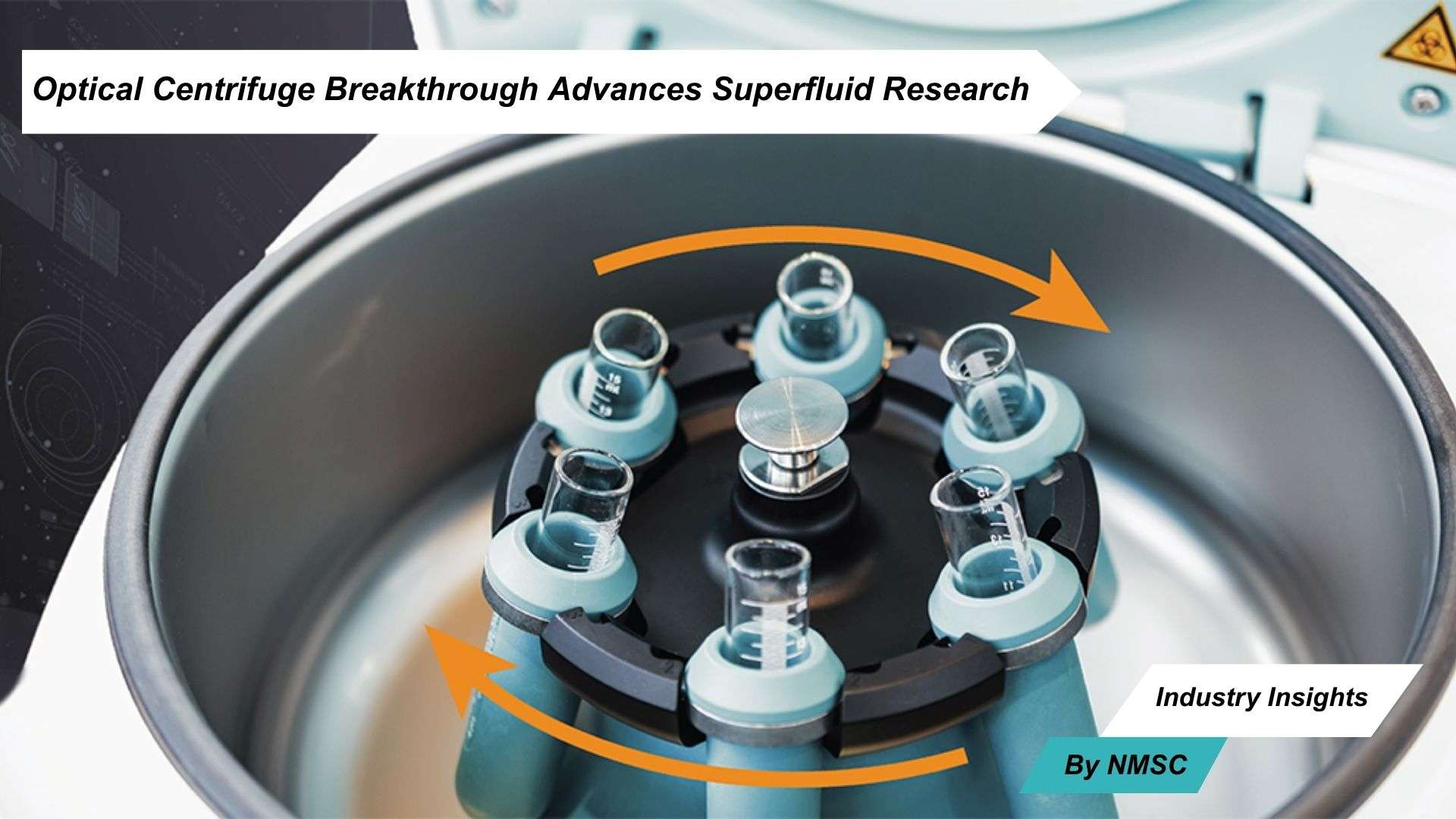
Physicists at the University of British Columbia (UBC), in collaboration with researchers from the University of Freiburg, have achieved a significant scientific milestone with the development of a new optical centrifuge capable of controlling molecular rotation inside a superfluid. This advancement marks a critical step toward understanding the complex behavior of superfluids exotic states of matter that flow without viscosity under near-absolute-zero conditions.
The research, recently detailed in Physical Review Letters, demonstrates for the first time that scientists can directly control both the direction and frequency of molecular rotation while the molecules are suspended within liquid helium nano-droplets. This capability is essential for probing how molecules interact with their surrounding quantum environment at varying rotational speeds.
A Breakthrough in Controlled Molecular Rotation
Until now, managing the rotation of molecules dissolved in any fluid has remained a formidable challenge. As explained by Dr. Valery Milner, associate professor in UBC’s Department of Physics and Astronomy and an author of the study, dissolved molecules interact strongly with the atoms or molecules around them, effectively increasing their size and making them more difficult to rotate. Despite their frictionless nature, superfluids still act as solvents, adding another layer of complexity to molecular motion.
The new optical centrifuge overcomes this barrier by enabling researchers to precisely set how fast and in which direction a molecule spins within a superfluid. This capability opens the door to studying how molecular behavior changes when transitioning from a normal fluid to a quantum superfluid a fundamental question in the science of quantum matter.
Reinventing the Optical Centrifuge Approach
Conventional optical centrifuges have long been used to study molecules in gases by applying a rotating laser pulse. Molecules align with the electric field of the laser and rotate accordingly. However, this method had not been effective for molecules embedded in superfluids.
Dr. Milner and his team introduced a novel approach by embedding molecules in helium nano-droplets doped with dimers of nitric oxide. By adding a carefully timed delay between laser pulses, they created an interference effect that produced a lower, constant rotation rate. This adjustment significantly increased the molecules’ ability to spin, making controlled rotation within a superfluid possible for the first time.
With this added “control knob,” researchers can now scan molecular rotation frequencies across a critical threshold. Beyond this point, molecular rotation is expected to decay much more rapidly due to the breakdown of superfluidity at the atomic scale an area that remains poorly understood.
Advancing the Study of Quantum Matter
The ability to explore how and when superfluid behavior breaks down at extremely small scales represents a major advance in experimental physics. According to Dr. Milner, identifying the exact frequency at which this transition occurs is a key focus of ongoing research. The findings are expected to deepen scientific understanding of quantum environments and molecular dynamics under extreme conditions.
The study was supported by the Natural Sciences and Engineering Research Council of Canada, the Canada Foundation for Innovation, and the BC Knowledge Development Fund, underscoring its importance within the broader scientific community.
Next Move Strategy Consulting’s View
From the perspective of Next Move Strategy Consulting, this development highlights the expanding role of centrifuge technologies beyond traditional industrial and laboratory applications. The emergence of advanced optical centrifuges demonstrates how precision control and innovation are redefining the capabilities of centrifuge systems in cutting-edge research environments.
As scientific exploration increasingly focuses on quantum materials and nanoscale phenomena, centrifuge technologies are evolving into highly specialized research instruments. Innovations such as the UBC optical centrifuge illustrate a shift toward customized, application-specific solutions designed to meet the growing demand for accuracy, control, and adaptability in advanced physics and materials science.
Next Move Strategy Consulting views such breakthroughs as indicative of a broader trend in the centrifuge market, where technological refinement and interdisciplinary research are driving new opportunities. The continued integration of advanced centrifuge systems into fundamental research is expected to play a pivotal role in shaping future discoveries across quantum science and beyond.
Redefining Experimental Possibilities
The successful demonstration of controlled molecular spinning inside a superfluid represents a defining moment in experimental physics. By extending the capabilities of optical centrifuges into quantum environments, researchers have opened new avenues for exploring the fundamental properties of matter.
As investigations continue, this innovation reinforces the importance of advanced centrifuge technologies in pushing the boundaries of scientific understanding transforming theoretical questions about superfluids into experimentally accessible realities.
Source: University of British Columbia
Prepared by: Next Move Strategy Consulting
About the Author
 Tania Dey is a content writer specializing in transformation-led, insight-driven storytelling. She develops research-backed, high-impact content aligned with evolving business priorities, digital behavior, and audience expectations. Her work helps organizations sharpen value propositions, strengthen visibility, and communicate strategic intent with clarity and precision. Grounded in data-informed storytelling, she brings a strong focus on relevance, consistency, and measurable digital impact across platforms.
About the Reviewer
 Sanyukta Deb is Digital Marketing Team Lead at Next Move Strategy Consulting, where she has led content strategy and technical SEO for the firm's B2B market research publications for over 2 years. Her editorial process translates NextMSC's primary and secondary research — spanning technology, industrial, and consumer sectors — into commercial narratives, backed by search-intent, keyword, and competitive analysis. She brings 5 years of overall experience in digital marketing and content strategy.

















Add Comment