Physical AI Partnership Drives HII Shipyard Efficiency
Industry Insights from Next Move Strategy Consulting
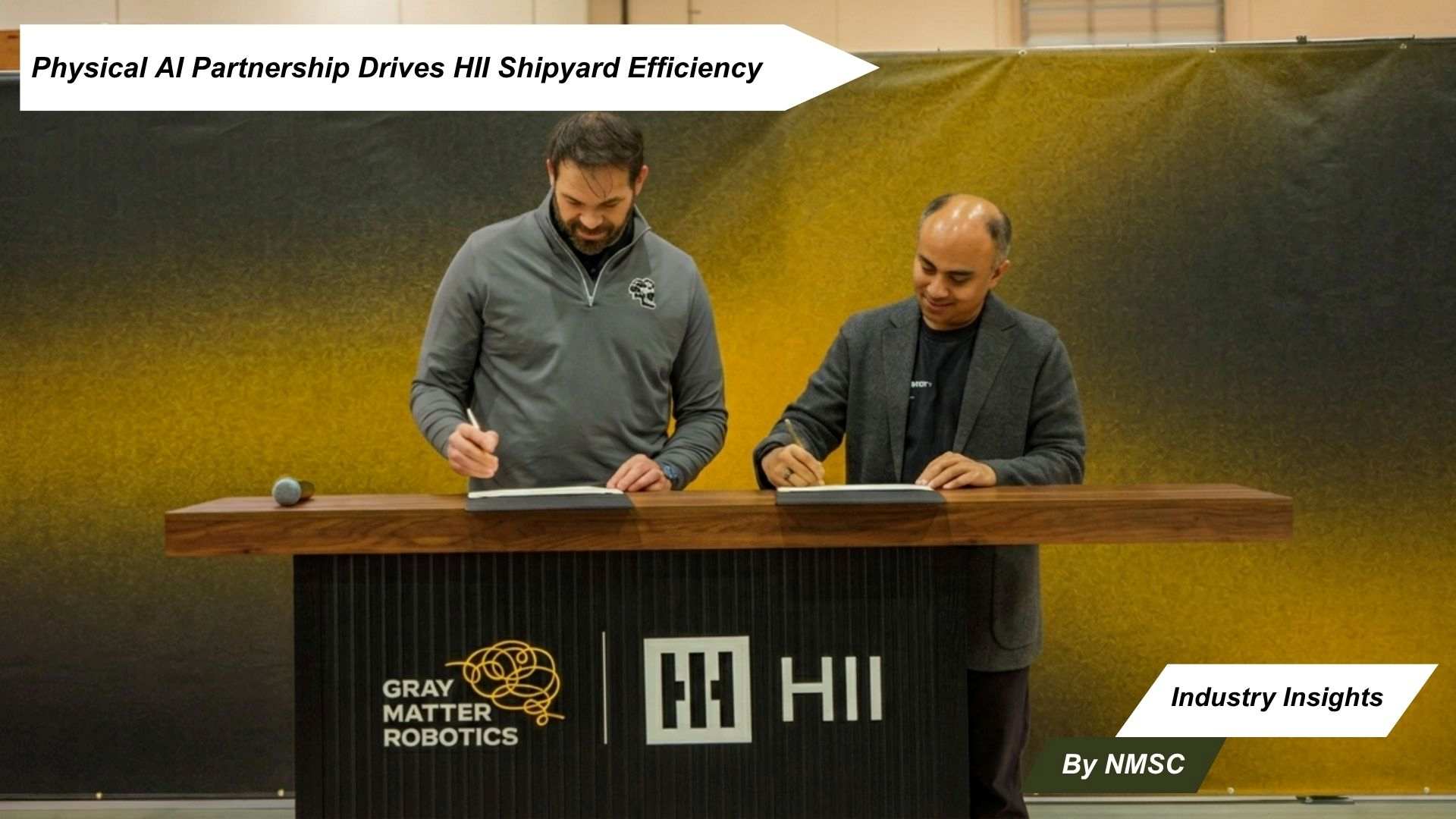
As industrial sectors increasingly look to automation for productivity gains, Huntington Ingalls Industries’ latest agreement with GrayMatter Robotics marks a notable step in the growing Physical AI landscape. By exploring the use of autonomous robotics for shipbuilding operations, HII is aligning advanced automation with large-scale infrastructure investments to strengthen efficiency, workforce capability, and fleet readiness.
The memorandum of understanding, signed in early April 2026, focuses on integrating GrayMatter’s Physical AI technologies into HII’s shipyards. Planned applications include autonomous surface preparation, coating, and inspection, alongside broader initiatives in autonomous shipbuilding capabilities, workforce training, and unmanned systems production.
Advancing Beyond Traditional Shipyard Operations
Shipbuilding has long depended on highly skilled labor, precise execution, and complex scheduling across large industrial facilities. HII’s collaboration with GrayMatter Robotics reflects a strategic move toward blending human expertise with AI-powered robotics to improve throughput and operational discipline.
The initiative complements more than US$1 billion in shipyard investments already underway. Rather than replacing the workforce, the agreement positions automation as a support layer that can enhance productivity while sustaining a skilled maritime labor base and meeting U.S. Navy fleet requirements.
At its core, the partnership is designed to reinforce HII’s efficiency-focused investment narrative, where faster execution, stronger margins, and dependable delivery schedules remain central priorities.
Key Focus Areas at a Glance
-
Autonomous Surface Preparation: Robotics designed to automate labor-intensive preparation processes with greater consistency.
-
AI-Driven Coating Systems: Intelligent automation to improve speed and precision in protective coating applications.
-
Smart Inspection Capabilities: Advanced systems aimed at strengthening quality control and reducing delays.
-
Workforce Training Integration: Supporting employees with new technical skills for AI-enabled shipyard environments.
-
Unmanned Systems Production: Expanding capacity in next-generation autonomous maritime solutions.
Strengthening the Efficiency Narrative
While the GrayMatter Robotics agreement highlights HII’s long-term ambition, analysts note that the company’s immediate catalysts remain tied to throughput gains and margin improvement from core shipbuilding programs. Recent milestones, including completion of post-shakedown availability for the Virginia-class USS New Jersey (SSN 796), more directly demonstrate HII’s operational execution capabilities.
Against that backdrop, the Physical AI partnership is best viewed as an incremental enabler—one that may help maintain schedules, control costs, and improve consistency across high-value naval platforms over time.
The company’s broader financial narrative projects US$14.6 billion in revenue and US$911.5 million in earnings by 2029, requiring steady annual revenue expansion and significant earnings growth from current levels. Automation initiatives such as this could play a supporting role in achieving those targets.
Industry Outlook and Market Perspective
The agreement also reflects a wider industrial shift as companies explore AI systems capable of operating directly in real-world environments. Physical AI combines robotics, machine vision, machine learning, and autonomous decision-making to perform physical tasks with greater adaptability and precision.
According to Next Move Strategy Consulting, the Physical AI Market is gaining momentum as manufacturers, defense contractors, logistics operators, and infrastructure providers seek new ways to modernize operations. Demand is expected to center on productivity enhancement, workforce augmentation, predictive maintenance, and autonomous production systems.
For capital-intensive industries such as shipbuilding, the adoption of Physical AI may become increasingly important as organizations pursue resilient supply chains, cost discipline, and faster delivery cycles.
Redefining the Future of Industrial Shipbuilding
HII’s collaboration with GrayMatter Robotics signals more than a technology trial it reflects how industrial leaders are rethinking operations in an era where automation and intelligence are becoming core competitive advantages.
As shipyards evolve to meet rising production demands and modern defense requirements, Physical AI could emerge as a critical tool for balancing efficiency, precision, and workforce development. With this move, HII positions itself at the intersection of traditional industrial strength and next-generation intelligent manufacturing.
Source: Sahm Capital News
Prepared by: Next Move Strategy Consulting
About the Author
 Sanyukta Deb
— Sanyukta Deb is Digital Marketing Team Lead at Next Move Strategy Consulting, where she has led content strategy and technical SEO for the firm's B2B market research publications for over 2 years. Her editorial process translates NextMSC's primary and secondary research — spanning technology, industrial, and consumer sectors — into commercial narratives, backed by search-intent, keyword, and competitive analysis. She brings 5 years of overall experience in digital marketing and content strategy.
Sanyukta Deb
— Sanyukta Deb is Digital Marketing Team Lead at Next Move Strategy Consulting, where she has led content strategy and technical SEO for the firm's B2B market research publications for over 2 years. Her editorial process translates NextMSC's primary and secondary research — spanning technology, industrial, and consumer sectors — into commercial narratives, backed by search-intent, keyword, and competitive analysis. She brings 5 years of overall experience in digital marketing and content strategy.
About the Reviewer
 Debashree Dey
— Debashree Dey is Assistant Manager at Next Move Strategy Consulting, where she supports cross-vertical market content and communications across diverse industries for 6 years. Her professional background includes senior content writing, communications, and published manuscript authorship, with experience developing audience-focused business narratives and maintaining clear, consistent messaging. Her role supports research-led content development and editorial quality across NextMSC publications.
Debashree Dey
— Debashree Dey is Assistant Manager at Next Move Strategy Consulting, where she supports cross-vertical market content and communications across diverse industries for 6 years. Her professional background includes senior content writing, communications, and published manuscript authorship, with experience developing audience-focused business narratives and maintaining clear, consistent messaging. Her role supports research-led content development and editorial quality across NextMSC publications.















Add Comment