Pudu $150M Raise Drives Robotics Industry Update
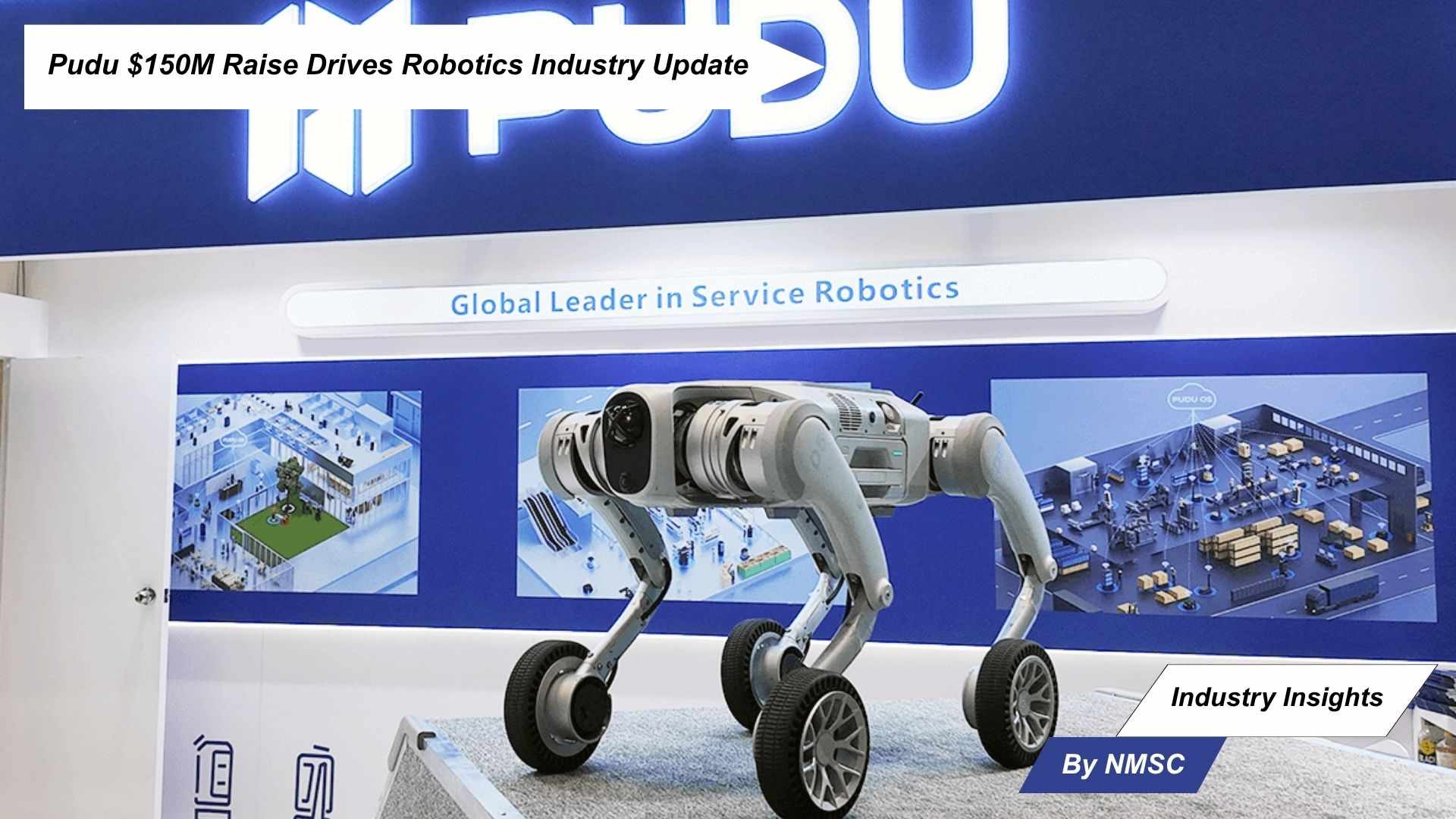
Pudu Robotics’ USD150M Funding Milestone Signals Commercial Service Robotics Industry Update
SHENZHEN, China — April 28, 2026 — Global investor confidence in scalable embodied AI robotics strengthened sharply this week after commercial service robotics leader Pudu Robotics announced it has secured nearly USD 150 million in a new funding round, pushing its valuation beyond USD 1.5 billion and marking one of the sector’s most significant capital milestones of 2026.
The financing announcement, disclosed through an official corporate release distributed on April 28, brings Pudu Robotics’ cumulative funding above USD 300 million and underscores rising market conviction that commercial robotics is moving beyond pilot-stage deployments into large-scale global monetization.
Billion-Dollar Valuation Reinforces Robotics Commercialization Shift
Unlike many robotics firms still focused on prototype innovation, Pudu Robotics has built measurable commercial traction across multiple automation categories including:
-
Service delivery robots
-
Commercial cleaning robots
-
Industrial delivery robots
-
General embodied AI robotics
This diversified robotics deployment strategy helped the company post a 100% year-over-year revenue increase in 2025, according to the announcement, reflecting accelerating enterprise acceptance of autonomous service systems across retail, logistics, hospitality, and facility operations.
Particularly notable is the company’s commercial cleaning division, which now contributes more than 70% of total company revenue, demonstrating that recurring operational robotics applications are becoming the primary revenue engine within the service robotics ecosystem.
Industrial Delivery Expansion Adds New Growth Layer
Pudu also confirmed that its industrial delivery robot business has entered a rapid expansion phase, with over 4,000 units shipped within just one year of launch.
This development is significant because it signals that the company is no longer dependent solely on hospitality or front-end service robotics. It is increasingly penetrating industrial and enterprise movement automation—an area analysts identify as one of the fastest-growing use cases for embodied AI-enabled machines.
According to analysts at Next Move Strategy Consulting, Pudu’s latest capital raise confirms a broader structural change in the robotics industry: investors are increasingly rewarding companies with proven deployment economics rather than conceptual AI narratives.
“Pudu Robotics has crossed a critical threshold where robotics valuation is now being justified by repeatable commercial adoption, global customer penetration, and scalable embodied AI integration,” notes Sikha Haritwal, Assistant Manager at Next Move Strategy Consulting. “This indicates the commercial service robotics market is entering a stronger industrialization cycle, with capital moving toward companies capable of converting autonomous systems into sustained enterprise revenue.”
Funding to Accelerate Embodied AI and Global Manufacturing
The company stated that proceeds from the new financing will be strategically used to:
-
Accelerate embodied AI technology development
-
Expand its robotics product portfolio
-
Deepen global market expansion
-
Increase manufacturing scale
-
Strengthen supply chain resilience
This funding allocation suggests Pudu is preparing not just for incremental sales growth, but for a larger competitive phase where robotics manufacturers will need stronger production efficiency, software intelligence, and international fulfillment capabilities.
Global Deployment Leadership Gives Pudu a Rare Advantage
Pudu Robotics currently operates from its Shenzhen headquarters with dedicated research centers in Chengdu and Hong Kong, while maintaining full-stack development capabilities across navigation algorithms, motion controllers, multi-robot scheduling, and integrated robotic joint modules.
More importantly, the company’s commercial execution already extends far beyond domestic Chinese deployments.
Its robotics systems are currently used by major multinational retailers and enterprises including Carrefour, Walmart, and EDEKA, while Frost & Sullivan’s global commercial service robotics assessment places Pudu Robotics at 23% global market share—ranking first worldwide in international deployments.
That level of global installation density is becoming increasingly important in embodied AI robotics, where real-world operational data, fleet management learning, and autonomous adaptation directly improve long-term competitive performance.
Why the Funding Round Matters for the Broader Robotics Market
The significance of this announcement lies less in the funding amount itself and more in what the valuation confirms:
commercial service robotics has entered a stage where enterprise-grade deployment scale is now attracting billion-dollar capital confidence.
Pudu’s latest raise demonstrates that investors are beginning to differentiate between robotics firms still dependent on future promises and those already generating tangible global adoption.
For robotics manufacturers, automation integrators, and industrial AI developers, the message is increasingly clear—commercial robotics is evolving into a high-growth infrastructure market rather than a niche experimental technology segment.
Next Move Strategy Consulting analysts view this development as a strong indicator that global embodied AI and commercial autonomous robotics investment will continue accelerating as deployment-led companies gain valuation premiums in the years ahead.
Source: ANTARA News
Prepared By: Joydeep Dey
About the Author
 Sanyukta Deb is Digital Marketing Team Lead at Next Move Strategy Consulting, where she has led content strategy and technical SEO for the firm's B2B market research publications for over 2 years. Her editorial process translates NextMSC's primary and secondary research — spanning technology, industrial, and consumer sectors — into commercial narratives, backed by search-intent, keyword, and competitive analysis. She brings 5 years of overall experience in digital marketing and content strategy.
About the Reviewer
 Debashree Dey is Assistant Manager at Next Move Strategy Consulting, where she supports cross-vertical market content and communications across diverse industries for 6 years. Her professional background includes senior content writing, communications, and published manuscript authorship, with experience developing audience-focused business narratives and maintaining clear, consistent messaging. Her role supports research-led content development and editorial quality across NextMSC publications.

















Add Comment