Riding the Wave: Global Surge in Commercial Seaweed Farming
The global Commercial Seaweed Market size is predicted to reach USD 18.66 billion by 2030 with a CAGR of 6.52% from 2024-2030. The industry is experiencing a transformative phase, driven by innovative farming models that blend local empowerment with global sustainability goals.
As demand rises for eco-friendly ingredients across industries, recent pilots in remote islands and offshore wind farms signal scalable opportunities for procurement professionals seeking resilient supply chains.
Latest Developments in the Commercial Seaweed Market (2024–2025)
The past year has marked pivotal advancements in seaweed cultivation, emphasizing commercial viability and environmental integration. In October 2024, North Sea Farmers achieved a milestone with the first harvest at North Sea Farm 1, a five-hectare commercial-scale seaweed operation embedded within the Hollandse Kust Zuid offshore wind farm, 18 kilometers off Scheveningen, Netherlands.
Funded by €2 million from Amazon’s Right Now Climate Fund, this initiative harvested seaweed from four 50-by-3-meter nets anchored to the seabed, using a specialized vessel to navigate turbine spacing. The project provides critical data on carbon sequestration and biodiversity impacts, monitored via satellite, seabed sampling, and environmental DNA techniques by partners like Plymouth Marine Laboratory.
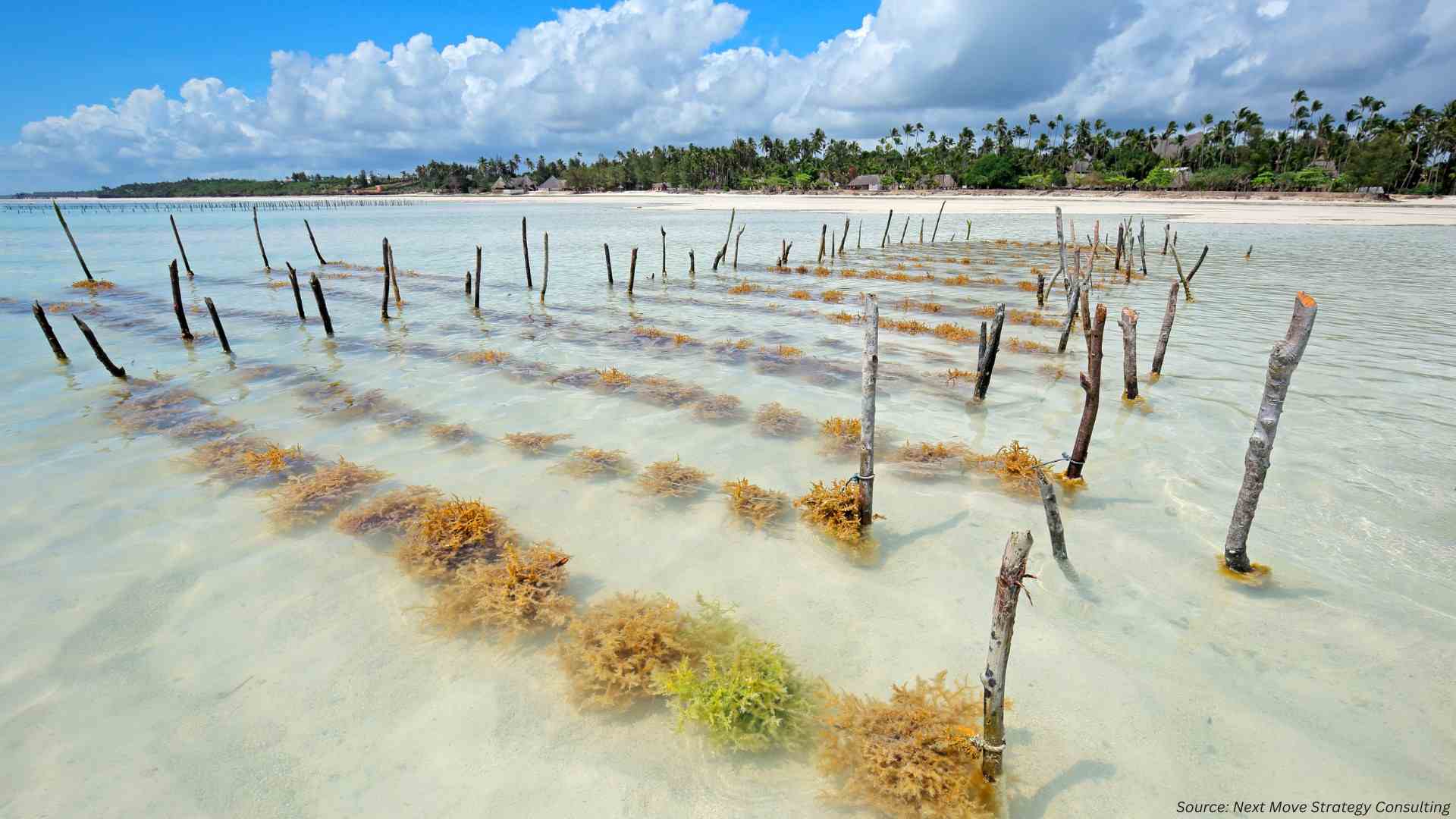
Complementing this European breakthrough, Zanzibar's seaweed sector expanded visibly in 2024, with satellite imagery from NASA's Landsat 9 on August 5 capturing extensive plots in Adamson Bay, Pemba Island, Tanzania. These rectangular beds, spanning 400 to 600 meters from shore in waters under 2 meters deep, highlight the archipelago's role as a hub for red seaweed like Eucheuma and Kappaphycus, farmed across over 80 villages and employing tens of thousands, predominantly women. The sector, which began commercial farming in 1989 with Philippine seedlings, now ranks as one of Tanzania's top exports, valued for its low-input model that avoids arable land and fertilizers.
In Asia, building on 2022-23 pilots, Lakshadweep's seaweed enterprise scaled in 2024-25 under ICAR-Central Marine Fisheries Research Institute (CMFRI) guidance. The TSC-Purple Turtle Company, Tuticorin, expanded from six plots in Chetlath island to 30 across multiple atolls, yielding 15 tons in the initial 45-day harvest and generating 3,000 man-days of employment at Rs 380 daily, primarily for women from Self Help Groups. This aligns with India's NICRA program, focusing on indigenous species like Gracilaria edulis.
These developments underscore a market shift toward integrated, low-impact farming, with global production poised to address supply bottlenecks for carrageenan and other extracts.
Applications Across Industries
Seaweed's versatility positions it as a cornerstone for sustainable sourcing in multiple sectors. In food and beverages, dried red seaweeds from Zanzibar supply carrageenan—a natural thickener used in yogurt, plant milks, and ice cream—exported globally without needing freshwater or land. Cosmetics and pharmaceuticals leverage its gelling properties for stabilizers and bioactive compounds, while emerging uses in textiles and wellness products emerge from Dutch harvests.
Environmental applications gain traction, as farms like North Sea Farm 1 demonstrate carbon absorption and nutrient uptake (nitrogen and phosphorus), enhancing climate resilience without fertilizers. In Lakshadweep, farms double as biodiversity supports in seagrass areas, though monitoring reveals potential trade-offs like reduced meadow health in high-density zones. For industrial buyers, this translates to traceable, regenerative inputs that meet ESG mandates.
Analysis of Dominating and Fastest-Growing Regions
The commercial seaweed market's regional dynamics reveal established powerhouses alongside rapid expanders, fueled by policy, geography, and innovation.
|
Region |
Dominating Countries |
Key Leadership Factors |
Fastest-Growing Countries |
Growth Drivers |
|
Asia-Pacific and Africa & Rest of World. |
India, Tanzania |
Policy-backed scaling; women-led employment (e.g., 3,000 man-days in Lakshadweep at Rs 380/day). Export dominance (Tanzania's top industry, 80+ villages). |
India (Lakshadweep focus) |
NICRA trials on indigenous species; KCC/Mudra loans for contract farming. Pemba expansion via subtidal plots. |
|
Europe |
Netherlands |
Offshore integration (first wind-farm harvest, €2M funding). Biodiversity/carbon data from Plymouth Lab. |
Netherlands |
Proof-of-concept for co-location; scalability studies. |
|
North America |
N/A (Emerging) |
Limited commercial scale in 2024-25; focus on research. |
N/A |
Potential via partnerships, but no verified large-scale ops. |
Africa (RoW), & Asia-Pacific dominates with 80%+ of global supply, led by Tanzania's Zanzibar (tens of thousands employed since 1989) and India's Lakshadweep pilots, where CMFRI's two-pronged model—private farms plus contract growing—leverages indigenous species for high-value yields. Europe emerges as the fastest-growing, with the Netherlands pioneering turbine-adjacent farms to minimize traffic conflicts and boost biodiversity, as noted by Managing Director Eef Brouwers:
"This harvest helps demonstrate that seaweed production within offshore wind farms can be carried out on a commercial scale." North America lags, lacking verified 2024-25 commercial breakthroughs.
Key Players with Recent Strategies/Deals
Established and emerging players are forging paths through targeted innovations and collaborations.
-
North Sea Farmers (Emerging, Netherlands): As a non-profit, it leads offshore integration with the 2024 North Sea Farm 1 harvest, partnering with Plymouth Marine Laboratory for carbon/biodiversity monitoring. Strategy focuses on scalable co-location; details at their research protocols page. Funded by Amazon’s €2M grant, emphasizing no-land/no-fertilizer production for food/textiles.
-
TSC-Purple Turtle Company (Emerging, India): Tuticorin-based, it executed Lakshadweep's first commercial pilot in 2022-23, expanding to 3,000 net tubes and employing 20 women. Recent strategy: Horizontal scaling with CMFRI for Gracilaria edulis; see farming techniques page. Ties to government loans for contract models.
-
ICAR-CMFRI (Leading Public Entity, India): Guides national efforts via NICRA, training locals since 2020 and advocating hatcheries/processing. 2024 strategy: Policy input with NITI Aayog for inclusive development; explore seaweed R&D innovations.
-
Zanzibar Seaweed Farmers (Community-Led, Tanzania): Informal networks dominate, with 30+ Pemba villages farming Eucheuma for carrageenan exports. 2024 push: Subtidal expansion to protect seagrass; strategies via sustainable farming guides.
-
Other Notable Players include Acadian Seaplants, Cargill Inc, CP Kelco, Cascadia Seaweed, Mara Seaweed, Roullier Group, and more.

These moves enhance supply reliability, with offshore and contract models reducing risks for buyers.
Future Prospects and Examples
Looking ahead, the commercial seaweed market could reach $20B by 2030, propelled by carbon-credit integrations and value-added processing. In Europe, North Sea Farmers' data will inform EU-wide wind-farm pilots, potentially absorbing excess nutrients while commercial-scale yields under evaluation; early pilots confirm viability. Asia's prospects hinge on infrastructure like Lakshadweep hatcheries, enabling 30-45 days’ cycles for year-round supply.
Examples include Pemba's women farmers exporting to pharma giants, storing carbon in meadows, and Dutch vessels processing harvests into wellness goods—models replicable in the U.S. Gulf via similar shallow zones. Challenges like biodiversity monitoring persist, but verified pilots offer blueprints for resilient chains.
These advancements directly impact the commercial seaweed market by validating scalable, inclusive models that lower costs (e.g., no fertilizer needs) and open ESG-compliant sourcing. For procurement teams, they signal diversified suppliers in high-growth regions, mitigating climate risks—empowering strategic pivots toward regenerative materials.
About Next Move Strategy Consulting:
Next Move Strategy Consulting is a premier market research and management consulting firm that has been committed to provide strategically analysed well documented latest research reports to its clients. The research industry is flooded with many firms to choose from, what makes NMSC different from the rest is its top-quality research and the obsession of turning data into knowledge by dissecting every bit of it and providing fact-based research recommendation that is supported by information collected from over 500 million websites, paid databases, industry journals and one on one consultations with industry experts across a diverse range of industry sectors. The high-quality customized research reports with actionable insights and excellent end-to-end customer service help our clients to take critical business decisions that enables them to move beyond time and have competitive edge in the industry.
We have been servicing over 1000 customers globally that includes 90% of the Fortune 500 companies over a decade. Our analysts are constantly tracking various high growth markets and identifying hidden opportunities in each sector or the industry. We provide one of the industry’s best-quality, syndicated, as well as custom research reports across 10 different industry verticals. We are committed to deliver high quality research solutions in accordance to your business needs. Our industry standard delivery solutions that ranges from the pre consultation to after-sales services, provide an excellent client experience and ensure right strategic decision making for businesses.
For more information, please contact:
Next Move Strategy Consulting
5th Floor 867
Boylston St, STE 500,
Boston, MA 02116, U.S.
E-Mail: [email protected]
Direct: +18577585017
Website: www.nextmsc.com
About the Author
 Sanyukta Deb
— Sanyukta Deb is Digital Marketing Team Lead at Next Move Strategy Consulting, where she has led content strategy and technical SEO for the firm's B2B market research publications for over 2 years. Her editorial process translates NextMSC's primary and secondary research — spanning technology, industrial, and consumer sectors — into commercial narratives, backed by search-intent, keyword, and competitive analysis. She brings 5 years of overall experience in digital marketing and content strategy.
Sanyukta Deb
— Sanyukta Deb is Digital Marketing Team Lead at Next Move Strategy Consulting, where she has led content strategy and technical SEO for the firm's B2B market research publications for over 2 years. Her editorial process translates NextMSC's primary and secondary research — spanning technology, industrial, and consumer sectors — into commercial narratives, backed by search-intent, keyword, and competitive analysis. She brings 5 years of overall experience in digital marketing and content strategy.
About the Reviewer
 Debashree Dey
— Debashree Dey is Assistant Manager at Next Move Strategy Consulting, where she supports cross-vertical market content and communications across diverse industries for 6 years. Her professional background includes senior content writing, communications, and published manuscript authorship, with experience developing audience-focused business narratives and maintaining clear, consistent messaging. Her role supports research-led content development and editorial quality across NextMSC publications.
Debashree Dey
— Debashree Dey is Assistant Manager at Next Move Strategy Consulting, where she supports cross-vertical market content and communications across diverse industries for 6 years. Her professional background includes senior content writing, communications, and published manuscript authorship, with experience developing audience-focused business narratives and maintaining clear, consistent messaging. Her role supports research-led content development and editorial quality across NextMSC publications.















Add Comment