Safran Launches Smart Materials Programme to Drive Aerospace Innovation

Safran Launches Dedicated Smart Materials Open Innovation Programme, Signalling a Structural Shift in Aerospace-Grade Responsive Technology Procurement
In a development that underscores the accelerating institutionalisation of smart materials within the global aerospace supply chain, Safran Group — the world's third-largest aerospace company excluding aircraft manufacturers — formally launched its Safran Explore Smart Materials 2026 open innovation programme on June 3, 2026. Structured around five technology challenges — Material Systems of the Future, Intelligence for Materials & Processes, M&P for Electrical Applications, Circularity & Recycling, and Inspection, Control and Maintenance — the initiative is explicitly designed to co-develop disruptive smart material technologies with start-ups, spin-offs, and SMEs over a five-to-ten-year horizon, directly embedding responsive materials into Safran's propulsion, aircraft equipment, defence, and space R&T roadmaps.
The scale and specificity of Safran's programme — spanning AI-driven material design, PFAS-free electrical insulation, carbon fibre circularity, and on-wing composite inspection — reflects a broader structural shift: smart materials are no longer confined to laboratory demonstration but are being actively integrated into the qualification and industrialisation pipelines of Tier-1 aerospace primes. This transition from research novelty to procurement imperative is a primary force reshaping the global smart materials market's commercial trajectory.
According to Next Move Strategy Consulting's Smart Materials Market report, the global smart materials market is projected to reach USD 115.97 billion by 2030, growing at a CAGR of 9.1% from 2025 to 2030. NMSC's proprietary research and analysis identifies rising military expenditure, accelerating automotive production volumes, and expanding healthcare device investment as the three principal demand vectors sustaining this growth trajectory across the forecast period.
For More Information: Download FREE Sample on Smart Materials Market Report
Military Expenditure Reaches a Record USD 2,887 Billion, Directly Expanding the Addressable Market for Defence-Grade Smart Materials
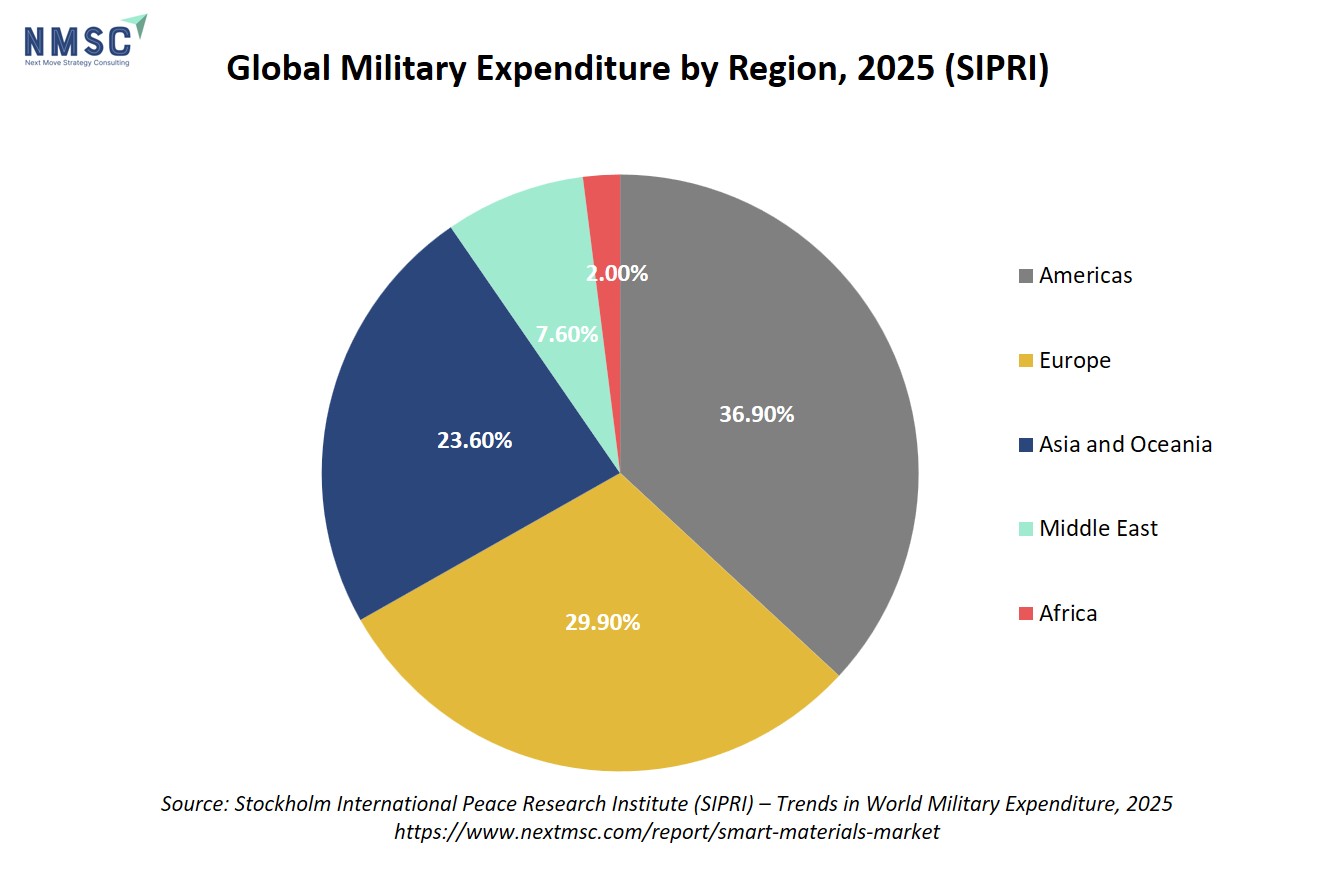
The defence and aerospace end-user segment remains the most structurally significant demand driver for high-performance smart materials, and the latest data from the Stockholm International Peace Research Institute (SIPRI) confirms that this demand base is expanding at an unprecedented pace. According to SIPRI's Trends in World Military Expenditure, 2025, published in April 2026, global military expenditure reached USD 2,887 billion in 2025 — an increase of 2.9% in real terms over 2024 and the eleventh consecutive annual increase in global defence spending.
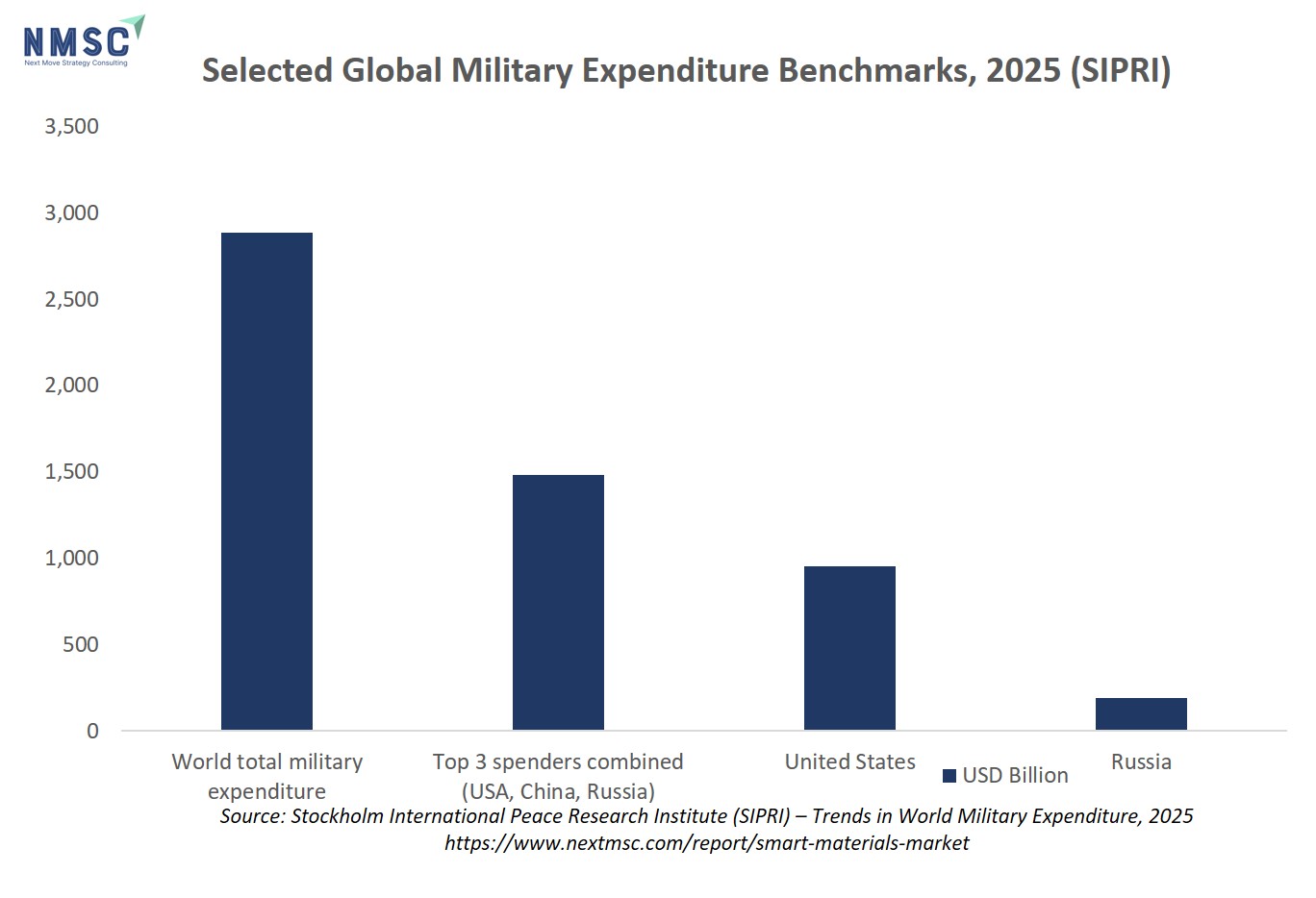
This sustained escalation in defence budgets is directly translating into procurement of shape-memory alloys for adaptive armour systems, piezoelectric sensors for structural health monitoring in aircraft, and self-healing polymer coatings for naval and ground vehicle applications — material categories that sit at the core of the smart materials market's highest-margin segments. North America, which NMSC's proprietary research identifies as the dominant regional market, benefits disproportionately from this trend: Canada's Parliamentary Budget Office has projected that the country's military expenditure will rise from 1.29% of GDP in 2024–2025 to 1.49% of GDP in 2025–2026, reflecting a deliberate policy commitment to defence technology modernisation that includes advanced material systems.
Automotive Production Volumes and Lightweighting Mandates Sustain Broad-Based Demand Across Material Categories
Beyond defence, the automotive sector represents the second-largest structural demand driver for smart materials, with the mechanism of growth operating through two distinct but reinforcing channels: rising production volumes and tightening fuel economy and emissions regulations that make lightweighting a commercial necessity rather than an engineering preference.
According to the International Energy Agency's latest vehicle sales data, global car sales grew by 5% from 72.8 million units in 2022 to 76.6 million units in 2023. Within this production expansion, the Asia-Pacific region has emerged as the most consequential growth theatre. According to a 2024 report by the Institute for Management Development, China became the world's largest automotive production economy, manufacturing over 30 million vehicles in 2023 — a volume that creates a proportionally large addressable market for smart materials used in adaptive suspension systems, self-healing exterior coatings, and piezoelectric energy harvesting components embedded in vehicle structures.
In September 2024, Li Auto entered into a joint innovation platform with Covestro specifically focused on smart materials advancements for automotive applications — a partnership that illustrates how original equipment manufacturers are moving from ad hoc material sourcing to structured co-development arrangements that lock in supply chain relationships for next-generation vehicle platforms.
Healthcare Spending Surge Accelerates Biocompatible Smart Material Adoption in Medical Devices and Implants
The healthcare end-user segment is identified by NMSC's proprietary research as the fastest-growing application vertical within the smart materials market, driven by a combination of rising institutional healthcare expenditure and the increasing clinical validation of smart hydrogels, shape-memory polymer implants, and piezoelectric biosensors in diagnostic and therapeutic applications.
According to the U.S. Centers for Medicare and Medicaid Services, U.S. healthcare spending reached USD 4.9 trillion in 2023, representing a 7.5% increase from the 4.6% growth rate recorded in 2022 — the sharpest acceleration in healthcare expenditure in over a decade. This spending surge is directly expanding procurement budgets for advanced medical devices that rely on smart material substrates: shape-memory alloy stents that self-expand at body temperature, electroactive polymer actuators in minimally invasive surgical tools, and phase-change material-based thermal management systems in implantable electronics.
The Deloitte 2026 Aerospace and Defense Industry Outlook further notes that investment in advanced manufacturing — including smart material-enabled production systems — is continuing to accelerate as manufacturers seek to improve competitiveness and agility across both commercial and defence supply chains, reinforcing the cross-sectoral demand dynamic that underpins NMSC's 9.1% CAGR projection.
India's Semiconductor Expansion Creates a Secondary Demand Multiplier for Smart Sensor Materials
A structurally underappreciated demand driver within the Asia-Pacific smart materials market is India's rapidly expanding semiconductor manufacturing sector, which creates derivative demand for piezoelectric and electrochromic materials used in sensor fabrication, MEMS devices, and advanced packaging applications.
According to the India Brand Equity Foundation, the Indian semiconductor market was valued at USD 26.3 billion and is projected to expand at a CAGR of 26.3% to reach USD 271.9 billion by 2032. As India's semiconductor fabrication capacity scales — supported by the government's USD 10 billion Production Linked Incentive scheme for semiconductors — the upstream demand for smart materials that enable sensor functionality, energy harvesting, and adaptive packaging will expand in direct proportion to wafer output growth.
Safran's Five-Challenge Framework: A Practical Procurement Map for the Next Generation of Smart Material Systems
The Safran Explore Smart Materials 2026 programme warrants detailed examination not merely as a corporate innovation initiative but as a forward-looking specification document for the entire aerospace smart materials supply chain. Each of Safran's five challenges maps directly onto a commercially significant smart material category:
-
Material Systems of the Future targets multifunctional bulk materials — including piezoresistive CFRP composites integrating carbon nanotubes or graphene, and SiC/SiC ceramic matrix composites combining mechanical performance with high-temperature resistance — alongside self-healing coatings and anti-icing surfaces that transform passive structural surfaces into functional sensing interfaces.
-
Intelligence for Materials & Processes deploys AI for composite architecture design, in-silico performance testing, and the structuring of legacy experimental data — a capability that directly reduces the qualification timeline for new smart material systems from years to months.
-
M&P for Electrical Applications addresses the material constraints imposed by aerospace electrification: high-voltage insulation above 1 kV, partial-discharge-resistant ceramics, PFAS-free cable alternatives including PEEK and PEKK, and rare-earth-free magnets — all of which represent high-value smart material sub-segments with limited current supply.
-
Circularity & Recycling targets performance-oriented carbon fibre valorisation from production scrap and end-of-life composites, alongside full material traceability software — a challenge that, if solved, would structurally reduce the raw material cost barrier that currently constrains smart material adoption in cost-sensitive applications.
-
Inspection, Control and Maintenance seeks portable, on-wing inspection solutions for composite components — including AI-assisted non-destructive testing interpretation — that would enable real-time structural health monitoring using embedded piezoelectric and fibre-optic smart material sensors.
Key Players and Competitive Developments
The smart materials competitive landscape is characterised by a combination of established electronic component manufacturers, specialised piezoelectric ceramics producers, and diversified industrial conglomerates, each pursuing product innovation and strategic partnerships to consolidate market position.
TDK Corporation launched a new solid-state battery material with higher energy density in June 2024, targeting wearable device applications including wireless earphones, hearing aids, and smartwatches — a product category that directly expands the addressable market for smart material-enabled consumer electronics. TDK's Investor Day, scheduled for September 1, 2026, is expected to outline the company's next-phase strategy for piezoelectric and energy-harvesting material platforms.
PI Ceramic GmbH launched a new product category of piezoceramic composites in June 2024, utilising an innovative manufacturing technology to embed piezoelectric ceramics within filled polymers — a development that expands the geometric and application flexibility of piezoelectric smart materials beyond traditional rigid ceramic form factors.
Parker Hannifin Corporation, whose fiscal year 2026 annual report filed with the U.S. Securities and Exchange Commission confirmed another record performance year, continues to deploy smart material-based actuation and motion control systems across aerospace, industrial, and medical end markets.
Regional Market Dynamics
|
Region |
Market Position |
Primary Growth Mechanism |
Key Institutional Data Point |
|
North America |
Dominant — largest market share |
Defence technology modernisation; advanced healthcare device procurement |
U.S. healthcare spending: USD 4.9 trillion (2023), up 7.5% — Centers for Medicare and Medicaid Services |
|
Asia-Pacific |
Fastest-growing region |
Automotive production scale; semiconductor manufacturing expansion |
China: 30M+ vehicles produced (2023) — Institute for Management Development, 2024 |
|
Europe |
Established, innovation-led |
Aerospace prime contractor R&D investment; green building regulations |
Safran Explore Smart Materials 2026 programme launched June 2026 — JEC Composites |
|
Rest of World |
Emerging, infrastructure-driven |
Smart city investment; defence procurement in Middle East and Latin America |
SIPRI: Global military expenditure USD 2,887B in 2025, up 2.9% in real terms |
NMSC Strategic Perspective: What the Safran Initiative Means for the Smart Materials Market's Commercial Architecture
From NMSC's analytical standpoint, the Safran Explore Smart Materials 2026 programme represents more than a single corporate innovation event — it is a leading indicator of a structural change in how Tier-1 aerospace primes are approaching smart material procurement. Historically, smart material adoption in aerospace has been constrained by three barriers: qualification timelines measured in years, limited supply chain depth for high-performance material sub-categories, and the absence of standardised inspection methodologies for composite structures incorporating embedded smart material elements.
Safran's five-challenge framework directly targets all three barriers simultaneously. By deploying AI-driven in-silico testing to compress qualification cycles, by co-developing PFAS-free and rare-earth-free material alternatives with SMEs to diversify supply, and by seeking portable on-wing inspection solutions that make embedded smart material sensors commercially viable in maintenance environments, Safran is effectively building the industrial infrastructure that will allow smart materials to transition from premium niche applications to standard-specification components across commercial aviation, defence, and space platforms.
NMSC's proprietary research and analysis indicates that this transition — from niche to standard specification — is the single most consequential commercial event that could accelerate the smart materials market's growth rate beyond the current 9.1% CAGR baseline. If Tier-1 primes beyond Safran adopt analogous open innovation frameworks over the 2026–2028 period, the addressable market for aerospace-grade smart materials could expand materially faster than current NMSC projections, particularly in the piezoelectric sensor, SMA actuator, and self-healing coating sub-segments where qualification barriers have historically been most restrictive.
The concurrent expansion of defence budgets — with global military expenditure reaching USD 2,887 billion in 2025 per SIPRI — and the scaling of automotive production in Asia-Pacific create a demand environment in which smart material suppliers face the unusual challenge of managing simultaneous growth across three structurally distinct end-user verticals, each with different qualification standards, supply chain requirements, and price sensitivity profiles. NMSC's view is that companies capable of serving all three verticals with differentiated material platforms — rather than single-application products — will capture disproportionate market share through the 2030 forecast horizon.
Bottom Line
The global smart materials market is entering a phase of accelerated commercial maturation, driven by the convergence of three independently powerful demand forces: record-level global military expenditure that is funding the integration of shape-memory alloys, piezoelectric sensors, and self-healing coatings into next-generation defence platforms; automotive production volumes in Asia-Pacific that are creating scale demand for lightweighting and adaptive material solutions; and healthcare spending growth that is validating biocompatible smart materials in clinical applications at an unprecedented rate. Safran's June 2026 launch of its dedicated Smart Materials open innovation programme — structured around AI-driven material design, aerospace electrification, carbon fibre circularity, and on-wing inspection — signals that Tier-1 aerospace primes are now treating smart materials as a strategic procurement category rather than an experimental technology. According to NMSC's proprietary research and analysis, the global smart materials market is projected to grow from USD 68.78 billion in 2024 to USD 115.97 billion by 2030 at a CAGR of 9.1%, with North America maintaining regional dominance and Asia-Pacific delivering the fastest growth. The primary risk to this trajectory remains the limited availability of certain high-performance smart material sub-categories, which constrains supply chain scalability and sustains elevated input costs for end-user industries.
About Next Move Strategy Consulting
Next Move Strategy Consulting is a premier market research and management consulting firm that has been committed to provide strategically analysed well documented latest research reports to its clients. The research industry is flooded with many firms to choose from, what makes NMSC different from the rest is its top-quality research and the obsession of turning data into knowledge by dissecting every bit of it and providing fact-based research recommendation that is supported by information collected from over 500 million websites, paid databases, industry journals and one on one consultations with industry experts across a diverse range of industry sectors. The high-quality customized research reports with actionable insights and excellent end-to-end customer service help our clients to take critical business decisions that enables them to move beyond time and have competitive edge in the industry.
We have been servicing over 1000 customers globally that includes 90% of the Fortune 500 companies over a decade. Our analysts are constantly tracking various high growth markets and identifying hidden opportunities in each sector or the industry. We provide one of the industry's best quality syndicate as well as custom research reports across 10 different industry verticals. We are committed to deliver high quality research solutions in accordance to your business needs. Our industry standard delivery solutions that ranges from the pre consultation to after-sales services, provide an excellent client experience and ensure right strategic decision making for businesses.
For more information, please contact:
Next Move Strategy Consulting
5th Floor 867 Boylston St, STE 500,
Boston, MA 02116, U.S.
E-Mail: [email protected]
Direct: +1-217-650-7991
Website: www.nextmsc.com
About the Author
 Sanyukta Deb
— Sanyukta Deb is Digital Marketing Team Lead at Next Move Strategy Consulting, where she has led content strategy and technical SEO for the firm's B2B market research publications for over 2 years. Her editorial process translates NextMSC's primary and secondary research — spanning technology, industrial, and consumer sectors — into commercial narratives, backed by search-intent, keyword, and competitive analysis. She brings 5 years of overall experience in digital marketing and content strategy.
Sanyukta Deb
— Sanyukta Deb is Digital Marketing Team Lead at Next Move Strategy Consulting, where she has led content strategy and technical SEO for the firm's B2B market research publications for over 2 years. Her editorial process translates NextMSC's primary and secondary research — spanning technology, industrial, and consumer sectors — into commercial narratives, backed by search-intent, keyword, and competitive analysis. She brings 5 years of overall experience in digital marketing and content strategy.
About the Reviewer
 Debashree Dey
— Debashree Dey is Assistant Manager at Next Move Strategy Consulting, where she supports cross-vertical market content and communications across diverse industries for 6 years. Her professional background includes senior content writing, communications, and published manuscript authorship, with experience developing audience-focused business narratives and maintaining clear, consistent messaging. Her role supports research-led content development and editorial quality across NextMSC publications.
Debashree Dey
— Debashree Dey is Assistant Manager at Next Move Strategy Consulting, where she supports cross-vertical market content and communications across diverse industries for 6 years. Her professional background includes senior content writing, communications, and published manuscript authorship, with experience developing audience-focused business narratives and maintaining clear, consistent messaging. Her role supports research-led content development and editorial quality across NextMSC publications.

















Add Comment