Sustainable Phone Cases Market Global Industry Analysis and Forecast (2026–2035)

The global Sustainable Phone Cases Market size was valued at USD 10.65 billion in 2025 and is estimated at USD 11.13 billion in 2026, projected to reach USD 16.54 billion by 2035, growing at a 4.5% CAGR from 2026 to 2035. Key drivers include rising consumer environmental awareness and expanding direct-to-consumer e-commerce distribution, with Asia-Pacific leading the global market.

Download Free Sample PDF
Base Year (2025)
$10.65 Billion
Forecast (2035)
$16.54 Billion
CAGR (2026-2035)
4.5%
Top Region
Asia-Pacific

What Is the Sustainable Phone Cases Market Size?

The global Sustainable Phone Cases market size was valued at USD 10.65 Billion in 2025 and is estimated at USD 11.13 Billion in 2026, projected to reach USD 16.54 Billion by 2035, growing at a CAGR of 4.5% from 2026 to 2035, led by Asia-Pacific with an estimated 34% share and the plant fiber-based segment holding an estimated 29% share.

Sustainable Phone Cases Market Global Industry Analysis and Forecast (2026–2035) Revenue Forecast

Values in USD Billion

2025 $10.65 Billion
2025
2026 $11.13 Billion
2026
2027 $11.63 Billion
2027
2028 $12.15 Billion
2028
2029 $12.70 Billion
2029
2030 $13.27 Billion
2030
2031 $13.87 Billion
2031
2032 $14.49 Billion
2032
2033 $15.15 Billion
2033
2034 $15.83 Billion
2034
2035 $16.54 Billion
2035

Key Takeaways

By Material Type: Plant Fiber Based held the largest share with approximately 29% (USD 3.09 Billion) in 2025; Recycled Ocean Plastic is the fastest-growing sub-segment at 5.5% CAGR from 2026–2035.

By Phone Compatibility: iPhone Compatible Cases held the largest share with approximately 42% (USD 4.47 Billion) in 2025; Other Android Devices is the fastest-growing sub-segment at 5.1% CAGR from 2026–2035.

By Distribution Channel: Online Retail held the largest share with approximately 58% (USD 6.18 Billion) in 2025; Online Retail is also the fastest-growing sub-segment at 4.8% CAGR from 2026–2035.

Dominant Region: Asia-Pacific dominated with approximately 34% revenue share (USD 3.62 Billion) in 2025.

Fastest-Growing Region: Latin America is the fastest-growing region at 5.2% CAGR from 2026–2035.

Dominant Country: U.S. led with approximately USD 1.92 Billion in 2025, representing the largest single covered country; China led within the Asia-Pacific region with USD 1.35 Billion.

Fastest-Growing Country: Argentina is the fastest-growing country within the fastest-growing region, Latin America, at approximately 5.5% CAGR from 2026–2035.

Market Opportunity: The Sustainable Phone Cases market is expected to create an incremental value opportunity of approximately USD 5.41 Billion between 2026 and 2035, representing a substantial addressable window for material innovators, contract manufacturers, and brand owners investing in compostable and recycled-content case production capacity.

According to NMSC analysis, replacement demand tied to shortening smartphone upgrade cycles, combined with retailer-level plastic reduction commitments, is emerging as a structural tailwind that is independent of overall handset shipment growth.

What does the Sustainable Phone Cases Market Encompass?

The Sustainable Phone Cases market report covers the design, manufacture, and sale of protective smartphone enclosures produced from biodegradable, compostable, plant fiber, bamboo, cork, or recycled plastic materials, sold through online and offline channels to individual consumers and corporate promotional buyers. We observed that the market definition excludes conventional silicone and polycarbonate cases with no verified recycled or bio-based content, ensuring the addressable base reflects genuinely lower-impact production methods rather than generic accessory demand.

The industry has evolved from a niche compostable-packaging offshoot into a mainstream accessory category as major electronics retailers and handset OEMs introduce plastic reduction targets. Extended producer responsibility regulations in the European Union and single-use plastic restrictions across several U.S. states are shaping material sourcing decisions, while rising consumer adoption of recyclable and take-back programs is influencing product design toward mono-material construction that simplifies end-of-life processing.

Consumer Behavior Analysis of the Sustainable Phone Cases Market

The above consumer behavior analysis maps the key decision-making stages, such as awareness, consideration, purchase, and loyalty, shaping the sustainable phone cases market. From our analysis, we observed that the awareness stage reflects consumers increasingly recognizing biodegradable materials, recycled content, and low-impact manufacturing practices, while the consideration phase involves buyers assessing durability, material safety, design appeal, sustainability certifications, and device compatibility. During purchase, consumers evaluate various options across retail and online channels, whereas repeat purchases strengthen through durability, transparent sourcing, attractive designs, and responsible packaging.

Market Drivers & Dynamics

Interactive Dataset
Rising consumer environmental awareness driver +1.1% Global 2026-2035
Single-use plastic regulations in EU and U.S. states driver +0.8% Europe, North America 2026-2032
Retailer and OEM plastic reduction commitments driver +0.7% Global 2026-2035
Growth in e-commerce accessory distribution driver +0.6% Global 2026-2035
Rising smartphone replacement and case-refresh cycles driver +0.5% Global 2026-2035
Premium pricing versus conventional plastic cases restraint -0.6% Global 2026-2030
Limited industrial composting infrastructure restraint -0.5% North America, LATAM, MEA 2026-2032
Durability perception gap versus polycarbonate cases restraint -0.4% Global 2026-2029
Feedstock supply variability for agricultural fiber inputs restraint -0.3% Asia-Pacific, LATAM 2026-2031
Source: Next Move Strategy Consulting

Growth Drivers

What is the primary growth driver of the Sustainable Phone Cases market?

During our market evaluation, we noticed that rising consumer environmental awareness stands out as the primary growth driver, reinforced by regulatory momentum. The U.S. Environmental Protection Agency reported that plastics comprised 12.2% of municipal solid waste generated in the country in 2018. This regulatory and public awareness backdrop is prompting accessory buyers to prioritize compostable and recycled-content cases over conventional polycarbonate alternatives.

How is e-commerce distribution driving market growth?

We observed that direct-to-consumer e-commerce channels are lowering customer acquisition costs for niche sustainable case brands, enabling smaller manufacturers to reach global buyers without physical retail placement. The United States Census Bureau reported that e-commerce sales accounted for 16.4% of total U.S. retail sales in 2025. This channel expansion allows sustainable case brands to test new bio-based materials with lower inventory risk than traditional retail listings.

Growth Inhibitors

What is restraining the Sustainable Phone Cases market?

Our assessment indicates that premium pricing relative to conventional plastic cases remains the primary restraint, as compostable feedstocks and specialized tooling raise per-unit production costs. No publicly verifiable dataset was identified to substantiate a specific price premium over standard polycarbonate equivalents. Limited industrial composting infrastructure in several regions further constrains the realized environmental benefit that brands can credibly communicate to price-sensitive buyers.

Segmentation Analysis

2025 (USD Billion)
2035 (USD Billion)
Biodegradable Plastics 2025: $2.61 Billion | 2035: $4.04 Billion
Biodegradabl
Plant Fiber Based 2025: $3.09 Billion | 2035: $4.80 Billion
Plant Fiber
Bamboo 2025: $1.28 Billion | 2035: $1.90 Billion
Bamboo
Cork 2025: $0.85 Billion | 2035: $1.24 Billion
Cork
Recycled Ocean Plastic 2025: $1.17 Billion | 2035: $2.00 Billion
Recycled Oce
Recycled Post-Consumer Plastic 2025: $1.02 Billion | 2035: $1.63 Billion
Recycled Pos
Natural Rubber and Silicone Blends 2025: $0.63 Billion | 2035: $0.93 Billion
Natural Rubb
Biodegradable Plastics $2.61 Billion $4.04 Billion 4.5%
Plant Fiber Based $3.09 Billion $4.80 Billion 4.5%
Bamboo $1.28 Billion $1.90 Billion 4.0%
Cork $0.85 Billion $1.24 Billion 3.8%
Recycled Ocean Plastic $1.17 Billion $2.00 Billion 5.5%
Recycled Post-Consumer Plastic $1.02 Billion $1.63 Billion 4.8%
Natural Rubber and Silicone Blends $0.63 Billion $0.93 Billion 4.0%

Which material type dominates the Sustainable Phone Cases market?

Our analysis shows that plant fiber based cases dominate the market with an estimated USD 3.09 Billion in 2025, favored for their tactile finish and visible botanical texture that reinforces sustainability positioning at the point of sale. Recycled ocean plastic is the fastest-growing sub-segment at a 5.5% CAGR through 2035, driven by traceable coastal cleanup supply chains and brand partnerships. Biodegradable plastics remain the second-largest sub-segment, supported by established compostability certification frameworks.

2025 (USD Billion)
2035 (USD Billion)
iPhone
Samsung Gala
Google Pixel
Other Androi
Segment Item 2025 (USD Billion) 2035 (USD Billion) CAGR
iPhone $10.0 USD Billion $40.0 USD Billion 15.0%
Samsung Galaxy $17.1 USD Billion $51.1 USD Billion 17.0%
Google Pixel $24.2 USD Billion $62.2 USD Billion 23.0%
Other Android Devices $31.3 USD Billion $73.3 USD Billion 13.0%

Segment-wise data is locked

Unlock complete segment-wise numbers for By Phone Compatibility.

Unlock Full Data

Which phone compatibility segment leads the market?

Based on research conducted by NMSC, we found that iPhone cases lead the segment with an estimated USD 4.47 Billion in 2025, reflecting Apple's sustained premium handset share and accessory attach rates. Other Android devices, spanning regional brands popular across Asia-Pacific and Latin America, represent the fastest-growing sub-segment at a 5.2% CAGR, supported by rising smartphone penetration in price-sensitive markets where locally manufactured devices are gaining share.

2025 (USD Billion)
2035 (USD Billion)
Online Retai
Brand Websit
E-Commerce M
Offline Reta
Specialty El
Segment Item 2025 (USD Billion) 2035 (USD Billion) CAGR
Online Retail $10.0 USD Billion $40.0 USD Billion 25.0%
Brand Websites $17.1 USD Billion $51.1 USD Billion 19.0%
E-Commerce Marketplaces $24.2 USD Billion $62.2 USD Billion 25.0%
Offline Retail $31.3 USD Billion $73.3 USD Billion 19.0%
Specialty Electronics Stores $38.4 USD Billion $84.4 USD Billion 20.0%

Segment-wise data is locked

Unlock complete segment-wise numbers for By Distribution Channel.

Unlock Full Data

Why does online retail dominate distribution of sustainable phone cases?

Our findings suggest that online retail dominates distribution with an estimated USD 6.18 Billion in 2025, as niche sustainable brands rely on direct-to-consumer websites and marketplaces to reach environmentally conscious buyers without extensive physical retail footprints. Offline retail continues to serve buyers seeking tactile product verification before purchase, particularly for premium bamboo and cork finishes, though its 4.0% CAGR trails online retail's 4.8% pace as accessory aisles face shelf-space competition from broader consumer electronics categories.

2025 (USD Billion)
2035 (USD Billion)
Premium
Mid-Range
Economy
Segment Item 2025 (USD Billion) 2035 (USD Billion) CAGR
Premium $10.0 USD Billion $40.0 USD Billion 13.0%
Mid-Range $17.1 USD Billion $51.1 USD Billion 27.0%
Economy $24.2 USD Billion $62.2 USD Billion 17.0%

Segment-wise data is locked

Unlock complete segment-wise numbers for By Price Range.

Unlock Full Data
2025 (USD Billion)
2035 (USD Billion)
Individual C
Corporate an
Segment Item 2025 (USD Billion) 2035 (USD Billion) CAGR
Individual Consumers $10.0 USD Billion $40.0 USD Billion 26.0%
Corporate and Promotional Buyers $17.1 USD Billion $51.1 USD Billion 16.0%

Segment-wise data is locked

Unlock complete segment-wise numbers for By End User.

Unlock Full Data

Growth Opportunities

We identified three forward-looking whitespace opportunities within the Sustainable Phone Cases market that extend beyond the near-term drivers already discussed.

Can Take-Back and Refurbishment Programs Unlock Recurring Revenue?

Brands offering structured take-back programs for worn cases can convert returned material into new production feedstock while capturing recurring customer relationships. CASETiFY's Re/CASETiFY initiative demonstrates this mechanism, benefiting both the brand through repeat engagement and consumers through discounted replacement pricing.

Does Corporate Promotional Procurement Represent an Underpenetrated Channel?

Enterprises seeking sustainability-aligned branded merchandise for employee and client gifting represent an underpenetrated buyer segment for compostable and recycled-content cases. Corporate procurement teams benefit from measurable ESG reporting contributions, while manufacturers gain higher-volume, lower-marketing-cost order pipelines compared with individual direct-to-consumer sales.

Can Regional Manufacturing Localization Reduce Cost and Emissions?

Establishing compounding and molding capacity closer to end markets, particularly across Asia-Pacific and Latin America, can reduce shipping emissions and landed costs relative to imported cases. Contract manufacturers and material compounders stand to benefit from new regional demand as brands pursue nearshoring to meet both cost and carbon-reduction targets.

Ecosystem Analysis

Regional Outlook

2025 (USD Billion)
2035 (USD Billion)
North Americ
Europe
Asia-Pacific
Middle East
Latin Americ
Region 2025 (USD Billion) 2035 (USD Billion) CAGR (%)
North America $10.0 USD Billion $40.0 USD Billion 9.0%
Europe $17.1 USD Billion $51.1 USD Billion 27.0%
Asia-Pacific $24.2 USD Billion $62.2 USD Billion 25.0%
Middle East & Africa $31.3 USD Billion $73.3 USD Billion 23.0%
Latin America $38.4 USD Billion $84.4 USD Billion 12.0%

Regional data is locked

Unlock complete regional numbers for this market.

Unlock Full Data

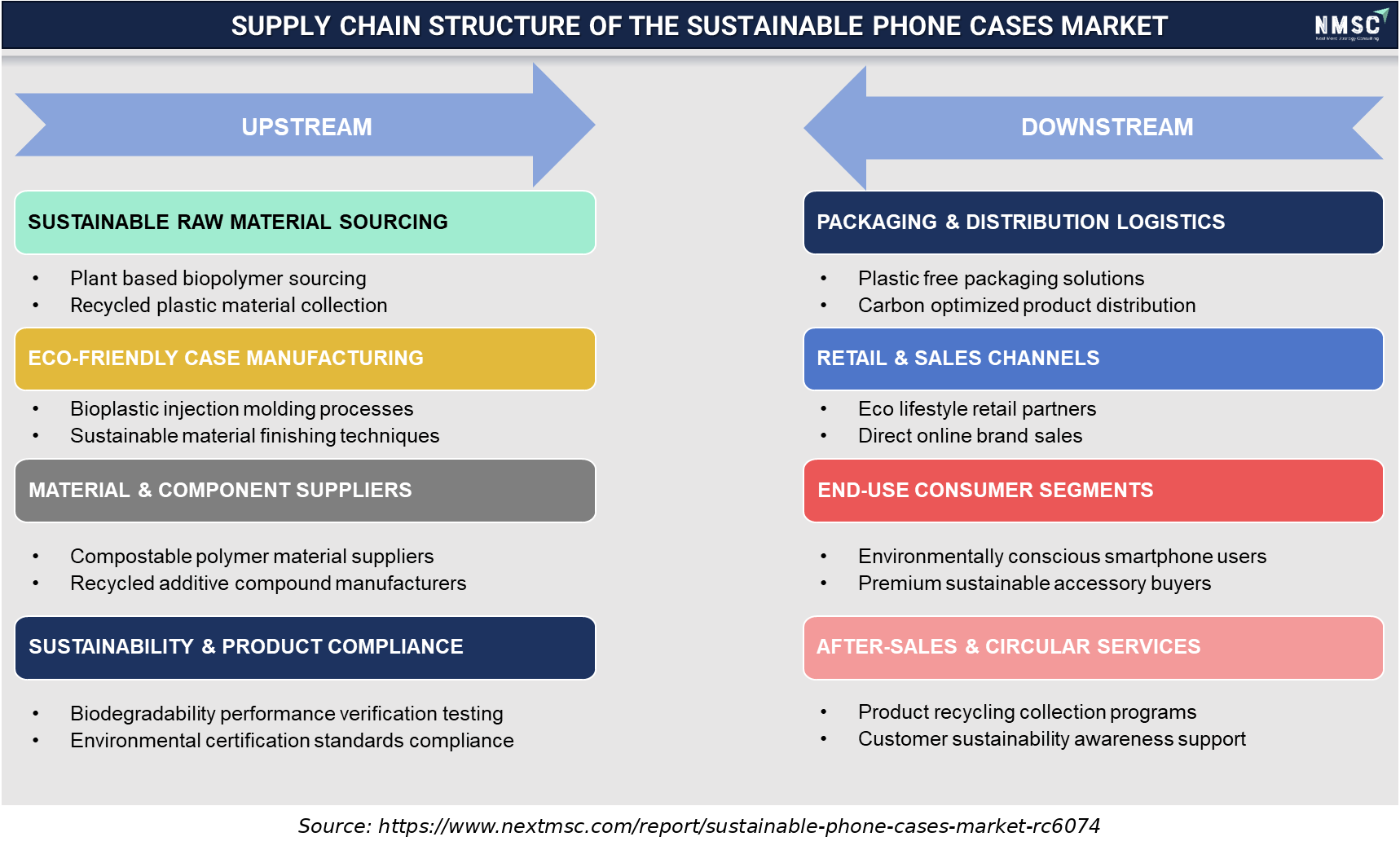
Supply Chain Structure of the Sustainable Phone Cases Market

Competitive Landscape

Our analysis shows that the Sustainable Phone Cases market remains moderately fragmented, with established compostable-case pioneers competing alongside diversified accessory manufacturers expanding into recycled-content product lines.
Dimension Description
Market Structure Moderately fragmented, with the top 10 companies collectively holding a validated share of total 2025 revenue
Innovation Focus Mono-material compostable formulations, recycled ocean plastic sourcing, and plastic-free packaging redesign
M&A Activity Publicly verifiable sustainable-phone-case-specific M&A activity is limited

How do companies compete in the Sustainable Phone Cases market?

Companies compete primarily on verified material certification, design differentiation, and pricing relative to conventional plastic alternatives. Industry participants increasingly publish third-party compostability and carbon footprint disclosures to substantiate sustainability claims. Brand partnerships with retailers committed to plastic reduction targets have become an important channel-access lever, while direct-to-consumer digital marketing remains the dominant customer acquisition strategy for smaller specialized manufacturers.

Which competitive archetypes dominate the market?

Two archetypes dominate: dedicated sustainability-first specialists such as Pela Case and Wave Case that built their brand identity around compostability, and diversified accessory manufacturers such as OtterBox and Incipio that have extended existing product portfolios with recycled-content lines. The former differentiate through material innovation credibility, while the latter leverage existing retail distribution scale and protective-case engineering expertise to reach broader mainstream buyers.

What innovation and differentiation strategies are companies pursuing?

Our findings suggest that companies are pursuing differentiation through proprietary bio-composite formulations, take-back and recycling programs, and plastic-free packaging redesign. Investment in third-party certification, such as compostability testing to recognized standards, has become a competitive necessity rather than a differentiator alone, pushing companies towards secondary differentiation through design aesthetics, colorways, and drop-protection performance validated through independent testing.

What M&A and geographic expansion activity is shaping the landscape?

Publicly verifiable M&A activity specific to sustainable phone cases is limited. Geographic expansion is concentrated in Asia-Pacific, where several brands have established regional distribution partnerships to capture rising smartphone penetration, while pricing strategies increasingly bundle sustainable cases with screen protectors to justify premium positioning.

Key Market Players

We found that the following companies represent the validated set of leading participants in the Sustainable Phone Cases market, ranked by market-specific revenue and scale of verifiable operations.

Pela Case CASETiFY Wave Case MMORE Agood Company Nimbus9 Urban Armor Gear (UAG) Otter Products, LLC Speck Products Incipio, LLC Case-Mate, Inc. Woodcessories Bare Cases Nudient Fairphone B.V. House of Marley Pipetto Proporta ECOALF Bureo Inc.

Latest Developments

Date Event
July 2025 Otter Products, LLC (OtterBox) launched its Cactus Leather Embroidery Collection, featuring phone cases wrapped in a plant-based leather alternative made from sustainably harvested organic nopal cactus. The collection combines sustainable material innovation with protective design, including three times the drop protection of the military standard.
September 2024 CASETiFY's sustainability reporting states that the Re/CASETiFY program was initiated to give discarded phone cases a second life by recycling them into new products and continued to support circularity in phone-case manufacturing.

Expert Insights

Ray Wang

Co-founder and Vice President of Product Development and Supply Chain Management | RHINOSHIELD

"It's not difficult to make a phone case, but it's very difficult to make a phone case with just one material."

Analyst Interpretation

The comment highlights the technical challenges involved in developing sustainable phone cases that combine durability, functionality, and recyclability. Single-material construction can simplify recycling by reducing the need to separate different materials at end of life, but achieving the required strength, flexibility, protection, and design quality remains technically demanding. As sustainability becomes increasingly important in the phone-accessories industry, manufacturers are therefore investing in material innovation and product designs that can reduce material complexity while maintaining the performance consumers expect from protective cases.

Investment Opportunities

Where are capital inflows concentrated in the Sustainable Phone Cases market?

Capital inflows are concentrated in early-to-growth-stage material science companies developing next-generation bio-composite and compostable polymer formulations. Venture and strategic investors are prioritizing companies with defensible feedstock supply agreements and third-party compostability certification, viewing these as prerequisites for scaling beyond niche direct-to-consumer distribution into broader retail partnerships.

What infrastructure investment is required to scale the industry?

Scaling sustainable case production requires investment in compounding capacity for bio-based resins, injection molding tooling adapted to plant fiber composites, and regional distribution infrastructure to reduce shipping-related emissions. No publicly verifiable dataset was identified to substantiate the stated expansion of compostable-material molding lines in Asia-Pacific.

How are ESG considerations shaping investment decisions?

ESG considerations increasingly determine capital allocation, with investors evaluating verified carbon footprint disclosures, supply chain labor practices, and end-of-life material recovery rates before committing funding. The U.S. Securities and Exchange Commission's climate-related disclosure discussions have raised awareness among consumer goods investors regarding supply chain emissions reporting, indirectly encouraging accessory brands to formalize sustainability data collection.

Key Benefits for Stakeholders

How does this report benefit industry leaders and manufacturers?

Industry leaders and manufacturers gain a validated market sizing framework, segmentation structure, and competitive benchmarking that supports product portfolio and capacity planning decisions. The report's regional analysis and country-level insights help manufacturers prioritize market entry and distribution investment based on quantified growth differentials rather than anecdotal demand signals.

How does this report benefit investors and financial analysts?

Investors and financial analysts benefit from the report's forecast methodology, growth driver and restraint quantification, and competitive landscape assessment, which together support valuation and due diligence work on companies operating within this market. The consolidated company profiles and latest developments tracking provide a structured basis for evaluating strategic positioning ahead of financing or acquisition decisions.

How does this report benefit technology vendors and product teams?

Technology vendors and product teams, including material suppliers and packaging designers, benefit from the report's trend analysis and segmentation data, which identify where bio-composite and recycled-content innovation is gaining commercial traction. This supports prioritization of research and development investment toward material formulations and packaging formats aligned with validated market demand.

Key Market Segments Evaluated

By Material Type

  • Biodegradable Plastics
  • Plant Fiber Based
  • Bamboo
  • Cork
  • Recycled Ocean Plastic
  • Recycled Post-Consumer Plastic
  • Natural Rubber and Silicone Blends

By Phone Compatibility

  • iPhone
  • Samsung Galaxy
  • Google Pixel
  • Other Android Devices

By Distribution Channel

  • Online Retail
  • Offline Retail

By Price Range

  • Premium
  • Mid-Range
  • Economy

By End User

  • Individual Consumers
  • Corporate and Promotional Buyers

Conclusion & Recommendations

The long-term outlook remains positive, with the market projected to grow from USD 11.13 Billion in 2026 to USD 16.54 Billion by 2035 at a 4.5% CAGR, supported by durable regulatory and consumer demand tailwinds rather than short-term promotional cycles. Material innovation is positioned to continue narrowing the price and performance gap with conventional plastic cases over the forecast period.

What strategic positioning should companies pursue?

Companies should pursue strategic positioning around verified material certification, transparent supply chain disclosure, and mono-material design that simplifies end-of-life processing. Building direct retailer partnerships aligned with published plastic reduction targets offers a durable channel-access advantage over competitors relying solely on direct-to-consumer digital marketing.

How attractive is the market for new investment?

The market presents moderate to high investment attractiveness, particularly in material science and regional manufacturing capacity, given the widening addressable opportunity of approximately USD 5.41 Billion between 2026 and 2035. Investors should prioritize companies with defensible feedstock agreements and certified compostability credentials over undifferentiated commodity case producers.

What market shifts and key risks should stakeholders monitor?

Stakeholders should monitor potential shifts in feedstock availability and pricing for agricultural fiber inputs, as well as evolving regional composting infrastructure that determines whether compostability claims translate into real-world environmental benefit. Regulatory changes affecting single-use plastic definitions could also alter competitive dynamics between biodegradable and recycled-content material categories.

What are the primary growth pathways for market participants?

Primary growth pathways include expanding take-back and recycling programs, deepening corporate promotional procurement relationships, and localizing manufacturing capacity within high-growth Asia-Pacific and Latin American markets. Companies that combine credible sustainability claims with competitive pricing and reliable protective performance are best positioned to capture disproportionate share of the market's forecast expansion.

FAQs

About the Author

Saista Faiyaz

Saista Faiyaz

Saista Faiyaz is Research Associate at Next Move Strategy Consulting, where she has covered consumer markets and healthcare technologies for 3 years. Her work includes primary interview review, secondary-source validation, market sizing, and structured analysis of company and industry data. She supports research by comparing evidence across sources, organizing findings into market narratives, and documenting assumptions used in analysis. Her scope includes cross-market benchmarking, and reports.

About the Reviewer

Supradip Baul

Supradip Baul

Supradip Baul is an accomplished business consultant and strategist with over a decade of rich experience in market intelligence, strategy, technology, and business transformation. His work has included rigorous qualitative and quantitative analysis across multiple industries, helping clients shape investment decisions and long-term roadmaps. Earlier in his career, he was associated with Gartner, where he contributed to industry-leading reports and market share analyses. He has worked with leading global companies and holds an MBA with a dual specialization in Marketing and Finance.

Download Free Sample

Pratyush Kumar Das

PRATYUSH KUMAR DAS

Assistant Manager

Polycab India Limited

We would like to express our appreciation for the data and insights provided by nextmsc. We are very pleased with the quality and depth of the information, which has proven to be highly valuable and beneficial for our business decision-making.

Diana Trejo

DIANA TREJO

Assistant Manager

Sumitomo Corporation de Mexico, S.A. de C.V.

Recently, we purchased a report on the Mexico Data Center Market from Next Move Strategy Consulting. The service has been excellent, with support that is always timely and thoroughly professional. The information provided is interesting, highly useful, and delivered with clarity. I would highly recommend NextMSC for anyone seeking insightful and dependable analysis.

Gustaf Hummel Burstrom

GUSTAF HUMMEL BURSTROM

Founder

Revline Tools AB

Joseph and the team at Next Move Strategy Consulting have been excellent to work with, in supplying us with relevant market data and forecasts for our specific category. We had some special requirements and they were able to do a custom package to suit our needs. We would definitely recommend them to any other company needing market data and forecasts

Melanie Samko

MELANIE SAMKO

Director of Marketing

TOSOH BIOSCIENCE, INC.

The information provided by NMSC is incredibly valuable, thank you so much for such a excellent work. I really appreciate it. I will make sure to reference all of it, in my summary document.

Ross J Mckenzie

ROSS J MCKENZIE

Business Insight Manager

Staysure Group

“Next MSC have been incredibly helpful in providing detailed & robust information on our market, alongside quantifying growth by different segments. The process to procure was simple and easy, with sample reports and regular contact to ensure we had what we needed. Succinct detail on their sources & methodologies is also greatly received, allowing transparency in this respect helps build trust in the detail you pay for. Joseph in particular was fantastic, and helped ensure efficient provision of the insight pack – thank you NMSC!”.

Custom Market Research Services

We will customize the research for you if the listed report does not fully match your requirements.

Get 30% Free Customization

Select License

This website uses cookies to ensure you get the best experience on our website. Learn more

✖